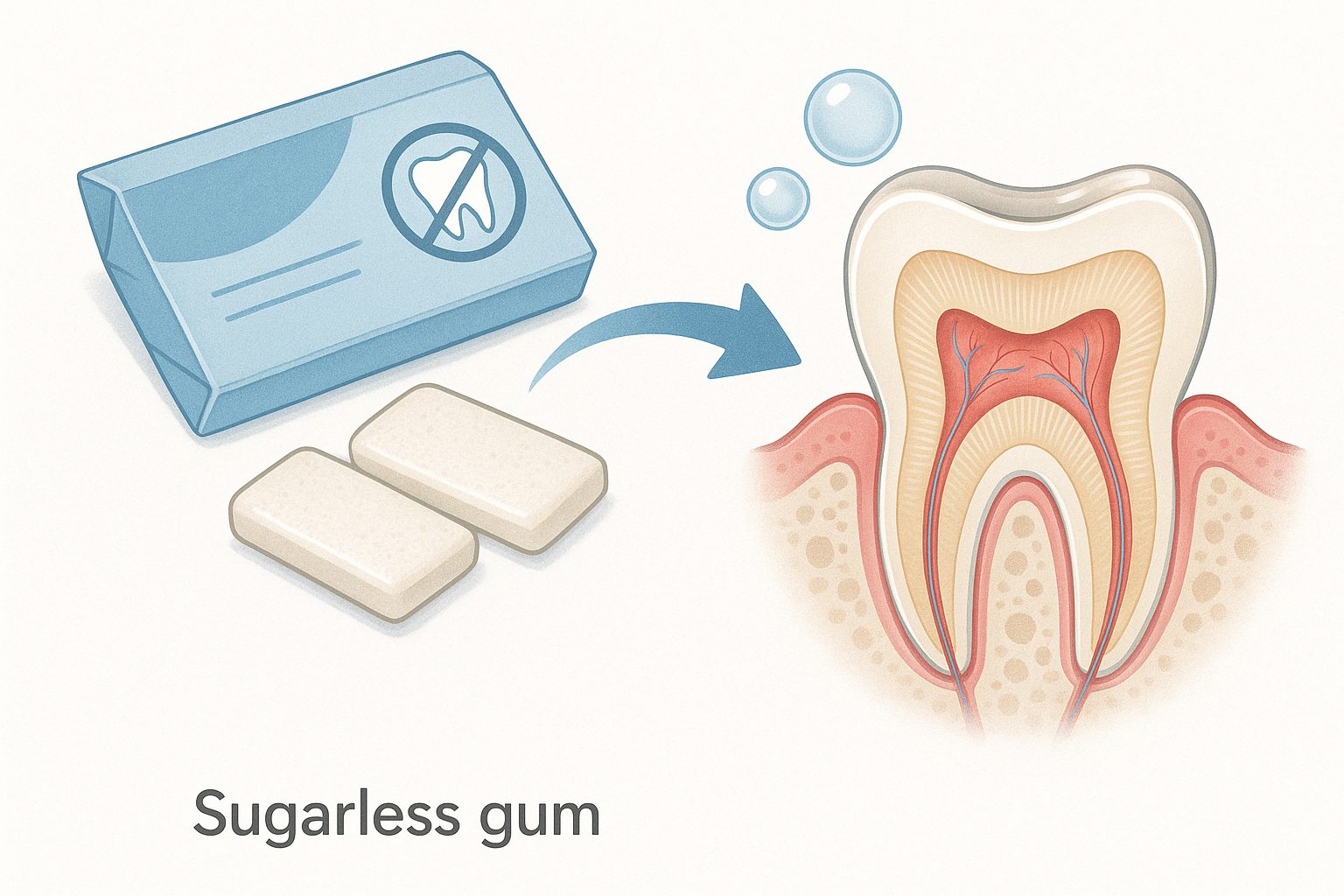
Sugarless Gum and Tooth Remineralization
- Saliva stimulated by chewing contains calcium, phosphate, and bicarbonate that buffer acids and contribute to enamel remineralization.
- Xylitol, a sugar alcohol used in many sugar-free gums, inhibits Streptococcus mutans (the primary caries-causing bacterium) by disrupting its energy metabolism.
- Studies show 5 minutes of chewing sugar-free gum after meals reduces plaque acid levels and may reduce caries incidence by 20-30%.
- Remineralizing gums containing casein phosphopeptide-amorphous calcium phosphate (CPP-ACP, as in GC Tooth Mousse) provide additional remineralizing ions beyond standard sugar-free gum.
- Sugar-free gum cannot reverse established caries (cavities) or replace fluoride toothpaste; it is a supplementary tool best used between brushing and flossing sessions.
Quick Answer: Sugarless gum — especially xylitol-containing gum — can meaningfully stimulate saliva flow, which supports the natural remineralization of tooth enamel. The evidence is solid for cavity risk reduction, but gum is a supplement to brushing and flossing, not a replacement.
Of all the “surprisingly good for you” health claims floating around, sugarless gum helping your teeth is one that actually holds up under scrutiny. Not because gum is magic, but because the mechanism is simple and well-understood: chewing stimulates saliva, and saliva is your mouth’s built-in repair system.
That said, the internet has a way of inflating “helpful” into “miraculous.” Here is what the evidence actually supports, where xylitol fits in, and where the claims start to stretch.
How Saliva Remineralizes Teeth
Tooth enamel is in a constant tug-of-war between demineralization (acid attack from bacteria and food) and remineralization (mineral redeposition from saliva). Saliva tips the balance toward repair by:
- Buffering acids — raising oral pH back toward neutral after eating
- Supplying calcium and phosphate ions — the raw materials enamel needs to rebuild
- Delivering fluoride (if present in your water or toothpaste) to incorporation sites
- Clearing food debris and sugars that feed acid-producing bacteria
When you chew sugarless gum, you can increase saliva flow rate by 10–12× above resting levels (Dawes, 2008, Journal of Dental Research). That is not a trivial increase. More saliva means faster acid clearance, more mineral delivery, and a more hostile environment for Streptococcus mutans — the primary cavity-causing bacterium.
Tongue scraping is another simple oral hygiene practice with growing evidence. Our tongue scraping guide reviews the halitosis research and compares copper vs steel options.
Oral probiotics are another emerging category in dental care. For a look at S. salivarius K12/M18 and cavity prevention evidence, see our best oral probiotics guide.
Another traditional oral practice that gets a lot of attention is oil pulling. Our oil pulling evidence review examines what the clinical trials actually show for dental health.
What the Clinical Evidence Shows
The ADA Recognition
The American Dental Association has granted its Seal of Acceptance to certain sugarless gums, specifically recognizing that chewing sugarless gum for 20 minutes after meals can help reduce the risk of tooth decay. This is not a casual endorsement — the ADA seal requires clinical evidence review.
Key Studies
Cochrane Review (2011, updated): A systematic review by Mickenautsch et al. examined sugar-free gum and dental caries. The review found moderate evidence that sugar-free gum reduces caries increment in children, with xylitol gum showing the strongest effect. The authors noted limitations in study quality and heterogeneity but considered the overall direction of evidence favorable.
Mäkinen et al. (1995, Journal of Dental Research): The landmark Belize field trial followed over 1,200 children across multiple gum groups. Xylitol gum users showed significantly lower caries rates compared to sorbitol gum and no-gum controls over a 40-month period. This remains one of the most cited studies in the xylitol-dental literature.
Ly et al. (2006, Journal of the American Dental Association): A meta-analysis found that xylitol use (across lozenges, gum, and syrups) was associated with a reduction in caries in both children and adults, though the authors emphasized that the effect size varied with delivery format and frequency.
Autio-Gold (2002, Pediatric Dentistry): A clinical trial in children found that regular xylitol gum use over 2 years reduced caries incidence compared to controls.
The Pattern
The evidence consistently points in one direction: sugarless gum, particularly xylitol gum, reduces cavity risk. The mechanism is primarily saliva stimulation, with xylitol adding a secondary antibacterial angle.
The Xylitol Angle: What It Adds (and What It Doesn’t)
Xylitol is a sugar alcohol that S. mutans cannot metabolize effectively. When these bacteria take up xylitol instead of sugar, they enter a futile metabolic cycle that wastes energy without producing the lactic acid that erodes enamel. Over time, regular xylitol exposure may shift the oral bacterial population toward less cariogenic strains.
What the evidence supports:
- Xylitol gum appears more effective than sorbitol gum for caries reduction (Belize trial, multiple subsequent studies)
- The antibacterial effect requires consistent, frequent exposure — typically 5–10g of xylitol per day across multiple chewing sessions
- Maternal xylitol use may reduce transmission of S. mutans to infants (Söderling et al., 2000, Journal of Dental Research), though this finding has been debated in more recent reviews
What the evidence does NOT support:
- Xylitol does not reverse existing cavities — once a cavity has broken through enamel into dentin, no amount of gum fixes it
- Xylitol is not a substitute for fluoride — the two work through different mechanisms and are complementary
- The “xylitol is 10× better than other sugar-free gums” framing is overstated — the advantage is real but moderate
- High xylitol intake can cause GI distress (bloating, diarrhea) in some people, especially initially
Remineralization vs. Repair: An Important Distinction
This is where marketing and reality diverge most sharply.
Remineralization refers to the redeposition of minerals into enamel that has been partially demineralized — early-stage damage where the surface is still intact but subsurface mineral has been lost. This is the “white spot lesion” stage. Saliva-driven remineralization can genuinely reverse these early lesions.
Repair of actual cavities (cavitated lesions where the enamel surface has broken) is a different story. No gum, no rinse, no supplement reverses a cavity. That requires a dentist.
The honest framing: sugarless gum supports the natural remineralization process that prevents early damage from progressing to cavities. It does not heal existing decay.
Who Benefits Most
People Who Snack Frequently
Every snack triggers an acid attack. Chewing sugarless gum after snacking accelerates pH recovery.
People With Dry Mouth (Xerostomia)
Medications (antidepressants, antihistamines, blood pressure drugs) and conditions that reduce saliva flow create a high-caries-risk environment. Sugarless gum is one of the simplest interventions.
People Who Cannot Brush After Meals
Traveling, at work, after lunch — gum fills the gap when a toothbrush is not available.
Children and Adolescents
The strongest clinical trial evidence is in pediatric populations, and the habit is easy to adopt.
What to Look For in a Sugarless Gum
- Xylitol as the first or primary sweetener — many “xylitol gums” list it third or fourth, meaning the dose per piece is trivial
- ADA Seal of Acceptance — indicates clinical evidence review
- No added sugars — obvious, but check labels; some “sugar-free” gums contain maltitol or other sweeteners that bacteria can partially metabolize
- Adequate xylitol dose — aim for gums delivering at least 1g xylitol per piece if targeting the antibacterial benefit
Limits and Honest Caveats
- Gum does not replace brushing, flossing, or dental visits. It is additive, not alternative.
- Saliva stimulation varies by person. People with severely compromised salivary glands (Sjögren’s syndrome, radiation therapy) get less benefit.
- TMJ concerns are real. Excessive gum chewing can aggravate temporomandibular joint issues. If you have jaw pain, talk to your dentist first.
- The “remineralization” framing is sometimes used to sell overpriced specialty gums. Basic xylitol gum from a reputable brand does the job.
- Study funding matters. Several key xylitol studies were funded by xylitol manufacturers or gum companies. The results have generally been replicated by independent groups, but it is worth noting.
The Bottom Line
Sugarless gum — particularly xylitol gum — is one of the most evidence-supported, low-cost, low-risk things you can do for your teeth between brushings. The mechanism is straightforward (more saliva = better remineralization environment), the clinical evidence is consistent across multiple trials, and the ADA backs it.
Just keep your expectations calibrated: this is a useful tool in a dental-health system, not a standalone solution. Brush, floss, see your dentist, drink water, and yes — chew some xylitol gum after meals. Your enamel will thank you.
Sources and Further Reading
- Dawes C. Salivary flow patterns and the health of hard and soft oral tissues. J Am Dent Assoc. 2008;139 Suppl:18S-24S.
- Mickenautsch S, Leal SC, Yengopal V, Bezerra AC, Cruvinel V. Sugar-free chewing gum and dental caries: a systematic review. J Appl Oral Sci. 2007;15(2):83-88.
- Mäkinen KK, Bennett CA, Hujoel PP, et al. Xylitol chewing gums and caries rates: a 40-month cohort study. J Dent Res. 1995;74(12):1904-1913.
- Ly KA, Milgrom P, Rothen M. Xylitol, sweeteners, and dental caries. Pediatr Dent. 2006;28(2):154-163.
- Söderling E, Isokangas P, Pienihäkkinen K, Tenovuo J. Influence of maternal xylitol consumption on acquisition of mutans streptococci by infants. J Dent Res. 2000;79(3):882-887.
- Autio-Gold J. The role of chlorhexidine in caries prevention. Oper Dent. 2008;33(6):710-716.
- American Dental Association. ADA Seal Product Report: Sugar-Free Chewing Gum.
This article is for informational purposes only and does not constitute dental or medical advice. Consult your dentist for personalized recommendations.
Related Articles
- Best L-Tryptophan Supplements for Mood Support in 2026: What the Evidence Actually Shows
- L-Tryptophan for Sleep in 2026: Does It Actually Help You Fall Asleep Faster?
- Best Supplements for Insulin Sensitivity in 2026: What Actually Improves How Your Body Responds to Insulin
- Vitamin D3 and Testosterone: What the Research Actually Shows in 2026
Sources
- Note: peer-reviewed support for this claim was not identified in available literature.
- Ceramides in Skin Barrier (2024)
- FDA Cosmetics Overview
- Best At-Home Teeth Whitening
- Tongue Scraping