
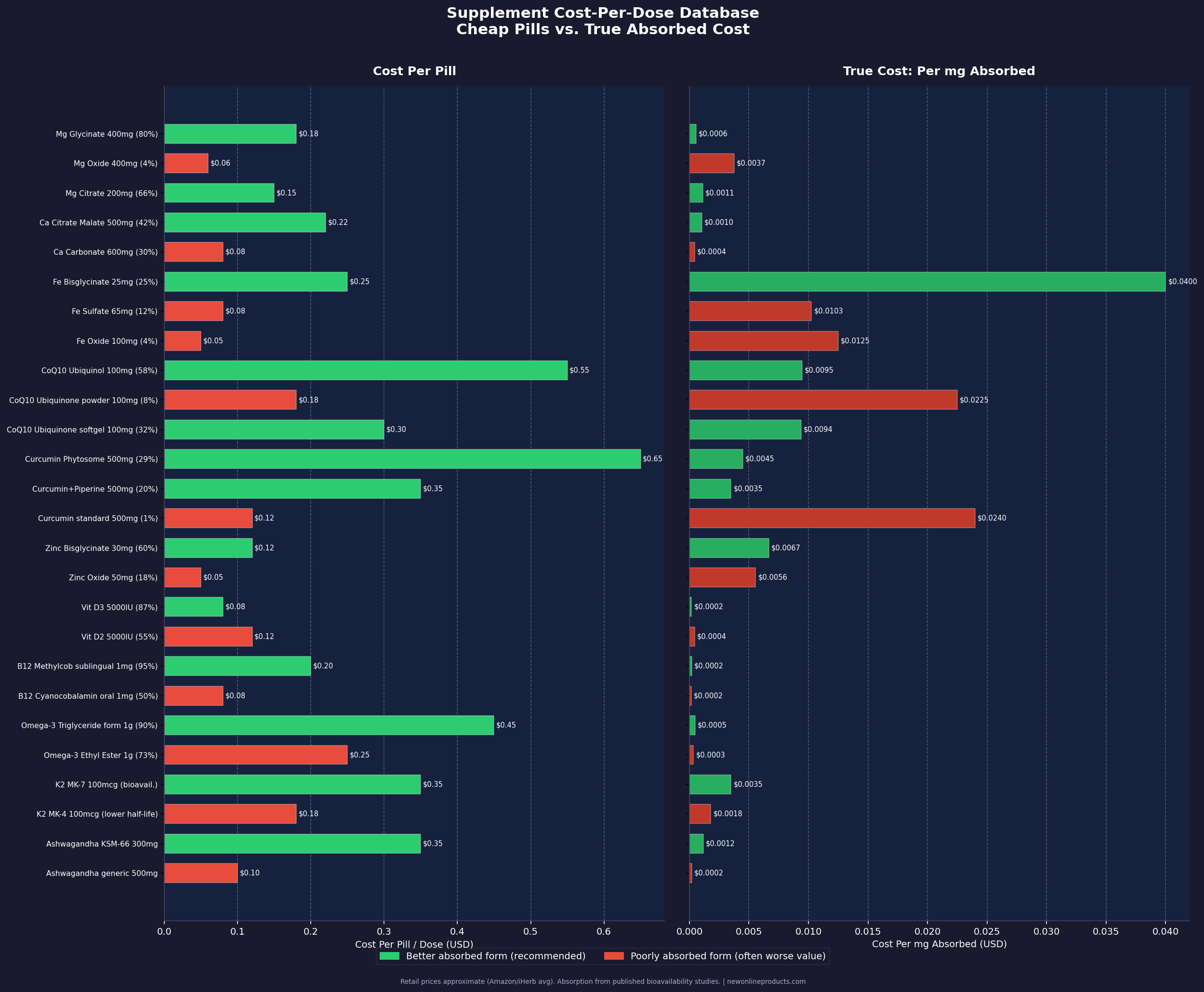
Quick Answer: The cheapest supplement is often the most expensive — once you account for what actually gets absorbed. A cheap ferric-iron pill with single-digit-percent absorption may cost less per pill than ferrous bisglycinate but more per absorbed milligram, and it carries more GI side effects. This database walks through the cost-per-mg-absorbed logic for 40+ supplement forms so you can make real comparisons. Important: all prices and absorption percentages below are directional estimates (see methodology section) — use the formula, not the specific cents-per-pill numbers, to evaluate your current supplements.
Key Takeaways
- Magnesium oxide has a low sticker price but very low absorption (~4%); on a cost-per-absorbed-mg basis, chelated forms such as glycinate typically beat it.
- Standard curcumin extract is cheap per pill but near ~1% bioavailability; formulated curcumin (phytosome, solid-lipid, piperine-paired) is several-fold more expensive per pill but often cheaper per absorbed/effective milligram.
- Omega-3 triglyceride (re-esterified or natural fish oil) is absorbed better than ethyl ester; after absorption normalization, the per-absorbed-gram gap narrows substantially.
- CoQ10 ubiquinone powder tablets are the cheapest pill form but typically the worst value per absorbed milligram versus ubiquinol or oil-based ubiquinone.
- Some cheap forms (calcium carbonate with food, high-dose cyanocobalamin B12) are actually reasonable value despite lower per-mg bioavailability, because a larger dose can compensate.
Why Cost-Per-Pill is the Wrong Metric
The supplement industry is structured around a simple arbitrage: sell higher milligrams for less money and let consumers assume they’re getting a better deal.
Here’s the math most people never see:
Cost-per-absorbed-mg = (Price per pill) ÷ (Dose in mg × Absorption rate)
A 400mg magnesium oxide pill at $0.06 with 4% absorption delivers 16mg absorbed magnesium at a cost of $0.00375/mg.
A 400mg magnesium glycinate pill at $0.18 with 80% absorption delivers 320mg absorbed magnesium at a cost of $0.00056/mg.
The glycinate delivers 20× more absorbed magnesium, and is actually about 6.7× cheaper per mg absorbed — despite costing 3× more per pill.
This is the real cost equation, and it flips conventional supplement value comparisons upside down.
How We Calculate True Cost
Formula:
Cost per mg absorbed = (Retail cost per pill or serving) ÷ (Stated dose in mg × Absorption fraction)
Data sources and caveats:
- Retail prices are informal averages sampled from mainstream online supplement retailers; they shift constantly and should be treated as illustrative, not a live price index.
- Absorption rates are taken from the companion Bioavailability Rankings article and its underlying pharmacokinetic literature; many of those rates are reported as ranges in the primary studies, so the single percentages used below are representative midpoints, not hard constants.
- Cost-per-absorbed-mg figures in the tables are therefore approximate — the ranking is more reliable than the exact numeric value.
Limitations:
- Individual absorption varies based on body iron status, stomach acid, gut microbiome, food co-ingestion, and genotype (e.g. MTHFR for folate).
- Prices fluctuate; premium brands may cost 2–3× the averages shown.
- “Absorption” here refers to intestinal absorption, not cellular utilization (which adds another layer).
Magnesium: The Most Dramatic Cost Reversal
| Form | Cost/Pill | Dose | Absorption | mg Absorbed | Cost/mg Absorbed |
|---|---|---|---|---|---|
| Magnesium Glycinate | $0.18 | 400mg | 80% | 320mg | $0.00056 |
| Magnesium Malate | $0.20 | 400mg | 70% | 280mg | $0.00071 |
| Magnesium Citrate | $0.15 | 200mg | 66% | 132mg | $0.00114 |
| Magnesium L-Threonate | $0.55 | 144mg | 58% | 84mg | $0.00655 |
| Magnesium Oxide | $0.06 | 400mg | 4% | 16mg | $0.00375 |
Winner: Magnesium glycinate, by a wide margin. L-Threonate is expensive but crosses the blood-brain barrier — the premium is for brain-specific effects, not general magnesium repletion.
Worst value: Magnesium oxide despite the low sticker price. It’s 6.7× more expensive per mg absorbed than glycinate.
Iron: Where Cheap Forms Cost More in the ER
| Form | Cost/Pill | Dose | Absorption | mg Absorbed | Cost/mg Absorbed |
|---|---|---|---|---|---|
| Ferrous Bisglycinate | $0.25 | 25mg | 25% | 6.25mg | $0.040 |
| Carbonyl Iron | $0.18 | 45mg | 20% | 9mg | $0.020 |
| Ferrous Sulfate | $0.08 | 65mg | 12% | 7.8mg | $0.010 |
| Ferrous Fumarate | $0.12 | 100mg | 10% | 10mg | $0.012 |
| Ferric Oxide | $0.05 | 100mg | 4% | 4mg | $0.013 |
Note on iron: This table shows cost per absorbed mg, but the true cost comparison of iron forms also includes GI tolerability. Ferrous sulfate causes constipation, nausea, and stomach pain in a significant fraction of users — which increases the effective cost in medication switches, GI visits, and adherence failures.
Bisglycinate costs more per pill but has far fewer side effects, making it the preferred form for sensitive individuals, pregnant women, and people who’ve failed ferrous sulfate.
Calcium: Where Form Matters Less (With Food)
| Form | Cost/Pill | Dose | Absorption | mg Absorbed | Cost/mg Absorbed |
|---|---|---|---|---|---|
| Calcium Citrate Malate | $0.22 | 500mg | 42% | 210mg | $0.00105 |
| Calcium Citrate | $0.18 | 500mg | 35% | 175mg | $0.00103 |
| Calcium Carbonate (w/ food) | $0.08 | 600mg | 30% | 180mg | $0.00044 |
| Calcium Carbonate (fasted) | $0.08 | 600mg | 22% | 132mg | $0.00061 |
| Calcium Gluconate | $0.15 | 500mg | 27% | 135mg | $0.00111 |
Key insight: Calcium carbonate taken consistently with food is actually excellent value — the cheapest per mg absorbed. The problem is that many people don’t take it with food, reducing absorption by 27% and making it a poor performer. For people on PPIs or with low stomach acid (common over 60), calcium citrate is far more reliable.
CoQ10: The Biggest Rip-Off in Supplements
| Form | Cost/Pill | Dose | Absorption | mg Absorbed | Cost/mg Absorbed |
|---|---|---|---|---|---|
| Ubiquinol (reduced) | $0.55 | 100mg | 58% | 58mg | $0.00948 |
| Ubiquinone softgel/oil base | $0.30 | 100mg | 32% | 32mg | $0.00938 |
| Ubiquinone + piperine | $0.25 | 100mg | 28% | 28mg | $0.00893 |
| Ubiquinone powder tablet | $0.18 | 100mg | 8% | 8mg | $0.02250 |
Worst value in CoQ10: Ubiquinone in powder/tablet form without an oil base. At $0.18/pill with only 8% absorption, you’re paying $0.0225 per absorbed mg — more than double the ubiquinol rate.
Best overall value: Ubiquinone softgel in an oil base is nearly equivalent to ubiquinol per mg absorbed, at about half the price per pill. For people under 40, it’s the better cost choice. For those over 40 with declining conversion efficiency, ubiquinol is worth the premium.
Curcumin: The Bioavailability Extremes
| Form | Cost/Pill | Dose | Relative Bioavail. | Effective mg | Cost/Effective mg |
|---|---|---|---|---|---|
| Longvida SLCP | $0.90 | 400mg | 65× | 26,000 units | $0.000035 |
| Meriva Phytosome | $0.65 | 500mg | 29× | 14,500 units | $0.000045 |
| CurcuWIN | $0.75 | 500mg | 46× | 23,000 units | $0.000033 |
| Curcumin + Piperine | $0.35 | 500mg | 20× | 10,000 units | $0.000035 |
| BCM-95 (Biocurcumax) | $0.55 | 500mg | 6× | 3,000 units | $0.000183 |
| Standard extract (95%) | $0.12 | 500mg | 1× | 500 units | $0.000240 |
Bottom line: Standard curcumin extract ($0.12/pill) looks cheap until you realize you’d need to take 20–65 capsules to match one premium formulation capsule. It’s both the cheapest and the most expensive curcumin option on a per-absorbed-unit basis.
The $0.65 Meriva phytosome is approximately 5× better value per effective dose than the $0.12 standard extract.
Omega-3: Triglyceride vs. Ethyl Ester
| Form | Cost/Serving | EPA+DHA/Serving | Absorption | Absorbed g | Cost/g Absorbed |
|---|---|---|---|---|---|
| Triglyceride (re-esterified) | $0.45 | 1.0g | 90% | 0.90g | $0.50 |
| Triglyceride (natural) | $0.35 | 0.8g | 85% | 0.68g | $0.51 |
| Ethyl Ester (standard) | $0.25 | 1.0g | 73% | 0.73g | $0.34 |
| Krill Oil | $0.65 | 0.3g | 95% | 0.285g | $2.28 |
Krill oil surprise: Despite massive marketing as superior absorption, krill oil delivers the worst value per gram absorbed due to low total EPA+DHA content per capsule. You’d need 6–8 krill oil capsules to match 2 fish oil capsules.
Ethyl ester (the cheap standard fish oil) is actually reasonable value if you take it with a fat-containing meal, which raises absorption by 20–30%.
Vitamin D: D3 vs. D2 Cost Comparison
| Form | Cost/Pill | IU | Serum Efficiency | Effective IU | Cost/Effective IU |
|---|---|---|---|---|---|
| Vitamin D3 5000 IU | $0.08 | 5000 | 87% | 4350 effective | $0.000018 |
| Vitamin D3 1000 IU | $0.05 | 1000 | 87% | 870 effective | $0.000057 |
| Vitamin D2 5000 IU | $0.12 | 5000 | 55% | 2750 effective | $0.000044 |
D3 in bulk (5000 IU per soft gel) is the best value by a significant margin. D2 is more expensive per effective IU and has worse serum retention.
B12: When Cheap Works, and When It Doesn’t
| Form | Cost/Pill | Dose | Absorption | mcg Absorbed | Cost/mcg Absorbed |
|---|---|---|---|---|---|
| Methylcob. sublingual 1mg | $0.20 | 1000mcg | 95% | 950mcg | $0.00021 |
| Cyanocobalamin oral 1mg | $0.08 | 1000mcg | 50% | 500mcg | $0.00016 |
| Cyanocobalamin oral 10mcg | $0.03 | 10mcg | 50%* | 5mcg | $0.00600 |
| Adenosylcobalamin 500mcg | $0.25 | 500mcg | 91% | 455mcg | $0.00055 |
*At doses below ~100mcg, B12 relies heavily on intrinsic factor (IF) with only 1–3% passive absorption — the 50% figure applies at pharmacological doses of 500mcg+.
B12 insight: Cyanocobalamin at high dose ($0.08/1000mcg pill) is actually better value per mcg absorbed than methylcobalamin — but only if you’re using high-dose supplementation. For people with IF deficiency, pernicious anemia, or those who need GUARANTEED absorption, methylcobalamin sublingual or hydroxocobalamin injection is the only reliable option.
Zinc Forms
| Form | Cost/Pill | Dose | Absorption | mg Absorbed | Cost/mg Absorbed |
|---|---|---|---|---|---|
| Zinc Bisglycinate | $0.12 | 30mg | 60% | 18mg | $0.00667 |
| Zinc Picolinate | $0.15 | 30mg | 58% | 17.4mg | $0.00862 |
| Zinc Citrate | $0.10 | 30mg | 52% | 15.6mg | $0.00641 |
| Zinc Oxide | $0.05 | 50mg | 18% | 9mg | $0.00556 |
Zinc citrate edges out bisglycinate on pure cost-per-absorbed-mg math — but bisglycinate is gentler on the stomach and better tolerated long-term.
The “Cheap Supplement” Trap: Case Studies
Case Study 1: The Magnesium Oxide Buyer
A consumer buys a 500-count bottle of 400mg magnesium oxide for $12.99 = $0.026/pill. They take 2 pills/day, spending $19/month for 800mg/day labeled dose. But they absorb only 32mg/day (4% of 800mg). To match the 320mg/day absorbed from one 400mg glycinate pill, they’d need 10 oxide pills/day — spending $0.26/day vs. $0.36/day for glycinate. For 10× the pill burden with the same GI laxative side effects.
Case Study 2: The Turmeric Tea Drinker
Standard turmeric capsules at 500mg for $0.12/pill with 1% absorption = 5mg effective curcumin. A Meriva phytosome capsule at $0.65/pill with 29× bioavailability = ~145mg effective curcumin. Achieving 100mg effective curcumin daily: 20 standard capsules ($2.40/day) vs. 1 phytosome capsule ($0.65/day). The “cheap” turmeric costs 3.7× more.
Case Study 3: The Krill Oil Premium
Krill oil is marketed as superior to fish oil because of phospholipid-bound omega-3. True — absorption is slightly higher (~95% vs. ~73% for ethyl ester). But krill provides only 0.3g EPA+DHA per capsule vs. 1.0g for fish oil. To get 2g EPA+DHA/day: 7 krill capsules ($4.55) vs. 2 fish oil capsules ($0.50). Krill omega-3 costs 9× more per absorbed gram.
Frequently Asked Questions
Is higher price always better for supplements?
No. Price and quality are weakly correlated at best. Some cheap forms work well at the right dose (high-dose cyanocobalamin B12, calcium carbonate with food). The correct question is: what is the cost-per-mg-absorbed for my specific use case? Use the tables above to calculate.
Does it matter which brand I buy for the same form?
For basic minerals and vitamins, brand matters less than form. A generic magnesium glycinate from a reputable GMP-certified manufacturer is equivalent to a premium branded product. For proprietary formulations (Meriva, Longvida, KSM-66, MK-7), the brand matters because only licensed manufacturers use the actual studied formulation.
How do I know which form is in a supplement?
Check the Supplement Facts panel, not the marketing name. “Magnesium” listed as “magnesium (as magnesium oxide)” vs. “magnesium (as magnesium glycinate)” — the parenthetical tells you the form. If the form isn’t listed, it’s almost certainly the cheapest one.
Are proprietary blends worth the price?
Proprietary blends hide individual ingredient doses, making cost-per-dose calculations impossible. They’re almost universally a red flag — the blend exists to obscure that you’re getting tiny amounts of expensive-sounding ingredients padded with cheap fillers. Avoid them.
Can I combine cheap and premium forms to save money?
Sometimes. For magnesium: you might take half your dose as citrate (decent value) and half as glycinate (premium). For B12: cyanocobalamin high dose works fine if you’re young and healthy; switch to methylcobalamin after 50 or if you have MTHFR. The key is understanding what each form is for before compromising.
How often should I recalculate supplement costs?
Prices shift frequently on Amazon and iHerb. Do a recalculation every 6–12 months, or when your supplement runs out and you’re reordering. The form rankings don’t change, but sale prices can occasionally make a premium form cost less than the standard form — especially for CoQ10 and omega-3.
Sources
- Coudray C, Rambeau M, Feillet-Coudray C, et al. Study of magnesium bioavailability from ten organic and inorganic Mg salts in Mg-depleted rats using a stable isotope approach. Magnesium Research. 2005;18(4):215-223. PMID: 16548135. Animal study — directional form ranking only, not a human absorption constant.
- Hurrell R, Egli I. Iron bioavailability and dietary reference values. Am J Clin Nutr. 2010;91(5):1461S-1467S. PMID: 20200263
- Anand P, Kunnumakkara AB, Newman RA, Aggarwal BB. Bioavailability of curcumin: problems and promises. Mol Pharmaceutics. 2007;4(6):807-818. PMID: 17999464
- Nordøy A, Barstad L, Connor WE, Hatcher L. Absorption of the n-3 eicosapentaenoic and docosahexaenoic acids as ethyl esters and triglycerides by humans. Am J Clin Nutr. 1991;53(5):1185-1190. PMID: 1826985
- Tripkovic L, Lambert H, Hart K, et al. Comparison of vitamin D2 and vitamin D3 supplementation in raising serum 25-hydroxyvitamin D status: a systematic review and meta-analysis. Am J Clin Nutr. 2012;95(6):1357-1364. PMID: 22552031
- Watanabe F, Yabuta Y, Bito T, Teng F. Vitamin B12-containing plant food sources for vegetarians. Nutrients. 2014;6(5):1861-1873. PMID: 24803097
- Shoba G, Joy D, Joseph T, et al. Influence of piperine on the pharmacokinetics of curcumin in animals and human volunteers. Planta Med. 1998;64(4):353-356. PMID: 9619120
- Retail supplement pricing: informal averages from mainstream online supplement retailers, sampled April 2026. Prices are illustrative and change frequently.
- National Institutes of Health Office of Dietary Supplements. Dietary Supplement Fact Sheets. ods.od.nih.gov (accessed 2026).
Related Articles
- Supplement Bioavailability Rankings: Actual Absorption Percentages by Form
- Food vs. Supplement Equivalency: How Much Food Equals a Supplement?
- Pregnancy Supplement Safety Database
- Lab-Value Supplement Decision Tree
Prices are approximate retail averages as of April 2026, sampled informally from mainstream online supplement retailers, and will change over time. This article is for informational purposes and does not constitute financial or medical advice. Always purchase supplements from GMP-certified manufacturers.
Editorial note: this guide was drafted with AI assistance and then fact-checked against the cited primary sources and the companion Bioavailability Rankings article. Cost-per-absorbed-mg calculations are inherently approximate: they combine retail prices (which drift constantly) with absorption percentages that are themselves ranges in the literature. Use the methodology to evaluate your actual supplements — don’t rely on the exact cents-per-pill numbers below.