
Quick Answer: MK-7 (vitamin K2) has a 72-hour half-life — you only need it twice a week. MK-4 lasts only 1–2 hours — you need it three times daily. Most people don’t know this and dose both the same way, getting either wasteful overdosing or inadequate coverage. This guide gives half-life data for 40+ supplements and tells you exactly how often to take each one.
Key Takeaways
- Vitamin K2 MK-7 has a 72-hour half-life; twice-weekly dosing maintains adequate blood levels.
- Vitamin K2 MK-4 has a 1–2 hour half-life; requires 3× daily dosing to maintain therapeutic levels.
- Water-soluble B vitamins (B1, B2, B3, B5, B6, C) have half-lives of 2–4 hours and benefit from split dosing.
- Vitamin D3 has a ~72-hour half-life in plasma (though tissue stores last much longer), making daily dosing the practical standard.
- Fat-soluble vitamins (A, D, E, K) accumulate in tissue — half-life refers to plasma half-life; accumulation risk is separate.
- Melatonin clears in 2 hours, explaining why it helps you fall asleep but doesn’t keep you asleep with standard 5mg doses.
What Is a Supplement Half-Life?
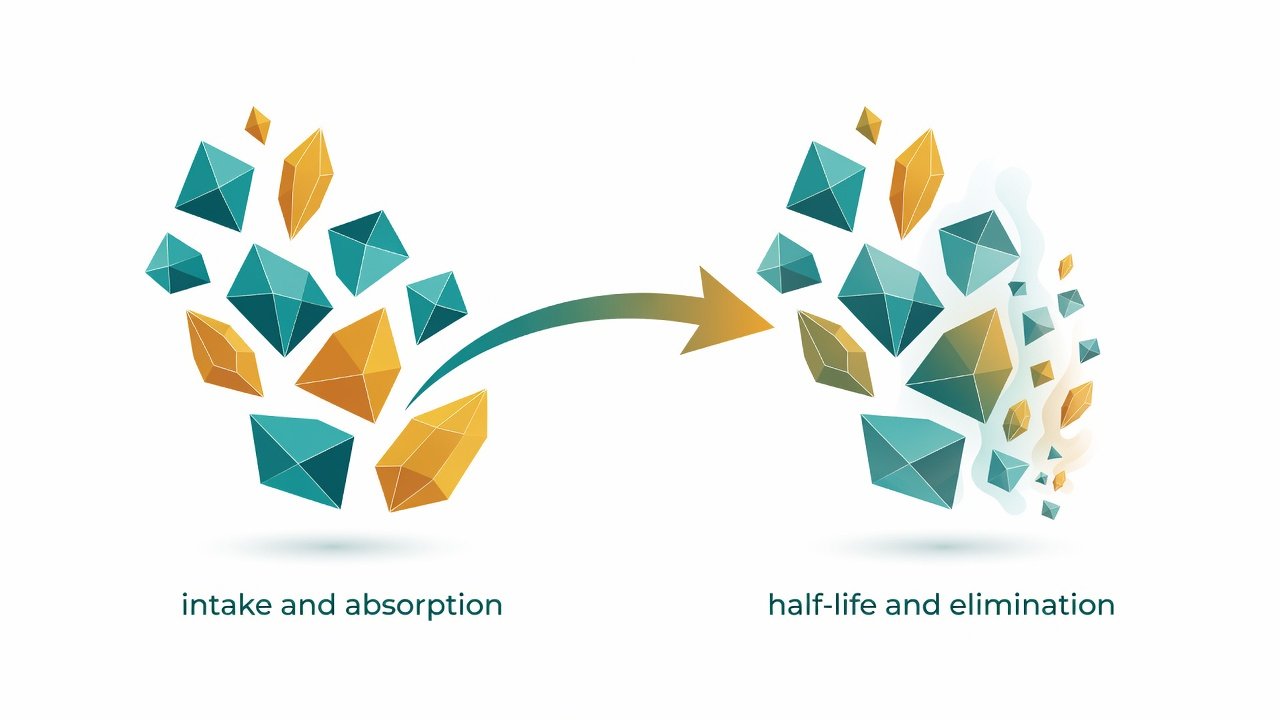
Half-life (t½) is the time required for the concentration of a substance in your bloodstream to fall to half of its peak value. After one half-life, 50% remains. After two half-lives, 25%. After five half-lives, ~97% has been cleared — effectively gone.
For supplements, half-life determines:
– How often you need to dose to maintain adequate blood levels
– Whether split dosing is beneficial for water-soluble compounds
– How long effects persist after you stop taking a supplement
– When to take a supplement relative to meals or activities
Plasma half-life vs. tissue storage: Fat-soluble vitamins (A, D, E, K) have two different timelines — plasma half-life (hours to days) and tissue depot half-life (weeks to months). You can build up fat-soluble vitamin stores even if plasma levels fluctuate daily.
Active metabolite half-life: Some supplements (like vitamin D) convert to active metabolites with their own half-lives. Vitamin D3 itself clears from plasma quickly, but its active metabolite 25(OH)D has a half-life of 15 days — which is why weekly or even monthly mega-dosing of vitamin D can work.
Very Long Half-Life (>36 hours): Weekly or Less
These supplements maintain blood levels so well that daily dosing is unnecessary — and in some cases, creates accumulation risk.
| Supplement | Half-Life | Recommended Dosing | Notes |
|---|---|---|---|
| Vitamin K2 MK-7 | 72 hours | 2–3× per week | MK-7 from natto; superior to MK-4 for bone/cardiovascular |
| Vitamin D3 (plasma) | 24–72 hours | Daily (practical standard) | Active metabolite 25(OH)D has 15-day t½ |
| Vitamin D3 (25(OH)D) | 15 days | Daily to weekly | Blood level determines dosing frequency |
| Vitamin A (Retinol) | 50–60 hours | Daily (moderate doses) | Fat-soluble; accumulation risk above 10,000 IU/day |
| Vitamin E | 48 hours | Daily | Tissue accumulation with prolonged excess |
| Selenium | 20–40 hours | Daily | Narrow therapeutic window; do not exceed 400mcg/day |
| Biotin (B7) | 24 hours | Daily | Water-soluble but long half-life |
| Iodine | 24 hours | Daily | Thyroid storage extends effective duration |
| Chromium | 24 hours | Daily | Accumulates in tissues |
| Vitamin K1 | 24 hours | Daily | Cleared quickly from plasma; adequate from diet often |
Medium Half-Life (8–24 hours): Once Daily
These supplements clear within one sleep cycle, making once-daily dosing appropriate for most people.
| Supplement | Half-Life | Recommended Dosing | Notes |
|---|---|---|---|
| Omega-3 DHA | 24 hours | Daily | Incorporates into cell membranes over weeks |
| Omega-3 EPA | 18 hours | Daily | EPA is more rapidly metabolized than DHA |
| CoQ10 Ubiquinol | 24 hours | Daily (with fat) | Fat-soluble; take with largest meal |
| CoQ10 Ubiquinone | 18 hours | Daily (with fat) | Needs conversion to ubiquinol |
| Vitamin B12 (Methylcob.) | 18 hours | Daily | Tissue binding extends effective duration |
| Folate (5-MTHF) | 18 hours | Daily | Active form; once daily is adequate |
| Iron (Ferrous forms) | 18 hours | Daily | Every-other-day dosing may improve absorption |
| Zinc Bisglycinate | 18 hours | Daily | High doses long-term deplete copper |
| Curcumin + Piperine | 6–8 hours | 2× daily | Short t½ argues for split dosing |
| Magnesium Glycinate | 12 hours | Daily or split | Brain/sleep: evening; muscle: split |
| Calcium Citrate | 12 hours | Split 2× daily | Max 500mg per dose for absorption |
| Ashwagandha KSM-66 | 10–12 hours | Daily or split 2× | Morning or split AM/PM |
| Quercetin | 8 hours | 1–2× daily | Short enough for twice-daily dosing |
| NAC (N-Acetyl Cysteine) | 6 hours | 2× daily | Split dosing maintains better levels |
Short Half-Life (<8 hours): Multiple Daily Doses
These supplements clear so quickly that single daily dosing leaves you with extended periods of sub-therapeutic plasma levels.
| Supplement | Half-Life | Recommended Dosing | Notes |
|---|---|---|---|
| Vitamin K2 MK-4 | 1–2 hours | 3× daily | Very short; osteoporosis studies in Japan use 15–45 mg/day split 3× |
| Vitamin C (Ascorbic Acid) | 2–4 hours | Every 4–6 hours | Liposomal extends effective duration |
| B1 Thiamine | 4 hours | 2–3× daily | Water-soluble; not stored well |
| B2 Riboflavin | 2–3 hours | 2–3× daily | Rapidly excreted; morning urine turns yellow |
| B3 Niacin | 2–4 hours | 2–3× daily | Flushing form has different pharmacokinetics |
| B5 Pantothenic Acid | 2–4 hours | 2–3× daily | Water-soluble; frequent dosing optimal |
| B6 Pyridoxine | 2–4 hours | 2× daily | P5P form has different pharmacokinetics |
| Choline | 2–4 hours | 2× daily | CDP-Choline: split AM/PM |
| Alpha-Lipoic Acid (ALA) | 2–3 hours | 2–3× daily | R-ALA has slightly longer t½ than racemic |
| Resveratrol | 2–4 hours | 2× daily | Poor bioavailability; nano forms help |
| L-Carnitine | 6 hours | 1–2× daily | ALCAR: 6h; standard L-carnitine: similar |
| Berberine | 3–4 hours | 3× daily (with meals) | Standard clinical dosing: 500mg 3×/day |
| 5-HTP | 3–5 hours | Split or as needed | Evening for sleep; morning for mood |
| Creatine | 3 hours | Daily (loading), then daily | Phosphocreatine stores more relevant than plasma t½ |
| Melatonin | 1–2 hours | Bedtime (30 min before) | Short t½ explains why it doesn’t maintain sleep |
| L-Theanine | 2–3 hours | As needed (45 min before effect desired) | Rapid onset, rapid clearance |
| GABA | 1–2 hours | As needed | Very short; crosses BBB poorly |
| Fisetin | ~3 hours | Daily (with food) | Poor oral bioavailability; limited human pharmacokinetic data |
Fat-Soluble Supplement Accumulation: The Other Side of Half-Life
Fat-soluble vitamins (A, D, E, K) and some supplements (CoQ10, curcumin in lipid formulations) accumulate in adipose tissue. This creates a tissue reservoir that:
- Extends effective duration beyond plasma half-life
- Provides a buffer against missed doses
- Creates toxicity risk with megadosing
Practical implication: If you’ve been taking 5,000 IU vitamin D3 daily for 6 months, you have significant tissue stores. Missing a week won’t cause deficiency. But if you’ve been taking 50,000 IU/day (a dangerous dose), tissue accumulation could cause hypercalcemia even after stopping.
The fat-soluble supplements most important to monitor:
– Vitamin A (retinol): Toxic accumulation above ~10,000 IU/day for months
– Vitamin D: Generally safe to 4,000 IU/day long-term; above 10,000 IU requires monitoring
– Vitamin E: High-dose supplementation (above 1,000 IU/day) associated with all-cause mortality in meta-analyses
Dosing Timing: When Half-Life Meets Meal Timing
| Supplement | Best Timing | Why |
|---|---|---|
| Fat-soluble vitamins (A, D, E, K) | With largest meal | Requires dietary fat for absorption |
| CoQ10 | With fatty meal | Requires fat; 3× better with fat |
| Magnesium | Evening | Relaxation/sleep benefits; better tolerability |
| B vitamins (B1, B2, B3, B5, B6) | Morning or split AM/PM | Energy; avoid at bedtime |
| Iron | Away from calcium/dairy | Calcium competes for absorption |
| Vitamin C | Split doses throughout day | Short t½; saturates transporters |
| Melatonin | 30–60 min before bed | Short t½; aligns with sleep onset |
| Ashwagandha | Morning or split AM/PM | AM dose blunts cortisol; PM supports relaxation |
| Berberine | With each meal | Short t½; blood sugar management |
| Curcumin + Piperine | With meals | Fat-soluble; piperine effect consistent |
| Creatine | Post-workout or anytime | Consistency matters more than timing |
| L-Theanine | 45 minutes before desired effect | Rapid but brief effect window |
Why Melatonin Timing Is Completely Misunderstood
Melatonin has a plasma half-life of 1–2 hours. Most standard supplements (3–10mg) create a massive peak in 30–60 minutes then crash back to near-zero within 2–3 hours. This explains why melatonin helps people fall asleep but rarely helps them stay asleep.
What the research actually supports:
– 0.3–1mg doses are as effective or more effective than 5–10mg for sleep onset
– Extended-release melatonin formulas provide more physiologically appropriate coverage
– Taking melatonin 30–60 minutes before desired sleep onset matches its pharmacokinetics
– Using 5–10mg every night may downregulate endogenous melatonin production over time
The supplement industry sells 10mg pills because consumers equate higher dose with stronger effect. The pharmacokinetics tell a different story.
The MK-4 vs. MK-7 Half-Life Difference: A Case Study in Form Selection
Both are vitamin K2. Both support calcium metabolism, bone density, and arterial calcification prevention. But they have radically different pharmacokinetics:
Vitamin K2 MK-4:
– Half-life: ~1–2 hours (Schurgers et al., Blood, 2007)
– Peak plasma: ~2 hours after dosing, then rapid clearance
– Clinical studies for osteoporosis use: 15–45 mg/day, divided into 3 doses
– Source: synthetic or animal-origin; found concentrated in brain, pancreas, and reproductive tissues
Vitamin K2 MK-7:
– Half-life: 72 hours
– Peak plasma: 4 hours after dosing, sustained for days
– Clinical studies use: 90–360mcg once daily or every other day
– Source: natto fermentation; higher accumulation in bone and arteries
For most supplement users, MK-7 is the practical choice:
– Once daily or less
– Lower doses required
– Better evidence for arterial health (longer time in circulation = more time to carboxylate matrix Gla protein)
MK-4 at pharmacological doses is used in Japan for established osteoporosis treatment under physician supervision.
Supplement Cycling: When Half-Life Arguments Support Breaks
Some practitioners recommend periodic supplement breaks based on two half-life-related arguments:
- Receptor downregulation: Some supplements (melatonin, adaptogens like ashwagandha) may reduce endogenous production or receptor sensitivity with continuous use
- Tissue accumulation: Fat-soluble supplements can reach problematic tissue levels with years of continuous use
Evidence-based cycling recommendations:
– Melatonin: 3–4 weeks on, 1 week off (or use only when sleep is disrupted)
– Ashwagandha: 8–12 weeks on, 4 weeks off
– Berberine: 8 weeks on, 4 weeks off (to prevent gut microbiome disruption)
– Creatine: Continuous use is well-tolerated; cycling is not necessary but some prefer it
Frequently Asked Questions
What happens if I skip a dose of a supplement with a long half-life?
For supplements like vitamin D3 (72h plasma half-life, 15-day active metabolite half-life) or MK-7 (72h), missing one day barely affects blood levels. After one missed dose of vitamin D3, plasma levels drop by less than 10%. After a week off, they might drop 30–40% — still within range if you’ve been consistent. Long-half-life supplements are the most forgiving.
Why does split dosing matter for vitamin C?
Vitamin C (ascorbic acid) is absorbed via sodium-dependent vitamin C transporters (SVCTs) that become saturated at about 200–500mg per dose. Above saturation, absorption efficiency drops significantly. Additionally, with a 2–4 hour half-life, a single 1000mg morning dose gives you high plasma C in the morning and very low levels by evening. Splitting into 250–500mg doses throughout the day maintains consistently higher plasma levels at better value per mg absorbed.
Does the half-life of a supplement affect its side effects?
Yes — significantly. Short-half-life supplements clear quickly, meaning side effects also pass quickly. Niacin flushing (from B3) typically resolves in 30–60 minutes. Conversely, fat-soluble supplements with long tissue half-lives can cause prolonged side effects that persist for weeks even after stopping. Vitamin A toxicity, for instance, can cause symptoms for 1–3 months after discontinuation.
Can I take all my supplements at once to simplify my routine?
You can — and most people do. While split dosing is theoretically superior for short-half-life supplements, the practical difference in health outcomes for most users is small. The bigger issue is absorption competition: don’t take calcium and iron together (they compete), and don’t take zinc and iron together at high doses. Fat-soluble vitamins should all go with a fat-containing meal. Beyond that, simplicity wins over optimization for adherence.
How does half-life relate to building up supplement levels?
It takes approximately 4–5 half-lives to reach steady-state plasma concentration. For vitamin D (15-day metabolite half-life), full steady state takes 60–75 days. This is why studies show it takes 2–3 months of daily vitamin D supplementation to see stable blood levels — and why getting your 25(OH)D tested after 3 months of consistent dosing is recommended.
Does body weight affect supplement half-life?
Yes, particularly for fat-soluble supplements. Higher body fat percentage means a larger tissue reservoir for fat-soluble vitamins and supplements. This can both extend their effective duration and mean you need higher doses to achieve equivalent plasma concentrations. For extremely obese individuals, vitamin D dose requirements can be 2–3× higher to achieve equivalent blood levels compared to lean individuals.
Sources
- Schurgers LJ, et al. “Vitamin K-containing dietary supplements: comparison of synthetic vitamin K1 and natto-derived menaquinone-7.” Blood. 2007;109(8):3279-83. PubMed 17158229
- Holick MF. “Vitamin D deficiency.” New England Journal of Medicine. 2007;357:266-281. PubMed 17634462
- Levine M, et al. “Vitamin C pharmacokinetics in healthy volunteers: evidence for a Recommended Dietary Allowance.” PNAS. 1996;93(8):3704-3709. PubMed 8623000
- Bhagavan HN, Chopra RK. “Coenzyme Q10: absorption, tissue uptake, metabolism and pharmacokinetics.” Free Radical Research. 2006;40(5):445-453. PubMed 16551570
- Jones KS, et al. “25(OH)D2 half-life is shorter than 25(OH)D3 half-life and is influenced by DBP concentration and genotype.” J Clin Endocrinol Metab. 2014;99(9):3373-3381. PubMed 24885631
- NIH Office of Dietary Supplements. Fact Sheets: Vitamins A, B, C, D, E, K, and Minerals. ods.od.nih.gov. Accessed 2026.
- Andersen LP, et al. “The Safety of Melatonin in Humans.” Clinical Drug Investigation. 2016;36:169-175. PubMed 26692007
- LPI (Linus Pauling Institute), Oregon State University. Micronutrient Information Center. oregonstate.edu. Accessed 2026.
- Kuang X, et al. “The characterization of berberine pharmacokinetics in humans and rats: current state and bioavailability enhancements.” Pharmaceutics. 2023 (and references therein).
- EFSA Panel on Nutrition. “Tolerable upper intake level for selenium.” EFSA Journal. 2023;21(1):7704. efsa.eu.
Related Articles
- Supplement Bioavailability Rankings: Absorption Percentages by Form
- Vitamin K2 MK-7 vs MK-4: Which Form and Dose Actually Work?
- Magnesium Timing Guide: Morning vs. Evening Dosing
- Melatonin: Why You Should Take Less, Not More
- Supplement Cost-Per-Dose Database: Are You Wasting Money?
This article is for informational purposes only and does not constitute medical advice. Supplement pharmacokinetics vary by individual. Consult your healthcare provider for personalized dosing guidance.
Last updated: April 2026.
AI disclosure: This article was drafted with AI assistance (Anthropic Claude) and subsequently fact-checked against peer-reviewed pharmacokinetic literature, NIH Office of Dietary Supplements fact sheets, and the Linus Pauling Institute Micronutrient Information Center. Numerical values (half-lives, doses, thresholds) were verified against primary sources where available. Remaining errors are the responsibility of the editor.