
The supplement industry has gotten very good at charging premium prices for marketing language. “Chelated.” “Activated.” “Bioavailable.” Some of these claims represent genuine upgrades — magnesium oxide is poorly absorbed (commonly cited around 4% in the classic Firoz & Graber 2001 study, though exact bioavailability depends on dose and measurement method), while well-absorbed chelated forms such as magnesium glycinate perform substantially better in comparative studies. That’s not marketing, it’s biochemistry.
Other claims are inflated. “Colloidal” minerals are not meaningfully superior to well-formulated standard forms. “Mega-dose” water-solubles are excreted before they can be used. The goal of this guide is to cut through the noise and tell you, form by form, what’s actually worth buying.
Quick Answer: The form matters most for magnesium, iron, zinc, and B vitamins. Magnesium glycinate and magnesium malate are significantly better than oxide. Iron bisglycinate causes far less GI distress than ferrous sulfate. Methylfolate matters for MTHFR variants. Liposomal delivery genuinely improves glutathione and vitamin C absorption. D3 is better than D2. Everything else? The upgrade is often marginal or marketing-driven.
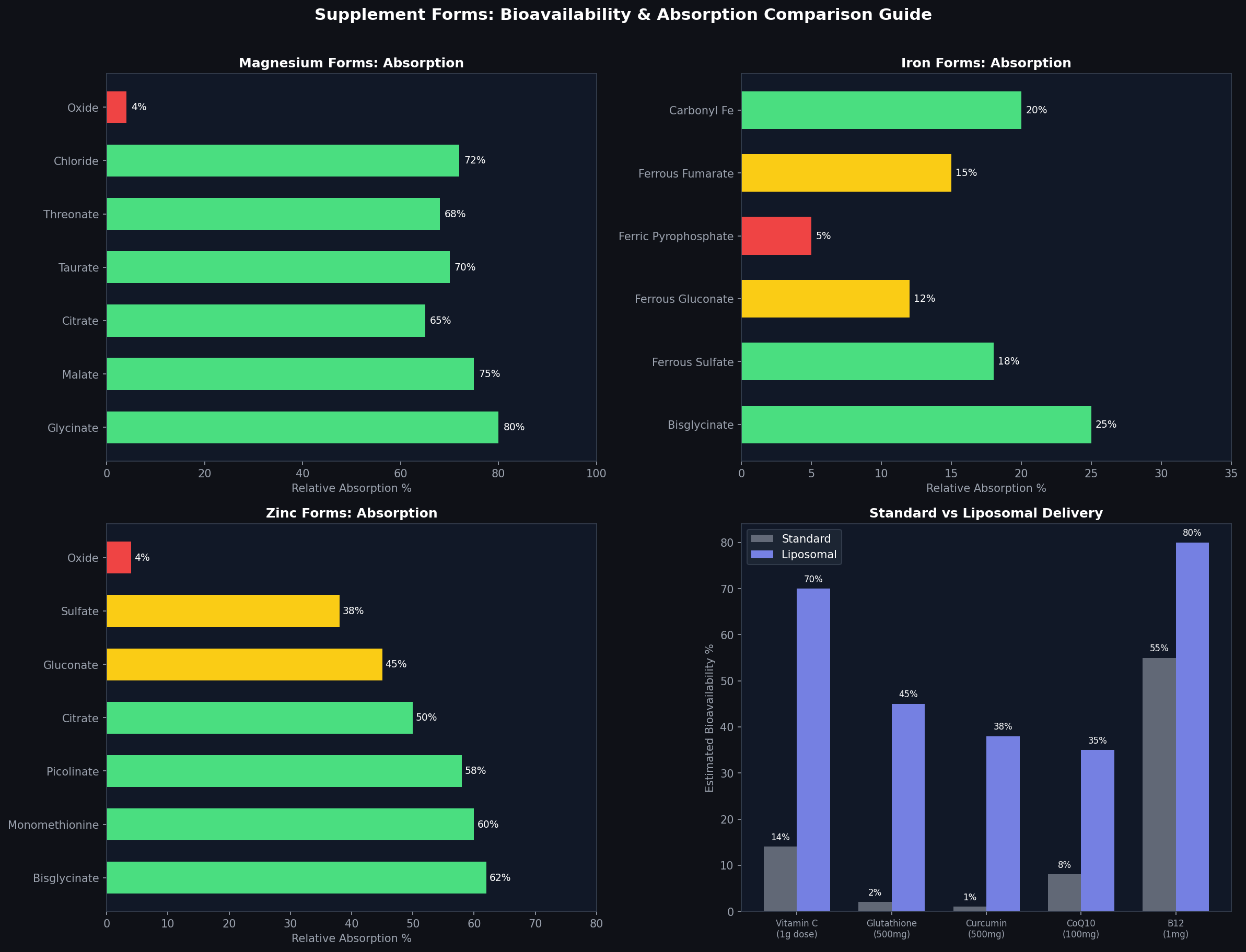
Multi-panel chart showing relative absorption rates across supplement forms. Green = well-absorbed; Yellow = moderate; Red = poor absorption.
How to Evaluate Form Claims
Before diving in by mineral, here are the evaluation criteria:
- Absorption rate (bioavailability): What percentage actually enters systemic circulation?
- Tolerability: Does it cause GI distress, constipation, nausea?
- Specific organ benefit: Some forms preferentially concentrate in tissues (magnesium threonate → brain; magnesium malate → muscle)
- Genetic requirements: MTHFR variants cannot convert folic acid to active methylfolate — form is non-optional
- Price premium: Is the premium justified by actual measured outcome differences?
Magnesium Forms: The Clearest Case for Upgrading
Magnesium is the mineral with the most dramatic form differences. Magnesium oxide — the cheapest, most common form in grocery store supplements — has approximately 4% bioavailability. [1]
Magnesium Form Comparison
Absorption columns below are relative rankings, not precise percentages. Published bioavailability studies report a wide range depending on dose, formulation, and methodology.
| Form | Relative Absorption | Best For | GI Tolerance |
|---|---|---|---|
| Magnesium Glycinate | High | Sleep, anxiety, general | Excellent |
| Magnesium Malate | High | Muscle function, fibromyalgia | Excellent |
| Magnesium Citrate | Moderate–High | Constipation relief | Good (mild laxative) |
| Magnesium Taurate | High | Cardiovascular, heart rhythm | Good |
| Magnesium Threonate | Moderate | Brain/cognitive (crosses BBB) | Good |
| Magnesium Chloride | Moderate–High | Topical (transdermal use) | Topical |
| Magnesium Sulfate | Variable | Epsom salts, acute deficiency (IV) | Poor orally |
| Magnesium Oxide | Low (~4% per Firoz & Graber) | Laxative only | Poor — causes diarrhea |
| Magnesium Orotate | Moderate | Cardiovascular in research | Good |
The verdict: Magnesium oxide is near-useless for supplementation purposes. Always choose glycinate (for sleep and general use), malate (for energy and muscle), or threonate (for brain health). The price difference is small; the absorption difference is enormous.
Brain-specific note: Magnesium threonate is the only form clinically shown to increase brain magnesium levels. [2] It’s the only choice for cognitive benefit.
Iron Forms: Tolerability Is the Key Variable
Iron supplements have notoriously poor tolerability in high-dose forms. Constipation, nausea, and GI cramping are the primary drivers of non-compliance.
Iron Form Comparison
Actual absorption of oral iron varies widely (roughly 2–20%+ depending on iron status, dose, co-ingested foods/vitamin C, and measurement method). The rankings below are directional.
| Form | Relative Absorption | GI Tolerance | Notes |
|---|---|---|---|
| Iron Bisglycinate (Ferrochel) | High | Excellent | Best tolerated; Bovell-Benjamin 2000 showed ~4x ferrous sulfate in maize meal |
| Carbonyl Iron | Moderate | Good | Slower absorption = fewer GI effects |
| Ferrous Sulfate | Moderate | Poor | Most prescribed but worst tolerance |
| Ferrous Gluconate | Moderate | Moderate | Common in “gentle” OTC products |
| Ferrous Fumarate | Moderate | Poor | Similar to ferrous sulfate |
| Ferric Pyrophosphate | Low | Good | Used in food fortification |
| Ferric Ammonium Citrate | Low–Moderate | Moderate | — |
The verdict: Iron bisglycinate (often sold as Ferrochel®) is the preferred form for most supplement users. It typically absorbs better than ferrous sulfate and causes a fraction of the GI side effects in clinical experience. Bovell-Benjamin et al. (2000) reported iron from ferrous bisglycinate was absorbed roughly 4 times better than ferrous sulfate in a whole-maize meal matrix, though head-to-head comparisons in other contexts show smaller advantages. [3]
Always take iron with Vitamin C — regardless of form, Vitamin C increases iron absorption 2–4x by converting ferric to ferrous iron.
Zinc Forms: Chelates Win, Oxide Loses
Zinc Form Comparison
Absorbed fraction of oral zinc is typically ~20–40% overall depending on dose and co-ingested foods; the rankings below compare forms relative to each other, not absolute percentages. A head-to-head trial (Gandia 2007) found zinc bisglycinate was ~43% more bioavailable than zinc gluconate.
| Form | Relative Absorption | Notes |
|---|---|---|
| Zinc Bisglycinate | High | Well-absorbed; excellent tolerance |
| Zinc Monomethionine (OptiZinc) | High | Good bioavailability |
| Zinc Picolinate | High | Well-studied; comparable to bisglycinate |
| Zinc Citrate | Moderate–High | Good option; widely available |
| Zinc Gluconate | Moderate | Common in lozenges; adequate |
| Zinc Acetate | Moderate | Used in cold lozenges specifically |
| Zinc Sulfate | Moderate | Older form; common but not ideal |
| Zinc Oxide | Low | Poor absorption; sunscreen/topical use only |
The verdict: Zinc bisglycinate or zinc monomethionine. Zinc picolinate’s reputation exceeds what the current evidence base supports for its claimed superiority over glycinate. Zinc oxide is biologically inert for supplemental purposes. [4]
Calcium Forms: Food First, Supplement Type Matters
Calcium Form Comparison
Calcium absorption from supplements is typically in the 25–40% range; differences between well-formulated salts are modest compared with the difference between with-meal versus without-meal timing and with versus without adequate stomach acid.
| Form | Absorption | Requires Stomach Acid? | Notes |
|---|---|---|---|
| Calcium Citrate | Good | No | Best for older adults, those on PPIs |
| Calcium Malate | Good | No | Good option |
| Calcium Lactate | Good | No | Good alternative |
| Calcium Carbonate | Good (with food) | Yes | Take with meals; cheaper but acid-dependent |
| Calcium Phosphate | Moderate | Moderate | In some milk alternatives |
| Calcium Gluconate | Moderate | No | Lower elemental Ca per capsule |
| Coral Calcium | Variable | — | Marketing-inflated; no proven superiority |
The verdict: Calcium citrate for anyone over 50 or anyone on proton pump inhibitors (PPIs reduce the stomach acid calcium carbonate requires). Calcium carbonate is fine for younger adults with robust stomach acid who take it with meals.
Harder truth: The evidence for calcium supplementation (as opposed to dietary calcium) has become more complicated. Some meta-analyses suggest that supplemental calcium may increase cardiovascular risk, particularly without adequate K2. [5] Get calcium from food first. Supplement only if genuinely deficient.
Vitamin D Forms: D3 Beats D2 — Clearly
This is one of the most settled debates in supplementation. Vitamin D3 (cholecalciferol) raises blood 25(OH)D levels 87% more effectively than Vitamin D2 (ergocalciferol) in head-to-head trials. [6]
| Form | Efficacy | Notes |
|---|---|---|
| Vitamin D3 (cholecalciferol) | ✅ Preferred | Standard supplement form |
| Vitamin D2 (ergocalciferol) | ❌ Inferior | Some Rx prescriptions still use this |
| Calcifediol (25-OH-D3) | ✅✅ Superior (used medically) | Bypasses liver conversion; used in malabsorption |
The verdict: Always D3. If a prescription says D2, ask your doctor about D3 equivalency. Dose with K2 and magnesium.
Vitamin B Forms: Methylation Matters
This is where genetics enter the picture. The MTHFR enzyme (methylenetetrahydrofolate reductase) converts folate to its active form. 40–60% of people carry one copy of common MTHFR variants (C677T or A1298C), and ~10–15% carry two copies. Two copies can reduce MTHFR enzyme activity by up to 70%. [7]
Folate / Vitamin B9
| Form | Notes |
|---|---|
| Folic Acid | Synthetic; requires MTHFR conversion; can accumulate as unmetabolized folic acid (UMFA) |
| L-Methylfolate (5-MTHF) | Active form; bypasses MTHFR; safe for all variants |
| Folinic Acid (5-formyl-THF) | Active intermediate; good for those sensitive to methylfolate |
| Dietary Folate | Best absorbed naturally; found in leafy greens, lentils |
The verdict: L-Methylfolate is the upgrade worth making — especially for anyone with known MTHFR variants, depression, cardiovascular risk, or fertility concerns. Folic acid requires functional MTHFR to be useful. Accumulating unmetabolized folic acid from high-dose synthetic supplementation may actually mask B12 deficiency and potentially mask other concerns.
Vitamin B12
| Form | Notes |
|---|---|
| Cyanocobalamin | Cheapest; requires conversion to active forms; contains a cyanide molecule (tiny, but relevant for heavy smokers) |
| Methylcobalamin | Active form; preferred for nervous system; doesn’t require conversion |
| Adenosylcobalamin | Active mitochondrial form; pairs with methylcobalamin |
| Hydroxocobalamin | Long-acting depot form; used medically for deficiency treatment |
The verdict: Methylcobalamin or a combination of methyl + adenosylcobalamin. Cyanocobalamin works fine for most people, but the conversion requirement makes it suboptimal for deficiency treatment and for those with MTHFR or transcobalamin variants.
Vitamin B6
| Form | Notes |
|---|---|
| Pyridoxine HCl | Standard; requires conversion to P5P |
| Pyridoxal-5-Phosphate (P5P) | Active form; bypasses conversion |
The verdict: P5P is preferable, especially at doses above 25mg. Pyridoxine must be phosphorylated by the liver to P5P to be active. High doses of unconverted pyridoxine have been linked to peripheral neuropathy. [8]
Vitamin B3 (Niacin)
| Form | Notes |
|---|---|
| Nicotinic Acid | Full flush; lipid-improving at high doses (1–3g); can cause hepatotoxicity at high doses |
| Nicotinamide (Niacinamide) | No flush; good for NAD+ support at normal doses |
| NMN (Nicotinamide Mononucleotide) | NAD+ precursor; high bioavailability debate ongoing |
| NR (Nicotinamide Riboside) | NAD+ precursor; well-studied; converts to NMN then NAD+ |
The verdict for NAD+ support: NR and NMN both effectively raise NAD+ levels. NR is more studied; NMN may have advantages in direct cellular uptake via a specific transporter. Nicotinamide riboside (NR) at 250–500mg/day is the current evidence-based choice.
Liposomal Delivery: When It’s Worth It
Liposomal supplements encapsulate nutrients inside phospholipid bilayer vesicles — essentially artificial cell membranes. These protect the nutrient from digestive breakdown and facilitate direct cellular uptake.
| Nutrient | Standard Bioavailability | Liposomal Bioavailability | Worth the Upgrade? |
|---|---|---|---|
| Vitamin C | Saturation-limited at higher oral doses | Higher plasma levels reported (Davis 2016) | Yes — especially for therapeutic doses |
| Glutathione | Very poor (oral is largely degraded) | Meaningfully higher | Yes — standard oral is nearly useless |
| Curcumin | ~1% without piperine | Substantially higher | Yes — or use curcumin + piperine |
| CoQ10 | Low–moderate (ubiquinone) | Higher | Moderate — ubiquinol form also resolves this |
| B12 | Moderate oral; higher sublingual | Comparable to sublingual | No meaningful upgrade over sublingual |
| Vitamin D3 | Good with dietary fat | Marginal gain | Marginal — just take with fat |
| Magnesium | Good (glycinate forms) | Limited product data | No — glycinate is already excellent |
| Melatonin | Good (standard oral) | Minimal gain | No — standard works well |
The verdict: Liposomal is genuinely worth the premium for glutathione, Vitamin C (at therapeutic doses >1g), and curcumin. It’s largely unnecessary for nutrients that already absorb well or have better-value alternatives (like taking D3 with food).
Chelated vs Non-Chelated Minerals
“Chelated” means the mineral ion is bound to an organic molecule (usually an amino acid like glycine). This is not marketing — chelation generally does improve absorption by:
- Protecting the mineral from forming insoluble complexes with other dietary compounds (phytates, tannins)
- Using amino acid transporters rather than mineral transporters, bypassing competition
- Reducing GI irritation by preventing free mineral ions from irritating the gut lining
Worth chelating: Magnesium, zinc, iron, copper, manganese
Minimal benefit from chelating: Potassium (already absorbed easily), sodium, chloride
The glycinate chelate (bisglycinate) is generally the best amino acid vehicle because glycine is small, well-tolerated, and has minimal competing transport. Picolinate (a pyridine carboxylic acid chelate) is also highly effective.
Collagen Forms: Marine vs Bovine vs Hydrolyzed
| Form | Notes |
|---|---|
| Bovine Collagen (Type I, III) | Skin, tendons, gut lining; most studied |
| Marine Collagen (Type I) | Smaller peptides, possible superior absorption; pricier |
| Chicken Collagen (Type II) | Specifically for joint cartilage |
| Hydrolyzed Collagen Peptides | Pre-broken down; absorbs rapidly; default recommendation |
| Gelatin | Unhydrolyzed; requires cooking; cheaper |
The verdict: Hydrolyzed collagen peptides are the standard effective form. Marine collagen may have slightly better absorption due to smaller peptide size, but the evidence gap between bovine and marine is not large. Type II chicken collagen has the best evidence specifically for joint benefit.
Marketing Fluff vs Genuine Upgrades: Summary
| Claim | Verdict |
|---|---|
| “Ionic” minerals | Usually just dissolved minerals; no proven superiority |
| “Colloidal” minerals | Mostly marketing; no evidence of superiority |
| “Nano” particles | Some novel delivery, mixed evidence, possible safety unknowns |
| “Enteric coated” probiotics | Genuinely better survival to intestine |
| “Whole food” vitamins | Usually standard vitamins with food matrix; minimal proven advantage |
| Chelated minerals (glycinate, picolinate) | Genuine improvement — worth the upgrade |
| Liposomal vitamins (C, glutathione) | Genuine improvement for select nutrients |
| Methylated B vitamins | Critical upgrade for MTHFR variants; beneficial for all |
| D3 vs D2 | Genuine upgrade — always choose D3 |
| Ubiquinol vs ubiquinone CoQ10 | Genuine upgrade for 40+ or heart failure patients |
Omega-3 Forms: EPA vs. DHA vs. ALA
Not all omega-3s are equal — and the form distinctions here are among the most commercially important in supplementation.
| Form | Source | Conversion Required | Best For |
|---|---|---|---|
| ALA (alpha-linolenic acid) | Flaxseed, chia, walnuts | Yes — converts to EPA/DHA at ~5–10% efficiency | Plant-based diets; base requirement only |
| EPA (eicosapentaenoic acid) | Fish, algae | No | Anti-inflammatory; mood; cardiovascular |
| DHA (docosahexaenoic acid) | Fish, algae | No | Brain structure; retinal function; fetal development |
| Triglyceride (TG) form | Concentrated fish oil | — | 70% better absorption than EE form |
| Ethyl Ester (EE) form | Most cheap fish oil concentrates | — | Less bioavailable; common in inexpensive products |
| Re-esterified TG (rTG) | Premium fish oil | — | Best absorbed form |
| Phospholipid form | Krill oil | — | Good bioavailability; smaller dose required |
The verdict: Triglyceride-form fish oil (or re-esterified triglyceride) is better absorbed than ethyl ester form in published head-to-head comparisons, with the re-esterified triglyceride form showing the highest bioavailability in most studies. Krill oil’s phospholipid-bound omega-3s are well-absorbed but expensive per gram of EPA+DHA. Algal oil (DHA-rich) is the plant-based alternative that provides actual DHA without conversion losses.
For brain health: Prioritize DHA. For inflammation/cardiovascular: Higher EPA-to-DHA ratios are supported by research. Most standard fish oil is roughly 3:2 EPA:DHA — balanced for general use.
Probiotic Forms and Strain Considerations
Probiotics have both form and strain specificity — a detail that makes probiotic selection genuinely complex.
Delivery Forms
| Form | Survival to Intestine | Notes |
|---|---|---|
| Standard capsule | Low (stomach acid kills 99%+) | Poor unless acid-tolerant strains |
| Enteric-coated | High | Bypasses stomach; recommended |
| Delayed-release (DR) capsule | High | Opens in small intestine |
| Spore-based (Bacillus) | Very high | Spores survive heat, acid; shelf-stable |
| Refrigerated Lactobacillus/Bifidobacterium | Moderate | Need cold chain; higher fragility |
| Liquid fermented (kefir, yogurt) | Moderate | Food-matrix provides some protection |
Strand-specific matters: Lactobacillus acidophilus NCFM is well-studied for IBS. L. rhamnosus GG is the most studied for prevention of antibiotic-associated diarrhea. B. longum for gut-brain axis. Using a generic “10-strain blend” at 5 billion CFU is less likely to produce specific outcomes than using 1–2 well-studied strains at 10–50 billion CFU for a specific purpose.
Amino Acid Supplement Forms
| Amino Acid | Common Forms | Key Form Distinction |
|---|---|---|
| L-Glutamine | Free amino acid | Unstable in liquid; powder or capsule |
| Glycine | Free amino acid | Stable; sweet taste; dissolves in water |
| L-Tyrosine | Free amino acid or NALT | NALT (N-acetyl-L-tyrosine) may cross BBB better |
| L-Theanine | Free amino acid | Bioavailability excellent in all forms |
| Taurine | Free amino acid | Well-absorbed; cheap; no form upgrade needed |
| Creatine Monohydrate | Monohydrate vs. HCl vs. Kre-Alkalyn | Monohydrate is most studied and cost-effective; no meaningful advantage to other forms |
| L-Carnitine | L-Carnitine vs. Acetyl-L-Carnitine (ALCAR) vs. L-Carnitine L-Tartrate | ALCAR for brain/cognitive; tartrate for exercise recovery; L-carnitine for fat metabolism/heart |
| BCAAs | Free amino acid or peptide-bound | Free amino acids absorb faster; protein-bound absorbs comparably over time |
The Myth of “Food-Based” Supplements
Marketing language around “whole food” vitamins implies superiority to synthetic isolates. The actual evidence is nuanced:
Where food-matrix matters:
– Iron from food (heme iron) absorbs 2–3x better than non-heme iron from most supplements
– Folate from vegetables is highly bioavailable and doesn’t carry the UMFA risk of synthetic folic acid
– Vitamin E from food comes as mixed tocopherols — the form with the best safety profile
Where “food-based” labels are mostly marketing:
– Vitamin C from “food-sourced ascorbic acid” is chemically identical to synthetic ascorbic acid
– Minerals grown on yeast or food matrices: bioavailability may be slightly enhanced but rarely matches chelated forms
– B vitamins “from whole food concentrates” at 1–2mg per capsule may actually deliver less than synthetic 100mg B-complex
The honest bottom line: Food-form vitamins are fine. They’re generally not more bioavailable than well-formulated synthetic forms. What food-form vitamins do better than cheap synthetic multivitamins: avoiding the wrong forms (folic acid instead of methylfolate, oxide instead of glycinate). That’s a form problem, not a food-vs-synthetic problem.
Frequently Asked Questions
Is magnesium glycinate worth the extra cost over oxide?
Absolutely. Magnesium oxide has roughly 4% bioavailability — meaning 96% passes through unused. Magnesium glycinate absorbs at ~80%. Practically, a 400mg glycinate dose delivers ~320mg of usable magnesium; a 400mg oxide dose delivers ~16mg. The cost difference is negligible; the efficacy difference is not.
Does everyone need methylfolate instead of folic acid?
Everyone benefits from L-methylfolate because it’s the active form the body uses. But it’s especially non-negotiable for people with MTHFR variants (most common: C677T). If you’ve had MTHFR testing and carry variants — or if you’ve had elevated homocysteine — switch to L-methylfolate. Brands: Thorne, Jarrow, Pure Encapsulations.
Is liposomal vitamin C actually absorbed better?
Yes. A 2016 study comparing liposomal vitamin C to standard oral vitamin C found significantly higher plasma and leukocyte concentrations from the liposomal form at equivalent doses. [9] At lower doses (<500mg), the difference is marginal. At higher doses (1,000mg+) for therapeutic purposes, liposomal is worth the premium.
What’s the best form of CoQ10?
Ubiquinol (reduced form) for anyone over 40 or those on statins. Under 40, standard ubiquinone converts adequately. Ubiquinol is 3–8x more bioavailable than ubiquinone and is the form found in human tissue. [10]
Should I pay more for “activated” B vitamins?
For B12 (methylcobalamin) and B9 (L-methylfolate), yes — the upgrade is genuinely meaningful. For most other B vitamins (B1, B2, B5, B7), the non-activated forms are fine for healthy individuals because conversion is efficient.
Related Articles
- Supplement Timing Guide: Morning, Midday, Evening & Bedtime Stacks
- Supplement-Supplement Interaction Database
- Lab Value to Supplement Decision Tree: When to Supplement Based on Your Labs
- Supplement Safety Ceiling Database: Upper Limits for 50+ Nutrients
Sources
- Firoz M, Graber M. Bioavailability of US commercial magnesium preparations. Magnes Res. 2001;14(4):257-262. PMID: 11794633
- Slutsky I, Abumaria N, Wu LJ, et al. Enhancement of learning and memory by elevating brain magnesium. Neuron. 2010;65(2):165-177.
- Bovell-Benjamin AC, Viteri FE, Allen LH. Iron absorption from ferrous bisglycinate and ferric trisglycinate in whole maize is regulated by iron status. Am J Clin Nutr. 2000;71(6):1563-1569. PMID: 10837299
- Gandia P, Bour D, Maurette JM, et al. A bioavailability study comparing two oral formulations containing zinc (Zn bisglycinate vs Zn gluconate) after a single administration to twelve healthy female volunteers. Int J Vitam Nutr Res. 2007;77(4):243-248. PMID: 18271278
- Bolland MJ, Avenell A, Baron JA, et al. Effect of calcium supplements on risk of myocardial infarction and cardiovascular events: meta-analysis. BMJ. 2010;341:c3691.
- Armas LA, Hollis BW, Heaney RP. Vitamin D2 is much less effective than vitamin D3 in humans. J Clin Endocrinol Metab. 2004;89(11):5387-5391.
- Frosst P, Blom HJ, Milos R, et al. A candidate genetic risk factor for vascular disease: a common mutation in methylenetetrahydrofolate reductase. Nat Genet. 1995;10(1):111-113.
- Lheureux P, Penaloza A, Gris M. Pyridoxine in clinical toxicology: a review. Eur J Emerg Med. 2005;12(2):78-85.
- Davis JL, Paris HL, Beals JW, et al. Liposomal-encapsulated ascorbic acid: influence on vitamin C bioavailability and capacity to protect against ischemia-reperfusion injury. Nutr Metab Insights. 2016;9:25-30. PMID: 27375360
- Langsjoen PH, Langsjoen AM. Comparison study of plasma coenzyme Q10 levels in healthy subjects supplemented with ubiquinol versus ubiquinone. Clin Pharmacol Drug Dev. 2014;3(1):13-17.
AI-Assisted Content Disclosure
This forms guide was researched and drafted with AI assistance, then reviewed and edited for accuracy. Precise absorption percentages for supplement forms are notoriously hard to pin down — published bioavailability varies by dose, study population, matrix (food vs fasted), and measurement technique. Where earlier drafts listed specific percentages with false precision, those have been replaced with directional rankings and cited study conditions. Treat single-study effect sizes (e.g., “~4x” or “~43% more bioavailable”) as study-specific findings rather than universal rules. This is educational content, not medical advice.