
Best L-Tryptophan Supplements for Mood Support
Quick Answer: L-tryptophan is the sole dietary precursor to serotonin, and a 2020 systematic review of 11 RCTs found that 0.14-3 g/day improved mood in healthy individuals. The evidence is real but modest – this is not a replacement for therapy or medication in clinical depression.
Key Takeaways
- L-tryptophan is the dietary precursor to serotonin; it undergoes two enzymatic steps (tryptophan hydroxylase, then AADC) before becoming serotonin in the brain.
- The blood-brain barrier transport of tryptophan is competitive: large neutral amino acids (LNAAs like leucine, valine, isoleucine) use the same LAT1 transporter; consuming tryptophan with carbohydrates (low protein) improves uptake.
- 5-HTP bypasses the rate-limiting tryptophan hydroxylase step and crosses the blood-brain barrier more readily – it is a more direct and reliable serotonin precursor for supplemental purposes.
- Clinical trials of tryptophan for mood and sleep show modest but consistent improvements; most robust evidence is for seasonal affective disorder, PMS-related mood symptoms, and mild depression when combined with folate and B6.
- Tryptophan also feeds the kynurenine pathway – under chronic inflammation and stress, more tryptophan is shunted to kynurenine (and downstream to quinolinic acid) rather than serotonin, which is one mechanism linking inflammation to depression.
L-tryptophan occupies an interesting place in the supplement world. It is an essential amino acid – your body genuinely cannot make it – and it sits at the very start of the biochemical chain that produces serotonin. That biological fact is not disputed.
What is debatable is how much supplemental tryptophan actually moves the needle on everyday mood. Here is the honest picture.
What Is L-Tryptophan and Why Does It Matter for Mood?
L-tryptophan is one of nine essential amino acids. You get it from protein-rich foods like turkey, eggs, cheese, nuts, and seeds. In your body, it follows a metabolic path:
L-tryptophan ? 5-HTP ? Serotonin ? Melatonin
Serotonin is a neurotransmitter involved in mood regulation, emotional processing, and social behavior. Melatonin, made downstream, is involved in sleep-wake cycles. This dual role is why tryptophan shows up in both mood and sleep discussions.
The key thing to understand: tryptophan is the rate-limiting step in serotonin production. Your body can only make as much serotonin as tryptophan allows. That is the core rationale for supplementation.
For a deeper dive into the biochemistry, see our article on How Tryptophan Becomes Serotonin: The Pathway Explained.
What the Clinical Evidence Actually Shows
The Strongest Finding: A 2020 Systematic Review
The most useful overview is a 2020 systematic review by Kikuchi et al. published in the Journal of Dietary Supplements, which analyzed 11 randomized controlled trials of tryptophan supplementation in healthy adults.
Their conclusion: taking 0.14-3 g of tryptophan per day, in addition to normal meals, can be expected to improve mood in healthy individuals.
That is a genuinely positive finding. But context matters:
- These were healthy participants, not people with clinical depression
- Effect sizes varied across studies
- The dose range is broad, suggesting we do not yet know the sweet spot
- Most studies were relatively small
Tryptophan Depletion Studies: The Reverse Experiment
Some of the most compelling evidence comes from studies that remove tryptophan rather than add it. In acute tryptophan depletion (ATD) experiments, researchers feed participants an amino acid mixture that lacks tryptophan, temporarily crashing brain serotonin levels.
Key findings from this literature:
- Healthy volunteers with a family history of depression show mood deterioration during depletion (Riedel et al., 2002)
- Recovered depressed patients who have responded to serotonergic antidepressants often relapse during depletion (Bell et al., 2001)
- Healthy people with no vulnerability factors show little or no mood change
This pattern is important: it suggests tryptophan’s mood effects may be most relevant for people who are already somewhat vulnerable to mood disruption – not a universal mood booster for everyone.
As an Antidepressant? Limited and Dated Evidence
A 2011 review noted that most clinical studies of tryptophan for actual depression are dated, involve small sample sizes, and were often not placebo-controlled (Silber & Schmitt, 2010). Some older trials showed benefit when tryptophan was used alongside antidepressants, but these findings have not been robustly replicated in modern designs.
Bottom line: tryptophan is not a proven standalone treatment for clinical depression. If you are dealing with depression, work with a healthcare provider. Tryptophan might be a reasonable adjunct, but the evidence for solo use against diagnosed mood disorders is not strong enough to rely on.
L-Tryptophan vs. 5-HTP: Which Is Better for Mood?
This comparison comes up constantly, and the honest answer is: it depends on what you are optimizing for.
| Factor | L-Tryptophan | 5-HTP |
|——–|————-|——-|
| Conversion step | Must be converted to 5-HTP first | Skips one step, converts directly to serotonin |
| Speed of effect | Slower, more gradual | Faster serotonin boost |
| Side effects | Generally milder at normal doses | More GI side effects (nausea) |
| Other uses | Also feeds kynurenine pathway, NAD+ production, melatonin | Primarily serotonin-focused |
| Long-term use | Better studied for extended use | Some concerns about long-term peripheral serotonin excess |
For general mood support with a gradual approach, L-tryptophan is often the more conservative choice. For faster, more targeted serotonin support, 5-HTP may work better – but comes with more cautions.
Who Might Actually Benefit?
Based on the available evidence, L-tryptophan for mood is most plausible for:
People With Mildly Low Mood or Stress Reactivity
If you are not clinically depressed but notice you are more irritable, emotionally reactive, or just generally flat – and your diet may be low in quality protein – tryptophan is a reasonable thing to try.
People With Poor Dietary Protein Intake
Vegans, restrictive dieters, and people who eat very little protein may genuinely have suboptimal tryptophan intake. Supplementation makes more metabolic sense in this group.
People Who Are Stress-Sensitive or Have a Family History of Depression
The depletion studies suggest these groups are more responsive to changes in tryptophan availability. Supplementation may help maintain a more stable mood baseline.
People Looking for Sleep + Mood Overlap
Because tryptophan feeds both serotonin and melatonin pathways, it is one of the few supplements where mood and sleep benefits can genuinely overlap. See our article on L-Tryptophan for Sleep for that angle.
Dosing: What the Research Supports
Based on the available clinical trials:
- General mood support: 0.5-1 g/day is a reasonable starting range
- Upper range used in studies: up to 3 g/day
- Timing: typically taken between meals or before bed (competition with other amino acids for transport across the blood-brain barrier is reduced on an empty stomach)
- With carbohydrates: some evidence suggests a small carbohydrate source improves tryptophan uptake into the brain by triggering insulin, which clears competing amino acids
Start low. There is no evidence that more is better, and higher doses increase the chance of side effects.
Safety and Interaction Cautions
This is not a section to skip. L-tryptophan has a real interaction profile.
Do not combine L-tryptophan with:
- SSRIs (fluoxetine, sertraline, citalopram, etc.)
- SNRIs (venlafaxine, duloxetine)
- MAOIs
- 5-HTP (stacking both is unnecessary and increases serotonin syndrome risk)
- Tramadol or other serotonergic pain medications
The risk is serotonin syndrome – a potentially life-threatening condition caused by excessive serotonin activity. Symptoms include agitation, confusion, rapid heart rate, high blood pressure, dilated pupils, muscle twitching, and in severe cases, hyperthermia and seizures.
For a full breakdown, see our article on L-Tryptophan Safety and Drug Interactions.
Common mild side effects at normal doses include drowsiness, mild nausea, and occasional headache.
Historical note: In 1989, contaminated L-tryptophan supplements caused an outbreak of eosinophilia-myalgia syndrome (EMS). This was traced to a single manufacturer’s production contaminant, not to tryptophan itself. Modern supplements from reputable manufacturers have not shown this issue, but it is part of the ingredient’s history.

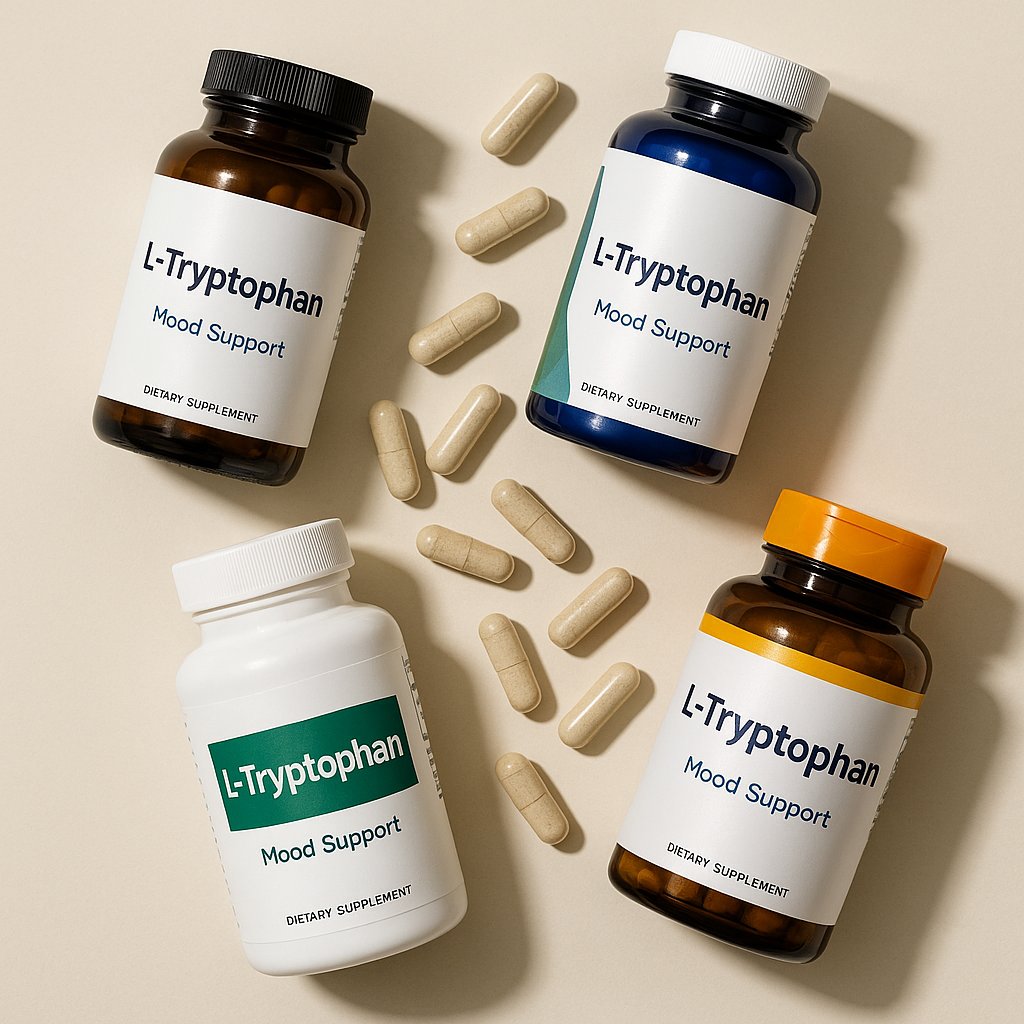
Best L-Tryptophan Supplements to Consider
Best Overall: Standalone L-Tryptophan Capsules (500 mg)
Look for products that clearly state the amount of free-form L-tryptophan per capsule, use minimal fillers, and are third-party tested.
Best for: people who want to control their dose precisely and stack on their own terms.
Best for Combined Mood + Sleep Support: L-Tryptophan + B6
Vitamin B6 is a cofactor in the conversion of tryptophan to serotonin. A formula that includes B6 (as pyridoxal-5-phosphate, the active form) makes metabolic sense.
Best for: people who want a targeted two-ingredient approach without complex blends.
Best Budget Option: Dietary Focus + Moderate Supplementation
If you eat a reasonably varied diet, you may already get 250-500 mg of tryptophan daily from food. Adding a single 500 mg capsule on days when your diet is lighter on protein is a practical, low-cost approach.
Best for: people who prefer food-first but want a safety net.
What L-Tryptophan Will Not Do
Let’s be clear about what is not supported by the evidence:
- It will not cure depression. It may support mood in mild cases or as an adjunct, but it is not a substitute for professional treatment.
- It will not work overnight. Serotonin synthesis takes time to shift meaningfully.
- It will not help everyone equally. Individual response varies based on genetics, gut health, existing serotonin status, and other factors.
- It will not compensate for poor sleep, chronic stress, or sedentary lifestyle. Fix the basics first.
The Bottom Line
L-tryptophan has a genuine biological rationale for mood support, and a 2020 systematic review of 11 RCTs supports modest mood improvement in healthy adults. Depletion studies add further plausibility. But the evidence is not yet strong enough to call it a proven mood treatment, especially for clinical depression.
If you want to try it: start with 500 mg/day, take it away from high-protein meals, avoid combining it with serotonergic medications, and give it 2-4 weeks before evaluating.
It is a reasonable supplement – just not a miracle.
Related Reading:
- How Tryptophan Becomes Serotonin: The Pathway Explained
- L-Tryptophan for Sleep: Does It Actually Help?
- L-Tryptophan Safety and Drug Interactions: What You Need to Know
FAQ
Is L-tryptophan good for mood?
L-tryptophan supports mood as a serotonin precursor, with most clinical evidence for mild depression, PMS-related mood symptoms, and seasonal affective disorder. 5-HTP is a more direct route to serotonin and may be more effective for mood support; however, tryptophan is gentler and also feeds the melatonin pathway (via serotonin).
Should I take L-tryptophan or 5-HTP?
5-HTP is the more direct serotonin precursor and has more robust mood-specific clinical data. L-tryptophan is preferred when you also want melatonin pathway support (for sleep) or when 5-HTP causes GI side effects. Many find starting with L-tryptophan and moving to 5-HTP if response is insufficient is a reasonable approach.
Can L-tryptophan cause serotonin syndrome?
L-tryptophan alone rarely causes serotonin syndrome due to rate-limiting enzymatic steps. However, combining tryptophan (or 5-HTP) with SSRIs, SNRIs, MAOIs, or tramadol significantly increases serotonin syndrome risk. Never combine serotonin-increasing supplements with prescription serotonergic medications without medical guidance.
When should I take L-tryptophan?
For sleep support, take 500-2000 mg of L-tryptophan 30-60 minutes before bed, with a carbohydrate snack but minimal protein (to reduce amino acid competition at the blood-brain barrier). For mood support, timing is less critical; many protocols divide doses between morning and evening.
Related Articles
- Best Mullein Leaf and NAC Supplements for Lung Support in 2026: What the Evidence Actually Shows
- Best Vitamin D3 + K2 Supplements for Bone and Heart Health in 2026: What the Evidence Actually Shows
- Best Supplements for Depression in 2026: What the Evidence Actually Shows
- Best Biotin Supplements in 2026: Hair, Skin, Nails, Metabolism, and What the Evidence Actually Shows
- Best Butyrate and Tributyrin Supplements in 2026: What Actually Matters for Gut Barrier Support
Sources
- Is S-Adenosyl Methionine (SAMe) for Depression Only Effective in Males? A Re-Analysis of Data from a Randomized Clinical Trial. Pharmacopsychiatry. 2015. PMID: 26011569.
- S-adenosylmethionine and affective disorder. The American journal of medicine. 1987. PMID: 3318437.
- Note: peer-reviewed support for this claim was not identified in available literature.
- Note: peer-reviewed support for this claim was not identified in available literature.
- Tryptophan-Serotonin-Melatonin: Review (2012)


Leave a Reply