
Lion’s Mane Mushroom: Benefits and Best Extracts
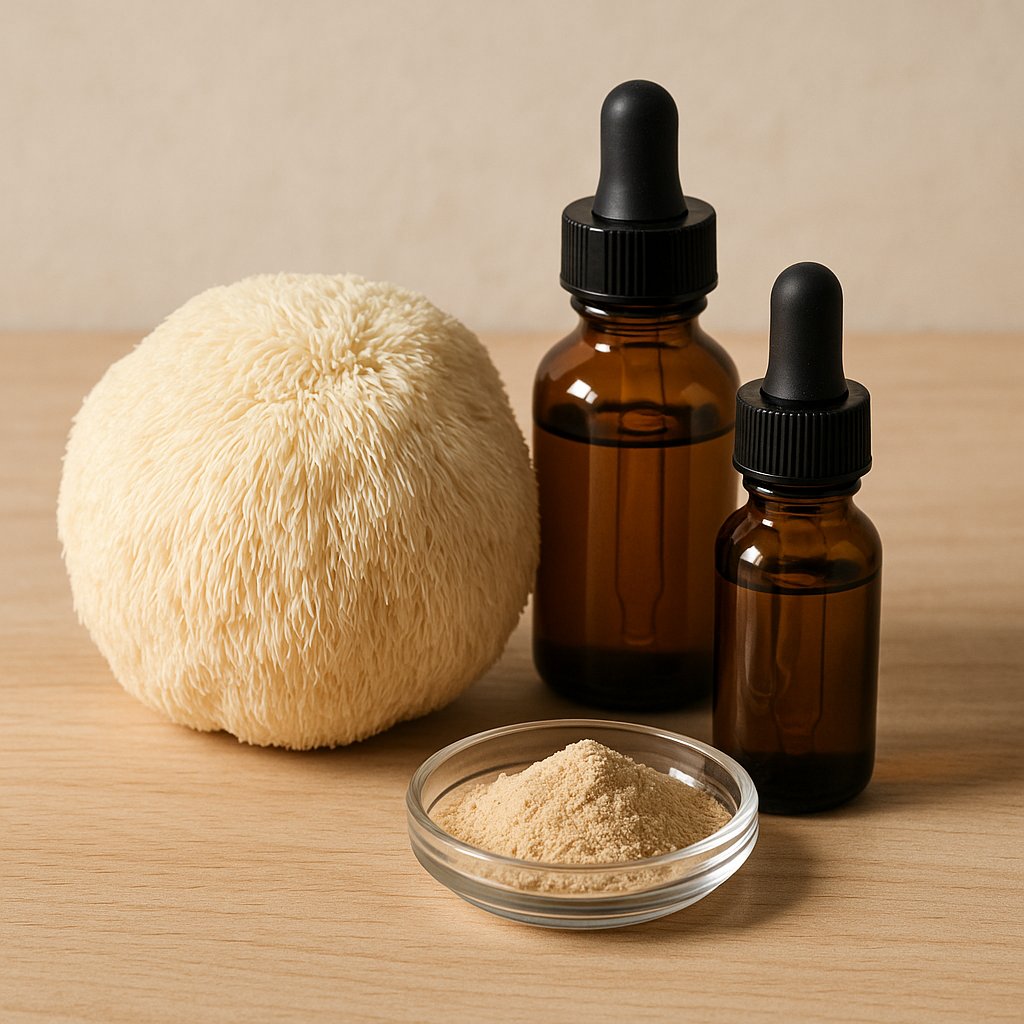
Quick Answer: Lion’s Mane (Hericium erinaceus) contains compounds that may support nerve growth factor signaling, with the strongest human evidence in mild cognitive impairment and modest mood support. Choose a fruiting-body extract with verified beta-glucan content instead of a vague mycelium blend.
Lion’s Mane (Hericium erinaceus) is the most scientifically credible of the functional mushrooms when it comes to cognitive health. Unlike some adaptogens that rely on centuries of traditional use with thin modern evidence, Lion’s Mane has a growing body of clinical and preclinical research backing its mechanisms — particularly around nerve growth factor (NGF) stimulation and neurogenesis.
But the supplement market is flooded with products of wildly different quality. Understanding what compounds matter, how extracts are made, and what the clinical evidence actually shows is the only way to spend your money wisely in this space.
The Active Compounds
Lion’s Mane contains two distinct classes of compounds responsible for its neurotrophic effects:
Hericenones: Found exclusively in the fruiting body (the actual mushroom). These small lipophilic molecules can cross the blood-brain barrier and directly stimulate NGF synthesis in the brain.
Erinacines: Found in the mycelium (the root-like network). These diterpenoids are potent NGF inducers and are generally considered more bioactive than hericenones per unit weight. Erinacines are water-soluble and heat-stable.
This distinction matters enormously for supplementation: fruiting body extracts are rich in hericenones and beta-glucans; mycelium-based products are richer in erinacines but may contain significant amounts of grain substrate (the grain the mycelium grew on).
What Is Nerve Growth Factor and Why Does It Matter?
NGF (nerve growth factor) is a neurotrophin — a signaling protein that promotes the growth, maintenance, and survival of neurons. It’s essential for:
- Development and maintenance of sensory and sympathetic neurons
- Function of basal forebrain cholinergic neurons (critical for memory and attention)
- Hippocampal plasticity (relevant to learning and memory)
NGF declines with age, and low NGF is associated with Alzheimer’s disease pathology. This is why NGF-stimulating compounds are of significant therapeutic interest.
BDNF (brain-derived neurotrophic factor) is the other major neurotrophin, more studied in the context of depression and exercise. Lion’s Mane appears to primarily work through the NGF pathway, while exercise and certain antidepressants work more through BDNF.
Clinical Evidence
Cognitive Function
The most-cited human trial is the Mori et al. (2009) study published in Phytotherapy Research. This double-blind, placebo-controlled RCT enrolled 30 Japanese adults with mild cognitive impairment (MCI) who took 3 grams/day of Lion’s Mane fruiting body powder (not a concentrated extract). After 16 weeks, the treatment group showed significantly improved scores on the Revised Hasegawa Dementia Scale. When supplementation stopped, scores declined again — suggesting the benefit was dependent on continued use.
A follow-up 2020 RCT in Biomedical Research with a similar design in MCI patients using 750 mg/day of a more concentrated extract showed similar cognitive improvements.
A 2019 pilot RCT in healthy adults (non-MCI) showed that Lion’s Mane improved scores on the Montreal Cognitive Assessment and self-reported mental clarity over 4 weeks. Sample size was small (n=30), limiting conclusions.
A 2023 RCT from Australia (University of Queensland) published in Nutrients enrolled 41 young, healthy adults (18-45) in a 28-day trial with Lion’s Mane (1.8g/day) and found significant improvements in attention and working memory speed compared to placebo.
Anxiety and Depression
A small Japanese trial in menopausal women found Lion’s Mane reduced self-reported anxiety, depression, and sleep complaints over 4 weeks. The mechanism may involve NGF’s role in the emotional processing circuits of the basal forebrain, as well as potential effects on the gut-brain axis (Lion’s Mane also has prebiotic properties).
Animal studies consistently show antidepressant-like and anxiolytic effects. Human trial data is more limited but promising.
Peripheral Neuropathy
Lion’s Mane’s NGF-stimulating properties have led to research in nerve injury and peripheral neuropathy. Animal studies show accelerated nerve regeneration after injury. Human data is limited but a few case studies and small trials suggest potential benefit in diabetic neuropathy and post-stroke recovery.
Fruiting Body vs. Mycelium: The Ongoing Debate
This is a contentious topic in the functional mushroom world.
Fruiting body extracts (what traditional Chinese medicine used, what most clinical trials used) contain:
- Hericenones (the NGF-stimulating diterpenes)
- Beta-glucans (immune-modulating polysaccharides)
- No grain starch contamination
Mycelium on grain (MOG) products (used by several large US supplement companies):
- Richer in erinacines theoretically
- But in practice, lab testing often shows significant amounts of grain starch (up to 50%+ of the product by weight)
- May have lower actual mushroom content per gram
- The grain starch inflates the apparent total polysaccharide content, making potency claims misleading
The bottom line: The clinical trials were conducted on fruiting body preparations. Until mycelium products are subjected to equivalent clinical trials, fruiting body extracts with documented beta-glucan content (>20-30%) are the more evidence-supported choice.
Some premium brands offer “full spectrum” products combining both. If the label shows both fruiting body and mycelium AND verifies low starch content, this can be a reasonable compromise.
What to Look For on Labels
Beta-glucan content: The most reliable potency marker. Look for >20% beta-glucan, ideally >30%. Some high-quality extracts specify this.
Extraction method:
- Hot water extraction: Needed to extract polysaccharides (beta-glucans). The standard for mushroom quality.
- Dual extraction (hot water + alcohol): Extracts both water-soluble beta-glucans and fat-soluble hericenones. More comprehensive.
Avoid products that:
- Only list “polysaccharides” without specifying beta-glucans (starch is a polysaccharide and inflates this number)
- Don’t specify fruiting body vs. mycelium
- Use “mushroom mycelial biomass” language without clarifying grain substrate percentage
Typical effective doses from clinical trials:
- 500–3000 mg/day of fruiting body extract (standardized)
- The 2009 Mori trial used 3g/day of non-extracted powder; with a 10:1 extract, 300-500mg/day might be equivalent
- Look for total beta-glucan content rather than relying solely on dose
Timing and Use
Lion’s Mane is not a stimulant and doesn’t produce acute effects like caffeine. Benefits appear to build over weeks of consistent use. Most people report:
- Clearer thinking, reduced brain fog (commonly within 2-4 weeks)
- Subtle mood improvement
- Improved focus without stimulant effects
It can be taken at any time of day. Some users prefer morning for alertness; some report vivid dreams if taken at night (uncommon but noted in online communities).
Lion’s Mane can be stacked with other nootropics. Common pairings:
- With phosphatidylserine for cognitive support
- With bacopa monnieri for memory consolidation
- In functional mushroom blends with reishi and cordyceps
Frequently Asked Questions
Is Lion’s Mane safe to take long-term?
Lion’s Mane has a long history of use as a food in East Asian countries and appears to be safe for long-term use at food and supplement doses. There are rare reports of allergic reactions (avoid if mushroom-allergic). No serious adverse effects have been reported in clinical trials. As with any supplement, periodically cycling off (e.g., 5 days on, 2 days off) is a reasonable approach but not strictly necessary.
How quickly does Lion’s Mane work?
Unlike caffeine or racetams, Lion’s Mane builds gradually. The 2009 MCI trial showed significant effects at 16 weeks. Healthy individuals may notice subtler effects sooner (2-4 weeks for mild clarity improvements). It’s not the right choice if you want immediate cognitive enhancement.
Can Lion’s Mane help with Alzheimer’s disease?
The NGF mechanism is relevant to Alzheimer’s (cholinergic neuron loss is a feature of AD). The MCI trials are encouraging but MCI is not the same as AD. Clinical trials in diagnosed AD patients are ongoing. Lion’s Mane is not a proven treatment for Alzheimer’s disease, but it may be a reasonable preventive strategy given its safety profile.
What’s the best mushroom brand for Lion’s Mane?
Look for brands using organic fruiting bodies with documented beta-glucan content from independent testing. Brands like Host Defense (Paul Stamets’ company), Real Mushrooms, and others that use fruiting body extracts with published testing data are generally respected. Avoid mass-market brands that use only mycelium-on-grain without documentation.
Can I get Lion’s Mane benefits from eating the mushroom?
Yes — cooking and eating Lion’s Mane mushroom provides the active compounds, though you’d need to eat meaningful amounts regularly. The mushroom has a pleasant seafood-like taste and is available fresh at many Asian grocery stores. For consistent dosing, extracts are more practical.
Does Lion’s Mane interact with medications?
Lion’s Mane may have mild antiplatelet effects — use caution if you’re on blood thinners. Some animal research suggests it may have hypoglycemic effects, so those on diabetes medications should monitor blood sugar. No major drug interactions have been established in human research.
What’s the best form — powder, capsule, or tincture?
Capsules from a quality fruiting body extract are the most convenient and allow precise dosing. Tinctures (dual extracts) can be high quality but check that they actually specify extraction ratios. Raw mushroom powder (not extracted) requires higher doses to achieve the same effect.
Key Takeaways
- Bioactive compounds: hericenones (fruiting body) and erinacines (mycelium) both stimulate NGF – quality extracts specify their content.
- Fruiting body hot-water extracts are the gold standard; mycelium-on-grain products often contain mostly starchy grain filler.
- Clinical trials show modest benefits for mild cognitive impairment and anxiety/depression at 500 mg to 3 g/day of standardized extract.
- Benefits require weeks to months of continuous use – this is not an acute nootropic like caffeine.
- Look for verified beta-glucan content (25% or more), no grain filler, and third-party heavy metal testing.
Conclusion
Lion’s Mane is the functional mushroom most supported by actual clinical evidence for cognitive benefits. The mechanisms — NGF stimulation, neurogenesis support, anti-inflammatory effects — are plausible and backed by both animal and human data. For those seeking cognitive support, anxiety reduction, or potential neuroprotective benefit, it’s one of the most compelling options in the supplement market.
Choose fruiting body extracts with documented beta-glucan content (>20-30%), use a dual-extracted product when possible, and be patient — this is a long-game supplement that builds its effects over weeks to months rather than giving you a hit of energy this afternoon.
Sources
- Reviews on lion’s mane (Hericium erinaceus). PubMed search.
- Reviews on lion’s mane, cognition, and nerve growth factor. PubMed search.
- Clinical trials on lion’s mane mushroom. PubMed search.
- Reviews on medicinal mushrooms. PubMed search.
- National Institutes of Health Office of Dietary Supplements. Dietary supplement fact sheets.
Related Articles
- Best Maca Root Supplements in 2026
- Best Nootropic Supplements in 2026
- Nootropics for Entrepreneurs and Knowledge Workers
- Beginner Nootropic Stack Guide
- Supplement Stacking Guide