Nootropic Mushrooms: Best Mushroom Supplements for Brain and Cognitive Function
Quick Answer: Several mushroom species have genuine evidence for cognitive support — lion’s mane leads the field with the strongest human clinical data on nerve growth factor (NGF) stimulation, followed by cordyceps for mental energy and oxygen utilization. Reishi and chaga have supportive roles but weaker direct cognitive evidence. Dosing, extract quality, and the specific bioactive compounds present matter enormously.
Walk into any supplement store today and you’ll find half a dozen products claiming to support your brain with mushrooms. It’s a crowded category with real science mixed in with a lot of marketing noise. The honest answer to “do mushroom nootropics work?” is: some of them might, for specific outcomes, if you buy the right product. The less honest answer is the one most brands want you to hear. This guide cuts through the hype and focuses on what the research actually says.
The term “nootropic mushrooms” describes fungal species with documented mechanisms for influencing brain function — whether through nerve growth factor stimulation, improved cerebral oxygenation, modulation of the HPA axis, or antioxidant protection of neural tissue. These are not the same thing as “functional mushrooms” broadly — a category that also includes immune-supporting, gut-supporting, and anti-inflammatory species like turkey tail or maitake that have limited cognitive relevance. If you’re looking at the broader wellness picture for mushrooms, our Functional Mushrooms Guide covers the full spectrum.
Why Mushrooms for Cognitive Support?
Fungi occupy a unique position in natural medicine. Unlike plant-based adaptogens, mushrooms contain a distinct set of bioactive compounds — beta-glucans, triterpenes, hericenones, erinacines, polysaccharides — many of which have no direct equivalents in the plant kingdom. Some of these compounds cross the blood-brain barrier, interact with neurotrophic signaling, or modulate the microbiome-gut-brain axis.
Mushrooms also have a long history of use in traditional East Asian medicine, particularly Chinese and Japanese herbalism, which provides a useful starting hypothesis for where to look — though traditional use is not evidence of efficacy and every claim still needs modern validation.
For context, if you’re exploring adaptogens alongside mushrooms, our articles on Ashwagandha and KSM-66 Ashwagandha cover the best-studied plant-based nootropic/adaptogen. Mushrooms and ashwagandha are often stacked together — and for good reason, as they target different systems.
Lion’s Mane: The Strongest Cognitive Evidence
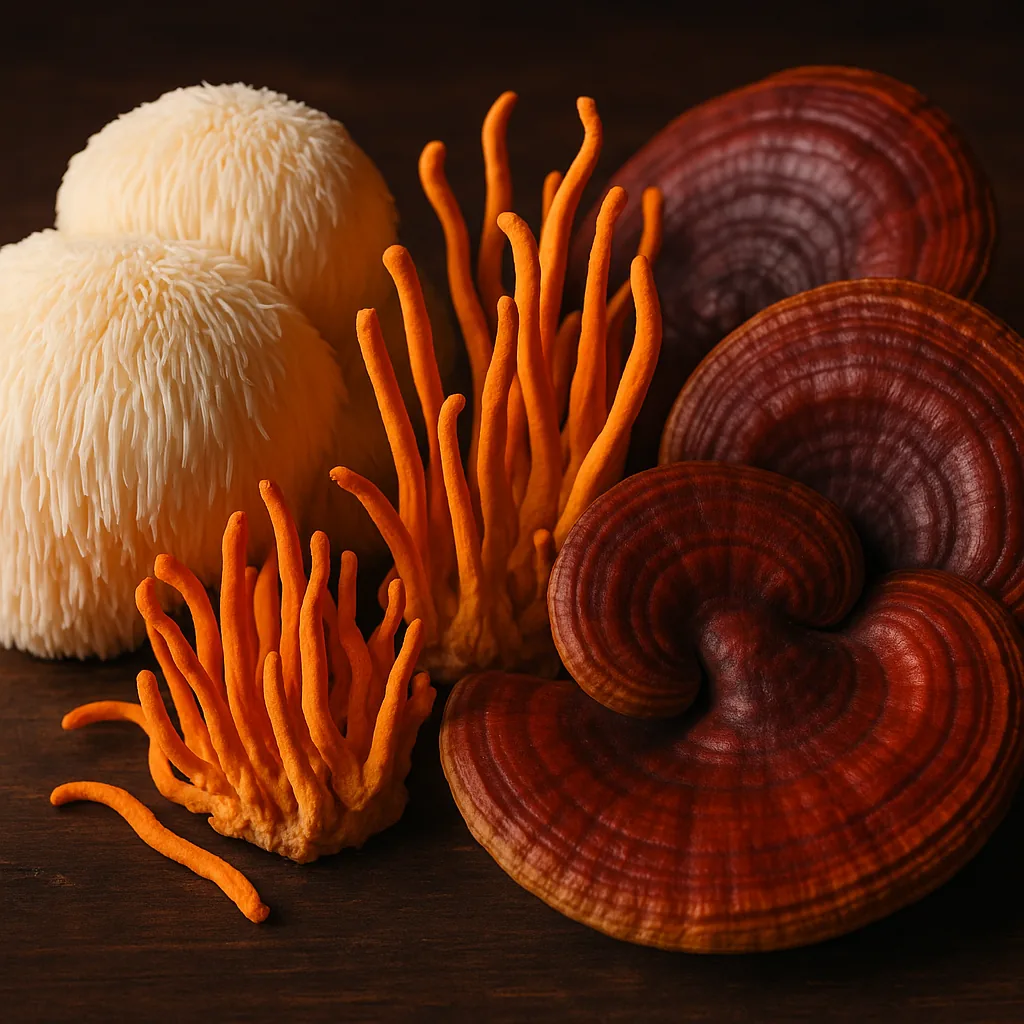
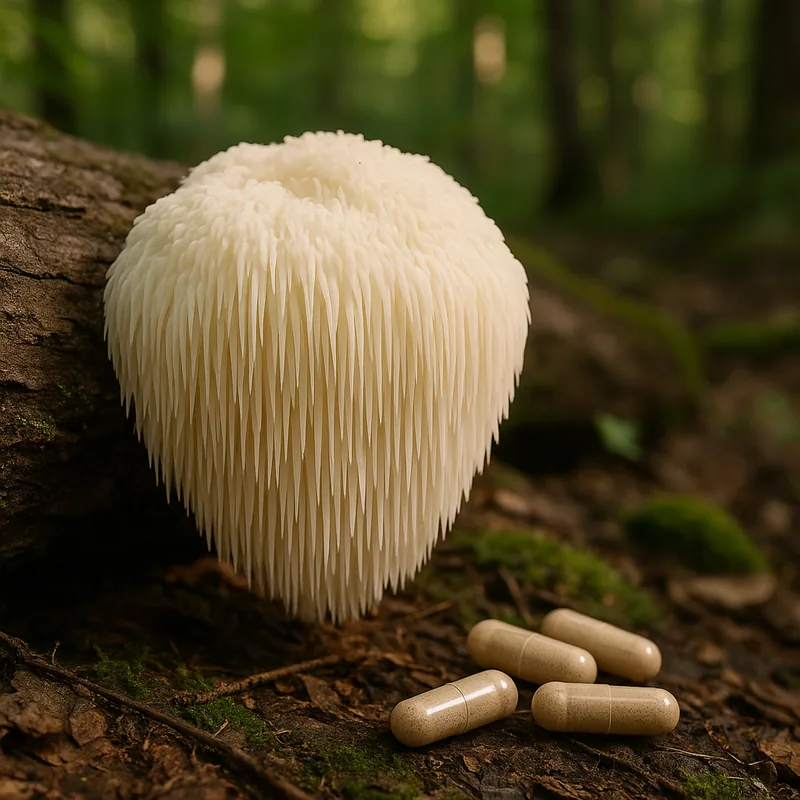
Hericium erinaceus, known as lion’s mane, is the runaway leader when it comes to actual cognitive evidence. It’s the only mushroom species with well-replicated mechanisms for stimulating the synthesis of nerve growth factor (NGF) — a protein that promotes the growth, maintenance, and repair of neurons.
The key bioactives here are hericenones (found in the fruiting body) and erinacines (found in the mycelium). Both have been shown to stimulate NGF synthesis in the brain, though they operate through different mechanisms and different parts of the plant — which is one reason why the fruiting body vs. mycelium debate matters for lion’s mane specifically.
Clinical Evidence
The landmark human study is by Mori et al. (Phytotherapy Research, 2009), which enrolled 30 men and women aged 50–80 with mild cognitive impairment in a double-blind, placebo-controlled trial. The lion’s mane group received 3 grams daily of powdered mushroom for 16 weeks. The result: significantly higher scores on the Hasegawa Dementia Scale in the lion’s mane group compared to placebo, with scores declining again after discontinuation — suggesting the effect was real and dependent on ongoing supplementation.
A 2020 study by Saitsu et al. (Biomedical Research, 2019) examined the effects of lion’s mane biscuits (3.2 g/day) in older adults over 12 weeks and found improvements in cognitive function on the Mini-Mental State Examination (MMSE). Another study by Chong et al. (Journal of Medicinal Food, 2019) examined lion’s mane in a younger cohort under stress conditions and found improvements in depression, anxiety, and sleep quality — outcomes relevant to cognitive performance even if not pure “brain power.”
NGF stimulation has implications not just for aging brains but potentially for neurogenesis and neuroprotection in healthy adults — though human data in healthy, younger populations is less robust.
Recommended Dose: 500–3,000 mg/day of standardized fruiting body extract (look for products specifying beta-glucan content of at least 25%) or mycelium extract standardized for erinacines.
Cordyceps: Mental Energy and Oxygen Efficiency
Cordyceps (Cordyceps militaris and the more traditional Ophiocordyceps sinensis) operates on a completely different pathway than lion’s mane. Rather than directly stimulating neurotrophins, cordyceps primarily supports cognitive function by improving cellular energy production and oxygen utilization.
The main bioactive compound in cordyceps is cordycepin (3′-deoxyadenosine), which has demonstrated effects on ATP synthesis and adenosine receptor modulation. Additionally, cordyceps appears to enhance VO2 max — the body’s maximum oxygen uptake — which has downstream effects on brain oxygenation and mental performance under physical or cognitive load.
Clinical Evidence
A double-blind, placebo-controlled study by Hirsch et al. (Journal of Dietary Supplements, 2017) gave healthy older adults 1,000 mg/day of Cordyceps militaris extract for 12 weeks and observed significant improvements in VO2 max and functional capacity compared to placebo. While this is primarily a physical performance marker, the relationship between cerebrovascular oxygenation and cognitive performance is well-established in exercise physiology research.
Chen et al. (Evidence-Based Complementary and Alternative Medicine, 2014) demonstrated that cordyceps supplementation reduced fatigue and improved cognitive performance on sustained attention tasks in healthy adults, proposed to be mediated by improved mitochondrial efficiency.
The cognitive relevance of cordyceps is most applicable to scenarios involving fatigue, mental fog associated with poor sleep or high workload, and performance under physical stress — rather than neurodegeneration or memory consolidation.
Recommended Dose: 500–2,000 mg/day of Cordyceps militaris fruiting body extract (the wild O. sinensis is endangered and most commercial products use the cultivated militaris strain, which has good cordycepin content).
Reishi: Cognitive Benefits Through Anxiety and Sleep Modulation
Reishi (Ganoderma lucidum) is one of the most revered mushrooms in traditional Chinese medicine and has an enormous body of research — but the cognitive benefits are largely indirect, mediated through its effects on stress, anxiety, and sleep quality rather than direct neurotrophin stimulation.
The bioactives responsible are ganoderic acids (triterpenes) and beta-glucans. Ganoderic acids have demonstrated inhibitory effects on histamine release and activity at benzodiazepine receptors (Chen et al., Phytotherapy Research, 2012), suggesting a mechanism for the anxiolytic and sleep-promoting effects observed clinically.
Clinical Evidence
A double-blind study by Tang et al. (Journal of Medicinal Food, 2005) found that reishi supplementation reduced fatigue and improved quality of life in patients with neurasthenia — a condition characterized by mental and physical exhaustion. Scores on standardized fatigue and anxiety instruments improved significantly versus placebo.
Matsuzaki et al. (Evidenced-Based Complementary Medicine, 2013) examined reishi’s effects on sleep architecture and found improvements in total sleep time and sleep quality in subjects with chronic insomnia at 80 mg/day of a concentrated triterpene extract.
Sleep quality and anxiety management are not traditionally classified as “nootropic” effects, but their cognitive relevance is enormous. Chronic sleep deprivation and anxiety are two of the biggest predictors of cognitive decline, impaired working memory, and reduced processing speed. Addressing these upstream factors may produce measurable cognitive improvements — making reishi a legitimate cognitive support strategy even without direct NGF or neurotransmitter effects.
Recommended Dose: 1,000–3,000 mg/day of reishi fruiting body extract standardized for triterpenoids (look for ganoderic acid content) and beta-glucans.
Chaga: Antioxidant Protection for Neural Tissue
Chaga (Inonotus obliquus) is technically not a fruiting body mushroom in the traditional sense — it grows as a sterile conk on birch trees, primarily in Siberia and northern climates. It’s one of the most antioxidant-dense natural substances measured, with ORAC (Oxygen Radical Absorbance Capacity) values substantially higher than most fruits and vegetables.
The cognitive relevance of chaga is primarily through its antioxidant and anti-inflammatory activity. Oxidative stress in neural tissue is a major driver of cognitive aging, neuroinflammation, and neurodegenerative conditions. Chaga’s key bioactives — melanin pigments, betulinic acid, inotodiol, and polysaccharides — have demonstrated neuroprotective activity in preclinical models.
Clinical Evidence
Human clinical evidence specifically for cognitive outcomes is thinner for chaga than for lion’s mane or even cordyceps. A study by Park et al. (World Journal of Gastroenterology, 2005) demonstrated significant anti-inflammatory effects in human subjects, and the same anti-inflammatory pathways that protect the gut are operative in neural tissue. Animal studies (Nakajima et al., International Journal of Medicinal Mushrooms, 2009) showed that chaga extract protected against cognitive impairment induced by oxidative stress and scopolamine — but these are animal models, not human RCTs.
Chaga is best understood as providing a foundational layer of antioxidant and anti-inflammatory support rather than direct cognitive enhancement. It fits well in a mushroom stack as a protective companion to more targeted nootropic species.
Recommended Dose: 400–1,200 mg/day of chaga extract.
Evidence Ranking: The Honest Assessment
Not all nootropic mushroom claims are created equal. Here’s where the evidence actually stands:
Mushroom
Primary Cognitive Mechanism
Human RCT Evidence
Strength of Evidence
Lion’s Mane
NGF stimulation, neurogenesis
Yes — multiple
★★★★☆ Strong
Cordyceps
ATP/O₂ efficiency, anti-fatigue
Yes — limited
★★★☆☆ Moderate
Reishi
Anxiety reduction, sleep quality
Yes — limited
★★★☆☆ Moderate (indirect)
Chaga
Neuroprotective antioxidants
No human cognitive RCTs
★★☆☆☆ Preclinical only
Tremella
Neural antioxidant, NGF support
Preclinical only
★★☆☆☆ Emerging
The honest caveat for the entire category: most mushroom cognitive studies use small sample sizes (typically 20–50 subjects), short durations (8–16 weeks), and varying product formulations. Replication is inconsistent. The field is promising but not settled science on par with, say, NAD+ precursors for aging or creatine for cognitive support. That doesn’t mean mushrooms don’t work — it means the evidence base is still maturing.
Building a Nootropic Mushroom Stack
If you’re interested in combining mushroom species for broader cognitive support, the lion’s mane + cordyceps + reishi combination is the most commonly used evidence-based stack:
Lion’s mane targets long-term neuroplasticity and nerve growth factor support — the foundational ingredient for anyone focused on cognition.
Cordyceps addresses energy and mental performance under load — particularly useful for demanding workdays or athletic performance.
Reishi manages the stress-sleep-recovery axis — the often-overlooked prerequisite for optimal cognition.
This stack complements non-mushroom adaptogens well. Ashwagandha (particularly KSM-66) addresses cortisol regulation from a different angle, and the combination of lion’s mane + KSM-66 is well-regarded in functional medicine circles for cognitive support with a stress-management component.
For broader energy and stress management context, our Energy and Stress Supplements Guide covers how mushrooms fit into a complete adaptogen and energy protocol.
Product Quality: What Actually Matters
The biggest quality trap in the mushroom supplement market is the mycelium-on-grain problem. Many commercial mushroom products are produced by growing mycelium on oats or rice, then drying and grinding the entire substrate — meaning a large fraction of what’s in the capsule is actually grain starch, not mushroom bioactives.
A 2017 analysis by Labdoor examined several popular mushroom supplements and found that some contained more starch (from the grain substrate) than actual fungal material. The workaround is to look for:
Fruiting body extracts (not mycelium-on-grain, or “full spectrum” products that include grain substrate)
Standardized beta-glucan content — ideally tested and stated on the label (25%+ for lion’s mane fruiting body)
Low starch content — some brands now test for and disclose starch content; high starch is a red flag
Third-party testing — NSF or Informed Sport certification, or COAs from independent labs
Hot water extraction is the standard process for releasing beta-glucans and most polysaccharides. Dual extraction (water + alcohol) is preferred for species like reishi and chaga that also contain significant triterpene content, as triterpenes require alcohol to extract.
If you’re also interested in the longevity and healthy aging angle alongside cognitive mushrooms, Ca-AKG is worth researching — see our AKG Supplement Guide for how it compares to and complements mushroom nootropics.
Key Takeaways
Lion’s mane has the strongest human clinical evidence for cognitive support, driven by NGF-stimulating compounds (hericenones/erinacines)
Cordyceps supports cognitive performance primarily through improved mitochondrial energy production and oxygen utilization — most relevant for mental and physical fatigue
Reishi’s cognitive benefits are largely indirect: better sleep quality and reduced anxiety, which are significant upstream drivers of cognitive performance
Chaga provides antioxidant and anti-inflammatory protection of neural tissue, with strong preclinical but limited human cognitive data
The biggest quality problem in mushroom supplements is mycelium-on-grain products with high starch content — look for fruiting body extracts standardized for beta-glucans
A lion’s mane + cordyceps + reishi combination addresses multiple cognitive pathways and is the most evidence-supported mushroom nootropic stack
Frequently Asked Questions
What is the best mushroom for brain function?
Lion’s mane (Hericium erinaceus) has the strongest and most consistent human clinical evidence for cognitive support, including improvements in cognitive test scores in individuals with mild cognitive impairment (Mori et al., 2009) and benefits in healthy adults under stress (Chong et al., 2019). It’s the starting point for anyone serious about mushroom nootropics.
How long does lion’s mane take to work?
Clinical studies showing cognitive improvements typically ran for 8–16 weeks. Most users report some effect on mental clarity and focus within 4–8 weeks, but the NGF-related neurotropic effects on memory and cognitive function likely require longer-term supplementation (3+ months) to fully manifest. It’s not a supplement where you expect to notice a dramatic difference on day one.
Can I take nootropic mushrooms with other supplements?
Generally yes. Mushroom nootropics are well-tolerated alongside most supplements. Common combinations include lion’s mane with racetams, lion’s mane with adaptogens like ashwagandha or rhodiola, and mushroom stacks alongside phosphatidylserine or omega-3s. No major drug interactions have been documented, but those on blood thinners should use caution with reishi, which has some anticoagulant activity.
Are nootropic mushrooms the same as psychedelic mushrooms?
No. Nootropic mushrooms are functional food species that contain no psilocybin or other psychoactive compounds. They are legal, non-intoxicating supplements. Lion’s mane, cordyceps, reishi, and chaga have nothing in common with Psilocybe species beyond both being fungi.
What’s better — mushroom powder or extract?
Extracts are generally preferable for cognitive outcomes. Raw mushroom powder has inconsistent bioactive content, and the cell walls of fungi are made of chitin (not digestible by humans), which means much of the beneficial polysaccharides may pass through without being absorbed unless the material is hot-water extracted. Look for products that specify extraction ratio (e.g., 8:1 extract) and beta-glucan content.
Do nootropic mushrooms help with anxiety?
Reishi has the best evidence for anxiety reduction among mushroom nootropics, likely through its effects on benzodiazepine receptors and HPA axis modulation. Lion’s mane has shown some benefit on anxiety and depression scores in human studies (Chong et al., 2019), possibly mediated by NGF effects on the hippocampus, which plays a role in emotional regulation.
Sources
Mori K, et al., “Improving effects of the mushroom Yamabushitake (Hericium erinaceus) on mild cognitive impairment,” Phytotherapy Research, 2009.
Saitsu Y, et al., “Improvement of cognitive functions by oral intake of Hericium erinaceus,” Biomedical Research, 2019.
Chong PS, et al., “Therapeutic potential of Hericium erinaceus for depressive disorder,” Journal of Medicinal Food, 2019.
Hirsch KR, et al., “Cordyceps militaris improves tolerance to high-intensity exercise after acute and chronic supplementation,” Journal of Dietary Supplements, 2017.
Chen S, et al., “Anti-fatigue effects of Cordyceps extracts and adenosine,” Evidence-Based Complementary and Alternative Medicine, 2014.
Tang W, et al., “A randomized, double-blind and placebo-controlled study of a Ganoderma lucidum polysaccharide extract in neurasthenia,” Journal of Medicinal Food, 2005.
Chen WC, et al., “Anxiolytic effects of Ganoderma lucidum triterpenes in mice,” Phytotherapy Research, 2012.
Matsuzaki H, et al., “Ganoderma lucidum effects on sleep and autonomic nerve activity,” Evidence-Based Complementary Medicine, 2013.
Park YM, et al., “In vivo and in vitro anti-inflammatory and antinociceptive effects of Inonotus obliquus,” World Journal of Gastroenterology, 2005.
Nakajima Y, et al., “Inonotus obliquus extract protects against oxidative stress-induced cognitive impairment,” International Journal of Medicinal Mushrooms, 2009.