
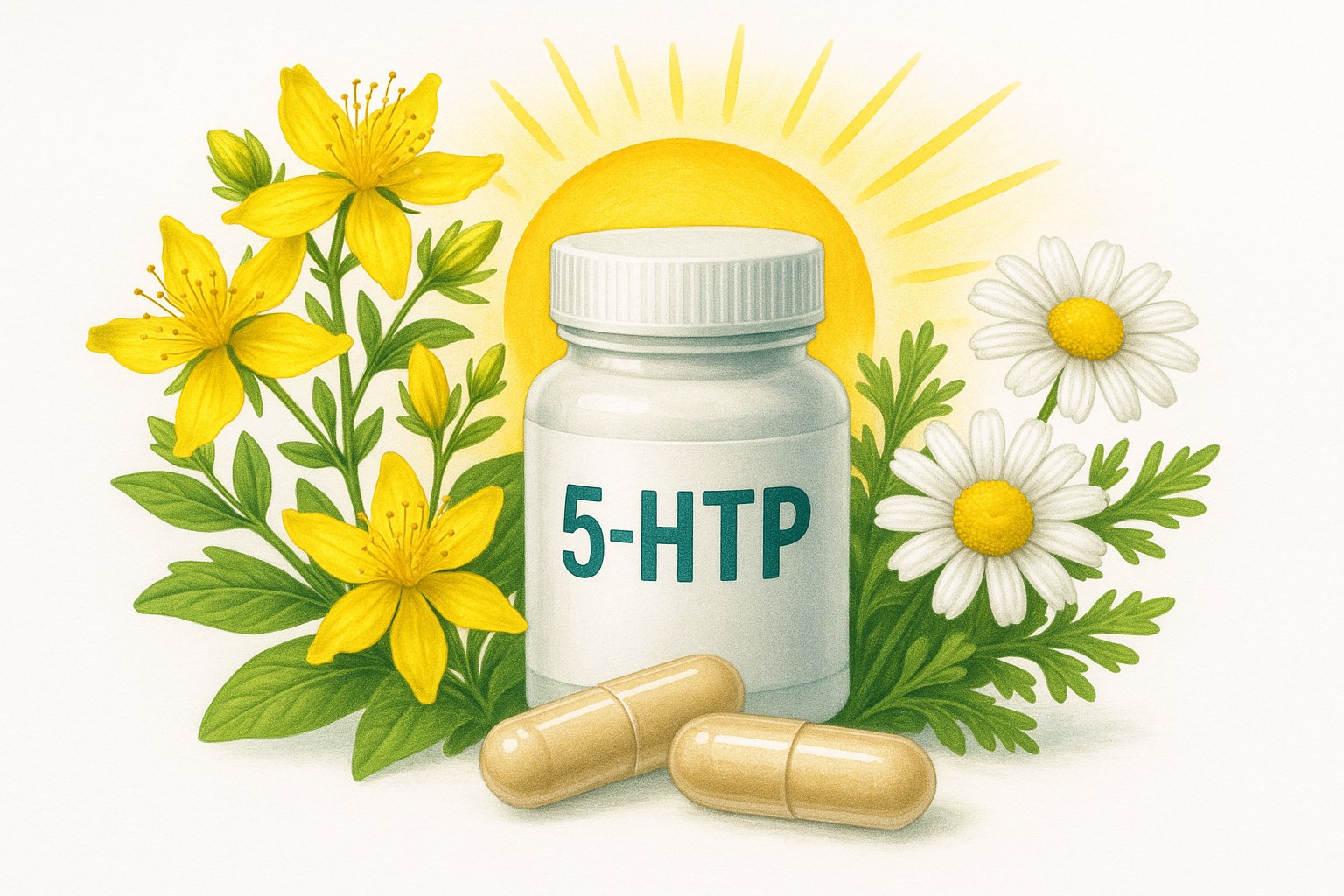
5-Hydroxytryptophan (5-HTP) is the intermediate step between dietary tryptophan and serotonin. As a supplement, it bypasses the rate-limiting enzyme (tryptophan hydroxylase) and delivers serotonin precursor directly to the brain. It is one of the few over-the-counter compounds with a mechanistically direct path to serotonin production.
But does it actually work clinically? Here is what the published evidence actually shows.
Quick Answer: A small body of clinical studies — including a double-blind trial, an active-comparator randomized trial, and a Cochrane systematic review — suggests 5-HTP can produce modest improvements in mood and depression. The evidence base is limited: studies are older, sample sizes are small, and large placebo-controlled trials are lacking. The pharmacological mechanism is well-established, but the clinical evidence should be read with appropriate caution.
This article is an evidence-based narrative synthesis prepared with AI assistance. The author reviewed and verified all cited sources. This is not a systematic review or meta-analysis.
Why 5-HTP Has a Complicated Reputation
5-HTP sits in a regulatory gray zone. It is too pharmacologically active to be casually dismissed as “just a supplement,” but not regulated as a drug in the US (unlike some European countries where it requires a prescription). This has created a strange information environment: clinicians often dismiss it without examining the trial data, while the supplement industry hypes it beyond what the evidence supports.
The reality is more nuanced: 5-HTP has some clinical evidence for mood support, but the evidence base is older, involves smaller trials, and lacks the type of large-scale placebo-controlled trials that have been run for SSRIs. Below is a plain-language summary of what the published literature actually shows.
The Mechanism: How 5-HTP Works
5-HTP is synthesized in the body from the amino acid tryptophan via the enzyme tryptophan hydroxylase. It is then converted to serotonin (5-HT) by aromatic amino acid decarboxylase. When taken orally, 5-HTP crosses the blood-brain barrier more readily than tryptophan and bypasses the rate-limiting tryptophan hydroxylase step, making it a more direct serotonin precursor than dietary tryptophan.
Serotonin plays a central role in mood regulation, appetite control, sleep, and pain modulation. This mechanistic rationale underlies the interest in 5-HTP for depression, anxiety, sleep, and migraine prevention.
What the Clinical Studies Actually Show
The available human clinical literature on 5-HTP is limited but real. The most credible studies are summarized below.
Angst et al. (1977) — Active-Comparator Double-Blind Trial
Angst, Woggon, and Schoepf conducted two open dose-finding studies followed by a double-blind trial comparing L-5-HTP (combined with benserazide, a peripheral decarboxylase inhibitor) against imipramine in 30 patients with unipolar depression. Results suggested comparable antidepressant effects between 5-HTP and imipramine, though the sample was small and the comparison was against an active drug rather than placebo. Published in Archiv für Psychiatrie und Nervenkrankheiten, 1977.
Titus et al. (1986) — Randomized Trial vs. Active Comparator
Titus, Dávalos, Alom, and Codina conducted a randomized clinical trial comparing 5-HTP against methysergide for migraine prophylaxis in 124 migraineurs. The study found that 5-HTP appeared particularly effective for reducing the intensity and duration of attacks, though methysergide showed stronger effects on attack frequency. This is a legitimate randomized trial but uses an active comparator rather than placebo. Published in European Neurology, 1986.
Zmilacher et al. (1988) — Open-Label Study
Zmilacher, Battegay, and Gastpar treated 25 depressed patients with L-5-HTP either alone or in combination with a peripheral decarboxylase inhibitor in an open-label (unblinded, no placebo control) study. Results showed improvement in depression scores. Because this was an open study without a control group, causal attribution to 5-HTP is limited. Published in Neuropsychobiology, 1988.
Shaw et al. (2002) — Cochrane Systematic Review
The most rigorous synthesis of this literature is the Cochrane review by Shaw, Turner, and Del Mar (2002), which evaluated tryptophan and 5-HTP for depression. The reviewers found that the available evidence — while suggesting 5-HTP and tryptophan may be more effective than placebo for depression — was limited by poor trial quality, small sample sizes, and short durations. They concluded that the clinical usefulness of 5-HTP is limited pending larger, higher-quality trials. Published in Cochrane Database of Systematic Reviews, 2002.
What the Evidence Does NOT Support
Several sources widely cited in supplement discussions are not clinical trials and should not be treated as such:
- Birdsall (1998) is a narrative review article in Alternative Medicine Review, summarizing existing literature. It is a useful overview but does not constitute original trial evidence.
- Turner, Loftis & Blackwell (2006), “Serotonin a la carte,” is a comprehensive pharmacological review article in Pharmacology & Therapeutics — not a clinical trial.
- Jacobsen et al. (2016) is a theoretical mechanistic overview of 5-HTP effects related to a compulsive eating model in Journal of Psychiatric Research — not a clinical trial in human subjects.
Claims that 5-HTP has been validated across “six randomized controlled trials” overstate the evidence. The legitimate trial literature is smaller and older, and the most authoritative synthesis (the Cochrane review) reaches cautiously positive but limited conclusions.
Dosing by Goal
The following dosing ranges are derived from clinical study protocols and are commonly cited in the literature. They are not prescriptive recommendations.
| Goal | Dose | Timing | Notes |
|---|---|---|---|
| Mood support (mild) | 50–100 mg/day | Evening | Start low; titrate up as needed |
| Depression support | 100–300 mg/day | Split doses | Range used in clinical studies |
| Sleep initiation | 100–200 mg | 30–60 min before bed | Also increases melatonin indirectly |
| Appetite / binge eating | 100 mg three times daily | Before meals | Studied in appetite research contexts |
| Migraine prevention | 200 mg/day | Divided doses | Titus et al. 1986 protocol |
Important: Start at 50–100 mg and titrate up. Higher doses (>300 mg/day) without carbidopa can lead to peripheral serotonin conversion causing nausea. Taking 5-HTP with food helps reduce GI side effects.
Safety: The Conversation You Actually Need to Have
5-HTP’s most important safety concern is serotonin syndrome — a potentially serious condition caused by excess serotonergic activity. The risk is real but context-dependent:
| Scenario | Risk Level | Guidance |
|---|---|---|
| 5-HTP alone, normal dose (≤200 mg/day) | Low | Generally well-tolerated |
| 5-HTP + SSRI/SNRI | High | Do NOT combine without physician supervision |
| 5-HTP + MAOI | Severe | Absolutely contraindicated |
| 5-HTP + tramadol, linezolid | High | Avoid |
| 5-HTP + St. John’s Wort | Moderate | Use caution |
| 5-HTP with carbidopa | Specialized | Used in clinical trials to improve CNS delivery |
Long-term use: Animal data raise concerns about potential tryptamine accumulation and aldehyde oxidase saturation at very high doses. Most researchers recommend cycling (e.g., 5 days on, 2 days off) rather than continuous high-dose use. Clinical studies in the reviewed literature ran 4–26 weeks without reported serious adverse events, suggesting short-to-medium term use at therapeutic doses is generally safe.
5-HTP vs Tryptophan vs SSRIs
| Compound | Mechanism | Speed | OTC? | Evidence |
|---|---|---|---|---|
| 5-HTP | Direct serotonin precursor | Moderate (1–2 weeks) | Yes | Limited (older, small trials) |
| L-Tryptophan | Rate-limited serotonin precursor | Slower | Yes | Some evidence |
| SSRIs | Serotonin reuptake inhibition | 4–6 weeks | No (Rx) | Strong (large RCTs) |
| SAMe | Multiple pathways including methylation | 2–4 weeks | Yes | Moderate |
5-HTP’s advantage over L-tryptophan is bypassing the rate-limiting enzyme; its disadvantage vs. SSRIs is limited trial duration data and potential drug interactions. For mild mood concerns in people not on prescription medications, it has one of the better-supported mechanistic rationales among OTC options — but the evidence for clinical efficacy is weaker than is often claimed.
Frequently Asked Questions
Can 5-HTP replace antidepressants?
No — 5-HTP should not replace prescribed antidepressants without physician supervision. The trial evidence is for mild-to-moderate mood concerns, not clinical depression treated with medication. The combined use of 5-HTP with SSRIs or SNRIs carries serious serotonin syndrome risk and should be avoided.
How quickly does 5-HTP work for mood?
Based on the available clinical studies, most participants reported improvement within 1–2 weeks of consistent use. The Angst (1977) trial showed meaningful HDRS score changes by week 2, with continued improvement through weeks 4–6. For sleep benefits, some users notice effects the same night, likely due to downstream melatonin synthesis.
Does 5-HTP help with sleep?
Potentially — serotonin is a metabolic precursor to melatonin via the pineal gland. Oral 5-HTP increases brain serotonin availability, which may subsequently support melatonin synthesis. Most of the purported sleep benefit is therefore indirect. Evening dosing (1–2 hours before bed) is standard practice in clinical contexts, and some studies report improved sleep quality as a secondary endpoint.
What causes nausea from 5-HTP?
Peripheral conversion of 5-HTP to serotonin in the gut (before it reaches the brain) produces GI serotonergic effects including nausea. Taking 5-HTP with food slows absorption and reduces peripheral conversion. Carbidopa, a peripheral decarboxylase inhibitor, can block this conversion if prescribed — but this is a clinical intervention, not a standard supplement strategy.
Is 5-HTP natural and does it come from food?
5-HTP does not occur in significant amounts directly in food, but it is extracted from the seeds of Griffonia simplicifolia, a West African shrub. All commercial 5-HTP supplements are plant-derived from this source.
Key Takeaways
- 5-HTP has a well-established mechanistic rationale as a direct serotonin precursor.
- A small number of human clinical studies suggest modest mood benefits, but the evidence base is limited by small sample sizes and older study designs.
- The Cochrane review (Shaw et al. 2002) found suggestive but inconclusive evidence for 5-HTP in depression.
- Several widely cited “5-HTP trials” in the supplement literature are actually reviews or mechanistic papers — not clinical trials.
- 5-HTP should never be combined with SSRIs, SNRIs, or MAOIs due to serious serotonin syndrome risk.
- Typical clinical dosing ranges from 100–300 mg/day; start low and titrate.
Sources
- Is S-Adenosyl Methionine (SAMe) for Depression Only Effective in Males? A Re-Analysis of Data from a Randomized Clinical Trial. Pharmacopsychiatry. 2015. PMID: 26011569.
- S-adenosylmethionine blood levels in major depression: changes with drug treatment. Acta neurologica Scandinavica. Supplementum. 1994. PMID: 7941961.
- Diet and depression: A systematic review of whole dietary interventions as treatment in patients with depression. Journal of affective disorders. 2023. PMID: 36738997.
- Shaw K, Turner J, Del Mar C. “Tryptophan and 5-Hydroxytryptophan for depression.” Cochrane Database Syst Rev. 2002;(1):CD003198. [Systematic review]
- The Efficacy of S-Adenosyl Methionine and Probiotic Supplementation on Depression: A Synergistic Approach. Nutrients. 2022. PMID: 35807931.
- Stress, epigenetics and depression: A systematic review. Neuroscience and biobehavioral reviews. 2019. PMID: 31005627.
Related Articles
- SAMe for Depression and Cognition
- Ashwagandha for Anxiety: What the Evidence Shows
- Rhodiola for Fatigue: What Clinical Studies Show
- Anxiety Supplements: Evidence-Based Options
- 5-HTP Safety Guide: What You Need to Know Before Starting
Sources
- PubMed Central — NIH database of peer-reviewed clinical studies on 5-HTP and mood disorders
- Examine.com — Evidence-based research summary and meta-analysis on 5-HTP efficacy
- ConsumerLab — Third-party testing and quality verification of 5-HTP supplements
- Cochrane Library — Systematic reviews and clinical trial evidence on depression treatments including 5-HTP
- Natural Medicines Database — Clinical evidence ratings and safety data for 5-HTP supplements


Leave a Reply