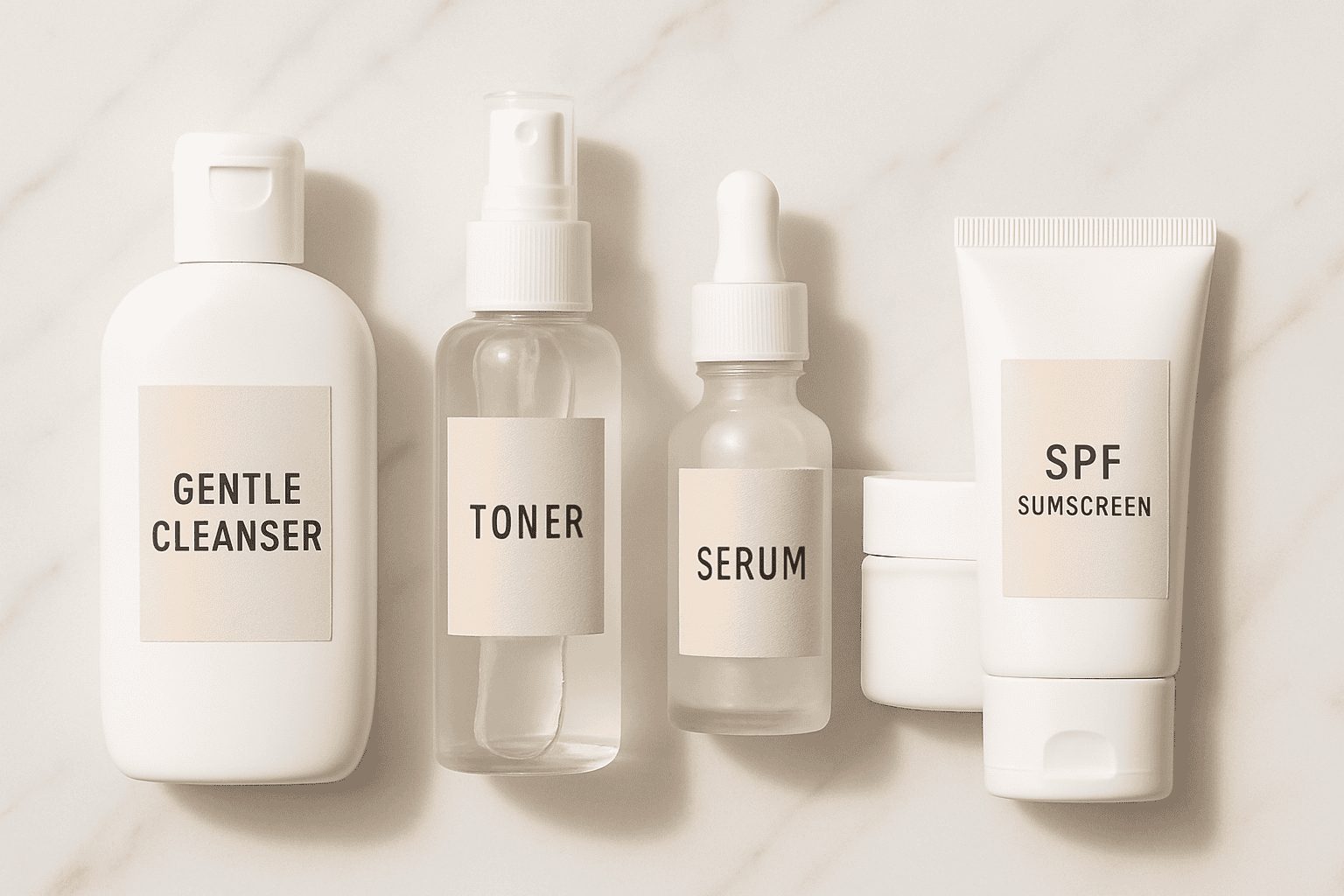
How to Build a Skincare Routine: AM/PM Guide
Quick Answer: A complete skincare routine has three non-negotiables: cleanser, moisturizer, and SPF in the AM. Add actives one at a time, wait 4-6 weeks before adding another, and always layer thin-to-thick. Even a 3-step routine done consistently beats a 12-step routine done inconsistently.
Building a skincare routine can feel overwhelming when faced with thousands of products and conflicting advice. The good news: an effective skincare routine doesn’t require 12 steps and a PhD in chemistry. This guide gives you a clear, actionable framework — based on how skin actually works — to build a routine that fits your skin type, concerns, and lifestyle.
Traditional ingredients are making a comeback in evidence-based routines. See how traditional ingredients like oud and rose water fit into modern formulation.
The Three-Layer Mental Model
Before selecting products, understand the basic architecture of a routine:
- Prepare: Clean the skin and, if needed, adjust its surface state (cleanse, tone)
- Treat: Apply actives that address specific concerns (serums, treatments)
- Protect and seal: Lock in moisture and, in the morning, protect from the sun (moisturizer, SPF)
Everything in skincare follows this pattern. The AM routine adds sun protection as its final step. The PM routine swaps that for recovery-focused products (barrier repair, retinoids).
The Cardinal Rule of Layering: Thin to Thick
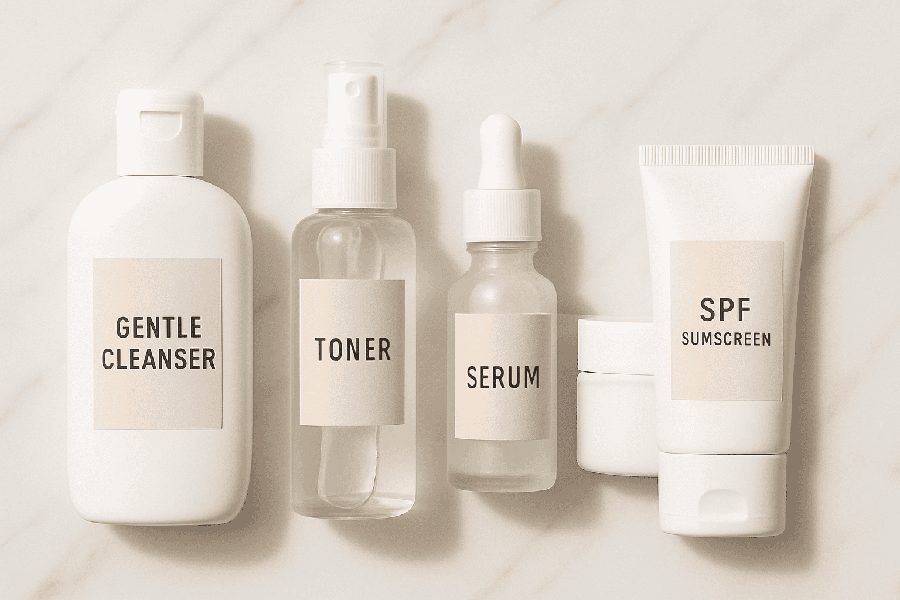
Apply products from thinnest to thickest consistency. The reason: thin, water-based products need direct skin contact to absorb. A thick cream applied before a serum creates a physical barrier that can prevent the serum from penetrating.
Order principle:
- Water-based serums (thinnest)
- Emulsions or gel-creams
- Moisturizers / creams
- Oils
- Sunscreen (AM only, always last)
The exception: acids (AHAs/BHAs) and retinoids are applied on nearly bare skin after cleansing for maximum absorption — most other products would buffer their action.
Understanding Your Skin Type
Routine design starts with honest skin type assessment. Common mistakes: conflating temporary conditions (dehydration feels like dry skin; stripped skin can look oily) with actual skin type.
Normal Skin
Balanced oil production, no significant sensitivities, small pores, occasional breakouts. The most versatile — can tolerate most formulations and actives. Focus on maintenance: vitamin C + SPF in the AM, retinol + moisturizer in the PM.
Dry Skin
Low sebum production, often feels tight or flaky, pores are typically small. Needs rich emollients and occlusives. Prioritize ceramides, hyaluronic acid, and shea butter-based formulas. Avoid drying ingredients (harsh sulfates, high alcohol-denat content, very low pH acids).
Oily Skin
Excess sebum, enlarged pores, prone to shine. Needs lightweight, non-comedogenic formulations. Doesn’t need to skip moisturizer — unhydrated oily skin produces more oil to compensate. Choose gel or fluid textures. Benefits greatly from niacinamide (sebum regulation) and BHAs.
Combination Skin
Oily T-zone (forehead, nose, chin), normal or dry cheeks. The most common skin type. May need different products for different areas, or well-formulated hybrid products that balance oil without drying.
Sensitive Skin
Easily irritated, prone to redness, stinging, or reactive responses. Needs gentle, fragrance-free formulations. Start any new routine minimal — build up products one at a time over weeks to identify triggers.
Acne-Prone
Can overlap with oily, combination, or even dry skin. Needs non-comedogenic products, regular exfoliation (BHA), and careful ingredient selection. Active acne may require prescription treatments alongside OTC routine.
The Minimalist Routine (3-4 Steps)
This is the right starting point for beginners, those with sensitive skin, and anyone with a simple, low-complexity lifestyle:
AM (3 steps)
- Gentle cleanser (or just water if skin is not very oily)
- Moisturizer
- Broad-spectrum SPF 30+
PM (3 steps)
- Gentle cleanser
- Moisturizer
- Optional: one targeted treatment (retinol, BHA, or niacinamide)
That’s it. This minimal approach, done consistently, produces better results than a complex routine done inconsistently or with incompatible products.
The Standard Routine (5-7 Steps)
Once you’ve established your skin’s baseline and tolerances, add targeted treatments:
AM Standard
- Gentle cleanser
- Vitamin C serum (antioxidant protection, brightening)
- Niacinamide serum or hydrating toner
- Moisturizer
- SPF 30–50
PM Standard
- Gentle cleanser (double cleanse if wearing SPF/makeup — first with micellar water or cleansing oil, then gentle cleanser)
- Exfoliant: AHA or BHA toner, 2–4 nights per week or retinol/retinoid nightly (don’t use both on the same night)
- Serum for specific concern (tranexamic acid for pigmentation, niacinamide for oiliness, hyaluronic acid for hydration)
- Moisturizer
The Full Routine (8–12 Steps)
For advanced users targeting multiple concerns simultaneously. Requires thorough understanding of ingredient interactions.
On days when you’re wearing long-wear or layered products, a single cleanser often leaves residue behind. Our guide to double cleansing for heavy makeup days when a single wash isn’t enough walks through the method step by step.
Choosing the right first cleanser depends on your skin type and makeup habits. For a side-by-side look at the two most popular options, see our comparison of how cleansing balms and micellar water compare as first-step cleansers.
AM Full
- Gentle cleanser
- Hydrating toner or essence (first essence if using K-beauty layering)
- Vitamin C serum
- Niacinamide serum
- Eye cream (if used)
- Moisturizer
- Facial oil (optional — only if your skin needs it)
- SPF (always last)
PM Full
- Oil/balm cleanser (first cleanse)
- Gentle water-based cleanser (second cleanse)
- Chemical exfoliant (3–4 nights/week)
- Treatment serum (tranexamic acid, peptides, brightening actives)
- Retinol or tretinoin (alternate nights with exfoliant)
- Eye cream
- Moisturizer
- Facial oil or occlusive spot treatment
Skin Type Specific Routine Suggestions
Dry Skin AM/PM
AM: Cream cleanser → HA serum → rich ceramide moisturizer → mineral SPF 30
PM: Gentle cream cleanser → lactic acid (2x/week) → retinol (3x/week) → thick ceramide cream → facial oil seal
Oily/Acne-Prone AM/PM
AM: Gel cleanser → niacinamide serum → lightweight SPF 50 (with mattifying finish)
PM: Gel cleanser → BHA salicylic acid toner (3x/week) → niacinamide serum → lightweight gel moisturizer → adapalene 0.1% (nightly)
Combination AM/PM
AM: Gentle foaming cleanser → vitamin C serum → lightweight fluid moisturizer → SPF
PM: Micellar + gentle cleanser → AHA toner on T-zone (3x/week) → retinol nightly → hydrating gel cream
Sensitive Skin AM/PM
AM: Gentle micellar rinse or cream cleanser → soothing toner (no alcohol) → simple moisturizer with niacinamide and ceramides → mineral SPF
PM: Cream cleanser → niacinamide serum → ceramide moisturizer (skip actives initially; introduce one at a time over months)
Ingredient Interactions: What to Know
Avoid combining on the same application:
- Retinol + AHA/BHA on the same night (irritation compounding)
- Vitamin C (low pH LAA) + Retinol on the same night (can neutralize each other)
- Benzoyl peroxide + retinol on same application (BP oxidizes retinol)
Excellent combinations:
- Niacinamide + anything (universal compatibilty)
- Hyaluronic acid + any serum (enhances hydration without interactions)
- Vitamin C (AM) + SPF (AM) — synergistic protection
- Retinol (PM) + niacinamide (PM) — niacinamide buffers retinol irritation
Patch Testing and Introduction Protocol
For sensitive skin or when introducing new actives:
- Apply a small amount to the inner arm for 24–48 hours
- If no reaction, apply a small amount behind the ear or jaw for 48 hours
- If clear, begin incorporating into your routine starting 2x/week
- Only introduce one new product every 2–4 weeks
This slow introduction makes it possible to identify which product causes a reaction if problems arise.
Frequently Asked Questions
Q: How long until I see results from a new routine?
A: Hydration improvements are visible within 1–2 weeks. Texture and tone improvements take 4–8 weeks. Anti-aging results (retinol, vitamin C) require 3–6 months of consistent use. Acne may improve within weeks or take 2–3 months depending on severity.
Q: Do I need an eye cream?
A: Dedicated eye creams are not strictly necessary — a good facial moisturizer applied gently to the eye area works. Eye creams are formulated to be safer for the thin eye skin and often contain specific actives (caffeine, peptides). If your regular moisturizer doesn’t sting around the eyes, you don’t need a separate product.
Q: How many products is too many?
A: There’s no universal limit, but more than 8–10 products creates a high risk of ingredient interactions, irritation from cumulative actives, and practical unsustainability. A well-curated 5–7 step routine outperforms a 15-step routine with redundant products.
Q: Should I use different products in summer vs winter?
A: Yes, seasonal adjustment is smart. Winter: heavier moisturizer, potentially reduce exfoliant frequency (dryness), add an occlusive. Summer: lighter moisturizer, ensure sufficient SPF, may increase exfoliant frequency if humidity helps with hydration.
Q: Can men use the same skincare as women?
A: Absolutely. Skin biology is largely the same across genders. Men’s skin tends to be slightly thicker and oilier (due to testosterone), but the same principles and ingredients apply. The “for men” skincare marketing distinction is primarily commercial, not scientific.
Q: What order do I apply toner and serum?
A: Toner first, then serum. Toners thin out and prepare skin for better serum absorption, and are typically more watery/thinner in consistency than serums.
Q: What should I do if my skin is irritated?
A: Simplify immediately. Go back to the minimalist routine — gentle cleanser, ceramide moisturizer, SPF. Pause all actives for 1–2 weeks. Once skin recovers, reintroduce one product at a time with 1–2 week intervals between additions.
Key Takeaways
- The universal layering rule: thinnest to thickest (water-based toners/serums first, then moisturizer, then SPF or facial oil).
- The three essentials are cleanser, moisturizer, and SPF in the morning – everything else is additive.
- Introduce one new active at a time, give it 6-8 weeks, then evaluate before adding another.
- Morning routine focus: antioxidants (vitamin C) plus SPF. Evening routine focus: retinol or AHA/BHA plus barrier repair.
- Patch test new products for 24-48 hours on the inner wrist or behind the ear before full-face application.
Conclusion
Building a skincare routine is an exercise in understanding your skin’s unique needs and applying a logical framework. Start minimal — cleanser, moisturizer, SPF — and add targeted actives one at a time as your baseline is established. Layer thin to thick. Never combine incompatible actives on the same application. Give each product time to work. The most sophisticated routine is not the most steps — it’s the one you’ll actually do every day, with products that are right for your skin. That consistency, over months and years, is where the real results come from.
Sources
- Efficacy Evaluation of a Topical Hyaluronic Acid Serum in Facial Photoaging. Dermatology and therapy. 2021. PMID: 34176098.
- Hyaluronic acid, a promising skin rejuvenating biomedicine: A review of recent updates and pre-clinical and clinical investigations on cosmetic and nutricosmetic effects. International journal of biological macromolecules. 2018. PMID: 30287361.
- Topical benzoyl peroxide for acne. The Cochrane database of systematic reviews. 2020. PMID: 32175593.
- Farage MA, et al. (2007). Changes in skin surface conditions. J Cosmet Dermatol, 6(2):77-82.
- Dias MC, Pinto DCGA, Silva AMS (2021). Plant Flavonoids: Chemical Characteristics and Biological Activity. Molecules (Basel, Switzerland). PMID: 34500810.