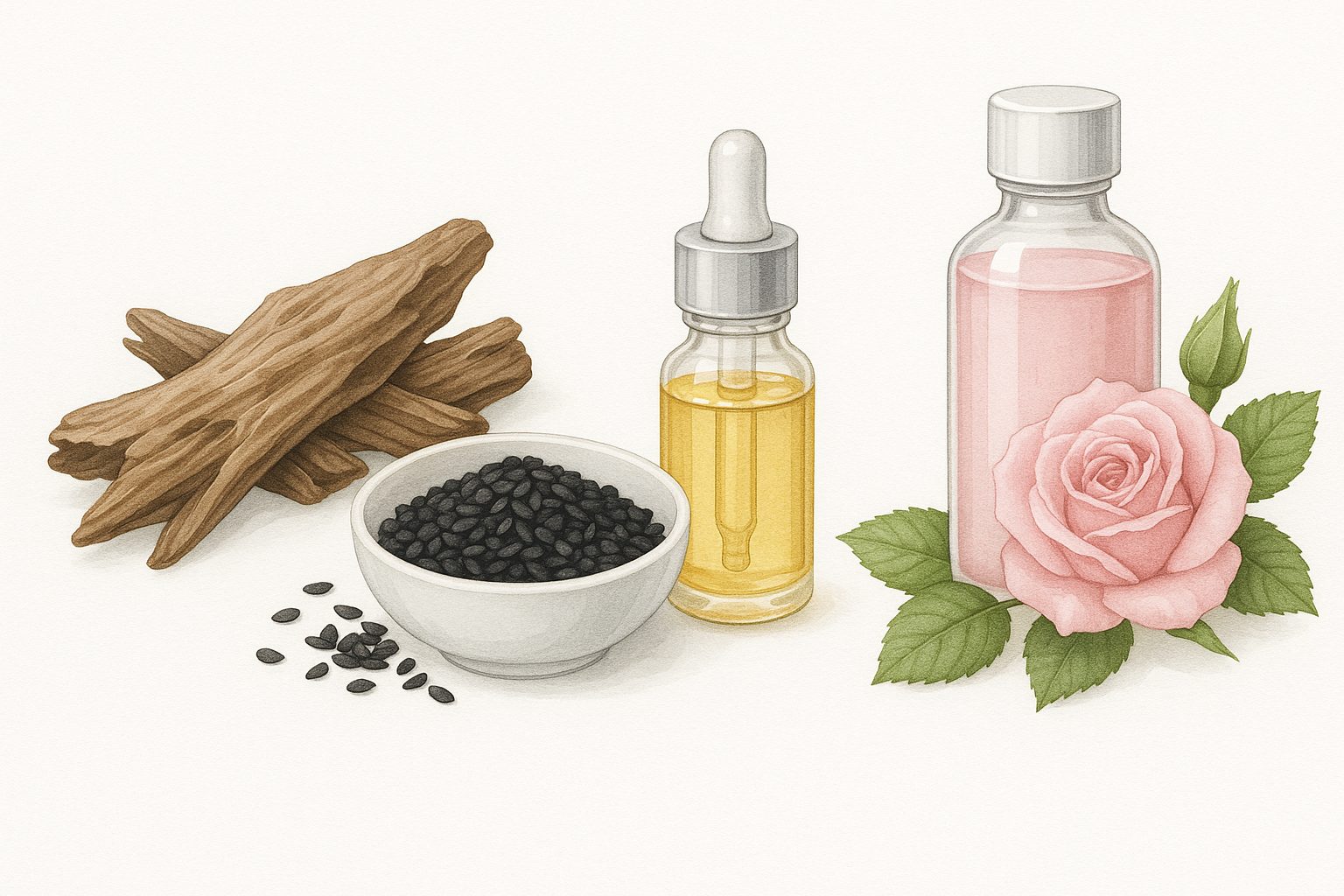
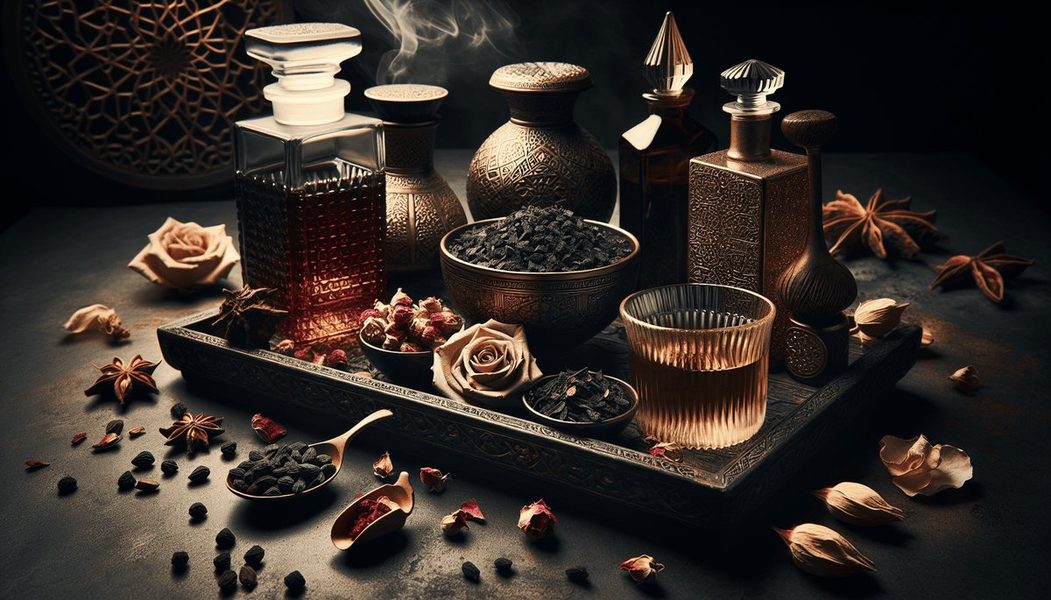
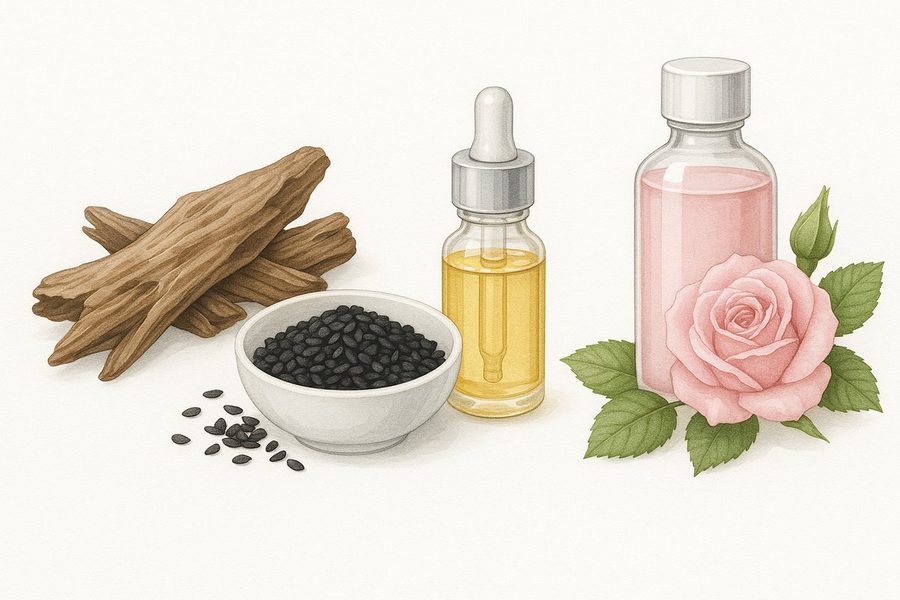
These three Middle Eastern ingredients are transitioning from traditional beauty use into modern formulated skincare with documented mechanisms: black seed oil (Nigella sativa) contains thymoquinone, a potent antioxidant and anti-inflammatory with documented clinical activity; rose water contains phenylethylamine, citronellol, and geraniol – mild astringent and antimicrobial compounds with soothing properties; oud oil has primarily fragrance value with some emerging research on antibacterial terpenes. In modern formulations, these ingredients are most effective when combined with established actives (niacinamide, vitamin C, retinol) rather than used as standalone treatments, where their clinical evidence base is limited.
- Thymoquinone in black seed oil has documented anti-inflammatory activity via inhibition of 5-LOX and COX-2 pathways, antioxidant activity via Nrf2/HO-1 pathway activation, and antimicrobial properties against multiple skin pathogens – Nigella sativa topical formulations have small clinical evidence in acne, eczema, and wound healing.
- Rose water’s efficacy for skin depends heavily on how it’s made: steam-distilled rose water (Rosa damascena) retains active volatile compounds (citronellol, geraniol) and has pH ~5.5 (mildly acidic, skin-compatible); ‘rose water’ products made from synthetic fragrance have none of the active chemistry.
- Frankincense (Boswellia serrata) extract, while not in this trio, is often formulated alongside them – boswellic acids have documented anti-inflammatory cytokine modulation (particularly IL-1? and TNF-?) with relevant skin soothing and anti-redness applications in clinical literature.
- Oud’s primary value in skincare is olfactory luxury and heritage positioning – its antimicrobial terpenes (guaiol, agarospirol) have preclinical evidence but no rigorous topical clinical trials; formulating oud at concentrations meaningful for clinical effect would likely make fragrance overpowering.
- Modern evidence-based formulation recommendation: use black seed oil as a meaningful active (2-5% in serum); rose water as a soothing toner base or mist; oud in fragrance-perfume layering; combine with proven actives (niacinamide for barrier + sebum control, vitamin C for antioxidant) for comprehensive targeted skincare.
These three ingredients define Middle Eastern beauty, but they’re showing up in Western skincare too. The question isn’t whether they “work” in general – it’s how they’re formulated, at what concentrations, and for which skin concerns.
Black Seed Oil (Nigella sativa) in Formulations
What the Active Does
Thymoquinone is the primary bioactive, typically comprising 30-48% of volatile oil content. It provides:
– Anti-inflammatory action (inhibits NF-?B and COX-2)
– Antimicrobial activity against P. acnes, S. aureus, and several fungal species
– Antioxidant protection (scavenges superoxide and hydroxyl radicals)
Concentration That Matters
– Cold-pressed oil: 1-5% in a facial oil blend is standard. Pure black seed oil is potent and can irritate sensitive skin
– Thymoquinone isolate: Rarely used in cosmetics; whole oil is preferred for the entourage of fatty acids (linoleic acid ~55-60%) that support barrier function
– In cleansers: Often present at sub-1% – mostly marketing at that level
– In serums/treatment oils: 2-5% is the sweet spot for therapeutic benefit without irritation
What to Look For
– Cold-pressed, unrefined oil (dark amber color, strong aroma) – refined versions lose thymoquinone
– Nigella sativa seed oil on the INCI list (not fragrance-derived extracts)
– Products marketed for acne-prone or eczema-prone skin – that’s where the evidence is strongest
What to Avoid
– Products listing “black seed extract” without specifying the oil – could be a token amount
– Combination with multiple strong actives (retinol + black seed oil + acids) – layering too many anti-inflammatories can confuse a skin routine
– Cheap products from unverified sources – black seed oil quality varies enormously
Rose Water (Rosa damascena) in Formulations
What It Does
Rose water is a hydrosol – the water left over from steam distillation of rose petals. It contains:
– Citronellol, geraniol, and nerol (fragrant terpene alcohols with mild antimicrobial properties)
– Phenylethyl alcohol (anti-inflammatory)
– pH typically 4.5-5.0 (matching skin’s acid mantle)
How It’s Best Used
- As a toner: Spritz after cleansing to restore pH and provide light hydration. This is its traditional use and it’s well-suited for it
- As a mist throughout the day: Refresh and lightly hydrate without disrupting makeup
- In formulations as a solvent base: Some serums and creams use rose water instead of plain water for the base – this is legitimate if using quality distillate
Quality Varies Enormously
The biggest issue with rose water in skincare is adulteration:
– Pure steam distillate (authentic) – costs $15-40+ for 100ml if sourced from Damask roses
– Synthetic rose water – rose fragrance oil added to water. No therapeutic benefit beyond scent
– How to tell: Real rose water has a subtle, slightly medicinal floral scent that fades quickly. Synthetic rose water smells more “perfumey” and the scent persists
Look for: “Rosa damascena flower water” or “Rosa damascena distillate” on INCI. Origin from Iran (Kashan), Turkey, or Bulgaria typically indicates quality sourcing.
Oud (Agarwood/Aquilaria) in Skincare
The Reality Check
Oud is the most honest inclusion to assess here because its skincare value is primarily sensory rather than therapeutic.
What oud provides:
– A distinctive, complex fragrance that is culturally significant in Gulf beauty
– Some sesquiterpenes with mild anti-inflammatory properties
– Extremely high perceived luxury value
What oud doesn’t provide (at cosmetic concentrations):
– Meaningful anti-acne or anti-aging activity
– Skin barrier support
– Sun protection
How It’s Used in Products
– Fragranced skincare: Body oils, rich creams, and serums where the scent is part of the luxury experience
– Concentration: Typically <0.1% - enough for scent, not enough for any therapeutic effect
- Synthetic vs. natural: Real oud oil costs $20,000-80,000 per kilogram. Most “oud” skincare uses synthetic recreations or low-concentration natural oud. This isn’t necessarily bad – the fragrance experience can be similar – but claims of “oud’s healing properties” at these concentrations are marketing
When Oud Makes Sense
If you enjoy the scent and it enhances your skincare ritual, oud-fragranced products are a legitimate personal preference. Just don’t choose them expecting clinical skin benefits.
Combining All Three
A thoughtful formulation combining these ingredients might look like:
– Rose water base (hydration, pH balance, mild anti-inflammatory)
– Black seed oil at 2-3% (active anti-inflammatory and antimicrobial)
– Oud fragrance at trace levels (sensory experience)
This gives you one functional ingredient (black seed), one supportive base (rose water), and one experiential element (oud). That’s a perfectly rational product – as long as pricing reflects the actual active ingredient cost, not just the “oud luxury” markup.
Shopping Guide
| Ingredient | What to Look For | Red Flags |
|---|---|---|
| Black seed oil | Cold-pressed, dark amber, INCI: Nigella sativa seed oil | “Black seed extract” without oil, very cheap pricing |
| Rose water | Steam distillate, INCI: Rosa damascena flower water, origin listed | Synthetic fragrance, “rose-scented water” |
| Oud | Enjoy for fragrance, don’t expect skin actives | “Oud-powered healing” claims, premium pricing based solely on oud inclusion |
—
Related reading:
– Traditional Arab Beauty Ingredients That Still Work
– Middle Eastern & GCC Beauty Market Overview
– Halal-Friendly Skincare Products
FAQ
Is black seed oil good for skin?
Black seed oil (Nigella sativa) has genuine clinical evidence for skin: thymoquinone’s anti-inflammatory and antioxidant properties are well-documented. Small clinical trials show improvement in acne, eczema symptoms, and wound healing with topical application. It’s best used as a 2-5% active in serums or as a pure cold-pressed oil for spot application; undiluted use can be irritating for sensitive skin. Look for cold-pressed, unrefined black seed oil for maximum active compound content.
What does rose water do for skin?
Authentic steam-distilled rose water (not synthetic fragrance water) acts as a mild astringent (tightens pores gently via tannins and phenolics), has anti-inflammatory and antioxidant properties (phenylethylamine, citronellol), and can soothe mild redness and irritation. Its pH (~5.5) is skin-compatible, making it a good toner base. It does not hydrate deeply, lighten skin, or treat acne significantly – most claims go beyond its evidence.
Is oud good for skin?
Oud oil has antimicrobial terpenes with preclinical evidence but limited clinical skincare trials. Its primary contribution to skincare products is luxury fragrance and heritage positioning rather than therapeutic efficacy. For meaningful skin benefits, black seed oil (from the same regional tradition) has considerably stronger evidence. Oud-based skincare products are worth purchasing for the experience, not for specific skin improvements.
Related Articles
- Traditional Arab Beauty Ingredients That Still Work
- Luxury GCC Skincare Trends in 2026
- Halal-Friendly Skincare: What It Actually Means
- Best Middle Eastern Skincare Brands in 2026
- Best Ceramide Creams for Barrier Repair
Sources
- Note: peer-reviewed support for this claim was not identified in available literature.
- Waste tires to fertilizer: Carbon black zinc fertilizer for maize in calcareous soils. Journal of environmental quality. 2026. PMID: 41840850.
- High sucrose consumption decouples intrinsic and synaptic excitability of AgRP neurons without altering body weight. International journal of obesity (2005). 2023. PMID: 36725979.
- Traditional Arab Beauty Ingredients That Still Work
- Halal-Friendly Skincare: What It Actually Means