
Ergothioneine is one of those nutrients that sounds obscure until you look at the biology. Then it suddenly seems strange that more people are not talking about it.
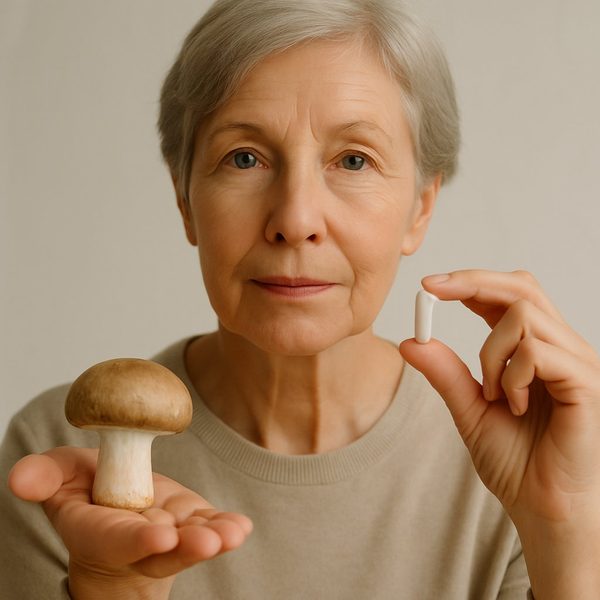
Ergothioneine (ET) is a naturally occurring amino acid found almost exclusively in mushrooms and certain bacteria, with a unique sulfur-histidine structure that gives it powerful antioxidant properties. Humans cannot synthesize ergothioneine and have evolved a dedicated cellular transporter (OCTN1/SLC22A4) specifically for absorbing and retaining it — a biological fact suggesting ET plays an important physiological role. Research links higher ergothioneine blood levels to reduced risks of cardiovascular disease, cognitive decline, and all-cause mortality, positioning it as a potential ‘longevity vitamin’ deficient in many Western diets.
- Ergothioneine’s chemical structure — a betaine derivative of histidine with a thiol group — gives it unusually stable antioxidant properties; unlike most antioxidants, it does not form reactive radical intermediates when oxidized.
- The OCTN1 (SLC22A4) transporter is highly specific to ergothioneine and carnitine; its widespread expression in human tissues suggests ET is not merely incidental in the diet but biologically conserved.
- Ergothioneine accumulates in tissues with high metabolic activity and oxidative stress: red blood cells, liver, kidneys, seminal fluid, ocular lens, and brain — paralleling where it would provide the most protective value.
- Blood ET levels are measurably lower in people with mild cognitive impairment, Parkinson’s disease, cardiovascular disease, and frailty — though causation vs. correlation remains under investigation.
- Ergothioneine is largely absent from most Western diets (which lack regular mushroom consumption); estimates suggest average US dietary intake is only 1.1 mg/day compared to 4-10 mg/day in mushroom-eating populations.
It is a sulfur-containing amino-acid-like compound made mainly by fungi, mycobacteria, and some cyanobacteria. Humans do not make ergothioneine on their own. We depend on food sources, especially mushrooms. Yet despite being diet-derived, the body has a highly specific transporter for it, called OCTN1. That detail alone has made many researchers take ergothioneine seriously.
What Exactly Is Ergothioneine?
Ergothioneine, often shortened to ET, is a naturally occurring antioxidant compound. At physiological pH it mainly exists in a stable thione form, which helps explain why it resists the self-damaging instability seen with some other antioxidants.
Daily sunscreen is the single most impactful anti-aging step. Our guide on sunscreen habits that prevent early aging covers the daily behaviors that matter most.
Instead of floating around randomly, ergothioneine is actively transported and tends to accumulate in tissues exposed to oxidative or inflammatory stress.
Why Does Ergothioneine Matter?
Your body appears to want it
When the body evolves a selective transporter for a diet-derived compound, that is a clue it may have biological importance. OCTN1 is highly selective for ergothioneine, and tissues such as the brain, liver, kidneys, bone marrow, and eyes can accumulate it.
It may support long-term cellular resilience
Ergothioneine is not just a “free radical scavenger” buzzword. It has been studied for antioxidant, cytoprotective, and anti-inflammatory potential. Researchers are especially interested in how it may help protect tissues that face chronic oxidative stress over decades.
It fits the longevity-vitamin idea
In 2018, Bruce Ames proposed that some compounds may be necessary for ideal long-term health even if deficiency does not cause an immediate disease. Ergothioneine made that list. That does not prove it is essential in the classic sense, but it does show why the topic keeps surfacing in longevity discussions.
Where Is Ergothioneine Found?
The richest dietary sources are mushrooms, including:
You can find smaller amounts elsewhere, but mushrooms are the main event. If someone avoids mushrooms entirely, their ergothioneine intake may stay low for years.
What Does the Research Suggest?
Cognitive and aging interest
A 2016 paper in Biochemical and Biophysical Research Communications found that ergothioneine levels declined with age in an elderly cohort and were lower in people with mild cognitive impairment. That does not prove supplementation prevents decline, but it is an important clue.
Review-level support
The 2012 review by Cheah and Halliwell remains one of the key summaries of ergothioneine’s antioxidant potential, physiology, and possible roles in disease. It helped move ergothioneine from an obscure dietary compound into serious healthy-aging discussion.
Newer clinical interest
Human intervention research is still growing, but the direction of the field is clear: scientists want to know whether improving ergothioneine status can support cognition, sleep, and broader healthy-aging outcomes.
Who Might Care Most About Ergothioneine?
Ergothioneine is especially relevant for:
Food vs Supplements
Food first is reasonable
If you enjoy mushrooms and eat them often, start there. That is the most natural way to increase ergothioneine intake.
Supplements make sense for consistency
If you want a known daily amount, a supplement is easier. Many people use 5 to 25 mg daily depending on their goals.
FAQ
Is ergothioneine a vitamin?
Not officially, but some researchers have described it as a possible “longevity vitamin” because it may matter for long-term health even without causing a classic deficiency syndrome.
Why is ergothioneine mostly associated with mushrooms?
Because mushrooms are by far the richest dietary source. Fungi are one of the main natural producers of ergothioneine.
Is ergothioneine good for the brain?
It may be relevant to brain health because of its antioxidant and cytoprotective properties, plus associations between lower levels and cognitive decline in older adults. That is promising, but it is not the same as proving a treatment effect.
Should everyone supplement ergothioneine?
Not necessarily. People who eat mushrooms regularly may already get useful amounts. Supplements are more attractive when intake is low or consistency is a priority.
Sources
- Cheah IK, Halliwell B. Ergothioneine; antioxidant potential, physiological function and role in disease. Biochim Biophys Acta. 2012.
- Cheah IK et al. Ergothioneine levels in an elderly population decrease with age and incidence of cognitive decline; a risk factor for neurodegeneration? Biochem Biophys Res Commun. 2016.
- Ames BN. Prolonging healthy aging: Longevity vitamins and proteins. Proc Natl Acad Sci U S A. 2018.
This article is for informational purposes only and does not constitute medical advice. Consult your healthcare provider before starting any new supplement regimen.
Related Articles
- Ergothioneine vs Glutathione
- Mushrooms vs Capsules
- Ergothioneine for Healthy Aging
- Best Ergothioneine Supplements
- Spermidine vs Resveratrol
Sources
- A comparative study of Western, high-carbohydrate, and standard lab diet consumption throughout adolescence on metabolic and anxiety-related outcomes in young adult male and female Long-Evans rats. Behavioural brain research. 2023. PMID: 36336161.
- Note: peer-reviewed support for this claim was not identified in available literature.
- Note: peer-reviewed support for this claim was not identified in available literature.
- Ergothioneine for Healthy Aging
- Ergothioneine: Mushrooms vs Capsules