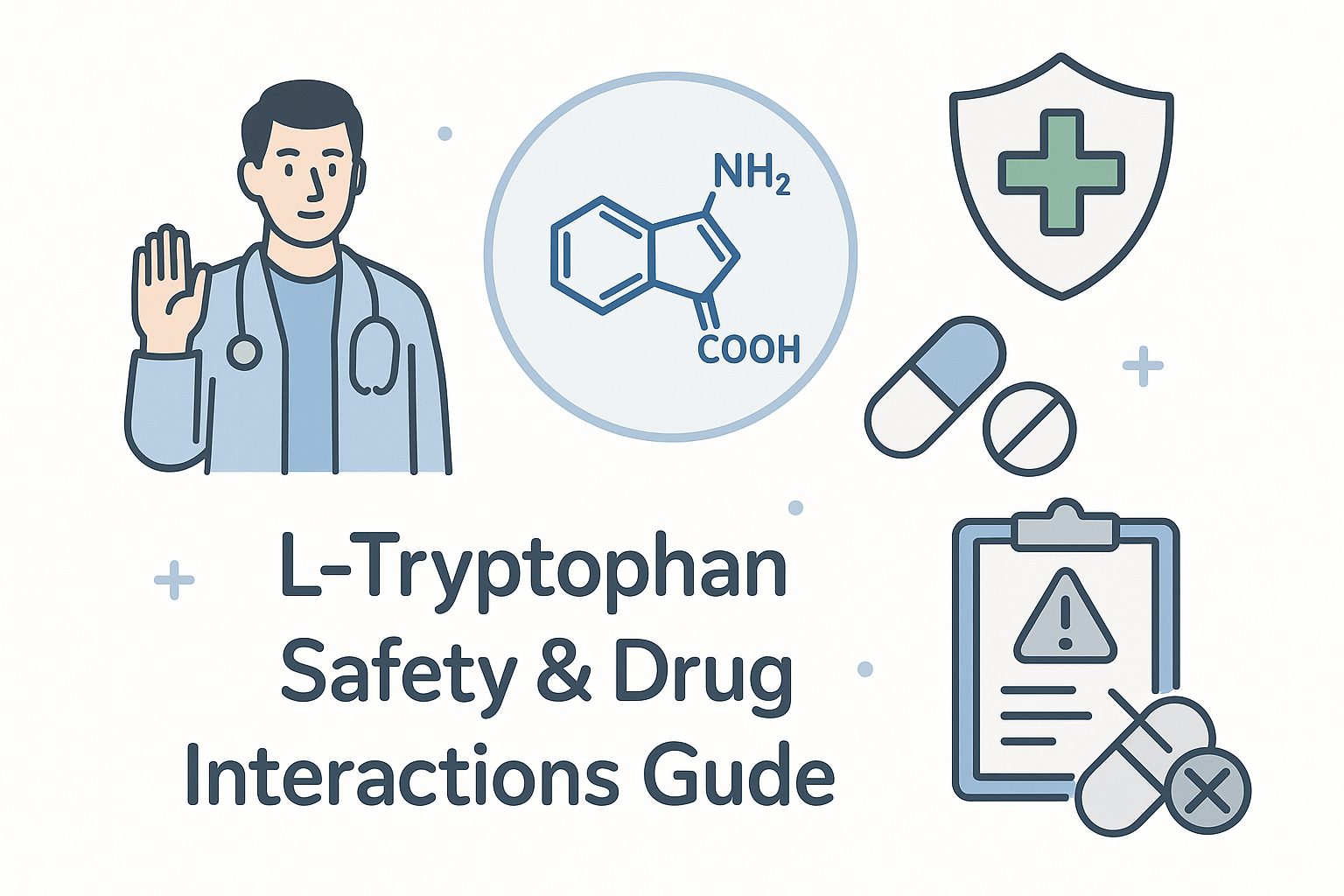
L-Tryptophan Safety & Drug Interactions Guide

Quick Answer: L-tryptophan is generally safe at normal doses (0.5-1.5 g/day) for healthy adults not taking serotonergic medications. The most serious risk is serotonin syndrome when combined with SSRIs, SNRIs, MAOIs, or other serotonin-boosting drugs. Do not skip this article if you take any psychiatric medication.
Key Takeaways
- L-tryptophan is generally safe at 500-3000 mg/day in healthy adults without serotonergic medications; eosinophilia-myalgia syndrome (EMS) cases in 1989 were traced to a contaminated batch from a single manufacturer, not tryptophan itself.
- The most serious drug interaction is with MAOIs (irreversible or reversible): combining tryptophan with MAOIs can cause life-threatening serotonin syndrome and is contraindicated.
- Combining tryptophan or 5-HTP with SSRIs or SNRIs significantly increases serotonin levels beyond what either drug alone produces; this combination requires medical supervision.
- Tryptophan may enhance the sedative effects of sleep medications and CNS depressants; caution is warranted with benzodiazepines, Z-drugs (zolpidem), and alcohol.
- Tryptophan is metabolized partly via the kynurenine pathway; chronic inflammation diverts more tryptophan to kynurenine (and potentially neurotoxic quinolinic acid) rather than serotonin – supplementation under high inflammation may be less effective for mood purposes.
L-tryptophan is a naturally occurring amino acid, and at reasonable doses, most healthy people tolerate it without issues. But “natural” and “safe in all circumstances” are not the same thing. This supplement has a real interaction profile and a historical safety incident worth understanding.
The serotonin pathway doesn’t end with tryptophan. Its downstream metabolite 5-HTP carries its own long-term risks. Our guide on 5-HTP long-term safety and catecholamine depletion covers what to watch for.
The Big Risk: Serotonin Syndrome
What It Is
Serotonin syndrome is a potentially life-threatening drug reaction caused by excessive serotonergic activity in the nervous system. It is not common, but it is serious.
Symptoms (Mild to Severe)
- Mild: agitation, restlessness, diarrhea, dilated pupils, rapid heartbeat
- Moderate: muscle twitching (myoclonus), hyperreflexia, sweating, shivering
- Severe: high fever (hyperthermia), seizures, irregular heartbeat, loss of consciousness
Severe cases require emergency medical treatment.
When It Happens With Tryptophan
Serotonin syndrome risk increases when L-tryptophan is combined with other substances that increase serotonin levels. Because tryptophan is a serotonin precursor, adding it on top of drugs that already boost serotonin can push the system past safe limits.
Drug Interactions: What Not to Combine
This is the most important section. If you take any of the following, do not add L-tryptophan without talking to your doctor:
SSRIs (Selective Serotonin Reuptake Inhibitors)
- Fluoxetine (Prozac)
- Sertraline (Zoloft)
- Citalopram (Celexa)
- Escitalopram (Lexapro)
- Paroxetine (Paxil)
SSRIs increase serotonin availability by blocking reuptake. Adding a serotonin precursor on top of this raises the risk of excessive serotonin activity.
SNRIs (Serotonin-Norepinephrine Reuptake Inhibitors)
- Venlafaxine (Effexor)
- Duloxetine (Cymbalta)
- Desvenlafaxine (Pristiq)
Same mechanism of concern as SSRIs – these drugs increase serotonin levels.
MAOIs (Monoamine Oxidase Inhibitors)
- Phenelzine (Nardil)
- Tranylcypromine (Parnate)
- Selegiline (Emsam)
MAOIs prevent the breakdown of serotonin. Combining with a serotonin precursor is one of the highest-risk combinations for serotonin syndrome.
Tricyclic Antidepressants
- Amitriptyline, clomipramine, imipramine, etc.
Many tricyclics have serotonergic activity and should not be combined with tryptophan without medical supervision.
Other Serotonergic Substances
- 5-HTP – do not stack with L-tryptophan; both feed the same pathway
- Tramadol – has serotonergic properties
- Triptans (migraine medications like sumatriptan) – serotonin agonists
- St. John’s Wort – has SSRI-like activity
- Dextromethorphan (DXM) – found in cough medicines, has serotonergic effects
- Lithium – can increase serotonin sensitivity
A Note on “Natural” Combinations
Some people assume that because tryptophan and 5-HTP are both “natural,” stacking them is safe. It is not. They both feed serotonin synthesis, and combining them increases the same risk as combining tryptophan with an SSRI. Pick one or the other.
Common Side Effects at Normal Doses
At doses of 0.5-1.5 g/day, side effects are generally mild and uncommon:
- Drowsiness – expected, especially when taken before bed
- Mild nausea – more common on an empty stomach at higher doses
- Headache – occasional
- Dry mouth – infrequent
At higher doses (above 3 g/day or above 70 mg/kg body weight), more noticeable effects have been reported, including tremor, dizziness, and nausea (Fernstrom, 2012).
The 1989 EMS Incident
What Happened
In 1989, a serious outbreak of eosinophilia-myalgia syndrome (EMS) was linked to L-tryptophan supplements. EMS symptoms included severe muscle pain, skin changes, nerve damage, and in some cases, death. Over 1,500 cases and 37 deaths were reported.
What Caused It
Investigations traced the outbreak to contaminated tryptophan produced by a single Japanese manufacturer (Showa Denko) that had recently changed its production process. The contaminant was identified as a trace impurity, not tryptophan itself.
What It Means Today
The FDA temporarily banned L-tryptophan supplements in 1990. The ban was lifted in 2001. Modern manufacturing processes and quality controls at reputable supplement companies have not produced similar issues.
However: This incident is why choosing third-party tested tryptophan from established manufacturers matters. Production quality is not guaranteed across all supplement brands.
Who Should Avoid L-Tryptophan?
- Anyone taking serotonergic medications (see list above) without doctor approval
- Pregnant or breastfeeding women – insufficient safety data
- People with liver disease – tryptophan is metabolized by the liver; cirrhosis can alter its processing
- People with carcinoid syndrome – this condition involves excess serotonin production
- People with eosinophilia or autoimmune conditions – out of an abundance of caution given the EMS history
Dosing Safety Guidelines
- Start at 500 mg/day and assess tolerance
- Do not exceed 3 g/day without medical supervision
- Take on an empty stomach for better absorption and to reduce competition at the blood-brain barrier
- Do not combine with 5-HTP or serotonergic drugs
- Tell your doctor if you are taking L-tryptophan – especially before any new medication is prescribed
When to Seek Medical Attention
If you experience any of the following while taking L-tryptophan (especially in combination with other substances):
- Rapid heartbeat or blood pressure changes
- Muscle twitching, rigidity, or tremor
- Agitation, confusion, or restlessness
- High fever or excessive sweating
- Diarrhea combined with any of the above
Seek emergency care immediately. These could be signs of serotonin syndrome.
The Bottom Line
L-tryptophan is safe for most healthy adults at normal supplement doses. The primary concern is drug interactions – specifically with anything that raises serotonin. If you are on psychiatric medication, this is a supplement that absolutely requires a conversation with your prescriber before starting.
For everyone else: buy from reputable manufacturers, start low, and pay attention to how you feel.
Related Reading:
- Best L-Tryptophan Supplements for Mood Support in 2026
- L-Tryptophan for Sleep: Does It Actually Help?
- How Tryptophan Becomes Serotonin: The Pathway Explained
FAQ
Is tryptophan safe to take every day?
Yes, for most healthy adults without serotonergic medications, 500-2000 mg daily appears safe long-term. The 1989 EMS outbreak was linked to a contaminated Japanese manufacturing batch; subsequent FDA oversight requires tryptophan manufacturers to certify purity. Choose reputable brands with third-party testing.
What medications interact with tryptophan?
Major interactions: MAOIs (contraindicated – serotonin syndrome risk), SSRIs and SNRIs (increased serotonin syndrome risk – requires medical supervision), tramadol, linezolid, and other serotonergic agents. Minor interactions: sleep medications and alcohol (additive sedation). Always check with a pharmacist or physician before combining.
Did tryptophan cause EMS?
The 1989 EMS (eosinophilia-myalgia syndrome) outbreak was traced to a contaminated batch of L-tryptophan from a single Japanese manufacturer (Showa Denko) that used a modified fermentation process producing a toxic contaminant. Properly manufactured L-tryptophan from certified sources has not been associated with EMS in subsequent decades.
Can I take tryptophan with melatonin?
Yes – tryptophan and melatonin are on the same biosynthetic pathway (tryptophan ? 5-HTP ? serotonin ? melatonin). Taking both is generally safe and may provide complementary sleep support, but the combination isn’t necessarily more effective than adequate tryptophan dosing alone.
Related Articles
- Omega-3 Dosing, Safety, and Drug Interactions: What You Need to Know
- Berberine Safety, Side Effects, Drug Interactions, and Dosage Guide
- Ashwagandha Side Effects and Safety: What You Should Know
- Castor Oil Safety and Side Effects: What You Need to Know
- L-Tryptophan for Sleep in 2026: Does It Actually Help You Fall Asleep Faster?
Sources
- Effects of Tryptophan Supplementation and Exercise on the Fate of Kynurenine Metabolites in Mice and Humans. Metabolites. 2021. PMID: 34436450.
- Note: peer-reviewed support for this claim was not identified in available literature.
- Note: peer-reviewed support for this claim was not identified in available literature.
- Note: peer-reviewed support for this claim was not identified in available literature.
- Adaptogens in Fatigue: Review (2009)