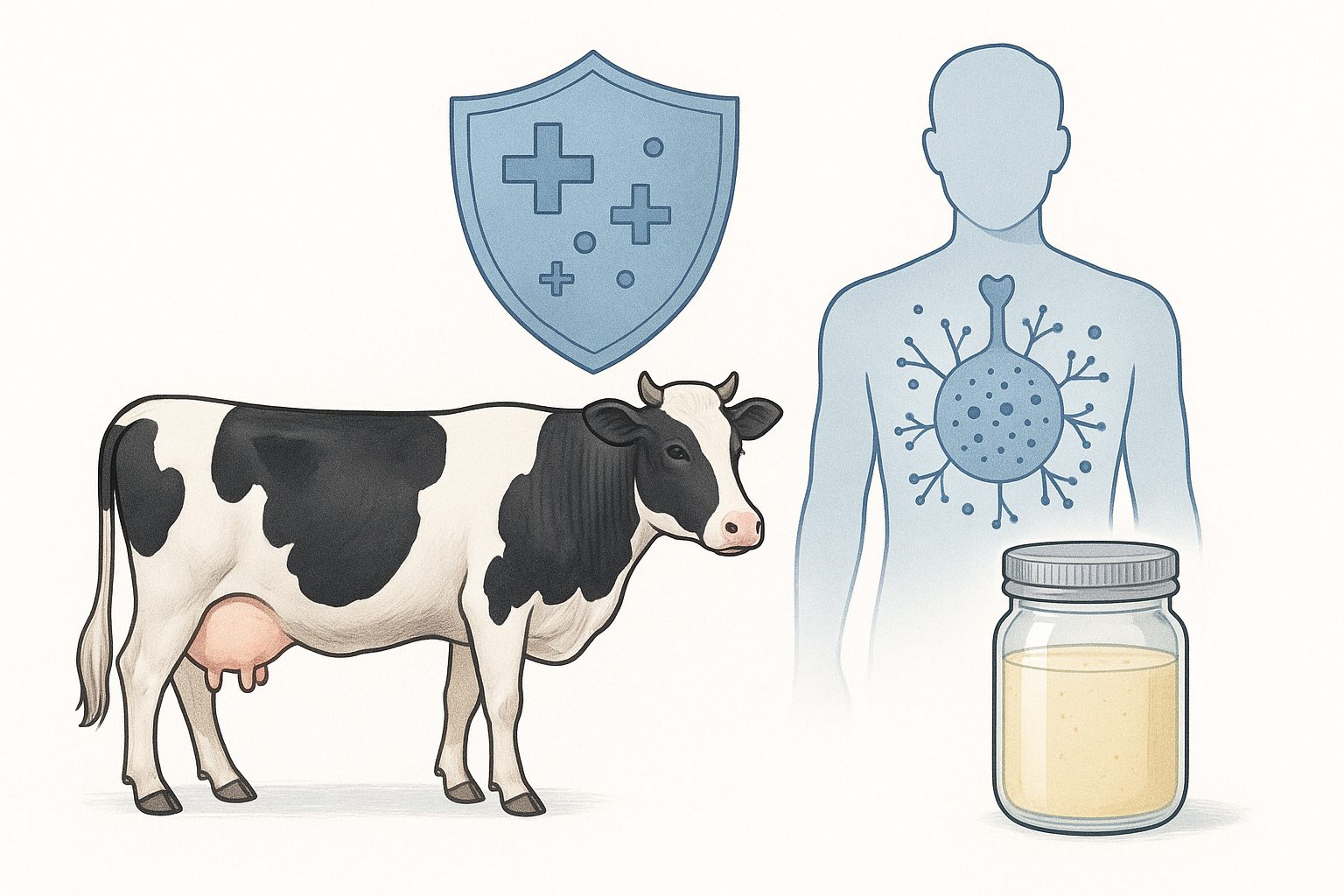
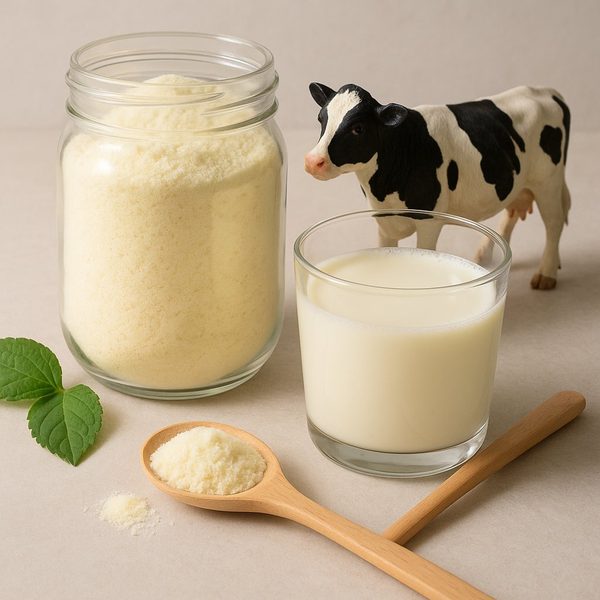
“Nature’s first immune supplement” is how colostrum gets marketed. And unlike most supplement marketing, there’s actually a reasonable biological basis for the claim. Colostrum exists specifically to transfer passive immunity from mother to newborn. The question is whether bovine colostrum taken orally by human adults provides meaningful immune benefits.
Bovine colostrum contains a range of bioactive compounds including immunoglobulins (IgA, IgG, IgM), lactoferrin, growth factors, and cytokines. Clinical evidence suggests it may modestly reduce the incidence and duration of upper respiratory infections, particularly in athletes during intense training periods. Benefits outside athletic or immune-stressed populations are less well-demonstrated, and quality varies considerably across products.
- Colostrum immunoglobulins survive partial GI digestion and may provide local gut-mucosal immune support; systemic absorption of intact immunoglobulins is more limited.
- Most clinical evidence for immune benefit involves athletes or people under high physical stress, where upper respiratory infection rates are reduced.
- Key active compounds include IgG antibodies, lactoferrin (antimicrobial), proline-rich polypeptides (PRPs), and IGF-1 and TGF-beta (growth factors).
- Colostrum is generally well-tolerated; people with dairy allergies should use caution as cross-reactivity is possible.
- Product quality is critical: pasteurization method, IgG content percentage, and sourcing from first-milking colostrum matter for potency.
The Biological Logic
Bovine colostrum contains immune-active compounds at concentrations far above regular milk:

- IgG antibodies (the dominant immunoglobulin in bovine colostrum) – 20-30% of protein content. These bind pathogens and toxins in the gut
- IgA antibodies – protect mucosal surfaces (respiratory tract, GI tract)
- Lactoferrin – antimicrobial, anti-inflammatory, iron-binding protein
- Proline-rich polypeptides (PRPs/colostrinin) – immunomodulatory peptides that can upregulate or downregulate immune responses depending on context
- Lysozyme – antimicrobial enzyme
- Cytokines – immune signaling molecules
Important distinction: Cows and humans face different pathogens. Bovine IgG won’t contain antibodies to every human pathogen. However, bovine colostrum does contain antibodies to many human-relevant pathogens including E. coli, Salmonella, Rotavirus, C. difficile, and influenza strains.
Clinical Evidence: Upper Respiratory Infections
This is colostrum’s strongest immune evidence category.
The Key Studies
Brinkworth & Buckley (2003):
- RCT: 174 adults, 60g/day colostrum or whey for 8 weeks during winter
- Colostrum group had significantly fewer days with URTI symptoms
- No difference in symptom severity – just fewer sick days
Crooks et al. (2006) – Meta-analysis:
- Combined data from colostrum URTI studies
- Found consistent (though modest) reduction in URTI incidence with colostrum supplementation
- Effect was more pronounced in physically active individuals
Shing et al. (2007):
- 29 competitive cyclists, 10g/day colostrum or whey for 5 weeks during heavy training
- Salivary IgA (a key mucosal immune marker) was maintained in the colostrum group but declined in the whey group
- URTI incidence was lower in the colostrum group
What the Evidence Adds Up To
Colostrum consistently reduces URTI frequency in studies, particularly in athletes during heavy training. The effect size is moderate – you’re not becoming immune to colds, but you may get sick less often. The mechanism (maintaining mucosal IgA levels) is plausible and measurable.
Evidence for Gut Immunity
The gut contains ~70% of the body’s immune tissue. Colostrum’s immunoglobulins work locally in the gut:
- IgG survives gastric digestion to some degree – studies show detectable IgG activity in stool after oral supplementation
- Bovine colostrum IgG has been shown to neutralize C. difficile toxins in vitro and in a small clinical trial
- Lactoferrin from colostrum modulates gut immune responses and has been studied for prevention of necrotizing enterocolitis in preterm infants (where evidence is promising)
- Travelers’ diarrhea: a hyperimmune colostrum product (immunized against E. coli) showed protective effects in a landmark 1999 study
Evidence for General Immune Function
Beyond URTIs:
- Influenza: A 2007 Italian study found colostrum was more effective than influenza vaccination alone in preventing flu episodes (colostrum + vaccine > vaccine alone > colostrum alone > placebo). This study is frequently cited but has design limitations (not double-blinded)
- HIV-associated diarrhea: Bovine colostrum (specifically hyperimmune colostrum) has shown benefits for cryptosporidium-associated diarrhea in HIV patients in several studies
- Immunomodulation, not just stimulation: PRPs from colostrum appear to balance immune responses rather than simply “boosting” them – potentially relevant for autoimmune tendencies, though human evidence is minimal
What the Evidence Does NOT Support
- “Colostrum replaces vaccines” – no. The flu study showed additive benefits, not replacement
- “Colostrum cures autoimmune disease” – the immunomodulatory potential is theoretical; no clinical trials for autoimmune conditions
- “Colostrum prevents cancer” – lactoferrin has anti-cancer properties in cell culture. This is nowhere near clinical relevance
- “Colostrum builds a stronger immune system in healthy people” – most evidence is in stressed populations (athletes, elderly, immunocompromised). Healthy people with normal immune function may see minimal benefit
Dosing and Practical Use
For immune support:
- 10-20g/day of colostrum powder (based on URTI study doses)
- Take on an empty stomach (reduces gastric acid exposure to IgG)
- Duration: at least 4-8 weeks (study durations)
When it makes most sense:
- During winter cold/flu season
- During heavy training blocks (athletes)
- Before and during travel (immune stress)
- During periods of sleep deprivation or high stress (known immunosuppressive states)
Product quality markers:
- IgG content listed (minimum 20% by weight, ideally 25-30%)
- Low-temperature processed (preserves immunoglobulin activity)
- Third-party tested for contaminants
Colostrum vs. Other Immune Supplements
| Supplement | Evidence Level | Mechanism | Best For |
|—|—|—|—|
| Bovine colostrum | Moderate | Passive immunity, mucosal IgA | Athletes, URTI prevention |
| Vitamin C | Moderate | Immune cell function | General (modest effect, ~8% duration reduction) |
| Vitamin D | Moderate-Strong | Immune regulation | Deficient populations (most adults) |
| Zinc | Moderate | Immune cell signaling | Zinc-deficient, cold duration reduction |
| Elderberry | Weak-Moderate | Antiviral in vitro | URTI symptom duration |
| Echinacea | Mixed | Immunostimulation | Inconsistent evidence |
Colostrum has a unique mechanism (passive antibody transfer) that other supplements don’t share. But vitamin D correction (for the ~40% of adults who are insufficient) likely has a larger overall impact on immune function.
Related reading:
- Best Colostrum Supplements
- Colostrum for Gut Health
- Adaptogens for Sleep and Stress
FAQ
Does bovine colostrum actually boost immunity?
The evidence is most convincing for reducing upper respiratory infection frequency in athletes and people under physical stress. Broader immune-boosting claims for healthy sedentary adults have less clinical support. The mechanism is likely related to gut mucosal immune support from immunoglobulins rather than systemic immune stimulation.
How much bovine colostrum should I take for immune support?
Most clinical trials used 10-60 grams per day. Concentrated IgG-standardized products may work at lower doses (1-3 g/day if highly concentrated). There is no well-established optimal dose for general immune support in healthy adults; follow product specifications that align with IgG content used in research.
Is bovine colostrum safe for people with milk allergies?
People with IgE-mediated cow’s milk allergy should consult a physician before using bovine colostrum. The immunoglobulins and proteins in colostrum share antigenic properties with cow’s milk proteins and could trigger reactions in sensitive individuals. Lactose intolerance alone is less of a concern.
What should I look for when buying bovine colostrum?
Look for first-milking colostrum standardized to IgG content (typically 25-40% IgG by weight), low-temperature pasteurization to preserve bioactives, third-party testing for contaminants, and transparent sourcing. Hyperimmune colostrum (from cows vaccinated against specific pathogens) is a different and more specialized category.
Related Articles
- Berberine and Blood Sugar: What the Clinical Evidence Actually Shows
- Best Mullein Leaf and NAC Supplements for Lung Support in 2026: What the Evidence Actually Shows
- Best L-Tryptophan Supplements for Mood Support in 2026: What the Evidence Actually Shows
- Berberine vs Metformin: What the Evidence Actually Shows for Blood Sugar Support
- Berberine vs Metformin: What the Evidence Actually Shows for Blood Sugar Support
Sources
- Development of Biocompatible Ciprofloxacin-Loaded Zinc-Bovine Serum Albumin Nanoflowers as Nontoxic Platform for Local Drug Delivery. Nanotechnology, science and applications. 2026. PMID: 41889447.
- Bovine colostrum: an emerging nutraceutical. Journal of complementary & integrative medicine. 2015. PMID: 25781716.
- Assessment of adipogenic, antioxidant, and anti-inflammatory properties of whole and whey bovine colostrum. Journal of dairy science. 2019. PMID: 31351710.
- Bovine colostrum and its potential contributions for treatment and prevention of COVID-19. Frontiers in immunology. 2023. PMID: 37908368.
- Pilot study of probiotic/colostrum supplementation on gut function in children with autism and gastrointestinal symptoms. PloS one. 2019. PMID: 30625189.