
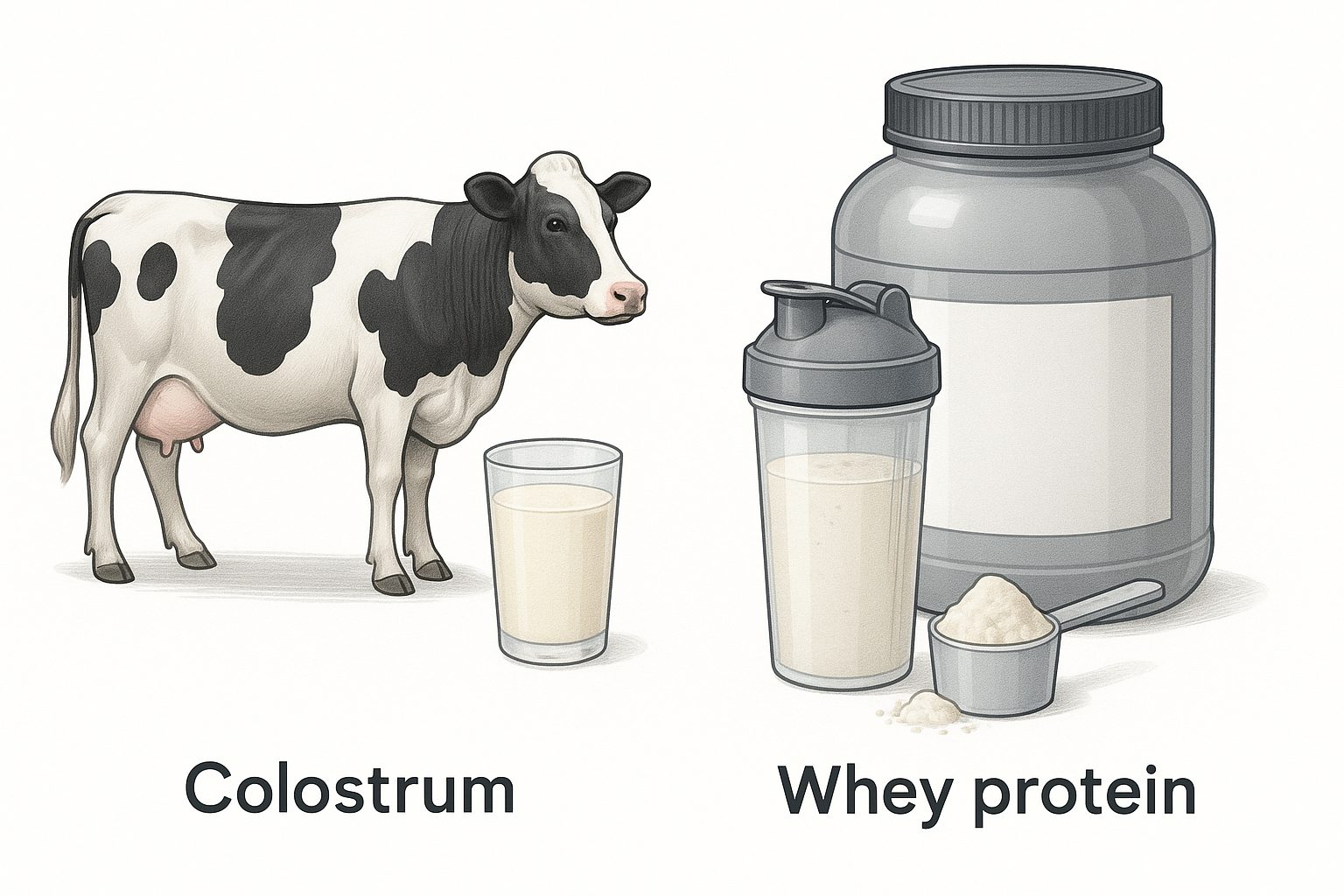
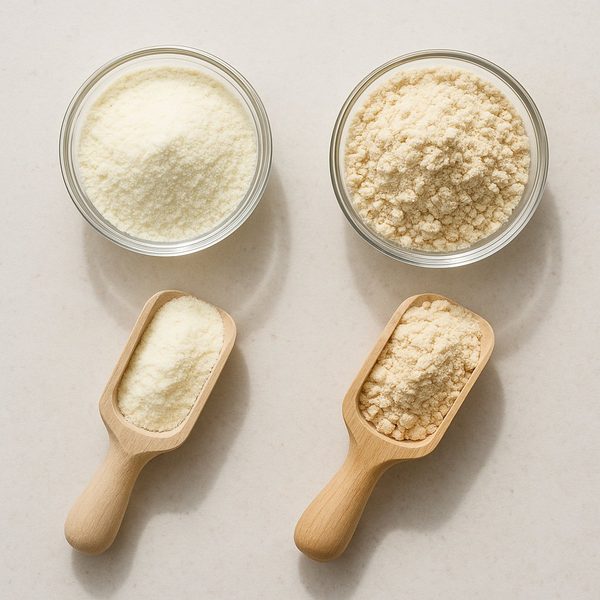
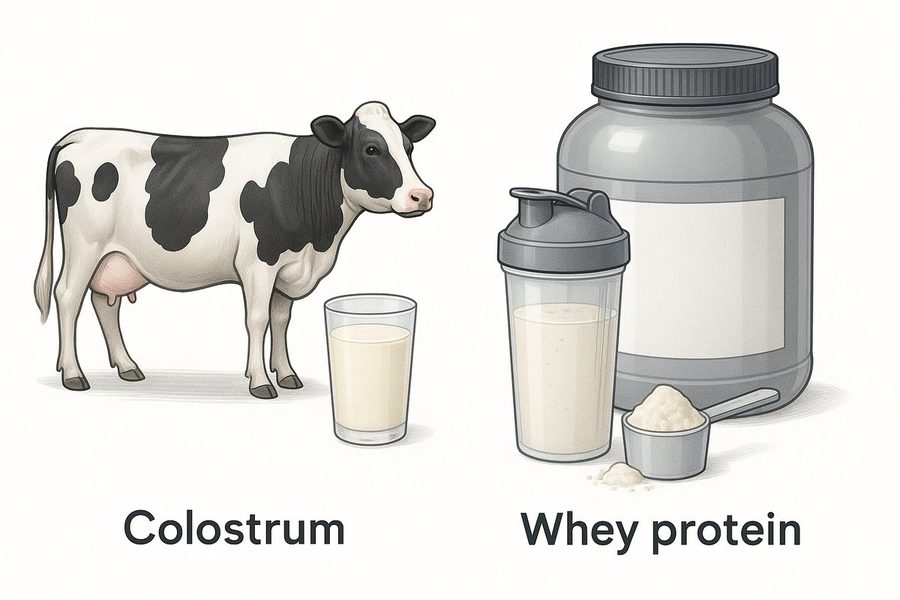
Colostrum has become the trendy sports supplement, positioned as the “upgrade” from whey protein. But at $60-100+ per month vs. $15-30 for whey, the question isn’t whether colostrum has benefits – it’s whether those benefits justify a 3-5x price premium.
Whey protein has stronger and more consistent evidence for muscle protein synthesis, recovery, and strength gains compared to bovine colostrum. Colostrum offers a different profile of benefits focused on immune support and gut integrity, which may be relevant during periods of high training volume. The two are not directly competing for the same mechanism: whey is primarily a protein source; colostrum is primarily a bioactive compound source. For most athletes, whey protein provides better value for muscle and recovery goals.
- Whey protein excels at stimulating muscle protein synthesis due to its leucine content and rapid digestion; colostrum is comparatively lower in leucine per gram.
- Some trials suggest colostrum combined with resistance training produces similar or slightly better lean mass gains vs. whey, but effect sizes are small and inconsistency exists.
- Colostrum’s main athletic advantage is immune support-reducing upper respiratory illness during heavy training blocks-not its protein yield.
- Cost per gram of protein is significantly higher for colostrum than whey; the cost premium is justified only for its bioactive properties, not protein content.
- Athletes susceptible to training-associated illness or gut issues during peak training may benefit from adding small doses of colostrum rather than replacing whey.
What Each Actually Contains
| Component | Whey Protein (30g serving) | Bovine Colostrum (20g serving) |

|—|—|—|
| Protein | ~24g | ~10-12g |
| BCAAs | ~5.5g | ~2-3g |
| Leucine | ~2.5g | ~1-1.5g |
| IgG antibodies | Trace | 4-6g |
| Growth factors (IGF-1) | Minimal | Significant |
| Lactoferrin | Minimal | 1-2g |
| Cost per serving | $0.50-1.00 | $2.50-5.00 |
Key insight: Colostrum is not a protein supplement. Its protein content per serving is modest. Its value proposition is the immunoglobulins, growth factors, and lactoferrin – compounds absent in whey.
Athletic Performance: Head-to-Head Evidence
Muscle Recovery and Strength
Whey protein:
- Hundreds of RCTs. The evidence is overwhelming that whey protein supports muscle protein synthesis and recovery
- Meta-analyses consistently show 1-3 kg lean mass gains over 12+ weeks when combined with resistance training
- Leucine content is the primary driver – whey has the highest leucine percentage of any protein source
Colostrum:
- A 2009 study in the International Journal of Sport Nutrition and Exercise Metabolism found 8 weeks of colostrum (20g/day) increased lean body mass more than whey in recreational athletes
- A 2001 study found colostrum improved sprint performance but not strength
- Most studies show modest or no advantage over whey for raw performance metrics
- IGF-1 from colostrum is theoretically anabolic, but whether oral IGF-1 survives digestion in meaningful amounts is debated
Verdict: For pure muscle building and recovery, whey wins on evidence volume, leucine content, and cost-effectiveness.
Immune Function During Heavy Training
This is where colostrum genuinely differentiates:
Whey protein:
- Contains some immunoglobulins but at low concentrations
- Glutamine and cysteine in whey support glutathione production (relevant to immune function)
- But no direct evidence that whey reduces upper respiratory tract infections (URTIs) in athletes
Colostrum:
- Multiple studies show colostrum reduces URTIs in athletes during heavy training
- A 2006 meta-analysis found colostrum supplementation was associated with fewer self-reported illness days in athletes
- IgA in colostrum supports mucosal immunity – the first line of defense against respiratory infections
- Most relevant during high-volume training phases when immune suppression is greatest
Verdict: Colostrum has a genuine, evidence-supported advantage for immune protection during intense training.
Gut Protection During Exercise
Whey protein:
- L-glutamine from whey may support gut barrier integrity, but at typical whey doses, the glutamine content is low
- No direct evidence for whey preventing exercise-induced gut permeability
Colostrum:
- Two human studies show colostrum prevents exercise-induced increases in gut permeability
- 20g/day reduced gut damage by ~80% during heat stress exercise
- Relevant for endurance athletes who experience GI distress during training/racing
Verdict: Colostrum wins clearly for gut protection during exercise.
The Practical Framework
Use Whey Protein If:
- Your primary goal is muscle building/recovery
- You’re on a budget
- You train at moderate intensity (not extreme endurance or twice-daily sessions)
- You don’t have recurring illness issues during training blocks
Consider Adding Colostrum If:
- You’re an endurance athlete with GI distress during training
- You get sick frequently during heavy training phases
- You’re in a high-volume training block (marathon prep, preseason, etc.)
- Budget isn’t a primary constraint
The Combo Approach
Many athletes use both: whey for daily protein needs and colostrum specifically during heavy training phases (4-8 weeks). This targets colostrum’s unique benefits without paying the premium year-round.
Practical protocol:
- Daily: 25-40g whey protein post-training
- Heavy training phases: Add 20g colostrum on an empty stomach (morning or pre-training)
- Maintenance phases: Drop colostrum, continue whey
The IGF-1 Question
Colostrum marketing leans heavily on IGF-1 content for anabolic claims. The reality:
- Oral IGF-1 is largely degraded in the stomach
- Some studies detect small increases in serum IGF-1 after colostrum supplementation, but the clinical significance is unclear
- WADA does not ban colostrum (they considered it and decided against it) – which suggests the IGF-1 absorption isn’t performance-enhancing enough to be considered doping
- Don’t buy colostrum primarily for IGF-1 benefits – the evidence for that specific mechanism is weak
Cost Analysis
Assuming daily use for 30 days:
| Supplement | Daily Dose | Monthly Cost | Primary Benefits |
|—|—|—|—|
| Whey protein | 30g | $15-30 | Muscle recovery, protein intake |
| Bovine colostrum | 20g | $60-100 | Immune support, gut protection |
| Both (training phases) | Whey 30g + colostrum 20g | $75-130 | All benefits |
For recreational gym-goers, whey alone is almost certainly sufficient. For competitive athletes in high-volume sports, the colostrum premium may be justified during key training phases.
Related reading:
- Best Colostrum Supplements
- Performance and Recovery Supplements
- Plant-Based Protein Supplements
FAQ
Is colostrum better than whey for building muscle?
No. Whey protein has a superior amino acid profile for muscle protein synthesis, particularly for leucine-triggered anabolic signaling. Colostrum’s muscle-building effects in trials are modest and may be partially explained by its protein content. For building muscle, whey protein at adequate daily protein intake is more cost-effective and better supported.
Can athletes take both colostrum and whey?
Yes. They serve different purposes: whey supports protein intake and muscle recovery; colostrum supports immune function and gut integrity during heavy training. If budget allows and immune or gut issues during training are a concern, combining both may be reasonable.
Does colostrum have growth factors that enhance athletic performance?
Colostrum contains IGF-1 and other growth factors, which is why it has historically attracted interest in sports. However, orally consumed growth factors are largely degraded in the GI tract before reaching the bloodstream in biologically meaningful amounts. WADA previously prohibited certain colostrum forms; regulations have changed but check current guidelines before use in competitive sports.
Which is easier to digest: colostrum or whey?
Both are dairy-derived and may cause issues for people with lactose intolerance or dairy sensitivity. Whey protein concentrate has significant lactose; whey isolate is lower. Bovine colostrum contains some lactose but also has gut-supportive properties that may partially offset digestive discomfort.
Related Articles
- Bovine Colostrum for Gut Health and Leaky Gut: What the Research Shows
- Bovine Colostrum for Immune Support: What the Clinical Evidence Actually Shows
- Best Colostrum Supplements in 2026: Gut, Immunity, Recovery, and What the Evidence Really Says
- Is GlyNAC Worth Taking Daily? Pros, Cons, and Who It Fits Best
- Protein Supplements for Ozempic Users: Complete Guide
Sources
- Assessment of adipogenic, antioxidant, and anti-inflammatory properties of whole and whey bovine colostrum. Journal of dairy science. 2019. PMID: 31351710.
- Bovine colostrum: an emerging nutraceutical. Journal of complementary & integrative medicine. 2015. PMID: 25781716.
- Fermented Whey Protein Supplement Slows the Progression of Frailty and Sarcopenia Among Older Korean Adults: A Randomized Blinded Trial. Journal of medicinal food. 2026. PMID: 41805014.
- Influence of Complexation with β- and γ-Cyclodextrin on Bioactivity of Whey and Colostrum Peptides. International journal of molecular sciences. 2023. PMID: 37762289.
- Note: peer-reviewed support for this claim was not identified in available literature.



Leave a Reply