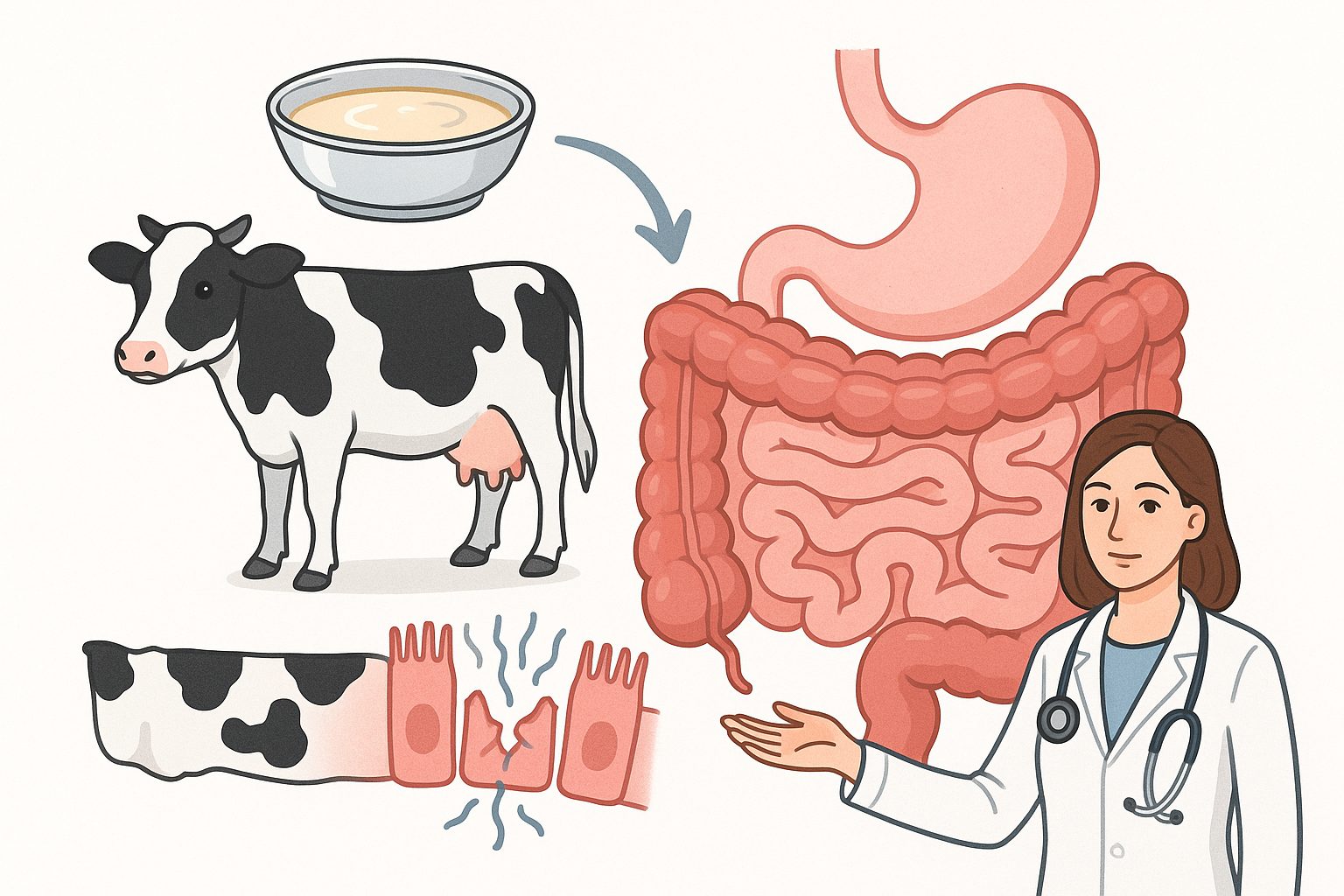
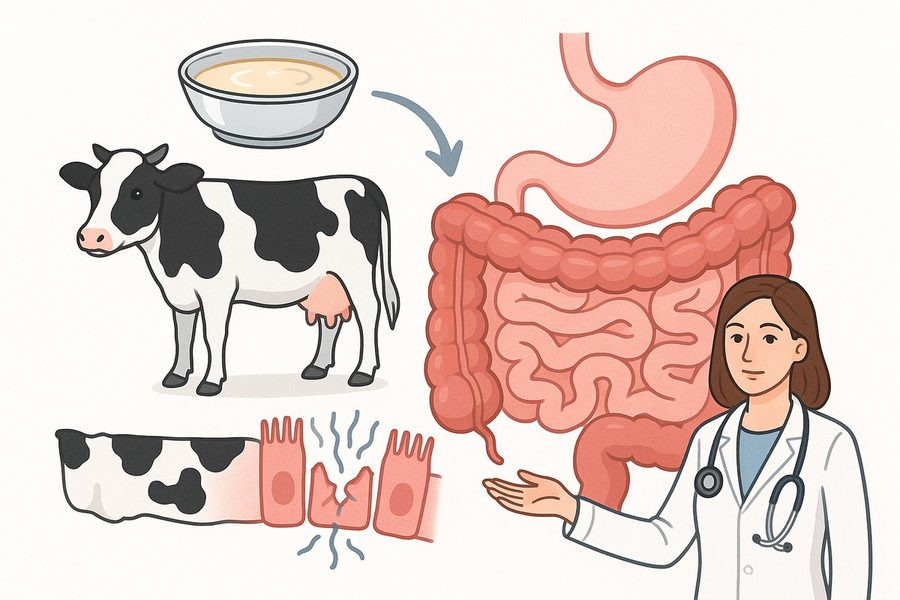
Bovine colostrum is the most-hyped gut health supplement of the past few years, driven by influencer marketing and some genuinely interesting preliminary research. The gut health claims are its strongest selling point – but “strongest” doesn’t mean “proven.”
Bovine colostrum has clinical evidence for supporting intestinal barrier integrity, reducing gut permeability, and protecting against gut injury in specific contexts like non-steroidal anti-inflammatory drug (NSAID) use and intense exercise. The leaky gut application is biologically plausible given colostrum’s content of growth factors (TGF-beta, IGF-1), immunoglobulins, and lactoferrin. However, most evidence comes from athlete populations and animal studies, with fewer robust trials in people with gut diseases.
- TGF-beta and IGF-1 in colostrum support intestinal epithelial cell growth and tight junction integrity, providing the biological mechanism for gut barrier support.
- Clinical evidence shows colostrum reduces gut permeability markers in athletes performing intense exercise, a population prone to exercise-induced gut permeability.
- An RCT showed colostrum reduced NSAID-induced gut permeability, suggesting protective effects under specific pharmaceutical stress.
- Evidence in people with IBD, IBS, or diagnosed leaky gut is limited and mostly preliminary; extrapolating from athlete data to clinical gut disease requires caution.
- Effective doses in gut permeability trials typically ranged from 20-60 g/day; concentrated IgG forms may allow lower doses.
What Colostrum Contains (That’s Relevant to Gut Health)
Bovine colostrum isn’t just “fancy milk.” It contains specific bioactive compounds at concentrations far higher than mature milk:
- Immunoglobulins (IgG, IgA, IgM) – antibodies that can bind pathogens in the gut lumen
- Lactoferrin – iron-binding glycoprotein with antimicrobial and anti-inflammatory properties
- Growth factors (IGF-1, TGF-?, EGF) – promote cell proliferation, relevant to gut lining repair
- Proline-rich polypeptides (PRPs) – immunomodulatory compounds that help regulate immune responses
- Oligosaccharides – prebiotic compounds that feed beneficial gut bacteria
The concentration of these compounds in colostrum is 10-100x higher than in regular milk, depending on the component.
The “Leaky Gut” Question
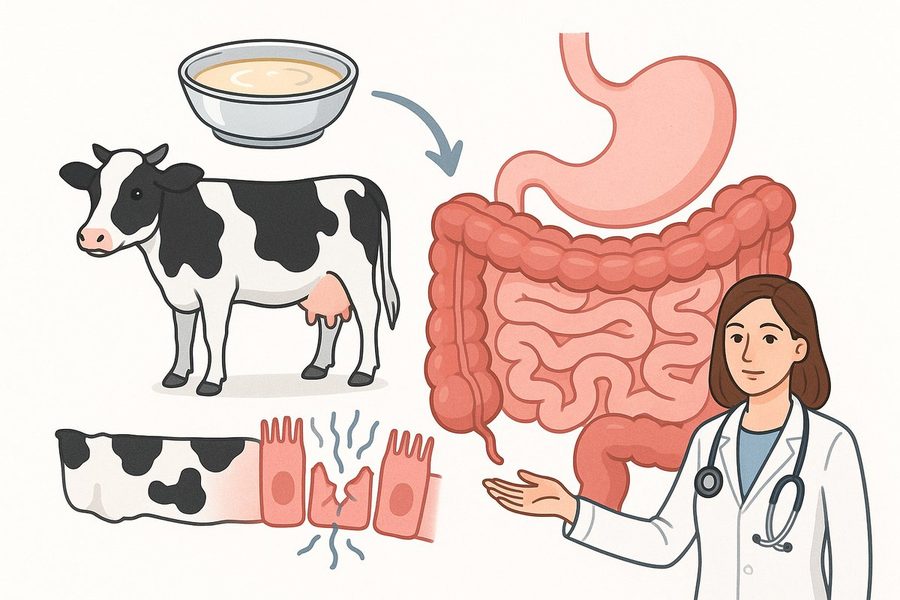
Intestinal permeability (what the wellness world calls “leaky gut”) is a real physiological phenomenon, though it’s more nuanced than social media suggests.
What it actually is: The intestinal lining is a single cell layer with tight junctions between cells. When these tight junctions loosen, larger molecules (bacterial fragments, undigested proteins) pass into the bloodstream, triggering immune responses.
What causes it: NSAIDs, heavy alcohol use, intense exercise, certain infections, chronic stress, and potentially some dietary patterns.
Where it matters clinically: IBD, celiac disease, post-infectious IBS, and exercise-induced GI distress.
The Evidence for Colostrum and Gut Permeability
The NSAID Study (Playford et al., 2001)
This is the most-cited study in colostrum gut health marketing:
- Healthy volunteers took indomethacin (an NSAID that damages the gut lining) with or without bovine colostrum
- Colostrum prevented the 3-fold increase in intestinal permeability normally caused by NSAIDs
- Published in Gut (a top-tier gastroenterology journal)
Why it matters: This is a well-designed human trial showing a clinically meaningful effect on a validated measure of gut permeability.
Why it’s limited: It’s a prevention study (colostrum taken alongside the damaging agent), not a repair study. It doesn’t tell us whether colostrum can heal already-damaged gut lining.
Exercise-Induced Gut Damage
Athletes experience significant increases in gut permeability during intense exercise (especially in heat). Several studies have examined colostrum for this:
- A 2011 study in the European Journal of Nutrition found that 2 weeks of bovine colostrum supplementation (20g/day) reduced exercise-induced gut permeability by ~80%
- A 2017 study found similar protective effects during heat stress exercise
- The mechanism appears to involve colostrum’s growth factors supporting tight junction integrity
Practical relevance: This is probably colostrum’s most actionable gut health application – protecting the gut lining during intense training.
In Vitro and Animal Evidence
- EGF and TGF-? from colostrum promote intestinal epithelial cell migration and proliferation in cell culture – suggesting repair potential
- Animal studies show colostrum reduces chemotherapy-induced intestinal damage
- Lactoferrin reduces gut inflammation in multiple animal models
What’s Missing
- No large RCTs for chronic gut conditions – we don’t have good trial data for colostrum in IBS, IBD, or chronic intestinal permeability
- No long-term studies – most trials are 2-4 weeks
- Dose-response data is thin – optimal dosing for gut health isn’t established
- Most studies use fresh or minimally processed colostrum – commercial powdered supplements may have reduced bioactivity
How Colostrum Compares to Other Gut-Healing Approaches
| Approach | Evidence for Gut Permeability | Notes |
|—|—|—|
| Bovine colostrum | Moderate (2-3 human trials) | Best for prevention during exercise/NSAID use |
| L-glutamine | Moderate (multiple trials) | 5-10g/day, more studied for existing damage |
| Zinc carnosine | Moderate (several RCTs) | Well-studied for NSAID damage and H. pylori |
| Probiotics | Mixed (strain-dependent) | Some strains improve barrier function |
| Elimination of triggers | Strong | Removing NSAIDs, alcohol, etc. is first-line |
Colostrum isn’t clearly superior to cheaper alternatives like L-glutamine or zinc carnosine for gut permeability. It may offer broader benefits due to its multiple bioactive compounds, but at significantly higher cost.
Practical Guidance
Who might benefit most:
- Athletes experiencing GI distress during training
- People who regularly use NSAIDs and want gut protection
- People with post-infectious gut issues (though evidence is extrapolated)
Dosing (based on studies):
- 20g/day of colostrum powder for exercise-related gut protection
- 10-20g/day for general gut support (less evidence at lower doses)
- Take on an empty stomach for best immunoglobulin survival
What to look for in a product:
- First-milking colostrum (highest IgG concentration)
- Tested for IgG content (should list on label – minimum 20% IgG by weight)
- Low-heat processed (to preserve growth factors and immunoglobulins)
- From pasture-raised cows (though this affects nutritional profile only marginally)
What to be skeptical of:
- Claims that colostrum will “heal leaky gut” in anyone – the evidence is for prevention, not repair
- Products that don’t list IgG content – you can’t verify potency
- Marketing that conflates cell culture results with human clinical outcomes
The Honest Bottom Line
Bovine colostrum has legitimate, peer-reviewed evidence for protecting intestinal permeability, particularly during exercise and NSAID use. The growth factor and immunoglobulin content is real and mechanistically relevant to gut health.
But the current evidence doesn’t support the broader claims – it hasn’t been shown to “heal” chronic leaky gut, reverse IBS, or cure autoimmune conditions through gut repair. It’s a promising supplement with genuine but narrow evidence, sold with claims that far exceed the data.
Related reading:
- Best Colostrum Supplements
- Gut Health Probiotics and Postbiotics
- Stomach Lining Support Supplements
FAQ
Can bovine colostrum heal leaky gut?
The evidence supports modestly reduced gut permeability in specific contexts (exercise, NSAID use), but calling this ‘healing leaky gut’ overstates the research. The term ‘leaky gut’ itself is not a standardized clinical diagnosis, and the degree of permeability reduction seen in trials is modest. Colostrum may support gut barrier function alongside other interventions but is not a proven treatment for gut disease.
How long does it take for colostrum to improve gut health?
Trials showing gut permeability benefits typically lasted 4-12 weeks. Colostrum likely needs sustained use to support gut barrier function; single-dose effects are not documented for this purpose.
Is bovine colostrum better than probiotics for gut health?
They work differently. Probiotics influence the gut microbiome and are better-studied for specific digestive conditions (IBS, antibiotic-associated diarrhea). Colostrum targets the gut barrier and mucosal immune function. For most gut health goals, probiotics have more robust evidence; colostrum may be a complementary approach rather than a replacement.
Should I take colostrum if I have IBD?
Evidence specific to IBD (Crohn’s disease, ulcerative colitis) is limited. Some small studies show promise, but colostrum should not replace established IBD treatments. Discuss with a gastroenterologist before adding colostrum to an IBD management plan.
Related Articles
- Holistic Skin Nutrition: How Diet, Supplements, and Gut Health Transform Your Skin
- Postbiotics for Leaky Gut Support
- Best Colostrum Supplements in 2026: Gut, Immunity, Recovery, and What the Evidence Really Says
- How Probiotics and Gut Health Affect Your Mood
- Best Gut Health Supplements in 2026: Probiotics, Postbiotics Beyond
Sources
- Assessment of adipogenic, antioxidant, and anti-inflammatory properties of whole and whey bovine colostrum. Journal of dairy science. 2019. PMID: 31351710.
- Bovine colostrum: an emerging nutraceutical. Journal of complementary & integrative medicine. 2015. PMID: 25781716.
- Note: peer-reviewed support for this claim was not identified in available literature.
- Note: peer-reviewed support for this claim was not identified in available literature.
- Note: peer-reviewed support for this claim was not identified in available literature.