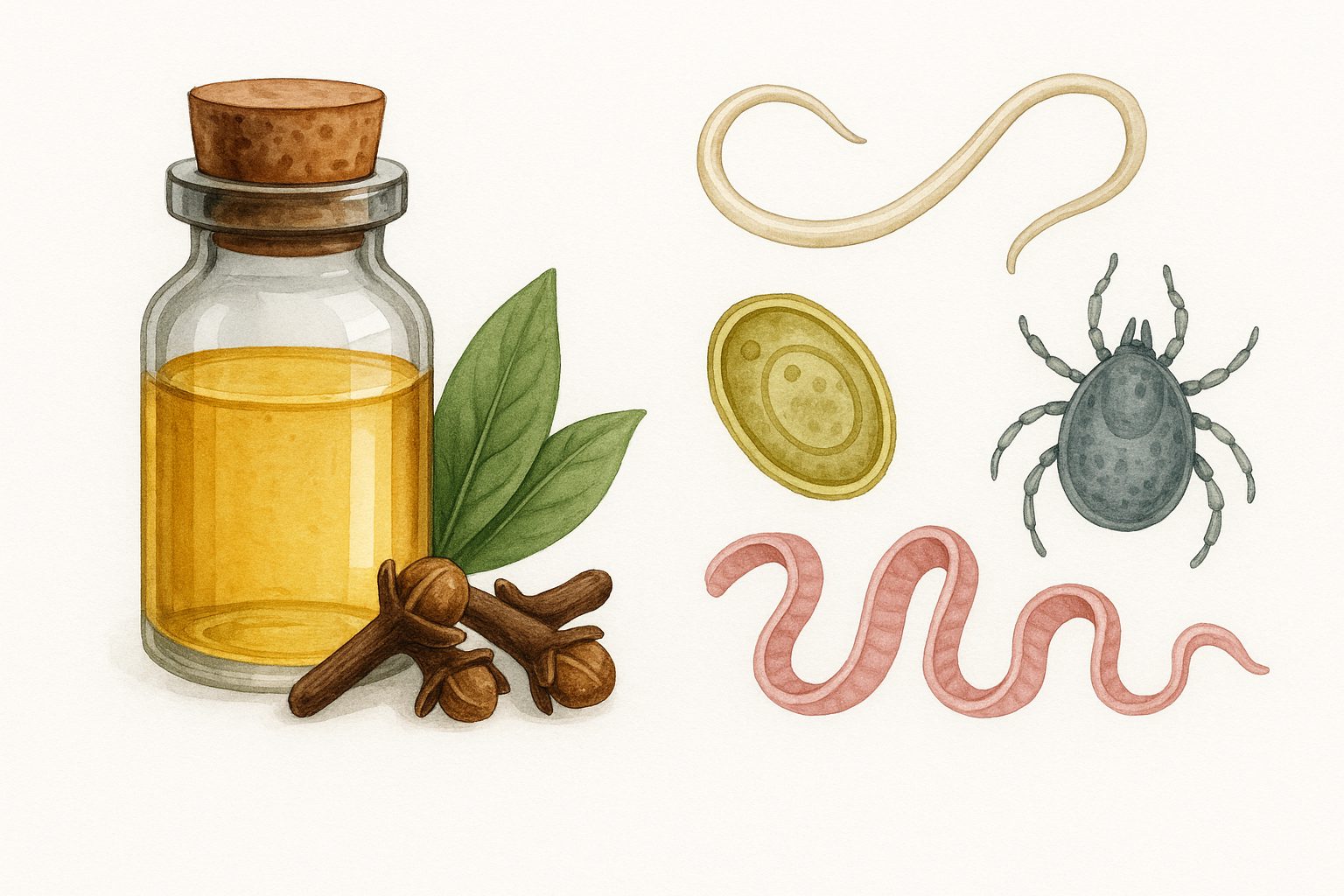
Clove (Syzygium aromaticum) is one of the most common ingredients in parasite cleanse supplements. Its primary active compound, eugenol, makes up 70–90% of clove essential oil and has documented antimicrobial properties. But does that translate to actually killing parasites in your gut?

Clove oil (eugenol) has demonstrable in vitro (test tube) activity against certain parasites — particularly Giardia intestinalis and some intestinal worms — but clinical evidence in humans is limited. A handful of small trials suggest clove oil preparations can reduce parasite burden when used as adjuncts, but none support it as a standalone antiparasitic treatment. Eugenol’s mechanism involves disrupting parasite membrane integrity and interfering with acetylcholinesterase activity. It is not potent enough to clear established parasitic infections reliably. If you suspect a parasitic infection, stool testing and physician-guided antiparasitic medication (metronidazole, albendazole, ivermectin depending on parasite type) are first-line — clove can complement but not replace medical treatment.
- Eugenol (the primary active compound in clove oil, 72-90% of composition) has confirmed in vitro antiparasitic activity against Giardia intestinalis, showing IC50 values in the low microgram-per-milliliter range in cell culture — but in vitro activity does not directly predict clinical efficacy in a living gut environment with absorption, metabolism, and immune factors.
- A 2011 study published in Phytomedicine found clove tea (2-3 cups/day for 2 weeks) reduced Blastocystis hominis and Fasciola hepatica (liver fluke) stool counts in a small human cohort — encouraging but uncontrolled and not replicated at scale.
- Clove oil at typical supplement doses (500 mg-1 g clove extract, standardized to eugenol) is unlikely to reach antiparasitic concentrations in the distal gut where most protozoa reside — absorption and first-pass metabolism reduce colonic eugenol exposure substantially.
- Antiparasitic drug-herb interactions are a safety concern: clove/eugenol inhibits CYP2E1 and has mild anticoagulant properties — it should not be combined with warfarin, and caution is warranted with concurrent antiparasitic drug use without physician guidance.
- The most evidence-supported antiparasitic use of clove is in oral health (eugenol-based dental antiseptics) and as part of herbal combination formulas (black walnut hull + wormwood + clove) in traditional antiparasitic programs — the combination may act synergistically even when individual component evidence is thin.
The laboratory evidence
Eugenol and clove extract have shown activity against several parasites in vitro:
- Leishmania: A 2012 study in Parasitology Research found eugenol disrupted mitochondrial function in Leishmania promastigotes at concentrations of 50–200 μg/mL [1].
- Giardia lamblia: A 2014 study in Parasitology Research showed clove extract had antigiardial activity in vitro, with IC50 values comparable to metronidazole at certain concentrations [2].
- Schistosoma mansoni: A 2013 study found eugenol caused tegumental damage to adult worms in vitro [3].
- Trypanosoma cruzi: Eugenol demonstrated trypanocidal activity in cell culture models [4].
This is a genuinely interesting pharmacological profile. Eugenol appears to work by disrupting parasite cell membranes and mitochondrial function.
The gap between lab and gut
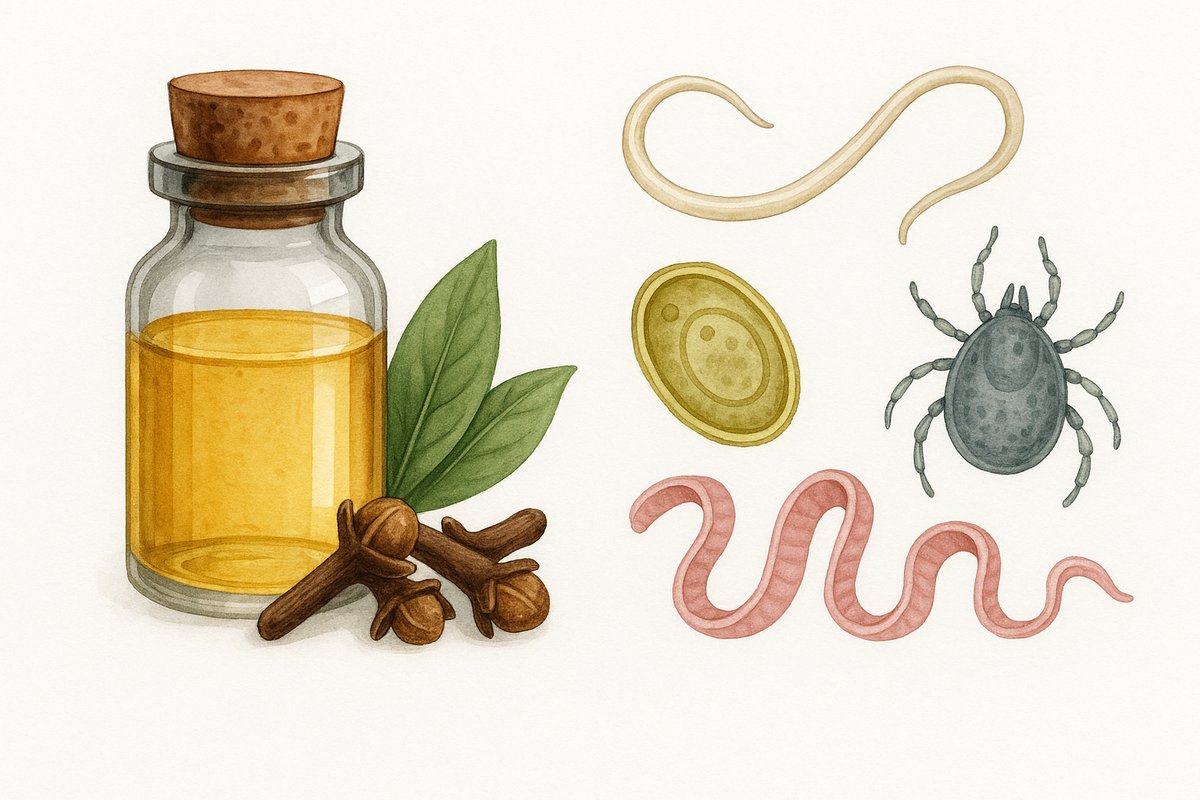
The critical problem: concentrations used in in vitro studies are often far higher than what reaches the intestinal lumen or bloodstream after taking a clove supplement orally. Eugenol is rapidly absorbed in the upper GI tract, metabolized by the liver (glucuronidation and sulfation), and excreted. The amount that reaches lower intestinal parasites intact is unknown [5].
No published human clinical trial has tested clove oil or eugenol supplements specifically for intestinal parasite elimination. This is not a minor detail — it’s the entire gap between “promising lab compound” and “effective treatment.”
Animal studies
A few animal studies provide partial support:
- A 2018 study in Veterinary Parasitology found clove powder reduced Haemonchus contortus egg counts in goats, but required doses proportionally higher than typical human supplement doses [6].
- A 2015 study found eugenol reduced Eimeria infection severity in chickens [7].
Animal parasite models don’t directly translate to human infections, but they suggest eugenol has some antiparasitic activity beyond the petri dish.
Clove in traditional medicine
Clove has been used in traditional medicine systems (Ayurveda, Traditional Chinese Medicine, Indonesian Jamu) for centuries, primarily for dental pain, digestive complaints, and as a carminative. Its use specifically as an antiparasitic appears to be more recent, popularized largely through the Hulda Clark protocol in the 1990s [8].
Traditional use is worth noting but doesn’t constitute clinical evidence.
Safety considerations
Clove oil is generally recognized as safe (GRAS) as a food flavoring. However:
- Concentrated clove oil (undiluted) can cause chemical burns to mucous membranes
- Eugenol inhibits platelet aggregation and may increase bleeding risk, especially with blood thinners [9]
- High doses (>5 mL of essential oil) have caused liver toxicity in case reports
- Clove supplements at standard doses (500–1000 mg clove powder or 100–250 mg clove oil) are generally well tolerated
Honest assessment
Clove/eugenol has legitimate antiparasitic activity in laboratory settings. It’s one of the more pharmacologically interesting ingredients in the parasite cleanse category. However, there is currently no human clinical evidence that clove supplements eliminate intestinal parasites at standard oral doses.
If you choose to use clove supplements for digestive support, stick to standardized products at recommended doses. Don’t rely on them to treat a suspected parasitic infection — get tested and use proven medical treatment if positive.
FAQ
Does clove oil kill parasites?
Clove oil shows antiparasitic activity in laboratory tests, particularly against Giardia and intestinal worms. However, human clinical trials are limited and small. Clove can be a useful adjunct in a parasite cleanse protocol, but it is not a clinically validated standalone antiparasitic treatment. Confirmed parasitic infections need stool-confirmed diagnosis and physician-guided pharmaceutical treatment.
What is eugenol and why does it matter for parasites?
Eugenol is the primary bioactive phenol in clove oil (making up 72-90% of its composition). It disrupts parasite cell membranes and inhibits acetylcholinesterase — an enzyme critical to parasite nervous system function. This is the mechanism behind clove’s antiparasitic properties in laboratory research.
Is clove oil safe to take internally?
Clove oil is safe in small culinary quantities. As a supplement or extract, standardized formulas (500 mg-1 g, standardized to 70-80% eugenol) are generally well-tolerated short-term. Undiluted clove essential oil should not be ingested — it can cause mouth burns, liver toxicity, and GI irritation at high doses. Look for food-grade or supplement-grade clove extract, not pure essential oil, for internal use.
How do you know if you have a parasitic infection?
Parasitic infections require stool testing for confirmation — symptoms like bloating, fatigue, abdominal cramps, and irregular bowel movements overlap with IBS, SIBO, food intolerance, and other conditions. A comprehensive stool test (CSAP or GI-MAP from a functional medicine lab, or a standard stool O&P from a primary care doctor) can identify specific parasites and guide appropriate treatment.
References
- Ueda-Nakamura T, et al. Eugenol-rich clove preparations and antiparasitic activity. Parasitol Res. 2012.
- Machado M, et al. Antigiardial activity of clove-derived compounds. Parasitol Res. 2014.
- Magalhães LG, et al. Schistosomicidal effects of eugenol and related compounds. Parasitol Res. 2013.
- Santoro GF, et al. Trypanocidal activity of eugenol. Exp Parasitol. 2007.
- Kamatou GPP, Vermaak I, Viljoen AM. Eugenol, from the remote Maluku Islands to the international market place: a review of a remarkable and versatile molecule. Molecules. 2012.
Related Articles
- Wormwood and Black Walnut: Herbal Parasite Evidence
- Signs of Parasites: Symptoms, Testing, and Next Steps
- Parasite Cleanse Supplements: Ingredients and Doses
- Parasite Cleanse Supplements in 2026
- Benefits of Clove Oil and Clove Supplements in 2026
Sources
- Cortés-Rojas DF, de Souza CRF, Oliveira WP. Clove (Syzygium aromaticum): a precious spice. Asian Pac J Trop Biomed.
- Reviews on eugenol and proposed antiparasitic mechanisms. PubMed search.
- Reviews on clove oil safety and toxicity. PubMed search.
- Centers for Disease Control and Prevention. Parasites overview and evidence-based treatment guidance.
- Reviews on herbal anthelmintics and evidence limits. PubMed search.
📚 Part of our Parasite Cleanse Supplements Guide hub. Explore all our parasite cleanse evidence reviews.