
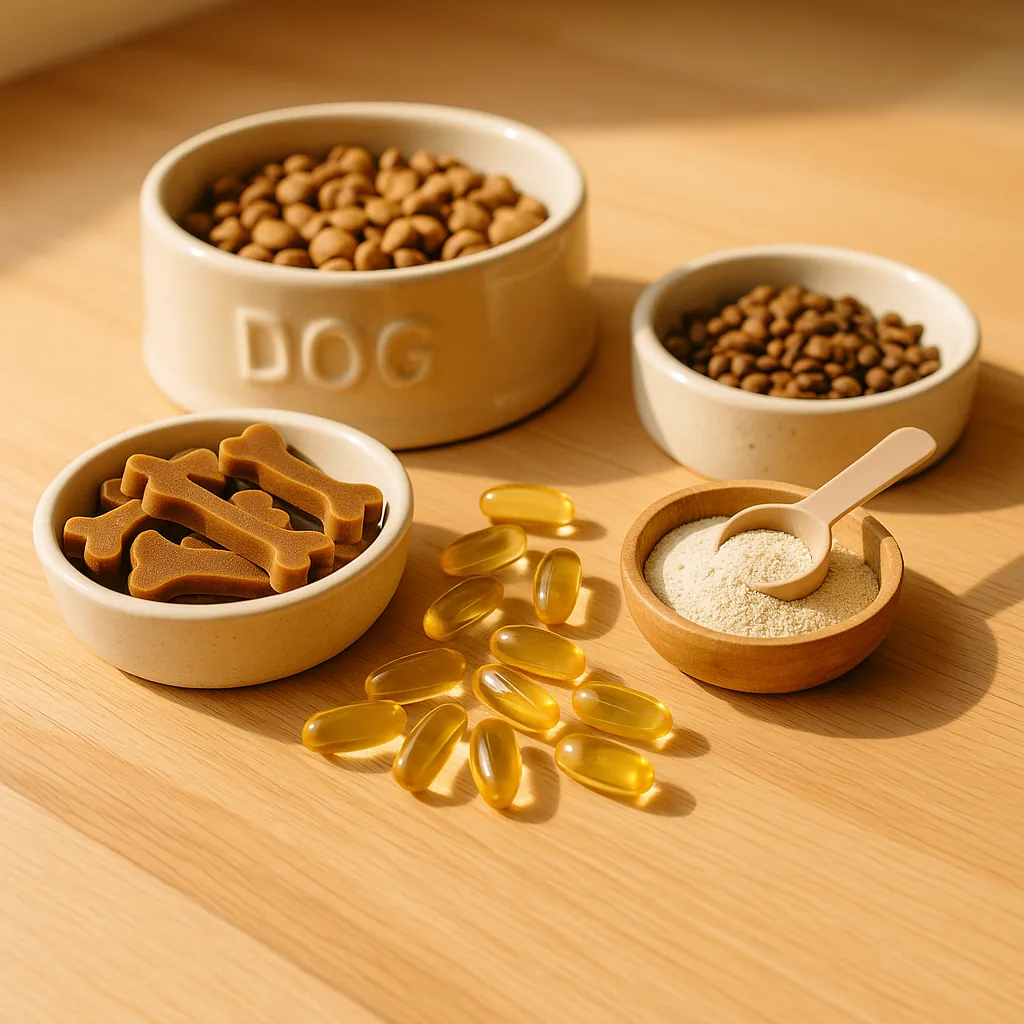
The Complete Guide to Pet Supplements in 2026: Evidence-Based Nutrition for Dogs and Cats
Do Pet Supplements Actually Work? A Complete Guide for Dog and Cat Owners
Walk into any pet store today and you’ll find an entire aisle — sometimes two — dedicated to supplements for your dog or cat: glucosamine chews, fish oil capsules, probiotic powders, calming treats, multivitamins. The market is worth billions of dollars and growing every year. But when you look past the packaging and ask whether any of it actually works, the answers are more nuanced than either enthusiastic pet-product marketers or skeptical veterinarians tend to admit.

Some pet supplements have real, replicated evidence behind them. Others are supported by little more than plausible mechanisms and manufacturer testimonials. This guide walks through the major categories honestly, with the actual evidence — veterinary trials, not wishful thinking.
Quick Answer: Some pet supplements have genuine evidence supporting their use — omega-3 fatty acids and certain probiotic strains have the strongest veterinary data. Glucosamine/chondroitin shows modest benefits for joint disease in dogs with mixed trial results. Calming supplements and most multivitamins have weak evidence for healthy, balanced-diet pets. Quality control varies widely; the NASC quality seal is the most practical marker of a trustworthy product. Always discuss supplementation with your veterinarian before starting, especially for cats.
Why Pet Supplements Exist: The Real Story

Gaps in Commercial Pet Food
The pet supplement industry exists in part because of genuine nutritional gaps and limitations in commercial pet food, and in part because of marketing that capitalizes on the same human anxieties about nutrition that fuel the human supplement industry. Separating these is important.
Commercial pet foods formulated to AAFCO (Association of American Feed Control Officials) standards are designed to meet minimum nutritional requirements for the life stage indicated on the label. A food labeled “complete and balanced” for adult maintenance has been formulated to meet those AAFCO nutrient profiles — it’s not a guess.
But “meets minimum requirements” doesn’t mean “optimal for every individual animal.” Processing can degrade heat-sensitive nutrients. The bioavailability of nutrients from rendered ingredients isn’t always equivalent to fresh-food sources. And AAFCO profiles themselves are periodically revised as nutrition science advances, which implicitly acknowledges that what we knew 20 years ago wasn’t complete. There are also legitimate debates about whether certain minimums are truly optimal for longevity rather than just adequate for preventing deficiency disease.
This means the question isn’t simply “does my pet need supplements?” The better questions are: What life stage and health status does my pet have? What is the quality and composition of their current diet? Does their specific situation create a documented need that supplementation could address?
Aging, Breed-Specific, and Health-Related Needs
Supplementation makes the most sense in specific contexts: senior pets with declining joint function, breeds with documented predispositions to certain deficiencies, animals with diagnosed conditions that nutritional support can address alongside veterinary treatment, and pets on homemade or raw diets that may not be correctly balanced.
A healthy adult Labrador eating a quality kibble formulated for its life stage probably doesn’t need a daily multivitamin. That same dog at age ten with hip dysplasia and early osteoarthritis is a completely different conversation. Context changes everything.
Joint Support Supplements: What the Veterinary Evidence Shows
Glucosamine and Chondroitin: The Actual Evidence
Joint supplements are the single biggest category in the pet supplement market, driven primarily by the epidemic of osteoarthritis in dogs — it’s estimated that 20% of dogs over one year of age have some degree of joint disease, with prevalence rising sharply in senior animals and large breeds.
Glucosamine (typically hydrochloride or sulfate) and chondroitin sulfate are the cornerstone ingredients in most joint supplements. The proposed mechanism is logical: these are structural components of cartilage, and providing them orally might support cartilage maintenance and reduce degradation. The in vitro evidence supports anti-inflammatory and chondroprotective effects on isolated cartilage cells.
The clinical trial evidence is more complicated. McCarthy et al. conducted one of the more rigorous veterinary trials, a randomized double-blind positive-controlled study in dogs with osteoarthritis comparing a glucosamine/chondroitin combination against carprofen (an NSAID). The supplement group showed improvement, but was less effective than carprofen, and the absence of a true placebo arm makes it difficult to separate drug effect from natural disease variation (McCarthy et al., The Veterinary Journal, 2007).
A systematic review by Innes et al. examining the veterinary literature on nutraceuticals for canine joint disease found that while some evidence supports benefit, the overall quality of the evidence base is limited by small sample sizes, short trial durations, and variable methodological quality. The conclusion was that glucosamine/chondroitin products likely provide some benefit in dogs with mild to moderate osteoarthritis, but the effect size is modest and the evidence is not as robust as proponents often suggest (Innes et al., Journal of Nutrition, 2006).
What this means practically: glucosamine and chondroitin probably help some dogs with joint disease. They are not going to replace NSAID therapy in dogs with meaningful pain, and they won’t regenerate cartilage that’s already lost. They’re most useful as part of a multimodal approach to joint disease management — alongside weight management (the single most impactful intervention for joint health), appropriate exercise, and veterinary-supervised pain management.
MSM and Other Joint Ingredients
Methylsulfonylmethane (MSM) is frequently added to joint formulas as a sulfur-containing compound theorized to support connective tissue health. Veterinary-specific trial data on MSM in dogs is sparse; most of the cited research is extrapolated from human studies, which themselves have mixed results. Avocado-soybean unsaponifiables (ASUs), green-lipped mussel extract, and boswellia are additional ingredients with varying levels of supporting evidence — all plausible mechanisms, limited high-quality veterinary clinical data.
The pattern in this space is consistent: mechanisms are reasonable, preliminary data suggests benefit, rigorous controlled trials are lacking. For a dog already managed with NSAIDs and a body weight program, adding a quality joint supplement is a low-risk adjunct. Expecting it to do the heavy lifting alone is setting the bar too high.
Omega-3 Fatty Acids: The Best-Supported Category
Omega-3 fatty acids — specifically EPA (eicosapentaenoic acid) and DHA (docosahexaenoic acid) from marine sources — have the strongest and most consistent evidence of any pet supplement category. This isn’t surprising given that the underlying anti-inflammatory biology is shared across mammalian species and has been studied extensively in both human and veterinary medicine.
Skin, Coat, and Inflammation Benefits
Bauer’s comprehensive review of therapeutic fish oil use in companion animals, published in the Journal of the American Veterinary Medical Association, documented evidence for omega-3 benefits across multiple conditions: inflammatory skin disease, atopic dermatitis, coat quality, kidney disease (reducing proteinuria), heart disease (especially in dogs at risk for arrhythmia), and joint inflammation as an adjunct to other therapies (Bauer, JAVMA, 2011).
The mechanisms are well understood. EPA and DHA compete with arachidonic acid for incorporation into cell membranes. When cells with higher EPA/DHA ratios produce inflammatory mediators, the resulting eicosanoids are less inflammatory than those derived from arachidonic acid. This isn’t a marginal effect — it’s a fundamental shift in the inflammatory signaling cascade, and it’s documented in veterinary patients, not just extrapolated from human data.
Skin and coat benefits are often visible and reportable by owners. Dogs with dry, flaky skin or dull coats frequently show noticeable improvement with fish oil supplementation over 6–8 weeks. This is one of the more reliable supplement effects owners can actually observe.
Dosing and Forms for Pets
The form of omega-3 matters more than many pet owners realize. Flaxseed oil contains ALA (alpha-linolenic acid), a plant-based omega-3 that many people assume is equivalent to EPA and DHA. It isn’t — conversion of ALA to EPA and DHA in dogs is inefficient, and in cats it’s even worse. For companion animals, marine-source omega-3s (fish oil, krill oil, algae-based sources) are the appropriate forms.
Dosing recommendations vary by condition and body weight. For general anti-inflammatory and skin support, most veterinary guidelines suggest 50–100 mg EPA+DHA per kg of body weight daily, though therapeutic doses for specific conditions like kidney disease or heart disease may be higher and should be guided by a veterinarian. Quality matters — fish oil can oxidize, and rancid oil is at best ineffective and at worst pro-inflammatory. Look for products with third-party testing for oxidation levels and purity.
Probiotics for Digestive Health: Strain-Specific Evidence
Gut microbiome research has exploded in both human and veterinary medicine over the past decade. The canine gut microbiome is now understood to be a complex and dynamic ecosystem that influences not just digestive health but immune function, brain-gut signaling, and systemic inflammation.
Suchodolski’s work at Texas A&M has been particularly influential in defining what intestinal dysbiosis (imbalanced gut bacteria) looks like in dogs and cats, and in documenting associations between microbiome disruption and conditions like chronic enteropathy, inflammatory bowel disease, and antibiotic-associated diarrhea (Suchodolski, The Veterinary Journal, 2016).
For probiotic supplementation, the key principle is that efficacy is strain-specific. A generic “probiotic” label tells you little. What matters is whether specific strains — at specific viable cell counts — have been tested in companion animals for the target condition. Pilla and Suchodolski’s review confirmed that probiotic supplementation can normalize disrupted microbiomes in dogs experiencing antibiotic-associated diarrhea and may benefit dogs with acute gastroenteritis (Pilla & Suchodolski, Frontiers in Veterinary Science, 2021).
Species-appropriate strains matter here. Enterococcus faecium SF68 has specific veterinary trial data in dogs. Lactobacillus rhamnosus and certain Bifidobacterium strains have been studied in both dogs and cats. Probiotics marketed primarily for humans may not contain strains that colonize the canine gut effectively, which is why canine-specific probiotic products are preferable.
For routine maintenance use in healthy pets, the evidence doesn’t clearly support daily probiotic supplementation as universally beneficial. Where the evidence is stronger: post-antibiotic use, periods of dietary transition, acute digestive upset, and dogs with known chronic digestive issues.
Calming Supplements: Where the Evidence Gets Thinner
Anxiety in dogs is a significant and underdiagnosed problem. Separation anxiety, noise phobia (especially around fireworks and thunderstorms), and general situational stress are common presentations that owners desperately want to address, and the market for calming supplements reflects this demand.
The most studied ingredients in this category include:
L-theanine, an amino acid found in green tea that may modulate GABA and other neurotransmitters with anxiolytic effects. Some small veterinary studies show modest reduction in anxiety-related behaviors.
Alpha-casozepine, a casein-derived peptide with some published evidence for reducing anxiety in cats and dogs — studies are small but promising.
Melatonin for noise phobia and situational anxiety — most commonly recommended in dogs, with anecdotal support and limited controlled trial data in veterinary patients.
Valerian root, chamomile, and passion flower appear frequently in commercial calming products. Veterinary-specific evidence for these botanical ingredients is generally weak, with most support coming from human studies or traditional use.
The honest assessment of calming supplements: they may take the edge off mild situational anxiety in some dogs. They are not likely to provide meaningful relief for severe separation anxiety or significant phobias, which require behavioral modification programs and potentially prescription anxiolytics under veterinary supervision. Expecting a calming treat to manage a dog that destroys the house during thunderstorms is setting up for disappointment.
Multivitamins: Mostly for the Owner’s Peace of Mind
For pets eating a complete and balanced commercial diet formulated to AAFCO standards, a daily multivitamin is almost certainly redundant. More importantly, supplementing certain vitamins and minerals beyond established requirements can cause harm. Vitamin D toxicity is a documented concern in pets, and excessive calcium supplementation in growing large-breed puppies can worsen developmental orthopedic disease rather than prevent it.
The legitimate uses for multivitamin supplementation are narrow: pets on homemade diets that haven’t been properly formulated by a veterinary nutritionist, animals with documented deficiencies confirmed by bloodwork, or those with absorption disorders preventing normal nutritional uptake. In these cases, supplementation is not optional — it’s veterinary treatment.
For the average pet on a quality commercial diet, a multivitamin mostly benefits the human who wants to feel they’re doing everything possible. That’s a real psychological function, but it’s worth being honest about what you’re buying.
Cat-Specific Considerations: The Most Important Caveats
Cats are metabolically distinct from dogs in ways that make careless supplementation potentially dangerous. A few specific points:
Cats are obligate carnivores and lack the enzyme delta-6-desaturase in adequate amounts to convert plant-based ALA to EPA/DHA. This means omega-3 supplementation for cats requires marine sources — plant-based sources are nutritionally worthless for felines in this context.
Many supplements formulated for dogs contain ingredients that are toxic to cats. Certain herbal ingredients, essential oils used in “natural” calming products, and even some synthetic additives that dogs tolerate poorly are potentially dangerous to cats. Never give a dog supplement to a cat without explicit veterinary confirmation that every ingredient is safe.
Cats require taurine, an amino acid that dogs can synthesize but cats cannot. A taurine deficiency in cats causes dilated cardiomyopathy and retinal degeneration. Any homemade cat diet or supplement program that doesn’t explicitly account for taurine is a serious problem.
Cats are also notoriously sensitive to stress and generally resist pill-giving, which affects compliance with any supplementation program. This is a practical consideration that matters for real-world outcomes.
Quality and Safety: What to Look For Before You Buy
The NASC Seal and What It Means
The National Animal Supplement Council (NASC) is a nonprofit trade association that maintains quality standards and an adverse event reporting system for pet supplement manufacturers. Products bearing the NASC Quality Seal have come from manufacturers that have passed an independent facility audit, meet adverse event reporting requirements, and follow labeling standards.
The NASC seal is not equivalent to FDA drug approval — that bar is much higher. But in a market with essentially no mandatory pre-market testing requirements for pet supplements, the NASC seal at least signals that a manufacturer has voluntarily submitted to outside quality oversight. It’s the most practical positive marker available to consumers.
Beyond the NASC seal, look for products that provide a Certificate of Analysis from third-party testing, clearly state the actual doses of each active ingredient (not proprietary blends that obscure amounts), and list a verifiable manufacturer with contact information. Avoid products that make unverified disease treatment claims, use vague ingredient descriptions, or can’t provide purity testing documentation.
The pet supplement industry has had documented contamination and mislabeling issues. Heavy metal contamination in fish-based products, microbial contamination in probiotic products, and label claims that don’t match actual contents have all been documented in independent testing. These aren’t hypothetical concerns.
When Supplements Are Unnecessary — or Could Cause Harm
It’s worth being direct about this: for a healthy adult pet, eating a complete and balanced diet at an appropriate weight, with normal bloodwork and no diagnosed conditions, the evidence for routine supplementation is thin to nonexistent. Commercial pet food formulated to AAFCO standards is designed to prevent nutritional deficiency, and most pets on good-quality food are not deficient.
The cases where supplementation is most justified are specific and identifiable: diagnosed joint disease, documented inflammatory skin conditions, post-antibiotic microbiome recovery, nutritionally incomplete homemade diets, and specific disease management under veterinary supervision.
Over-supplementation carries real risks. Fat-soluble vitamins (A, D, E, K) accumulate in the body and can reach toxic levels. Calcium and phosphorus supplementation in growing dogs can interfere with skeletal development. Some herbal ingredients have hepatotoxic potential in cats. The impulse to do more for a pet you love is natural and admirable — but “more” isn’t always better, and the risk-benefit calculation should be honest.
Frequently Asked Questions
At what age should I start giving my dog joint supplements?
There’s no single right answer, but the general principle is that joint supplements are more useful as a response to early signs of joint disease than as universal prevention for all dogs. Large breed dogs — especially those with known genetic predispositions to hip or elbow dysplasia (German Shepherds, Labrador Retrievers, Golden Retrievers) — may benefit from earlier introduction of joint support once their skeletal development is complete (around 12–18 months). For most dogs, joint supplements become relevant in the senior years (7+ for large breeds, 10+ for smaller breeds) when arthritis risk increases. Starting a young, healthy dog on joint supplements without evidence of joint disease is less well-supported by evidence.
Are fish oil supplements for pets the same as supplements for humans?
The EPA and DHA in fish oil are the same molecules regardless of the packaging. However, human fish oil supplements may contain additives, flavorings, or enteric coatings that aren’t tested for pet safety. Dosing is also different — small pets need smaller amounts, and liquid fish oil formulated for pets makes dosing more precise. If you do use a human fish oil product for a pet, choose a simple, additive-free version and calculate the dose by EPA+DHA content, not by capsule count.
Do probiotics for pets need to be refrigerated?
Some probiotic products require refrigeration to maintain viable cell counts; others use heat-stable strains or freeze-dried formats that are shelf-stable. The label should indicate storage requirements. A probiotic that requires refrigeration but has been sitting on a warm retail shelf for months may have significantly reduced viability. This is part of why buying from reputable sources and checking manufacturing dates matters. Regardless of storage, look for products that guarantee a minimum viable cell count at the time of expiration, not just at the time of manufacture.
Can my cat take the same supplements as my dog?
Not without explicit verification of every ingredient. Many dog supplements contain ingredients that are toxic to cats, including certain herbs, synthetic antioxidants, and essential oil derivatives. Cats also have very different metabolic capacities than dogs — they’re significantly more sensitive to many compounds that dogs tolerate well. Always check with your veterinarian before giving any supplement intended for dogs to a cat. Cat-specific products formulated by a manufacturer that clearly tests for feline safety are the appropriate starting point.
Are there pet supplements with evidence for cognitive aging?
This is an emerging area of veterinary research. Cognitive Dysfunction Syndrome (CDS) — the canine equivalent of dementia — is increasingly recognized as dogs live longer lives. Omega-3 fatty acids (DHA specifically) have some supporting evidence for brain health in aging dogs. Medium-chain triglycerides (MCTs) have been investigated as an alternative energy substrate for aging neurons and show promise in early studies. SAMe (S-adenosylmethionine) has been studied for both cognitive and liver support in dogs. These interventions are most appropriately discussed with a veterinarian who can evaluate whether a specific dog shows signs of cognitive aging and whether supplementation fits their overall health picture.
What is the NASC and why does the seal matter?
The National Animal Supplement Council is a nonprofit industry organization that requires member manufacturers to complete independent facility audits, maintain adverse event reporting systems, and comply with labeling standards. While this doesn’t provide FDA-level drug review, it’s a meaningful signal in a market where mandatory pre-market quality testing doesn’t exist. A manufacturer willing to submit to independent auditing and adverse event tracking has made a greater commitment to quality than one that hasn’t. The NASC website also maintains a database of member companies, so you can verify claims.
Sources
- Adverse effects of exposure to petrol-generator exhaust fumes on the reproductive hormones, testis and spermatozoa in male dogs. Reproductive toxicology (Elmsford, N.Y.). 2024. PMID: 38042436.
- Outcomes of medical dissolution for suspected struvite uroliths in dogs using a therapeutic multipurpose urinary diet and antimicrobial therapy. Journal of veterinary internal medicine. 2026. PMID: 41742526.
- Bauer, J.E. (2011). Therapeutic use of fish oils in companion animals. Journal of the American Veterinary Medical Association, 239(11), 1441–1451.
- Suchodolski, J.S. (2016). Diagnosis and interpretation of intestinal dysbiosis in dogs and cats. The Veterinary Journal, 215, 30–37.
- Pilla, R., & Suchodolski, J.S. (2021). The role of the canine gut microbiome and metabolome in health and gastrointestinal disease. Frontiers in Veterinary Science, 7, 498.
- National Animal Supplement Council (NASC). (2024). Quality Standards and Adverse Event Reporting Program. nasc.cc.
- Association of American Feed Control Officials (AAFCO). (2024). AAFCO Methods for Substantiating Nutritional Adequacy of Dog and Cat Foods. aafco.org.
- Landsberg, G.M., Nichol, J., & Araujo, J.A. (2012). Cognitive dysfunction syndrome: a disease of canine and feline brain aging. Veterinary Clinics of North America: Small Animal Practice, 42(4), 749–768.
- Beata, C., Beaumont-Graff, E., Diaz, C., Marion, M., Massal, N., Marlois, N., … & Lefranc, C. (2007). Effects of alpha-casozepine (Zylkene) versus selegiline hydrochloride (Selgian, Anipryl) on anxiety disorders in dogs. Journal of Veterinary Behavior, 2(5), 175–183.
- Lenox, C.E. (2016). Role of dietary fatty acids in dogs and cats. Today’s Veterinary Practice, November/December, 83–90.



Leave a Reply