
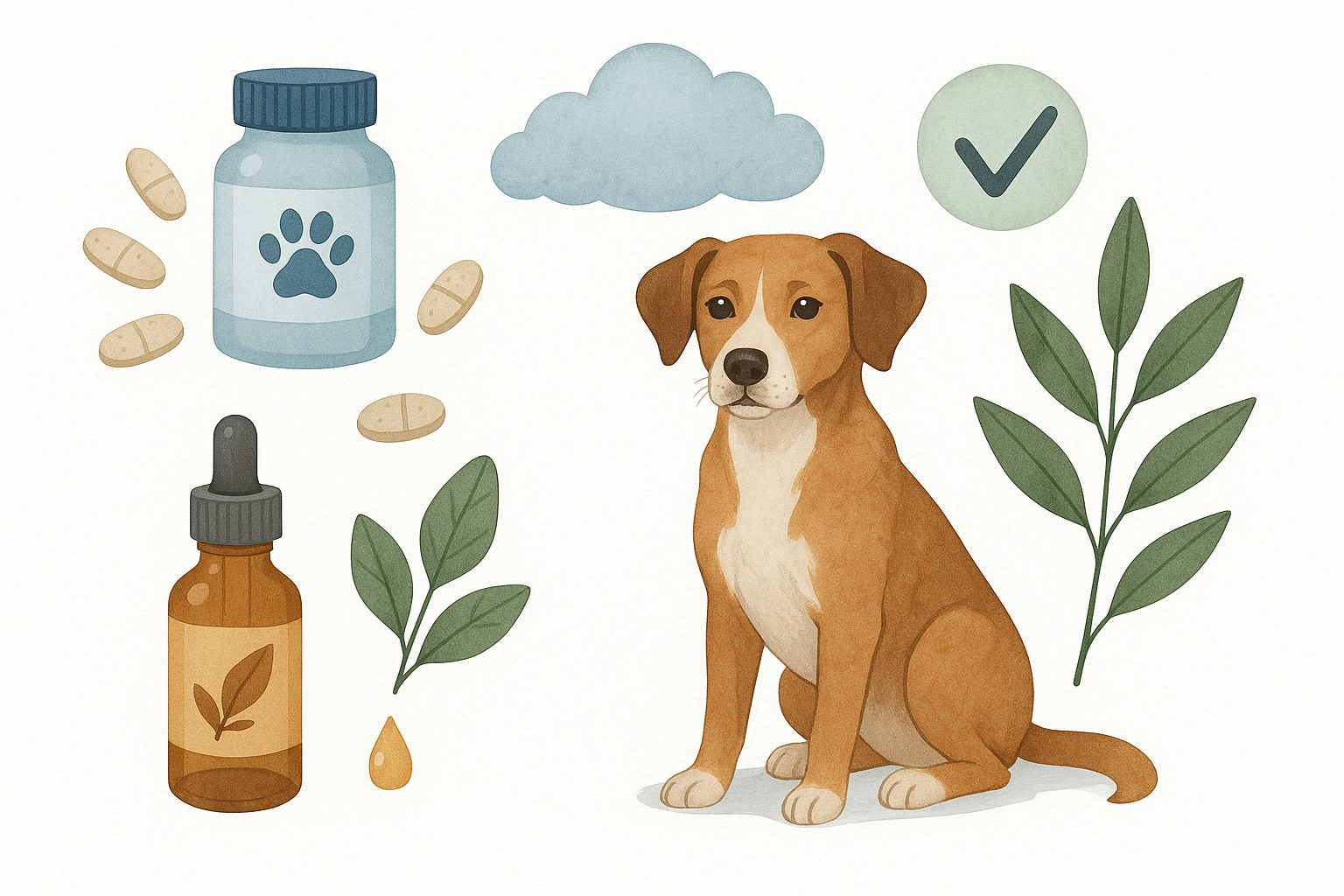
Anxious dogs can pace, whine, pant, cling, bark, hide, shake, or become destructive. That sends owners looking for calming supplements fast. The good news is that some supplements may help mild to moderate stress. The important catch is that they work best when matched to the right problem.

Canine anxiety — whether situational (storms, fireworks, travel) or chronic (separation anxiety, social fear) — is one of the most researched areas of veterinary behavioral medicine. Evidence-backed calming supplements include: L-theanine (Anxitane) with three positive RCTs in dogs showing reduced fear scores; alpha-casozepine (Zylkene), a casein-derived peptide with three veterinary RCTs showing reduced anxiety responses; Adaptil (dog-appeasing pheromone, DAP) with modest but consistent evidence across multiple studies; and melatonin for noise-phobia and situational anxiety. Combination products stacking these ingredients are common. CBD is increasingly used but veterinary evidence is still emerging. Prescription anxiolytics (fluoxetine, trazodone, alprazolam) have the strongest evidence for severe chronic anxiety and should be discussed with a veterinarian.
- Alpha-casozepine (Zylkene, 15 mg/kg/day) is derived from casein and acts on GABA-A receptors similarly to benzodiazepines — three controlled veterinary studies found it reduces fear and anxiety scores in dogs with social fears and noise phobia without the sedation or dependency risk of pharmaceutical benzodiazepines.
- L-theanine (Anxitane) has 3 veterinary clinical trials: two positive studies for noise-related fear and one for social fears — doses of 5 mg/kg/day shown to be effective. It works by increasing GABA, glycine, and serotonin neurotransmitter activity. Results are moderate — it reduces anxiety expression without causing sedation.
- Dog-appeasing pheromone (DAP/Adaptil) — synthetic analogue of the pheromone secreted by nursing mother dogs — has the most veterinary publications (15+ studies) of any non-drug calming intervention: it reduces fear responses in puppies, reduces noise-phobia severity, and helps during transport. Diffusers work best for home environments; collars for on-the-go situations.
- Melatonin (1-3 mg for small dogs, 3-9 mg for large dogs, given 30-60 min before triggering event) is commonly used for noise phobia and storm anxiety — veterinary case series and some controlled data support its use, though large RCTs in dogs are lacking. Safety profile is excellent and it is widely recommended by veterinarians for situational anxiety.
- CBD for dogs is gaining traction but the veterinary evidence base is early-stage: a 2019 Cornell study found CBD oil (2 mg/kg twice daily) did not worsen behavior scores and was well-tolerated, but it was designed for pain (OA), not anxiety specifically. Safety at recommended doses appears good; efficacy for anxiety requires more controlled trials.
A dog with thunderstorm fear, separation distress, chronic pain, or generalized anxiety may not respond the same way. Supplements can be useful, but they are often adjuncts, not stand-alone fixes.
The short answer: which calming ingredients are most reasonable?
The better-known evidence-aware options include:
- L-theanine, an amino acid used for relaxation support [1]
- Alpha-casozepine, a milk-derived peptide found in some veterinary calming products [2]
- Probiotics aimed at the gut-brain axis, an emerging area with early animal data [3]
- Melatonin, used more for situational calming or sleep timing than broad anxiety treatment [4]
Herbal blends may help some dogs, but they are harder to evaluate because formulas vary so much.
First: make sure it is actually anxiety
Medical problems can look like anxiety
Pain, itching, cognitive decline, sensory loss, and GI upset can all make a dog seem restless or distressed. Older dogs especially deserve a medical check before you assume the problem is purely behavioral.
Behavior context matters
Ask whether the anxiety happens during storms, when left alone, around visitors, or all day with no clear trigger. That pattern helps determine whether a calming supplement is likely to be enough.
Common calming supplement ingredients for dogs
L-theanine
L-theanine is one of the more credible non-sedating options. It is thought to support a calmer mental state without functioning like a heavy tranquilizer. Veterinary products using L-theanine have shown encouraging results in stress-related behaviors [1].
Alpha-casozepine
This milk protein derivative is found in several canine calming diets and supplements. Some veterinary literature suggests it may help dogs prone to stress, noise sensitivity, or anxious behavior [2].
Melatonin
Melatonin is not a universal anxiety cure, but it may be useful for situational events such as travel, fireworks, or nighttime restlessness. Dosing varies by size, so your veterinarian should guide it, especially for dogs with endocrine disease.
Probiotic-based calming support
The gut-brain axis is getting more attention in both people and animals. Certain probiotic strains have shown behavior-related promise in animal research, but this area is still developing for dogs [3].
Hemp or CBD products
These are widely marketed, but quality, legality, and consistency are uneven. Some early canine studies suggest possible benefit for stress or pain, yet product standardization remains a major issue [5]. If you consider one, veterinary guidance matters.
How to tell if a calming supplement is good
Prefer single-purpose formulas or transparent blends
A label should clearly tell you what active ingredients are included, how much is present, what size dog the serving fits, and whether the manufacturer provides testing information.
Avoid “knockout” expectations
The best calming supplements aim for a milder nervous system response, not sedation. If your dog is panicking, self-injuring, or cannot function normally, a supplement is probably not enough.
Best use cases for calming supplements
Supplements may be most helpful for:
- mild daily nervousness
- travel stress
- visitor-related arousal
- grooming or vet-visit support
- storm or fireworks prep when started early
They may be less effective alone for severe separation anxiety, bite-risk behavior, or trauma-level fear.
What to combine with supplements
Behavior modification matters
Desensitization and counterconditioning often make the biggest difference long term. Supplements may help lower the intensity enough for training to work better.
Environmental support helps too
Use predictable routines, quiet recovery spaces, lick mats, scent enrichment, and white noise for trigger events.
Sometimes medication is the humane choice
There is no prize for avoiding prescription help if your dog is suffering. Veterinary behavior medicine can be life-changing for severe cases.
FAQ
What is the best calming supplement for anxious dogs?
L-theanine and alpha-casozepine are among the more evidence-aware options. Melatonin can also be useful for specific situations.
Do calming chews work for dogs?
Some do, especially for mild stress. Results depend heavily on ingredient quality, the anxiety trigger, and whether other training or medical care is included.
How fast do calming supplements work?
Some situational products may work within hours, while others need daily use for several days or weeks to assess.
Are calming supplements safe for senior dogs?
Often yes, but older dogs should be screened for pain, cognitive decline, and drug interactions before starting new products.
- Pike AL, Horwitz DF, Lobprise H. An open-label prospective study of the use of L-theanine in storm-sensitive client-owned dogs. J Vet Behav. 2015;10(4):324-331. doi:10.1016/j.jveb.2015.04.002.
- Beata C, Beaumont-Graff E, Diaz C, et al. Effects of alpha-casozepine on anxiety in dogs. J Vet Behav. 2007;2(2):40-46. doi:10.1016/j.jveb.2007.01.003.
- Kirchoff NS, Udell MAR, Sharpton TJ. The gut microbiome correlates with conspecific aggression in a small population of rescued dogs. PeerJ. 2019;7:e6103. doi:10.7717/peerj.6103.
- Plumb DC. Plumb’s Veterinary Drug Handbook. Melatonin monograph.
- Morris EM, Kitts-Morgan SE, Spangler DM, et al. The impact of cannabidiol on canine aggressive behavior and stress response. Front Vet Sci. 2021;8:759565. doi:10.3389/fvets.2021.759565.
—
This article is for informational purposes only and does not replace veterinary advice. If your dog is panicking, self-harming, or becoming aggressive, involve a veterinarian or veterinary behaviorist promptly.
Related Articles
- Best Pet Supplements for Dogs and Cats
- Probiotics for Cats With Digestion Issues
- Omega-3 Supplements for Pets
- Multivitamins for Picky Dogs
- Best Joint Supplements for Senior Dogs
Sources
- Reviews on nutraceutical and supplement approaches for canine anxiety. PubMed search.
- Studies on L-theanine for stress and anxiety support in dogs. PubMed search.
- Studies on alpha-casozepine and calming support in dogs. PubMed search.
- Clinical studies on nutraceutical support for canine noise phobia and stress behaviors. PubMed search.
- Reviews on veterinary behavior supplements and calming aids for dogs. PubMed search.
📚 Part of our Best Pet Supplements hub. Explore all our pet health guides.



Leave a Reply