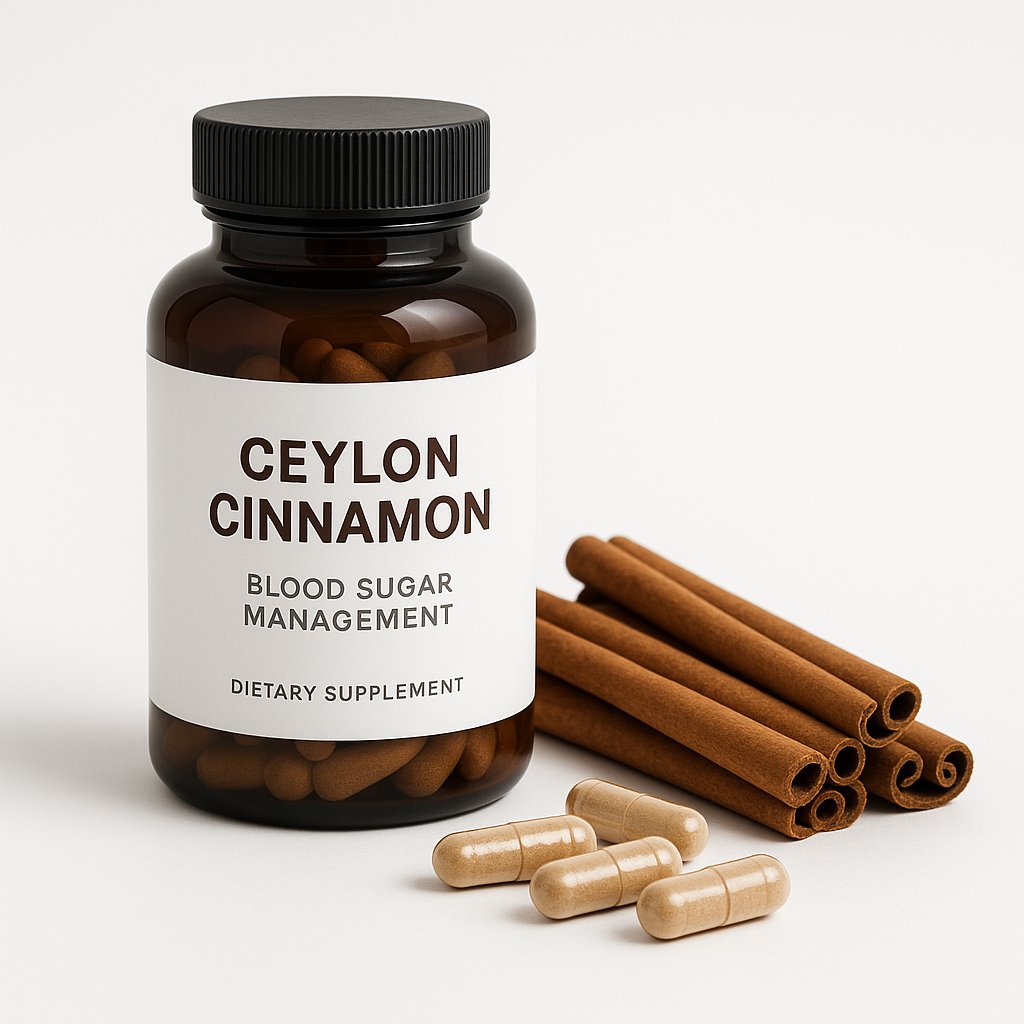
Quick Answer: Cinnamon can modestly improve blood sugar markers in some people, especially those with poorer baseline control, but effects are usually small. If using cinnamon daily, Ceylon is generally safer than Cassia due to lower coumarin content.
Key Takeaways
- Cinnamon has plausible mechanisms and mixed-but-positive human evidence for glucose support.
- The average effect is usually modest, not medication-level.
- Cassia is used in many studies but has higher coumarin, which can raise liver safety concerns with chronic high intake.
- Ceylon is lower in coumarin and often preferred for long-term daily use.
- Standardized extracts and clear labeling are more useful than random powder dosing.
- Cinnamon works best as part of a full metabolic plan, not as a stand-alone fix.
Why Cinnamon Became a Blood Sugar Staple
Cinnamon is inexpensive, familiar, and easy to add to daily routines. That makes it one of the most tried natural interventions in metabolic health. It also has a rare advantage in supplement culture: there is actual clinical trial data, not just anecdotes.
The challenge is interpretation. Some meta-analyses show clear benefit, others show weak or inconsistent outcomes. The difference often comes down to population, dose, cinnamon type, and study quality.
For bigger-picture context:
Ceylon vs Cassia: The Safety and Evidence Tradeoff
Cassia cinnamon
- Most common supermarket type
- Frequently used in older blood sugar trials
- Higher coumarin content
- Coumarin in high chronic intake can stress liver function in susceptible people
Ceylon cinnamon (“true cinnamon”)
- Lower coumarin levels
- Better fit for long-term daily use
- Historically less represented in older studies, but increasingly preferred in practical protocols
Practical conclusion
If your goal is regular supplementation, Ceylon is usually the safer long-term choice. If a product does not clearly specify cinnamon species, that is a quality red flag.
What Clinical Trials Suggest
The positive signal
Many pooled analyses report improvements in fasting glucose, and some show small HbA1c reductions, especially in type 2 diabetes populations with elevated starting values.
Why results vary so much
- Different cinnamon species and extraction methods
- Wide dose ranges
- Different durations (too short in some trials)
- Baseline control varies widely across participants
- Medication co-use not always consistent
When you average all this together, cinnamon looks helpful but not uniformly powerful.
Realistic effect framing
Think of cinnamon as a “small edge” intervention. A small edge is still useful if it is safe, sustainable, and combined with stronger drivers like diet, movement, sleep, and medication adherence where needed.
Mechanisms: Why It Could Help
Cinnamon’s proposed mechanisms include:
- Supporting insulin signaling pathways
- Slowing gastric emptying in some contexts
- Influencing carbohydrate digestion enzymes
- Providing polyphenol-driven antioxidant activity
Mechanistic plausibility is good, but mechanism alone does not guarantee clinical magnitude. This is why outcomes remain modest in many trials.
Dosing and Product Selection
Common supplemental ranges
- Powder use in studies often ranged around 1–6 g/day
- Extract products often use lower milligram doses due to concentration
Practical starting approach
- Start conservatively (for example, a low daily extract dose)
- Reassess fasting and post-meal trends after 8–12 weeks
- Prefer standardized products with transparent species labeling
Label checklist
- Cinnamon species specified (Ceylon vs Cassia)
- Third-party testing or quality assurance
- Coumarin transparency if Cassia is used
- Clear active amount per serving
Safety and Interactions
Main concern: coumarin load (mostly Cassia)
High chronic Cassia intake can push coumarin exposure above conservative safety thresholds for some people.
Other cautions
- Potential additive blood sugar lowering with medication
- Occasional GI discomfort
- Rare allergic sensitivity
If you are on medication for diabetes, increase monitoring when introducing cinnamon supplements.
How Cinnamon Fits Into a Smart Blood Sugar Stack
Cinnamon is usually best in one of two roles:
- Entry-level support for people making first metabolic changes
- Secondary add-on for people already doing foundational work
It is less ideal as a “single solution.”
Useful sibling reads:
- Gymnema Sylvestre for Blood Sugar
- Alpha-Lipoic Acid for Blood Sugar and Neuropathy
- Chromium Picolinate for Blood Sugar
Evidence-Informed Expectations by User Type
Different users should expect different outcomes:
- Prediabetes with high processed-carb intake: may see small-to-moderate fasting/post-meal improvements when combined with diet changes.
- Well-controlled type 2 diabetes on strong medication regimens: usually sees smaller incremental effect.
- Healthy individuals using cinnamon as prevention tool: likely minimal measurable glucose change, but culinary use can still support diet quality.
This expectation-matching prevents over-promising and helps people decide whether cinnamon is worth continuing after a structured trial.
FAQ
Is cinnamon actually effective for blood sugar?
It can be modestly helpful, especially in people with elevated baseline glucose, but effects are usually small.
Which cinnamon is better for daily use?
Ceylon is generally preferred for long-term use because it contains much less coumarin.
How long should I take cinnamon before evaluating results?
A fair trial window is 8–12 weeks with consistent routine and objective tracking.
Can I just use kitchen cinnamon?
You can, but dosage consistency and species certainty are harder. Supplements can offer better standardization.
Is cinnamon enough to reverse diabetes?
No. It is an adjunctive tool, not a replacement for comprehensive care.
Common Mistakes That Make Cinnamon “Fail”
Many people conclude cinnamon does nothing because protocol quality is poor. The ingredient may not be the only issue.
Frequent mistakes include:
- Using unknown-species powder without dose consistency
- Expecting changes in one week
- Taking cinnamon while continuing high sugar and low fiber patterns
- Ignoring sleep and inactivity, which overpower small supplement effects
- Choosing products that hide active concentrations in proprietary blends
Cinnamon is a marginal helper. If fundamentals are unchanged, marginal helpers become invisible.
Who Should Prioritize Caution
Caution matters most in:
- People with liver enzyme abnormalities (especially with Cassia use)
- People already on multi-drug glucose-lowering regimens
- People taking multiple herbal glucose agents simultaneously
For these users, conservative dosing and periodic lab monitoring are more important than chasing maximal short-term effect.
12-Week Decision Framework
At week 12, classify your outcome:
- Responder: measurable fasting/post-meal improvement + good tolerance
- Partial responder: mild benefit, keep only if easy and safe
- Non-responder: discontinue and redirect effort to higher-impact actions
This framework prevents supplement drift where people keep taking products indefinitely with no objective benefit.
Bottom Line
Cinnamon is one of the more evidence-aware natural options for blood sugar support, but expectations should stay realistic. The effect is usually modest, and safety depends heavily on cinnamon type. If you choose it, prioritize Ceylon, quality labeling, and integration into a bigger metabolic strategy.
Related Articles
- Cinnamon Supplements for Blood Sugar: Ceylon vs. Cassia
- Berberine Benefits in 2026: Blood Sugar, Weight Loss, and How to Choose a Good Supplement
- Best Supplements for Blood Sugar in 2026
- Best Supplements for Metabolic Health and Blood Sugar
- Best Metabolic Health Stacks: Blood Sugar & More
Sources
- The effect of cinnamon supplementation on glycemic control in patients with type 2 diabetes mellitus: An updated systematic review and dose-response meta-analysis of randomized controlled trials. Phytotherapy research : PTR. 2024. PMID: 37818728.
- The effect of Gymnema sylvestre supplementation on glycemic control in type 2 diabetes patients: A systematic review and meta-analysis. Phytotherapy research : PTR. 2021. PMID: 34467577.
- Safety and efficacy of alpha-lipoic acid oral supplementation in the reduction of pain with unknown etiology: A monocentric, randomized, double-blind, placebo-controlled clinical trial. Biomedicine & pharmacotherapy = Biomedecine & pharmacotherapie. 2021. PMID: 34649217.
- National Institutes of Health Office of Dietary Supplements. Dietary supplement fact sheets.
- Wallace TC, Cowan-Pyle AE, Klatt KC, Bailey RL (2025). Relationship of Choline Intake with Biomarkers of Liver Health by Genotype-A Cross-Sectional Analysis. The Journal of nutrition. PMID: 40306555.