
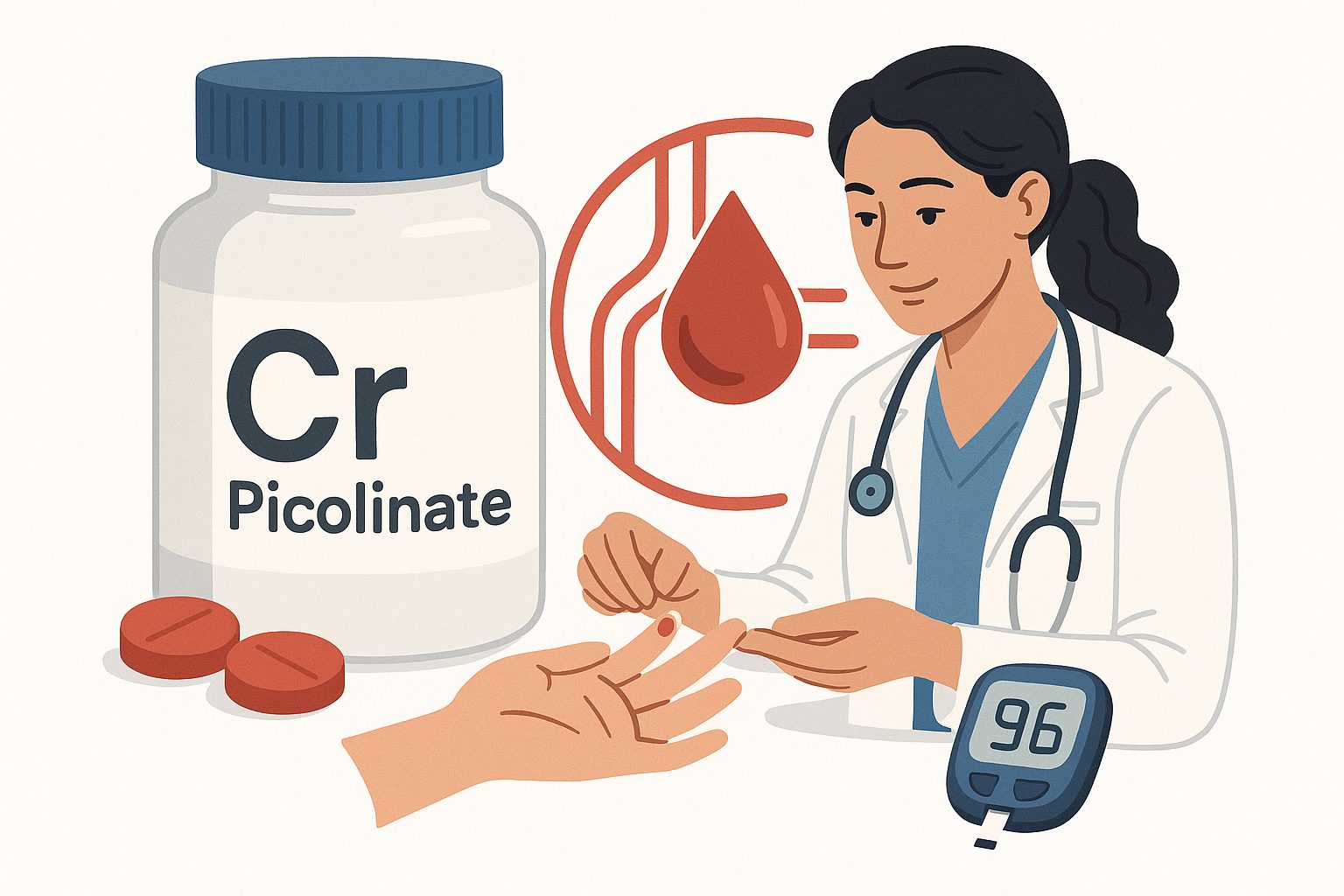
Chromium is an essential trace mineral involved in insulin signaling. Chromium picolinate is the most studied supplemental form – and the one with the most (and most contentious) clinical data for blood sugar management.

Quick Answer: Chromium picolinate has inconsistent clinical evidence for blood sugar control. Some meta-analyses show modest improvements in fasting glucose and HbA1c in people with type 2 diabetes, but effect sizes are small and study quality is variable. Chromium is genuinely involved in insulin signaling, but whether supplementation adds benefit beyond correcting subclinical deficiency is unclear. Evidence does not support it as a standalone glucose-lowering intervention.

Key Takeaways

  • Chromium is a trace mineral that enhances insulin receptor signaling by interacting with chromodulin (a chromium-binding protein in insulin-sensitive cells).
  • Meta-analyses show small but statistically significant reductions in fasting glucose and HbA1c in type 2 diabetics, but effect sizes are modest.
  • Results are inconsistent across studies; benefit may be concentrated in people with true chromium insufficiency rather than broader populations.
  • Chromium picolinate is better absorbed than chromium chloride; picolinate form is preferred in research.
  • Evidence is insufficient to recommend chromium as a primary glucose-management supplement; it is at best a supportive option alongside diet and exercise.

The Mechanism

Chromium appears to enhance insulin receptor activity by increasing insulin receptor substrate phosphorylation. It may also upregulate GLUT-4 transporters, helping cells absorb glucose more efficiently. The key word is “appears” – the molecular mechanism is still debated.

What the Clinical Trials Show

The Positive Data

  • Anderson et al. (1997): The landmark study. 180 Chinese adults with type 2 diabetes randomized to 200 mcg, 1,000 mcg chromium picolinate, or placebo for 4 months. The 1,000 mcg group showed significant reductions in fasting glucose, 2-hour glucose, fasting insulin, and HbA1c. The 200 mcg group showed smaller improvements.
  • Martin et al. (2006): 37 adults with type 2 diabetes. 1,000 mcg/day for 6 months improved insulin sensitivity (measured by euglycemic clamp – the gold standard) by 8.9%.
  • Meta-analyses (2014, 2020): Pooled analyses of 20-28 RCTs show modest fasting glucose reduction (~0.9 mmol/L) and HbA1c reduction (~0.6%) in diabetic populations.

The Skeptical Data

  • Kleefstra et al. (2006): 57 well-controlled Dutch type 2 diabetics saw no improvement with 500 mcg/day for 6 months. This study is often cited because the population was well-nourished and already on medication.
  • ADA Position: The American Diabetes Association has stated there is “insufficient evidence” to recommend chromium for glycemic control. Their concern: the best results come from populations likely to be chromium-deficient.

Reconciling the Contradiction

The most honest interpretation: chromium supplementation helps people who are chromium-insufficient, and does little for those who aren’t. This is consistent with its role as an essential nutrient – supplementing when you’re deficient fixes something, supplementing when you’re replete adds nothing.

Chromium Picolinate for Blood Sugar: What the Research Actually Shows

Who might be chromium-insufficient?

  • People eating highly processed diets (refining strips chromium)
  • Older adults
  • People with high sugar intake (sugar increases chromium excretion)
  • Athletes with high training volumes

Dosing

From trials: 200-1,000 mcg/day of chromium picolinate.

Most benefit seen at 400-1,000 mcg in deficient populations. The Adequate Intake (AI) is only 20-35 mcg/day, so therapeutic doses are well above nutritional intake.

Safety

  • Well tolerated in most trials up to 1,000 mcg/day for 6 months
  • Rare case reports of kidney damage at very high chronic doses
  • Drug interaction: Can potentiate insulin and sulfonylureas – hypoglycemia risk. Monitor closely.
  • The picolinate form specifically has been questioned (picolinic acid chelation), but no clinical toxicity has been demonstrated

Other Chromium Forms

  • Chromium polynicotinate: Less studied, some positive results
  • Chromium chloride: Poorly absorbed; older studies used this form
  • Chromium-enriched yeast: Some European trials use this; results comparable to picolinate

Bottom Line

Chromium picolinate is a reasonable, cheap, low-risk supplement for blood sugar support – especially if your diet is processed-food-heavy or you suspect insufficiency. Don’t expect dramatic results if you’re well-nourished and already on medication. It’s a gap-filler, not a game-changer.

For a broader view of blood sugar supplements, see our complete blood sugar supplement guide. For berberine specifically (stronger evidence), see our berberine guide.

Frequently Asked Questions

Does chromium picolinate lower blood sugar?

Some meta-analyses show small improvements in fasting glucose and HbA1c with chromium supplementation, particularly in type 2 diabetics. However, effect sizes are modest and results vary across trials. It is not a reliable standalone treatment for blood sugar management.

What is the best dose of chromium picolinate for blood sugar?

Research has used 200-1000 mcg/day. Many trials use 400-600 mcg/day. The chromium picolinate form is preferred over chromium chloride for bioavailability. There is no strong evidence for a dose-response effect above 400-600 mcg/day.

Is chromium picolinate safe?

At typical supplement doses (up to 1000 mcg/day), chromium picolinate appears safe in short-term studies. Very high doses (far above supplement levels) have been associated with kidney and liver toxicity in case reports. The picolinate form has faced some theoretical concerns about DNA damage at high doses in cell studies, but human safety data at normal supplement doses appears acceptable.

Can chromium picolinate help with sugar cravings?

Some small studies suggest chromium supplementation may reduce carbohydrate cravings in people with binge eating patterns, but this is a distinct and more speculative area from blood sugar management. Evidence is very preliminary.

References

  • Anderson RA et al. (1997) Chromium supplementation and type 2 diabetes. Diabetes.
  • Kleefstra N et al. (2006) Chromium and type 2 diabetes. Diabetes Care.
  • Martin J et al. (2006) Chromium picolinate and insulin sensitivity. Diabetes Obes Metab.
  • Costello RB et al. (2016) Chromium supplements for glycemic control. Diabetes Technol Ther.
  • Asbaghi O et al. (2020) Chromium and type 2 diabetes meta-analysis. J Trace Elem Med Biol.

Related Articles

Sources

This article is not medical advice. Always consult a physician before taking any supplements.

4 responses

  1. […] Chromium Picolinate for Blood Sugar: What the Research Actually Shows […]

  2. […] Chromium Picolinate for Blood Sugar: What the Research Actually Shows […]

  3. […] Chromium Picolinate for Blood Sugar: What the Research Actually Shows […]

  4. […] Chromium Picolinate for Blood Sugar: What the Research Actually Shows […]

Leave a Reply

The Expert

Join Richard as he dives into the health benefits and life changing aspects of natural supplements, treatments, etc.

PHP Code Snippets Powered By : XYZScripts.com

Discover more from New Online Products

Subscribe now to keep reading and get access to the full archive.

Continue reading