
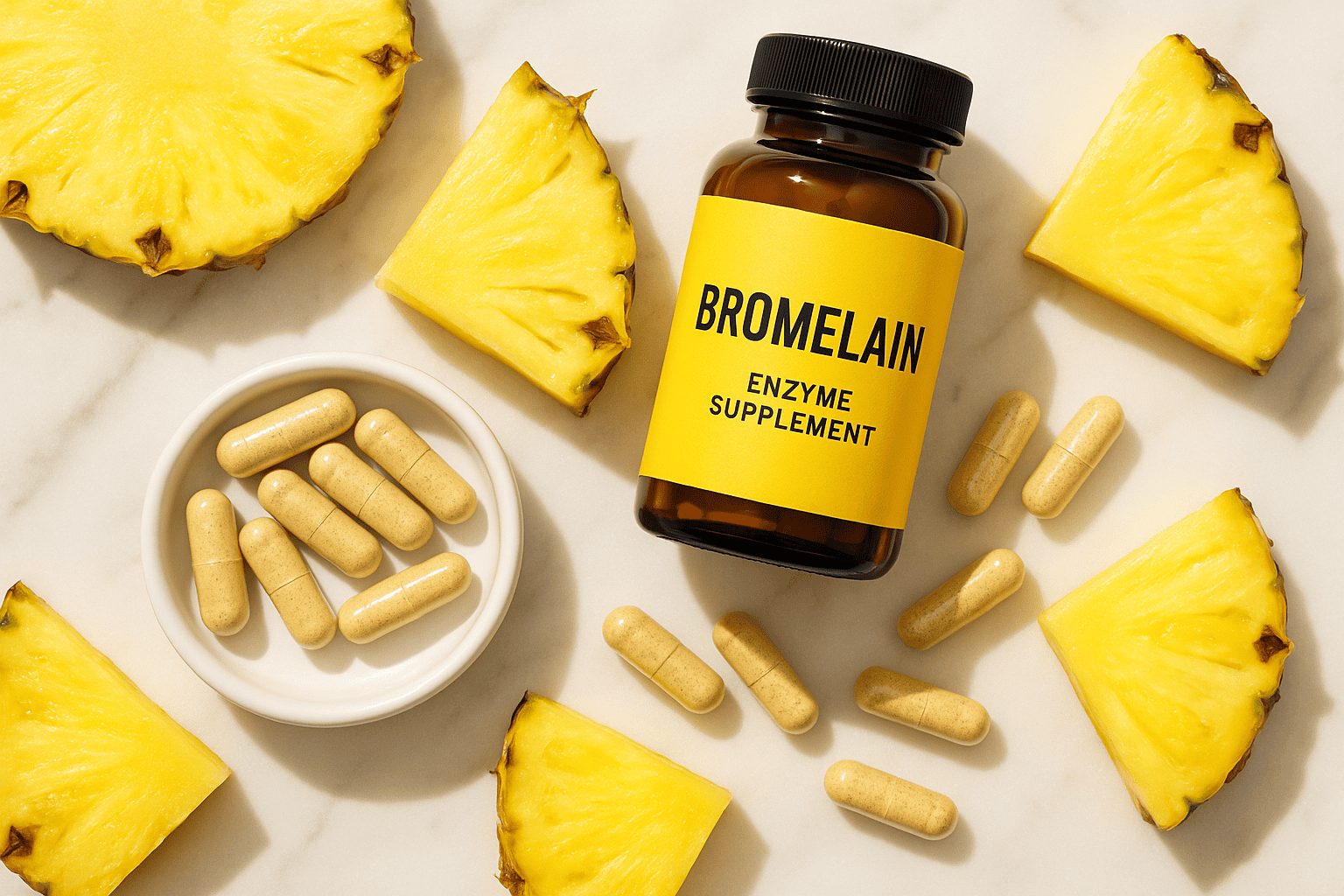
Bromelain Supplements: Evidence & Dosing Guide

Quick Answer: Bromelain is a proteolytic enzyme from pineapple with evidence for reducing sinusitis inflammation, post-surgical swelling, and osteoarthritis pain. For digestive support, take with meals. For systemic anti-inflammatory effects, take away from food on an empty stomach. The evidence is real but moderate quality overall.
Bromelain is one of those supplements that sits comfortably between food ingredient and therapeutic agent. As a protease from pineapple (Ananas comosus), it’s used in both digestive enzyme blends and as a standalone systemic anti-inflammatory. The distinction between these two applications — digestive vs. systemic — fundamentally affects when and how you should take it, and the evidence base for each is different.
What Is Bromelain?
Bromelain is actually a mixture of several proteolytic (protein-digesting) enzymes found in the stem and fruit of pineapple. It was first described for therapeutic use in the late 1950s and has been extensively studied in Europe (particularly Germany, where Wobenzym — a multi-enzyme supplement containing bromelain — is widely used).
Key properties:
- Protease activity across a wide pH range (active in both stomach acid and intestinal alkaline environment)
- Well-absorbed intact through the gut wall (unlike many enzymes) — allowing systemic activity
- Anti-inflammatory (inhibits prostaglandins, bradykinin; affects platelet aggregation)
- Fibrinolytic (can dissolve fibrin like nattokinase, though less potent)
- Mucolytic (breaks down mucus proteins)
- Possible anticancer activity in cell studies (induces apoptosis in tumor cells)
- Antibacterial effects against certain pathogens (in vitro)
Bromelain for Digestion
When taken with meals, bromelain helps digest dietary proteins in the stomach and small intestine. This makes it useful for:
- Protein maldigestion: Those with reduced stomach acid (hypochlorhydria) or insufficient pancreatic protease production
- Bloating from high-protein meals: Breaking down large protein chains reduces fermentation of undigested protein fragments by colonic bacteria
- Food sensitivity: Some large, incompletely digested proteins can trigger immune responses; bromelain may reduce this by more completely digesting proteins
Bromelain in digestive enzyme blends: Bromelain is commonly included with amylase, lipase, lactase, and other enzymes in broad-spectrum digestive products. It contributes protease activity with a different pH profile than pancreatic proteases, providing coverage across more of the GI tract.
For comprehensive digestive enzyme guidance, see our Best Digestive Enzyme Supplements in 2026.
Bromelain for Sinusitis
This may be bromelain’s strongest clinical evidence application:
A 2006 meta-analysis in Journal of the Association of Physicians of Great Britain and Ireland found bromelain significantly reduced nasal mucosal inflammation and improved sinus drainage in patients with sinusitis. Multiple European clinical trials support this use.
Mechanism: Bromelain reduces sinus inflammation by:
- Reducing prostaglandin synthesis
- Breaking down mucus (mucolytic activity facilitates drainage)
- Reducing vascular permeability (reduces swelling)
- Inhibiting bradykinin (a mediator of pain and swelling)
Approved as a pharmaceutical for sinusitis in Germany (Wobenzym product line). Standard dose for sinusitis: 200-400 mg/day (between meals).
Bromelain for Swelling and Bruising (Post-Surgical and Traumatic)
Bromelain has consistent evidence for reducing post-operative and post-traumatic swelling and bruising:
- Dental surgery: Multiple RCTs show bromelain reduces postoperative edema and pain after tooth extraction
- Rhinoplasty and facial surgery: Studies show faster resolution of bruising and swelling with bromelain
- Sports injuries: Several trials show accelerated recovery from sprains and contusions
The mechanism involves bromelain’s fibrinolytic activity (breaking down fibrin deposits in bruises) and prostaglandin inhibition. Standard dose for this application: 250-500 mg 2-3x/day between meals, starting 2-3 days before and continuing 5-10 days after procedure or injury.
Bromelain for Osteoarthritis
Several trials support bromelain for osteoarthritis pain, often as part of a combination:
- Phlogenzym (bromelain + trypsin + rutin): Multiple European RCTs showed this combination comparable to diclofenac (anti-inflammatory drug) for OA of the knee in terms of pain and function
- Standalone bromelain: A 2006 RCT found 540 mg/day bromelain for 4 weeks significantly reduced knee OA pain compared to placebo
- The effect size is modest but consistent, with the advantage of avoiding NSAID side effects (GI, cardiovascular)
Other Applications with Emerging Evidence
Colon health: Some evidence that bromelain may benefit IBD (inflammatory bowel disease) through immunomodulatory effects on intestinal epithelium
Cancer adjunct: In vitro and animal studies show bromelain induces apoptosis in tumor cells and modulates tumor microenvironment. No human RCT evidence for cancer treatment.
Cardiovascular: Antiplatelet and fibrinolytic activity may support vascular health — additive with other blood-thinning approaches (use caution)
Muscle recovery: Some evidence for reduced muscle soreness after exercise, similar to tart cherry

Dosing: The Critical Timing Issue
This is the most important practical point about bromelain supplementation:
WITH meals: Acts as a digestive enzyme, helping digest dietary proteins. Bromelain is occupied with food proteins and primarily stays in the GI tract.
BETWEEN meals / empty stomach (2+ hours after or before food): Bromelain absorbs through the intestinal wall into systemic circulation. This is when it has anti-inflammatory, fibrinolytic, and mucolytic effects throughout the body.
You cannot achieve both goals simultaneously with the same dose. Choose your primary application:
- Digestive support → take with meals
- Anti-inflammatory/systemic → take between meals (morning on empty stomach and/or evening 2+ hours after dinner)
Dosing:
- Digestive: 200-400 mg with each protein-containing meal
- Anti-inflammatory: 250-500 mg 2-3x/day away from food
- Sinusitis: 200-400 mg 2-3x/day between meals
- Post-surgical swelling: 500 mg 2-3x/day between meals
Potency: Bromelain is measured in GDU (gelatin digesting units) or MCU (milk clotting units) or FIP units. 2,000-2,400 GDU/gram is standard; some products are listed as mg without enzyme activity units — less informative.
Safety and Interactions
Generally safe: Bromelain has an excellent safety profile at typical supplement doses. Most adverse effects are mild (GI upset, diarrhea at high doses).
Interactions:
- Blood thinners (warfarin, heparin): Bromelain has antiplatelet and fibrinolytic activity — potential additive bleeding risk. Use with caution; inform physician
- Antibiotics (tetracyclines, amoxicillin): Bromelain may increase blood levels of these antibiotics — potentially beneficial (can enhance antibiotic effect) but unpredictable
- ACE inhibitors: Possible interaction; monitor
- Chemotherapy: Some preclinical evidence suggests bromelain may enhance certain chemotherapy drugs — discuss with oncologist
Allergy: Those with pineapple allergy or latex allergy should avoid bromelain (cross-reactivity is possible)
Pregnancy: Insufficient safety data; avoid during pregnancy as high doses may have uterine effects
Key Takeaways
- Bromelain has genuine evidence for sinusitis, post-surgical edema, osteoarthritis pain, and general anti-inflammatory effects
- The systemic anti-inflammatory effect requires taking bromelain on an empty stomach — taken with food, it acts as a digestive enzyme
- Timing determines the application: with food for digestion, between meals for systemic effects
- Evidence quality is mostly European trials, with many showing good results; total RCT database is moderate-sized
- Drug interactions with anticoagulants are clinically significant — inform your physician
- Bromelain + quercetin is a classic anti-inflammatory pairing — both flavonoids and enzymes contribute complementary mechanisms
Frequently Asked Questions
Can I get enough bromelain from eating pineapple?
Pineapple contains meaningful amounts of bromelain, particularly in the core. However, canned or cooked pineapple has minimal bromelain (heat destroys the enzyme). Fresh pineapple (especially the core) provides some active bromelain, but the amounts are substantially below concentrated supplement doses used in clinical trials.
The quercetin-bromelain pairing is also being studied for gut inflammation and mucosal protection. See our detailed review of quercetin paired with bromelain for gut inflammation and stomach mucosal protection.
Quercetin is the classic pairing partner for bromelain. For a full breakdown of forms and evidence, see our guide on quercetin paired with bromelain for anti-inflammatory and immune support.
How long does bromelain take to work for sinusitis?
Most sinusitis trials showed improvements within 1-3 weeks of consistent use. Some patients notice symptomatic improvement (easier drainage, reduced congestion) within 3-7 days.
Is bromelain better than NSAIDs for inflammation?
For mild-to-moderate inflammation (osteoarthritis, post-surgical edema), bromelain provides meaningful benefit with far fewer GI and cardiovascular side effects than chronic NSAID use. It’s generally less potent for acute pain than NSAIDs, but as a maintenance anti-inflammatory with better tolerability, it’s a reasonable alternative or adjunct.
Does bromelain interfere with probiotics?
No direct interference established. Taking them at different times is a reasonable precaution but not strictly necessary.
Can athletes use bromelain for recovery?
Yes — there’s modest evidence for reduced muscle soreness and faster recovery from muscle damage. Taking bromelain between meals post-training makes sense. Best Performance & Recovery Supplements in 2026 covers the broader recovery supplement landscape.
Sources
- Reviews on bromelain and anti-inflammatory effects. PubMed search.
- Reviews on bromelain and digestive support. PubMed search.
- Reviews on bromelain and sinusitis. PubMed search.
- Reviews on bromelain dosing and safety. PubMed search.
- NIH ODS. Dietary supplement fact sheets.
Related Articles
- Turmeric for Joints and Inflammation
- Best Quercetin Supplements
- Digestive Enzyme vs Probiotic
- Pineapple Juice for Cough in 2026
- Supplement Stacking Guide
Related Articles
- Best Digestive Enzyme Supplements in 2026
- Bromelain and Horse Chestnut for Swelling
- Best Turmeric & Curcumin Supplements in 2026
- Best Performance & Recovery Supplements in 2026

Leave a Reply