If you are shopping for a butyrate supplement, you will quickly hit a confusing choice: tributyrin vs sodium butyrate.
Quick Answer
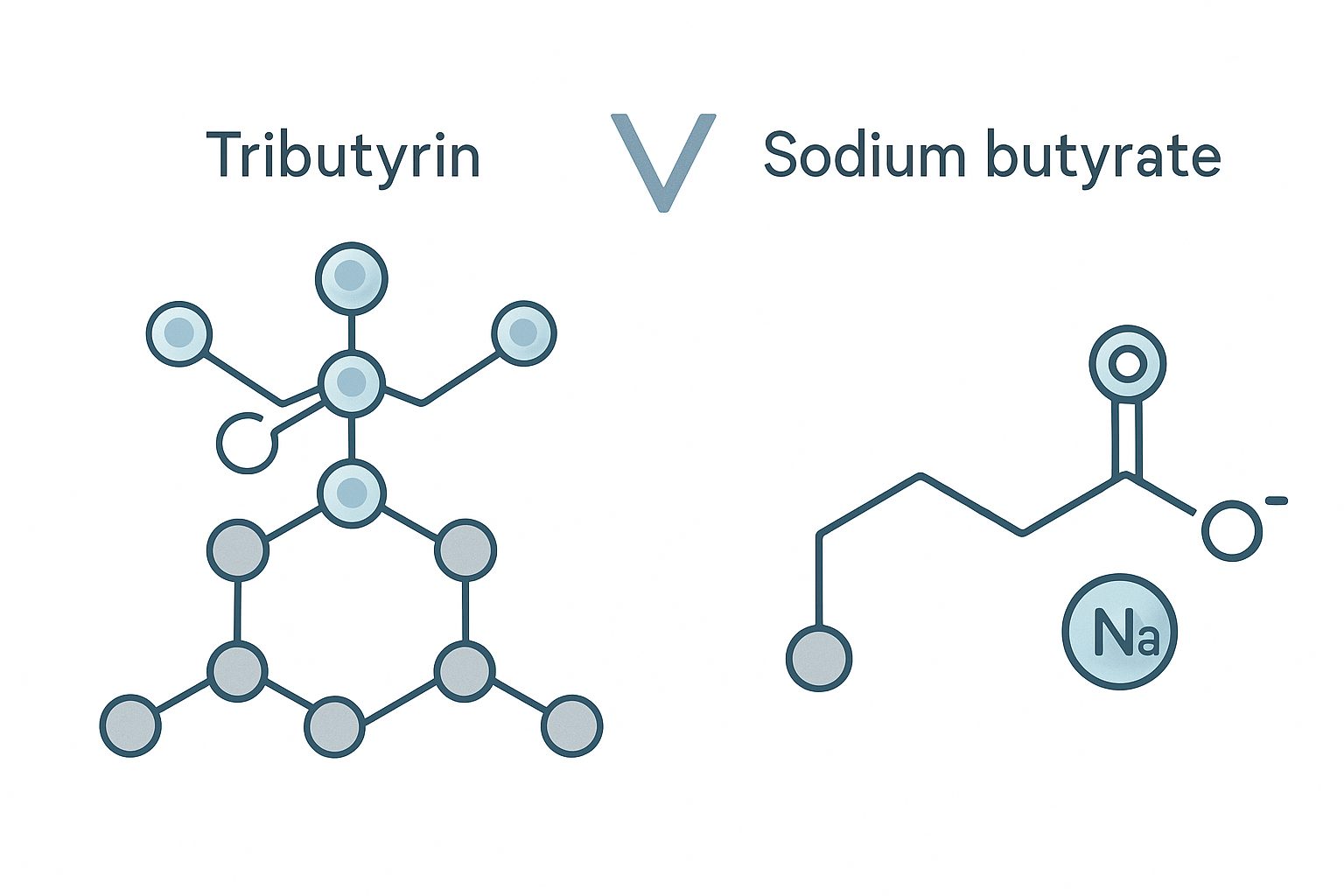
Tributyrin and sodium butyrate are both butyrate supplement forms but differ substantially in delivery, bioavailability, and clinical relevance. Sodium butyrate is a straightforward salt of butyric acid that releases butyrate rapidly in the stomach and small intestine – most of it is absorbed before reaching the colon where it is most needed. Tributyrin is a triglyceride ester of butyric acid: it resists gastric breakdown, is transported via the lymphatic system as a fat, and is cleaved by intestinal lipases progressively throughout the GI tract, delivering butyrate further down and at the colon. For colonocyte fuel and tight-junction support, tributyrin’s delivery profile is generally considered superior.
Key Takeaways
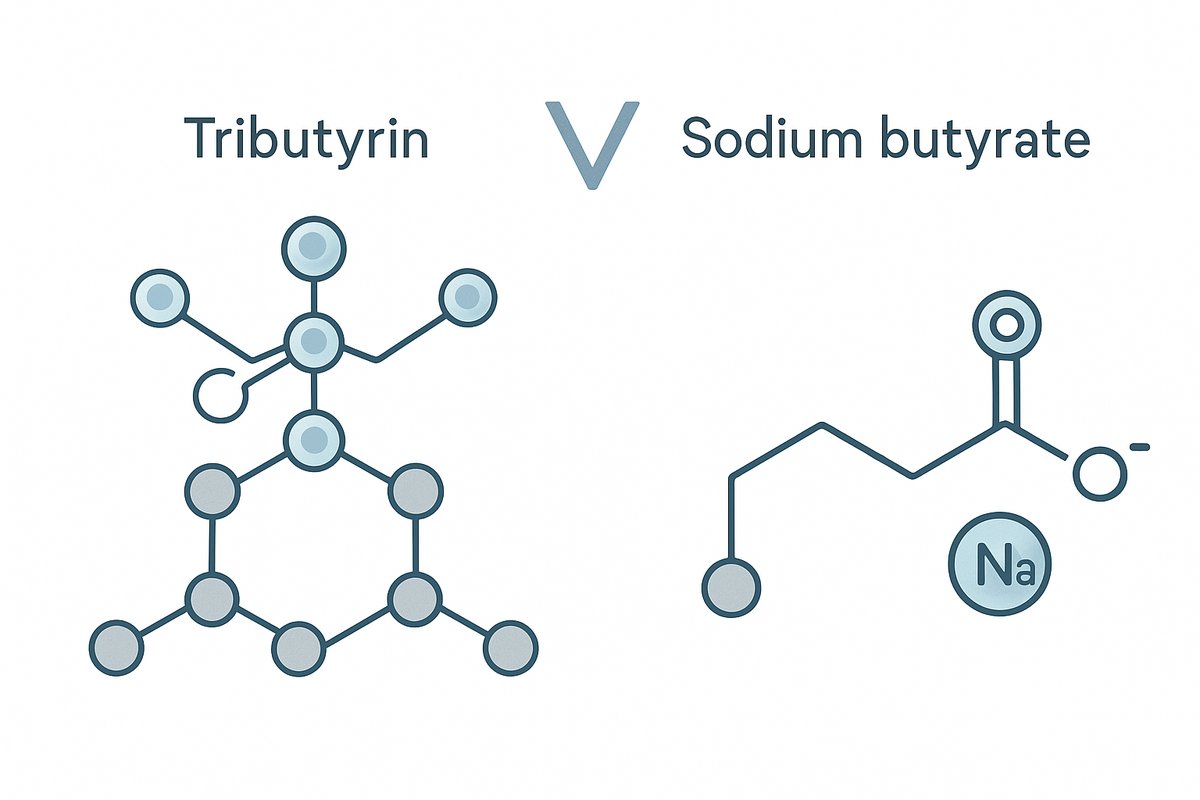
- Tributyrin is structurally a triglyceride (glycerol + three butyric acid chains) – it is absorbed via the lymphatic system like other dietary fats, bypassing first-pass hepatic metabolism and releasing butyrate gradually as lipases cleave the ester bonds throughout the GI tract.
- Sodium butyrate has a characteristic unpleasant smell (butyric acid is the compound responsible for the smell of vomit) – enteric-coated sodium butyrate capsules largely address this, but the fundamental proximal absorption problem remains unless microencapsulated with delayed-release technology.
- Clinical trial doses: sodium butyrate has been studied at 150-600 mg/day in IBS trials with modest symptom improvement; tributyrin studies commonly use 300-1000 mg/day. Head-to-head comparison data in humans is limited but pharmacokinetic modeling strongly favors tributyrin for colonic delivery.
- Butyrate suppresses NF-kB inflammatory signaling and acts as a HDAC inhibitor (epigenetic regulator), positioning it beyond simple colonocyte fuel – it has anti-tumor properties in colorectal cancer cells (paradoxically via the same Warburg metabolism reversal), neuroprotective effects in animal models, and anti-inflammatory actions in T-cell regulation.
- For practical selection: tributyrin-based products (Kailos Genetics, Tributyrin-X, BodyBio Tributyrin Complex) are preferred when the therapeutic goal is colonic delivery, gut barrier repair, or microbiome support. Sodium butyrate is an acceptable alternative if cost is a barrier, particularly in enteric-coated or microencapsulated form.

Both are used to deliver butyrate, a short-chain fatty acid that helps support colon cells, intestinal barrier integrity, and local immune signaling. But they are not the same ingredient, and they are usually not priced the same either.
The practical answer is simple: sodium butyrate is the straightforward starting point, while tributyrin is the more premium, specialized format.
Why butyrate matters
Butyrate is naturally produced in the colon when gut bacteria ferment fiber. It serves as a major fuel source for colonocytes and has been studied for its role in intestinal barrier support and inflammatory regulation (Canani et al., World J Gastroenterol, 2011).
Research also suggests butyrate can help support tight-junction assembly, which is why it appears so often in gut-lining conversations (Peng et al., J Nutr Biochem, 2009).
What is sodium butyrate?
Sodium butyrate is a salt form of butyric acid. It is one of the most common and accessible butyrate supplements on the market.
Pros
- Easier to find
- Usually less expensive
- Simple and direct ingredient identity
- Good fit for people who want a no-frills product
Cons
- Some formulas smell unpleasant
- Tolerability varies by product design
- Some users want a more advanced delivery form
What is tributyrin?
Tributyrin is a triglyceride form containing three butyrate molecules attached to glycerol. In supplements, it is usually marketed as a more refined delivery system.
Pros
- Premium positioning
- Often chosen by users wanting a different delivery profile
- Useful for people comparing advanced butyrate formulas
Cons
- Usually more expensive
- Fewer product choices
- Marketing claims can outrun the evidence
Key differences
1. Cost
Sodium butyrate is usually more budget friendly. Tributyrin tends to cost more, sometimes a lot more.
2. Format
Sodium butyrate is a mineral salt. Tributyrin is a triglyceride. That is why they are marketed so differently.
3. User experience
Some people prefer tributyrin because it feels like a more elegant formula. Others do perfectly well with sodium butyrate and see no reason to pay extra.
4. Best first experiment
For most first-time buyers, sodium butyrate is the practical test case. If it works well, great. If not, tributyrin can be the next experiment.
Which one is better for gut support?
Sodium butyrate may be better if you want:
- A lower-cost starting point
- A simple direct formula
- Basic butyrate support without a premium price
Tributyrin may be better if you want:
- A premium butyrate format
- A different delivery approach
- An alternative if standard butyrate products were not ideal for you
The key point is that the evidence base centers more on butyrate as a concept than on supplement marketing claims about one consumer format beating the other every time.
How to choose intelligently
Start with the goal.
If your goal is general gut-barrier support, sodium butyrate is often enough as a first step. If your goal is more specific experimentation with delivery and tolerance, tributyrin may be worth the extra cost.
For either form, look for:
- Clear ingredient identity
- Dose disclosure
- Reputable brand practices
- Minimal proprietary fluff
Bottom line
If you want the plain answer:
- Choose sodium butyrate first if you want a simpler, cheaper, practical starting point.
- Choose tributyrin if you want a premium butyrate-delivery format and are comfortable paying more for the experiment.
Both are trying to solve the same problem: getting butyrate support into a supplement routine. The best choice depends more on budget, tolerance, and priorities than on hype.
FAQ
Is tributyrin better than sodium butyrate?
Not automatically. Tributyrin is a different delivery form and may be worth trying, but sodium butyrate is often the better starting point for simplicity and cost.
Which is better for leaky gut support?
Both are used for gut-barrier support goals because both relate to butyrate delivery. Most people can sensibly start with sodium butyrate.
Why is tributyrin more expensive?
It is usually marketed as a premium delivery form and often appears in more specialized formulas, which raises price.
Does sodium butyrate contain too much sodium?
Usually the sodium contribution is modest, but it still makes sense to review the label if you are on a sodium-restricted plan.
Related Articles
- Van den Abbeele P, Goggans M, Deyaert S, Baudot A, Van de Vliet M, Calatayud Arroyo M, et al (2023). . International journal of molecular sciences. PMID: 36982942.
- Butyrate Supplements for Gut Lining Support
- Postbiotics Dedicated Guide: Benefits, Butyrate, Safety, and Best Uses
- Are Postbiotics Better for IBS?
- Are Postbiotics Safer Than Probiotics?
Sources
- Note: peer-reviewed support for this claim was not identified in available literature.
- Hamer HM, Jonkers D, Venema K, et al. Review article: the role of butyrate on colonic function. Aliment Pharmacol Ther. 2008.
- Canani RB, Costanzo MD, Leone L, et al. Potential beneficial effects of butyrate in intestinal and extraintestinal diseases. World J Gastroenterol. 2011.
- Scheppach W. Effects of short chain fatty acids on gut morphology and function. Gut. 1994.
- Tributyrin and butyrate delivery reviews on gut barrier support and colonocyte fueling. PubMed search.
📚 Part of our Best Butyrate and Tributyrin Supplements in 2026 hub. Explore all our postbiotic and butyrate guides.