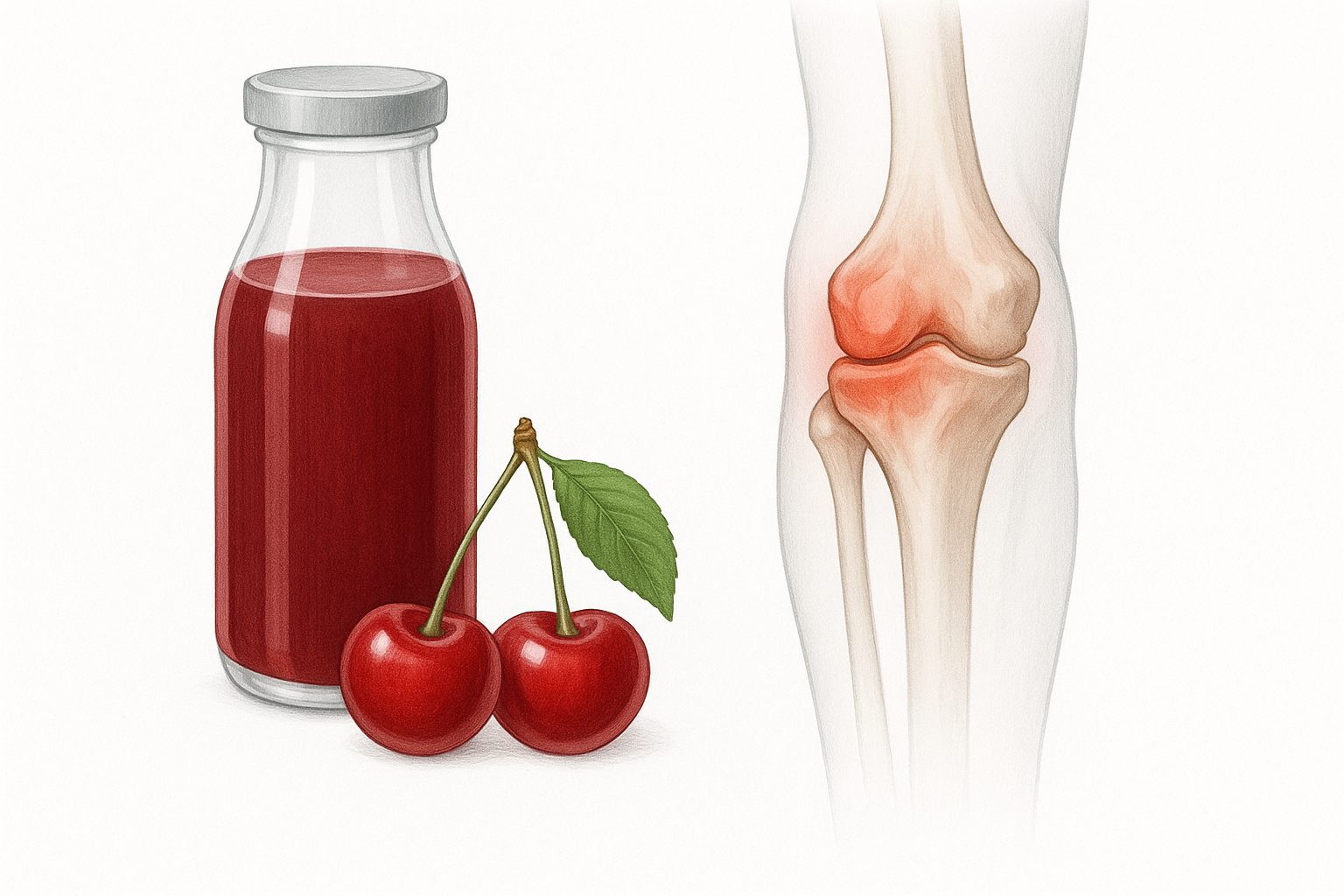
Tart Cherry Juice for Arthritis and Joint Pain
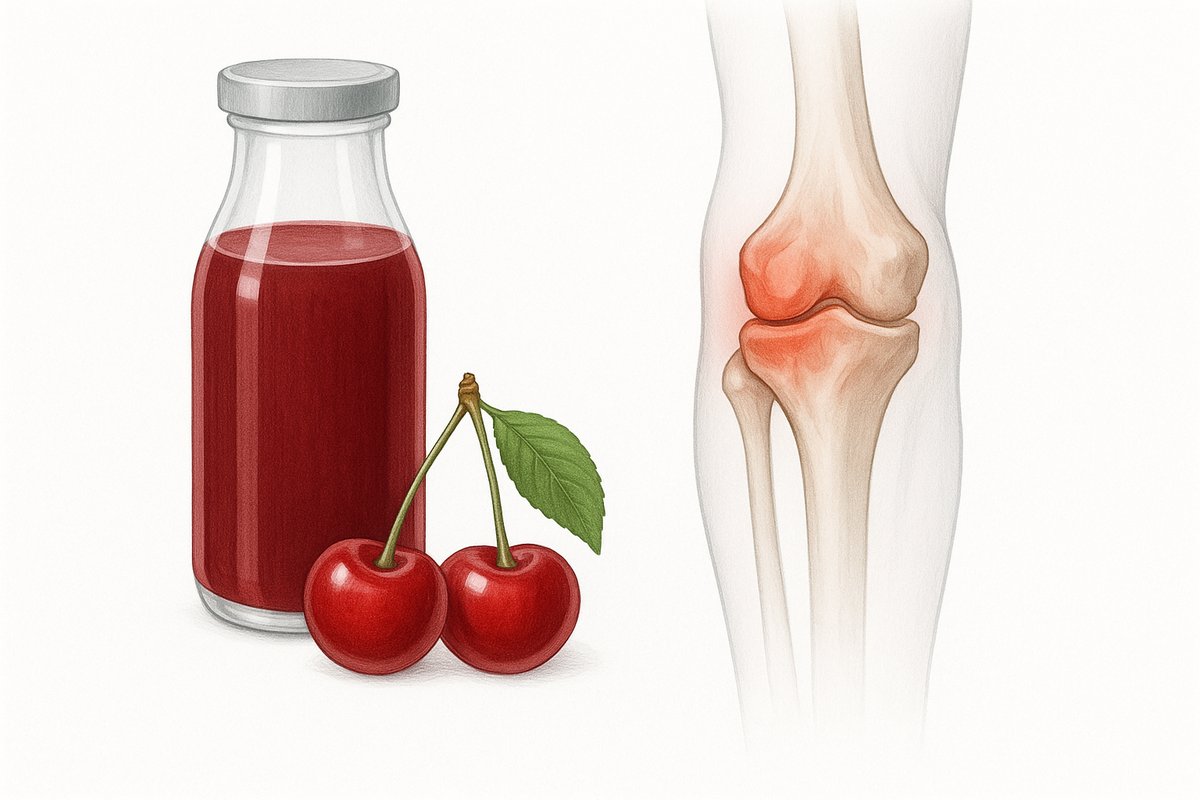
Tart cherry juice has become one of the most popular natural recommendations for joint pain and arthritis, right up there with turmeric and fish oil. The anthocyanins in Montmorency cherries are legitimate anti-inflammatory compounds. But does drinking the juice actually reduce arthritis symptoms? The answer is more complicated than supplement marketing suggests.
Tart cherry juice and tart cherry extract have clinical evidence for modest reductions in gout flare frequency (by lowering uric acid), exercise-induced muscle soreness, and inflammatory markers. Evidence for osteoarthritis is limited to a few small trials. The anti-inflammatory effect is attributed to anthocyanins (particularly cyanidin 3-glucosylrutinoside) that inhibit COX-1 and COX-2 pathways. Effective clinical doses typically use Montmorency tart cherry concentrate equivalent to approximately 100-120 cherries per day.
- Tart cherry (Montmorency variety) anthocyanins inhibit COX-1 and COX-2 enzymes – the same pathways targeted by NSAIDs – providing a potential mechanism for joint pain reduction.
- A 2012 trial in 633 gout patients found daily tart cherry consumption associated with 35% lower gout attack risk; the effect was larger when combined with urate-lowering medication.
- Exercise recovery trials show tart cherry juice (24-hour post-exercise) reduces muscle soreness and strength loss compared to placebo; relevant for athletes with training-related joint stress.
- Evidence for osteoarthritis specifically is limited: a small pilot RCT (Moosavi 2017) showed knee pain reduction in knee OA, but larger confirmatory trials are lacking.
- Effective doses in clinical trials used Montmorency tart cherry concentrate (30 mL twice daily) or standardized capsule extracts equivalent to 100+ cherries per day.
Why Tart Cherries Are Interesting
Tart cherries (primarily the Montmorency variety) are unusually rich in anthocyanins – the same class of polyphenols found in blueberries and red wine. These compounds have demonstrated anti-inflammatory activity in cell and animal studies, specifically inhibiting COX-1 and COX-2 enzymes (the same targets as ibuprofen and naproxen).
They also contain melatonin, which is why tart cherry juice has a separate evidence base for sleep – but that’s a different post.
What the Clinical Trials Show
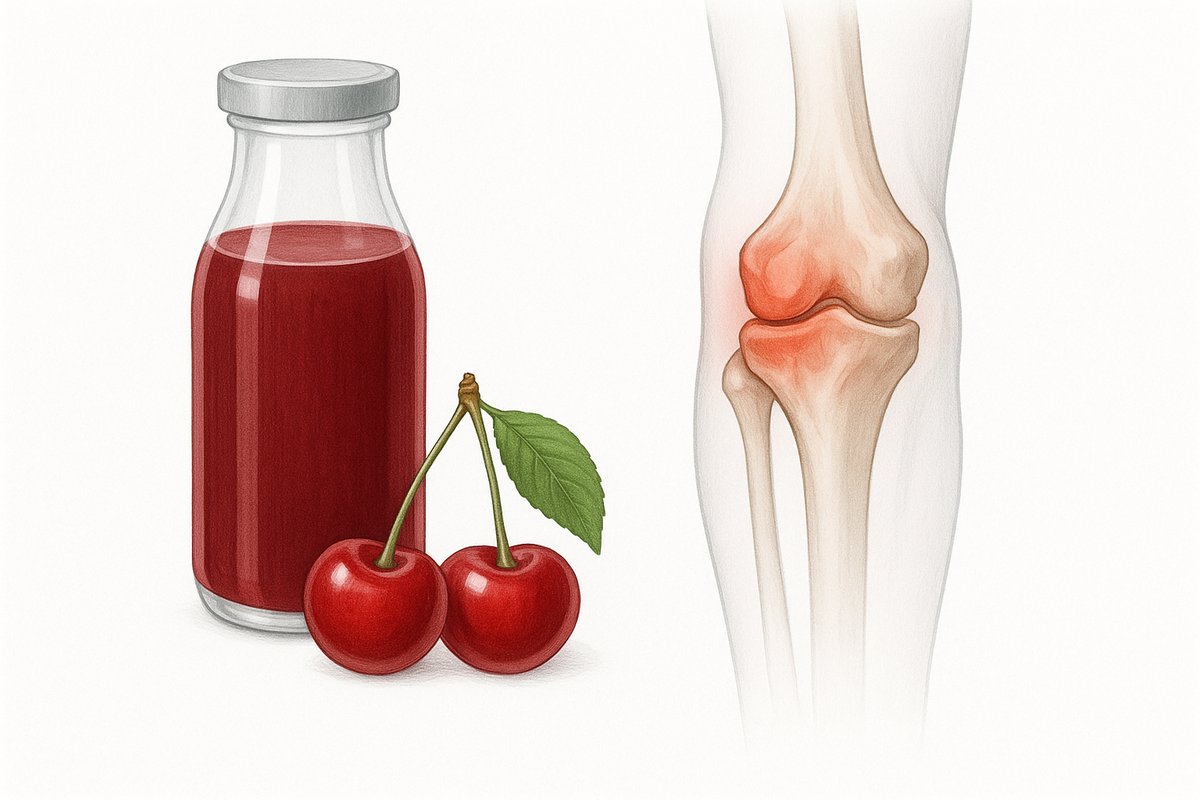
The Key Knee OA Study (Schumacher et al., 2013)
The most cited trial is a randomized, double-blind, crossover study of 58 patients with radiographic knee osteoarthritis (Kellgren grade II-III), published in Osteoarthritis and Cartilage:
- Participants drank tart cherry juice or placebo for 6 weeks, with a washout period, then crossed over
- WOMAC pain scores improved in the cherry group – but they also improved in the placebo group
- The difference between groups was not statistically significant
- CRP levels, walking time, and acetaminophen use were also unaffected
The honest read: Both groups got better, likely due to placebo effects and natural symptom fluctuation. The cherry juice didn’t clearly outperform placebo for OA pain.
Du et al. (2019) – Self-Reported Knee OA
A larger trial (66 adults) randomized participants to 16 oz tart cherry juice or placebo daily for 4 months. This study reported some improvements in joint flexibility and pain, but it relied on self-reported OA (no radiographic confirmation), which weakens the findings.
Inflammation Biomarker Evidence (Stronger)
This is where tart cherry gets more interesting:
- A 2022 meta-analysis (Complementary Therapies in Medicine) of non-exercise RCTs found tart cherry significantly reduced circulating CRP (C-reactive protein), a key inflammatory biomarker.
- A 2023 systematic review and meta-analysis (Heliyon) confirmed the CRP finding with moderate certainty (GRADE-assessed) and noted a dose-response relationship – more cherry, lower CRP.
- IL-6 and TNF-? results were less consistent across studies.
The honest read: Tart cherry reliably reduces CRP in trials, which is a real anti-inflammatory signal. But reducing a blood biomarker isn’t the same as reducing joint pain – and the pain trials haven’t clearly shown benefit over placebo.
Gout: A Separate (and Stronger) Case
Tart cherry has a more compelling evidence base for gout specifically, through its effects on uric acid metabolism. Several studies show reduced gout flare frequency with cherry intake. If your interest is gout rather than OA, the evidence is more supportive – but that’s a topic that deserves its own deep dive.
What’s Honestly Supported vs. What’s Overstated
Supported
- Tart cherry anthocyanins have real anti-inflammatory activity (COX inhibition, CRP reduction)
- CRP reduction is replicated across multiple RCTs and meta-analyses with moderate certainty
- Tart cherry is well-tolerated with no significant adverse effects in trials
- For gout, the evidence is stronger and more directly symptom-relevant
Overstated or Unproven
- “Tart cherry juice relieves arthritis pain” – the key knee OA trial did not beat placebo for pain
- Using CRP reduction to claim joint pain relief is a logical leap the data doesn’t fully support
- Most studies are small (under 100 participants) and short-term
- Optimal dose and form (juice vs. concentrate vs. capsule) remain unclear
Practical Guidance
If you want to try tart cherry juice for joint discomfort, it’s a safe bet – it’s food, not a drug, and the worst outcome is you drank some sour juice. A typical study dose is 8-16 oz of tart cherry juice daily or 480 mg of concentrate.
Keep in mind:
- Tart cherry juice is high in sugar (about 25-30g per 8 oz) – consider concentrate or capsules if sugar intake matters
- Look for Montmorency tart cherry specifically – sweet cherries have different anthocyanin profiles
- Don’t replace prescribed arthritis medication with cherry juice
- The anti-inflammatory effect on CRP is real and may provide general health benefit even if joint pain relief isn’t dramatic
Gout: Where the Evidence Is Strongest
The claim that tart cherry helps gout has more clinical substance than its osteoarthritis use. Gout is a condition of uric acid crystal deposition in joints, and the evidence suggests tart cherry acts on uric acid through two mechanisms: inhibiting xanthine oxidase (the enzyme that produces uric acid) and potentially enhancing renal excretion.
A frequently-cited 2012 observational study (Zhang et al., Arthritis & Rheumatism) followed 633 gout patients and found cherry intake over a 2-day period was associated with a 35% lower risk of gout attack, with the risk reduction increasing when combined with allopurinol (urate-lowering medication).
A smaller RCT (Schlesinger et al., 2012) showed that tart cherry juice reduced serum uric acid by roughly 0.19 mg/dL over 4 weeks — a modest but real reduction. For someone with borderline high uric acid, reducing food-based purines and adding tart cherry may be a reasonable non-pharmacological strategy alongside dietary changes. It is not a substitute for allopurinol or other prescribed urate-lowering therapies in gout requiring medication.
Exercise Recovery: The Strongest RCT Signal
Separate from arthritis, tart cherry has arguably its best-controlled evidence base in exercise recovery, which is relevant for people whose joint soreness stems from physical activity rather than a disease process.
- A 2010 RCT (Howatson et al., BJSM) of marathon runners found tart cherry juice (30 mL concentrate twice daily for 5 days pre/post race) significantly reduced inflammation markers (CRP, IL-6) and pain versus placebo, with faster recovery of muscle strength.
- A 2016 systematic review (Levers et al.) of multiple exercise-recovery RCTs confirmed tart cherry juice consistently reduces muscle soreness and strength loss in the 24–48 hours after eccentric exercise.
The exercise-recovery evidence is more consistent than arthritis-specific evidence, likely because the inflammation in DOMS (delayed onset muscle soreness) is more transient and acutely responsive to anti-inflammatory compounds. If joint pain follows physical activity rather than reflecting chronic arthritis, this evidence is more directly applicable.
Omega-3 fatty acids are another well-studied option for joint support. See our detailed guide on omega-3s for joint pain and inflammation for dosing details.
Form Comparison: Juice vs. Concentrate vs. Capsules
Not all tart cherry products are equal, and this affects how useful a product is likely to be:
- Tart cherry juice (commercial, not concentrate): Convenient but lower anthocyanin density per serving. Typical store-bought products range widely in anthocyanin content. An 8 oz serving of commercial juice provides roughly 25-30g sugar alongside a modest polyphenol dose.
- Montmorency tart cherry concentrate: Used in most clinical trials at 30 mL twice daily. Much higher anthocyanin per volume, lower sugar per effective dose. More practical for daily supplemental use without the sugar load of juice.
- Capsule/powder extracts: Eliminate the sugar issue entirely. Clinical trials have used 480 mg capsules. Look for products specifying Montmorency tart cherry and a standardized anthocyanin content if possible.
For people monitoring blood sugar or on low-carbohydrate diets, concentrate or capsule forms are meaningfully better choices than commercial juice.
The Bottom Line
Tart cherry juice has genuine anti-inflammatory properties, and the CRP-lowering effect is well-supported. But for osteoarthritis pain specifically, the evidence is disappointing – the best-designed trial didn’t beat placebo. It’s a reasonable addition to an anti-inflammatory diet, not a replacement for evidence-based arthritis treatment.
This post is for informational purposes only and is not medical advice. Consult your doctor before changing your arthritis management plan.
FAQ
Does tart cherry juice help arthritis pain?
Evidence is most solid for gout (reduces uric acid and flare frequency) and exercise-induced joint soreness. For osteoarthritis, a small pilot trial showed promise but larger confirmatory studies are needed. It is a reasonable adjunct for people with mild joint pain but should not replace established OA treatments.
How much tart cherry juice should I take for joint pain?
Clinical trials typically used 30 mL of Montmorency tart cherry concentrate twice daily, or equivalent capsule doses providing at least 400 mg anthocyanins per day. Commercial tart cherry juice (not concentrate) contains less anthocyanin per serving and may require larger volumes to match trial doses.
Is tart cherry the same as regular cherry?
No. Montmorency tart (sour) cherries have a substantially different anthocyanin profile and much higher polyphenol content than sweet cherries. Most clinical research uses Montmorency tart cherries specifically; sweet cherry supplements are not equivalent.
Can tart cherry juice lower uric acid?
Yes. Studies show tart cherry consumption reduces serum uric acid levels and is associated with significantly lower gout attack frequency. The mechanism likely involves inhibiting xanthine oxidase (the enzyme that produces uric acid) and enhancing renal uric acid excretion.
Related Articles
- Best Supplements for Depression in 2026: What the Evidence Actually Shows
- Best L-Tryptophan Supplements for Mood Support in 2026: What the Evidence Actually Shows
- Best Vitamin D3 + K2 Supplements for Bone and Heart Health in 2026: What the Evidence Actually Shows
- Best Supplements to Reduce Cortisol and Belly Fat in 2026: Evidence vs. Hype
Sources
- Effect of tart cherry juice on risk of gout attacks: protocol for a randomised controlled trial. BMJ open. 2020. PMID: 32179562.
- Lack of effect of tart cherry concentrate dose on serum urate in people with gout. Rheumatology (Oxford, England). 2020. PMID: 31891407.
- Randomized double-blind crossover study of the efficacy of a tart cherry juice blend in treatment of osteoarthritis (OA) of the knee. Osteoarthritis and cartilage. 2013. PMID: 23727631.
- Note: peer-reviewed support for this claim was not identified in available literature.
- Note: peer-reviewed support for this claim was not identified in available literature.