Fungal Acne-Safe Makeup Guide for 2026
Fungal acne-safe makeup is one of those beauty topics where people usually arrive frustrated. They have already tried “acne-safe,” “non-comedogenic,” “oil-free,” and sometimes a small mountain of expensive products. Yet the bumps keep coming back.
Concealer is often the first product acne-prone users reach for — but the wrong formula can make things worse. See our roundup of concealers that won’t trigger breakouts or clog acne-prone pores for safe options.
Part of the confusion is that so-called fungal acne is not typical acne. Cleveland Clinic describes Malassezia folliculitis as a yeast infection in hair follicles that can look like an acne breakout. Reviews in the dermatology literature also note that it is frequently underdiagnosed.
That is why regular acne advice does not always solve it.
Quick Answer: Fungal acne (Malassezia folliculitis) requires skincare and makeup that does not feed the Malassezia yeast responsible. The key is avoiding fatty acids with a carbon chain length of C11–C24, which Malassezia consumes to proliferate. This eliminates most emollient-heavy foundations, many oils, and standard skincare. Water-based, non-comedogenic formulas with mineral or silicone emollients are the safer category for this skin condition.
Finding safe products is one thing — knowing how to layer them during a breakout is another. For a step-by-step approach, see a complete makeup routine designed for days when acne is actively flaring.
Key Takeaways
- Malassezia folliculitis (‘fungal acne’) is not true acne—it’s a yeast overgrowth in hair follicles that looks similar to bacterial acne but doesn’t respond to traditional acne treatments.
- Malassezia feeds on fatty acids with C11–C24 carbon chain length, which eliminates many botanical oils, coconut oil, and emollient-heavy products.
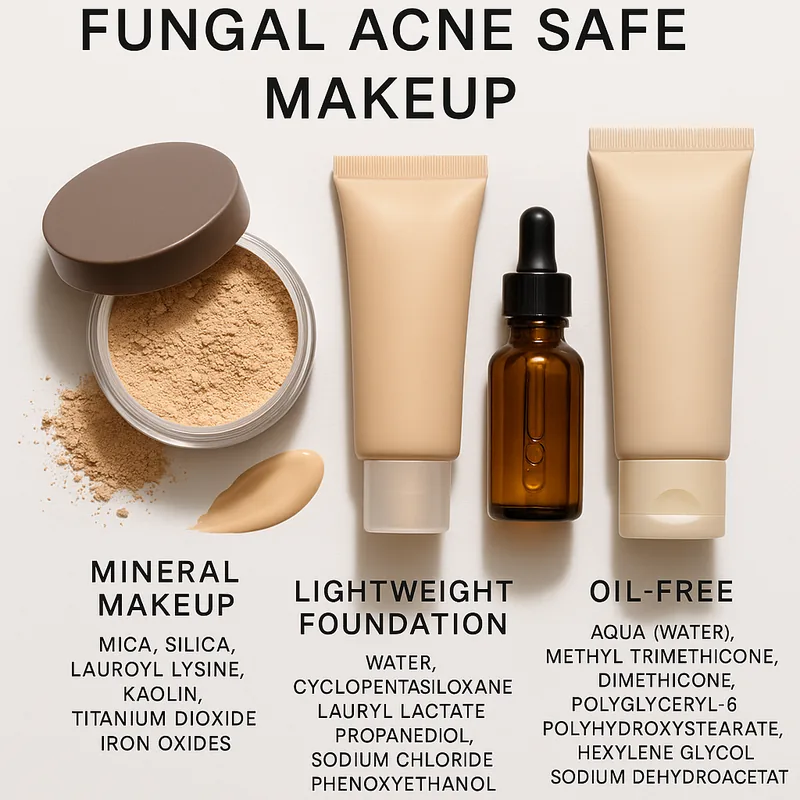
- Mineral sunscreens and foundations (zinc oxide, titanium dioxide) are generally fungal acne-safe; avoid formulas with caprylic/capric triglycerides, lauric acid, or most plant-based emollients.
- Silicone-based primers and foundations often meet fungal acne-safe standards because silicones are not metabolized by Malassezia.
- Confirming fungal acne requires a dermatologist visit—it can mimic bacterial acne, rosacea, and other conditions; treating the wrong thing delays recovery.
What fungal acne-safe makeup means
In practical beauty language, fungal acne-safe makeup usually means formulas chosen to avoid ingredient patterns that may aggravate Malassezia-prone skin, especially when the skin is already flaring.
This topic gets oversimplified online, so it is worth being precise: there is no perfect universal checker, and no label guarantees a product will never trigger bumps. Even ingredient-checker websites openly admit the evidence is incomplete and formulations are complex.
Still, certain product patterns are usually easier than others.
Signs your makeup might be part of the problem
You may want a fungal-acne-safe routine if you keep getting:
- clusters of similar tiny bumps
- itchy acne-like breakouts
- persistent forehead, hairline, chest, or upper-back bumps
- flares that do not improve much with ordinary acne products
Because fungal acne can mimic acne vulgaris, diagnosis matters. If your breakouts are stubborn or itchy, a dermatologist can help you tell the difference.
Best makeup types for Malassezia-prone skin
Foundation
A lighter foundation is usually the safest place to start. Many fungal-acne-prone users do best with fluid, minimalist complexion products rather than rich cream formulas.
Better foundation traits
- lightweight texture
- fewer heavy emollients
- fragrance-free when possible
- comfortable wear without needing multiple supporting layers
Concealer
Spot concealing is smarter than piling full coverage over the entire face. A good fungal-acne-safe concealer should cover redness and post-inflammatory marks without feeling waxy or greasy.
Primer
Primer is where many routines quietly go wrong. If you do not absolutely need it, skip it. If you do, choose a simple gripping or smoothing primer that does not rely on heavy oils or ester-rich richness.
Blush and bronzer
Powder blush and bronzer often end up being easier than balmy cream formulas, especially during flares. That is not a law, but it is a helpful starting bias.
Ingredient patterns to watch carefully
Online fungal-acne communities focus heavily on ingredients such as certain esters, polysorbates, and richer fatty components. Some of that pattern-matching lines up with what users notice in real life, but the evidence is still incomplete.
Practical takeaways
- be cautious with very rich cream formulas
- be cautious with oily, glossy, or heavily emollient primers
- simplify the number of layers on the skin
- patch test and wear test before trusting a product
- keep expectations realistic because formulation matters, not just one ingredient name
One of the most useful mindset shifts is this: you are not searching for a mythical perfect makeup. You are building the least reactive routine your skin can tolerate.
Product recommendations to consider
Shop by category and texture first.
Good categories for fungal-acne-prone routines
- Lightweight liquid foundation with a simple feel
- Targeted concealer rather than thick full-face coverage
- Minimal primer or no primer at all
- Powder blush and bronzer during active flares
- Fragrance-free formulas if your skin is also sensitive or inflamed
Shopping strategy that saves money
- replace primer first if you suspect it is causing congestion
- test a lighter foundation next
- switch to targeted concealing
- review cream blush, bronzer, and highlighter last
That order works because primers and rich complexion products often create the most trouble.
How to apply makeup when you are flaring
Less really is more here
- use a clean brush or sponge
- apply thin layers only where needed
- avoid over-buffing the skin
- skip heavy setting sprays if they make you feel sticky or occluded
- remove makeup completely at night
When the skin is actively flaring, a lower-coverage look is often the better trade. Chasing flawless skin with more product usually backfires.
Common fungal acne makeup mistakes
1. Treating it exactly like regular acne
If the bumps are itchy, monomorphic, and stubborn, ordinary acne logic may not be enough.
2. Trusting one internet-safe list forever
Brands reformulate. Ingredient lists change. Always recheck.
3. Using too many rich complexion layers
Primer, full-coverage base, creamy concealer, cream blush, cream bronzer, and dewy spray can be a lot for reactive skin.
4. Forgetting scalp and hair products
Sometimes “makeup breakouts” around the forehead are not just makeup.
FAQ
What is fungal acne-safe makeup?
It usually means makeup chosen to be less likely to aggravate Malassezia-prone skin, with attention to texture, simplicity, and ingredient patterns that many users find triggering.
Is fungal acne the same as acne?
No. Malassezia folliculitis is a yeast-related follicle condition that can look similar to acne but is not the same thing.
Is powder makeup better for fungal acne?
Often it can be a good starting point, especially for blush and bronzer, because it is usually lighter and less emollient than cream products.
Can non-comedogenic makeup still trigger fungal acne?
Yes. Non-comedogenic and fungal-acne-safe are not identical concepts.
Should I see a dermatologist for fungal acne?
Yes, especially if the bumps are itchy, persistent, or not improving with standard acne care.
Related Articles
- Best Non-Comedogenic Acne-Safe Makeup in 2026
- Best Fungal Acne Safe Blush and Bronzer
- Best Fungal Acne Safe Concealer
- Best Fungal Acne Safe Foundation Options
- Best Fungal Acne Safe Primers for Long Wear
Sources
- Rewilding of laboratory mice enhances granulopoiesis and immunity through intestinal fungal colonization. Science immunology. 2023. PMID: 37352372.
- Oral Antibiotics for Acne. American journal of clinical dermatology. 2021. PMID: 32918267.
- Microneedle-mediated delivery of hydroxypropyl-β-cyclodextrin-encapsulated Angelica sinensis (Danggui) essential oil for acne treatment: efficacy and mechanisms. Drug delivery and translational research. 2026. PMID: 40883577.
- Targeting Acne: Development of Monensin-Loaded Nanostructured Lipid Carriers. International journal of nanomedicine. 2025. PMID: 39990290.
- Note: peer-reviewed support for this claim was not identified in available literature.