Sea Moss Supplements: Benefits, Evidence, and What to Look For in 2026
Quick Answer: Sea moss is a marine algae with a legitimate nutritional profile — it’s a real source of iodine, certain B vitamins, and soluble fiber — but the popular claims, particularly that it contains “92 minerals” or that it functions as a cure-all superfood, are vastly exaggerated and not supported by clinical evidence. The most evidence-backed applications are thyroid iodine support (with important cautions about over-supplementation), prebiotic gut support, and skin hydration. Forms vary meaningfully in bioavailable nutrient content. Heavy metal contamination from low-quality sourcing is a genuine concern. Sea moss can be a useful addition to a supplement routine for specific people, but it requires realistic expectations and careful sourcing.
Sea moss went from an obscure regional food — primarily consumed in Caribbean and Irish coastal communities — to a global supplement trend in the span of a few years. Social media influencers began promoting it as a “superfood” containing 92 of the 102 minerals the human body needs, with claimed benefits ranging from thyroid support and immune boosting to weight loss and sexual performance. Supplement sales exploded. Gel jars, capsules, and dried bundles proliferated across health food stores and Amazon.
What the viral marketing largely omitted: the science of sea moss is thin compared to the claims, the “92 minerals” figure is unverified at best and actively misleading at worst, and certain forms of overconsumption carry real health risks. That doesn’t mean sea moss is useless — there are legitimate reasons certain people might benefit from it. But understanding the difference between what sea moss genuinely offers and what’s marketing fantasy requires taking an honest look at the evidence.
What Sea Moss Actually Is
“Sea moss” is a common name used loosely to refer to several species of red algae, with two predominating in the supplement market:
Chondrus crispus — known as Irish moss — is a small, fan-shaped red alga native to the rocky Atlantic coastlines of Ireland, Great Britain, and northeastern North America. It has been consumed in Ireland for centuries, particularly during times of food scarcity (the Great Famine of the 1840s is part of its cultural history). Chondrus crispus is the species traditionally associated with “Irish moss” and was the original basis for the sea moss health tradition.
Gracilaria species — particularly Gracilaria debilis and related species — are the variety most commonly sold today as “sea moss” in supplements and gel form. Gracilaria is widely farmed in the Caribbean (particularly in Saint Lucia and Jamaica) because it grows rapidly, tolerates warmer waters, and is far cheaper to cultivate at scale than Chondrus crispus. Most sea moss gel products and capsules on the market are Gracilaria, not true Irish moss, even when marketed as such.
The distinction matters for two reasons: nutritional composition differs somewhat between species, and Gracilaria is more susceptible to heavy metal accumulation from contaminated growing environments. The research — what little exists — has largely focused on Chondrus crispus rather than Gracilaria, meaning that evidence from Irish moss studies may not translate precisely to the Gracilaria products most people are actually consuming.
Fact-Checking the “92 Minerals” Claim
The “92 minerals” claim is arguably the most widely repeated and least substantiated factoid in the sea moss world. It appears to originate from the teachings of Dr. Sebi, an herbalist (not a medical doctor) who promoted sea moss as containing the same 102 minerals found in the human body. The specific number 92 — or 102 depending on the version you encounter — has no peer-reviewed citation behind it.
What does sea moss actually contain? A 2021 review in Marine Drugs by Lomartire and colleagues examining the health benefits of seaweed consumption found that seaweeds including red algae contain a range of minerals including iodine, calcium, magnesium, phosphorus, iron, and zinc — but in amounts and concentrations that vary significantly by species, growing location, season, and processing method (PMID: 34203804). The idea that any single food source contains a comprehensive 92 or 102 minerals in bioavailable forms is nutritionally incoherent — “minerals” as commonly listed include dozens of trace elements present in essentially all foods and water in unmeasurable amounts. Presence at any measurable level is not the same as a meaningful nutritional contribution.
To be direct: the 92 minerals claim is not supported by any published nutritional analysis. Independent testing of commercial sea moss products has found wildly varying mineral profiles, often far less impressive than the marketing implies. Sea moss is nutritionally real — it has genuine content — but the specific claim is marketing mythology, not biochemistry.
The Actual Nutritional Profile
Setting aside the mythology, what does sea moss genuinely offer?
Iodine is sea moss’s most clinically relevant nutrient. Red algae are among the better plant-based sources of iodine, a mineral essential for thyroid hormone synthesis (thyroxine/T4 and triiodothyronine/T3). Iodine deficiency is the leading cause of preventable hypothyroidism worldwide. In populations with low iodine dietary intake — vegans, people avoiding dairy and seafood, those living in iodine-poor regions — sea moss represents a legitimate supplemental source.
However, iodine content in sea moss varies dramatically — from less than 1 mg per serving to over 10 mg — depending on species and growing conditions. The recommended daily intake (RDI) for iodine is 150 mcg (0.15 mg) for adults. Many sea moss products deliver multiple times this amount, and excessive iodine intake causes its own thyroid problems: it can trigger hypothyroidism (Wolff-Chaikoff effect) or hyperthyroidism in susceptible individuals. Anyone with existing thyroid disease, or taking thyroid medications, should exercise particular caution and consult a physician before using sea moss supplements regularly.
Carrageenan is a polysaccharide extracted from Chondrus crispus and other red algae, widely used as a food thickener. It exists naturally in sea moss gel. The safety of food-grade carrageenan has been debated — animal studies using degraded carrageenan (poligeenan) showed inflammatory effects, but this form differs from the intact carrageenan in foods. Regulatory bodies including the FDA and European Food Safety Authority have concluded that food-grade carrageenan is safe at normal dietary amounts, though the debate continues in the research community.
Fiber — specifically soluble fiber in the form of agar and carrageenan — is present in useful amounts in sea moss. Soluble fiber feeds gut microbiota (prebiotic function) and contributes to feelings of satiety.
Other nutrients: Sea moss contains modest amounts of B vitamins (including B2/riboflavin and folate), vitamin C, calcium, and magnesium. These contributions are real but rarely dramatic compared to common foods — a serving of sea moss gel typically adds less mineral content than a glass of milk or a handful of nuts.
Evidence by Health Claim
Thyroid Support
This is sea moss’s most legitimate application. Iodine deficiency is a real global health problem, particularly in populations avoiding iodized salt and dairy products. For people in this situation, sea moss provides a plant-based iodine source that could meaningfully support thyroid function. A 2019 review in Nutrition Reviews by Cherry and colleagues examining seaweeds as food noted that seaweed is one of the few significant plant-based sources of iodine, while emphasizing that overconsumption is a genuine risk (PMID: 30840077).
The catch: you need a reliable, tested product with known iodine content to use sea moss safely for thyroid support. Products with inconsistent or unlabeled iodine content make it impossible to control intake, which is exactly the problem when both deficiency and excess are harmful. Our thyroid health supplements guide covers iodine and thyroid nutrition in more detail.
Gut and Digestive Health
The soluble fiber in sea moss — primarily carrageenans and agars — can serve as a prebiotic, feeding beneficial gut bacteria. A review by Wells and colleagues in the Journal of Applied Phycology confirmed that seaweed polysaccharides demonstrated prebiotic activity in several in vitro and animal models, promoting growth of bifidobacteria and lactobacillus species (PMID: 28458464). Human clinical trials specifically on sea moss as a prebiotic food are lacking, but the mechanism is plausible and the fiber content is real.
Sea moss gel is also mucilaginous — it has a soothing, coating property that may provide some relief for GI irritation, which is consistent with traditional Caribbean use for digestive complaints.
Skin Health
The carrageenan and mineral content of sea moss have made it popular in skincare, and there’s reasonable mechanistic basis for topical applications. Carrageenan is hygroscopic — it attracts and holds water — making it a legitimate humectant for skin hydration. Several commercial skincare brands use it as an ingredient for this reason, and the scientific basis is sound at a cosmetic level.
For oral supplementation and skin benefits, the evidence is thinner. Some proponents suggest that sea moss’s mineral content and antioxidants support skin health from the inside out, but controlled trials specifically measuring skin outcomes from oral sea moss consumption are absent from the literature. See our detailed coverage of sea moss benefits for a full breakdown.
Immune Function
Seaweeds contain various polysaccharides and compounds with immunomodulatory properties documented in laboratory studies. A review by Shannon and Abu-Ghannam published in Phycologia (2019) noted that red algae contain sulfated polysaccharides with antiviral and immunomodulatory activity in cell culture models. However, the gap between in vitro immunological activity and clinically meaningful immune benefits in humans is enormous — most things that have activity in cell culture don’t translate to taking a supplement and getting sick less often.
The honest assessment: sea moss is unlikely to significantly boost immune function in a well-nourished person, but it may have mild immunomodulatory effects that contribute to general wellness — effects that are difficult to measure in everyday use.
Weight Management
Some proponents claim sea moss supports weight loss through fiber-induced satiety. The soluble fiber claim is plausible in a minor way — fiber does contribute to satiety — but sea moss is consumed in relatively small quantities, and the fiber content per typical serving of gel is modest. There is no clinical trial evidence for sea moss specifically producing meaningful weight loss outcomes.
Sexual Health and Libido
Sea moss has been promoted in some communities — particularly Caribbean traditional medicine — as an aphrodisiac and libido enhancer. There is no peer-reviewed evidence supporting this claim for either men or women. The minerals in sea moss contribute to general health, and good nutritional status supports hormonal health, but this is a stretch from clinical aphrodisiac activity. For women-specific health considerations, see our sea moss benefits for women article.
Forms Compared: Gel, Capsules, and Powder
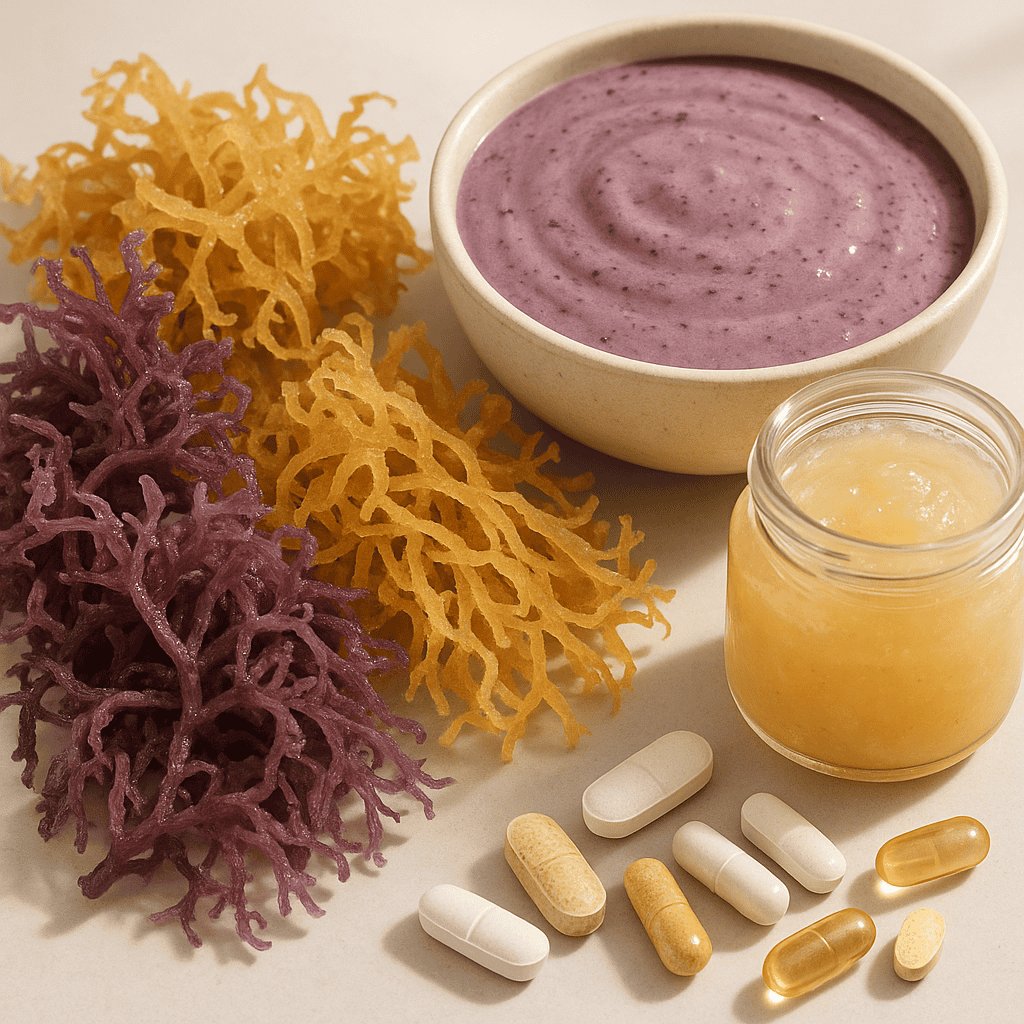
Raw/wildcrafted and dried sea moss: The traditional form. You soak it, blend it into a gel, and add it to foods or beverages. This form preserves the full polysaccharide structure and requires no additives. It has the widest variety in quality — wildcrafted product from clean Atlantic waters can be excellent; Gracilaria farmed in contaminated environments can be problematic.
Sea moss gel (pre-made): Convenient, but requires refrigeration and has a short shelf life. The preparation process and storage conditions affect nutrient retention. Quality varies widely — look for minimal ingredient lists (sea moss and water, possibly with lemon or sea salt) and known sourcing information.
Capsules or powder: More convenient and shelf-stable. Iodine content is easier to regulate and quantify if the manufacturer tests for it. However, processing may reduce some heat-sensitive nutrients and the mucilaginous fiber properties are less intact in dried form.
Gummies: The least controlled form, often with added sugars and minimal actual sea moss content. Generally not recommended if the goal is meaningful nutritional contribution.
Quality, Sourcing, and Heavy Metal Concerns
This is the section that most sea moss marketing omits, and it’s important. Seaweeds — all seaweeds — bioaccumulate minerals from their environment. In clean, cold Atlantic waters (where traditional Chondrus crispus is harvested), this primarily means beneficial minerals. In warmer, potentially polluted waters, it can mean heavy metals: arsenic, lead, cadmium, and mercury.
A 2021 study found that seaweed products on the market showed significant variability in heavy metal content, with some products containing arsenic at levels that could present concerns with regular consumption at recommended serving sizes. Arsenic in seaweed occurs in both inorganic (more toxic) and organic (less toxic) forms — the proportion depends on species and growing conditions.
What to look for in a quality sea moss supplement:
Third-party heavy metal testing — a certificate of analysis (COA) from an independent laboratory showing lead, arsenic, cadmium, and mercury levels
Species identification — whether the product contains Chondrus crispus or Gracilaria, and from where
Wildcrafted vs. farmed — either can be good or poor quality; wildcrafted doesn’t inherently mean safer or more nutritious
Iodine quantification — especially important for anyone using sea moss for thyroid support
Minimal processing — avoidance of bleaching (which destroys nutrients) and artificial additives
Bleached or “golden” sea moss products have been chemically treated to achieve a pale color often associated with “cleanliness” in marketing — but bleaching degrades the polysaccharides and much of the nutritional content. Naturally dried Chondrus crispus ranges from purple-gold to dark reddish-brown. Avoid any sea moss product that is pure white or bleached-looking.
Safety, Dosing, and Interactions
Typical serving: 1–2 tablespoons of sea moss gel per day, or 500–1,000 mg of capsule/powder form, is the range commonly used. There is no established RDI or official therapeutic dose.
Key safety concerns:
Iodine excess: As discussed, excessive iodine can disrupt thyroid function. Daily sea moss consumption by someone also eating iodized salt, dairy, and seafood may result in meaningful iodine over-intake. Monitor symptoms of hyperthyroidism (palpitations, anxiety, unexplained weight loss, heat intolerance) and adjust or discontinue if they appear.
Anticoagulant interactions: Carrageenan and other seaweed polysaccharides may have mild anticoagulant effects. Anyone on blood-thinning medications (warfarin, apixaban, clopidogrel) should discuss seaweed supplementation with their physician.
Thyroid medication: Sea moss iodine directly affects the substrate your thyroid uses. People on levothyroxine or other thyroid medications need stable iodine intake — variable sea moss consumption can complicate dosing management.
Heavy metals: For daily supplementation, use only products with third-party metal testing. Occasional use of unverified products poses minimal risk; daily use without testing information is a different calculus.
Pregnancy: Iodine is critical during pregnancy (the RDI increases to 220 mcg/day), but excessive iodine is also harmful to fetal thyroid development. Sea moss during pregnancy should only be used under medical supervision and with a product that has quantified, controlled iodine content.
For how sea moss fits within a broader women’s wellness supplement protocol, see our women’s health supplements guide. For skin and connective tissue applications, sea moss pairs conceptually with collagen — see our collagen hub for the full evidence base on collagen supplementation.
Who Is Sea Moss Actually For?
Given an honest assessment of the evidence, sea moss makes the most sense for:
People with low iodine intake (strict vegans, those avoiding dairy and seafood, people in iodine-depleted regions) who want a food-based iodine source — provided they use a tested product with known iodine content and their intake is calculated to avoid excess.
People seeking additional soluble fiber as part of a gut-health protocol, where sea moss gel can contribute modestly to daily fiber intake alongside other sources.
People interested in seaweed’s mineral and antioxidant profile as part of a whole-food nutrition approach — similar to using it as a culinary ingredient in the way Irish and Caribbean cultures traditionally have.
Sea moss is not the right choice for people with existing thyroid disease (without medical supervision), people on anticoagulant therapy, or anyone expecting dramatic health improvements from a single ingredient that market hype has oversold. It’s a genuine food with real nutritional content — when sourced and used correctly, a reasonable addition to a health-conscious routine. When sourced poorly or taken in excess, it carries real risks.
The best version of sea moss supplementation is informed, measured, and part of a diet and supplement approach grounded in realistic expectations — not the mythologized cure-all of social media.
Shannon E, Abu-Ghannam N. Seaweeds as nutraceuticals for health and nutrition. Phycologia. 2019;58(5):563–577.
Wells ML, Potin P, Craigie JS, et al. Algae as nutritional and functional food sources: revisiting our understanding. J Appl Phycol. 2017;29(2):949–982. PMID: 28458464
Fitzgerald C, Gallagher E, Tasdemir D, Hayes M. Heart health peptides from macroalgae and their potential use in functional foods. J Agric Food Chem. 2011;59(13):6829–6836.
van Netten C, Hoption Cann SA, Morley DR, van Netten JP. Elemental and radioactive analysis of commercially available seaweed. Sci Total Environ. 2000;255(1-3):169–175.
Teas J, Pino S, Critchley A, Braverman LE. Variability of iodine content in common commercially available edible seaweeds. Thyroid. 2004;14(10):836–841.
Brownlee IA, Allen A, Pearson JP, et al. Alginate as a source of dietary fiber. Crit Rev Food Sci Nutr. 2005;45(6):497–510.







Leave a Reply