
Sea Moss or Spirulina — Which One Should You Actually Be Taking?
You’ve seen both names on supplement shelves and in smoothie recipes, but sea moss and spirulina are very different organisms with very different nutritional profiles, and the decision between them isn’t as obvious as “one is better.” What they offer doesn’t overlap as much as the generic “superfood” label suggests — which means the right answer almost certainly depends on what you’re actually trying to get out of a supplement.
Quick Answer: Spirulina is significantly higher in protein and B vitamins than sea moss, making it a stronger all-around nutritional supplement. Sea moss provides more iodine and is a better source of certain minerals. For most people, spirulina delivers more per gram, but both are legitimate additions to a diet if used at appropriate doses. Neither replaces whole vegetables and real food.
Two Very Different Organisms
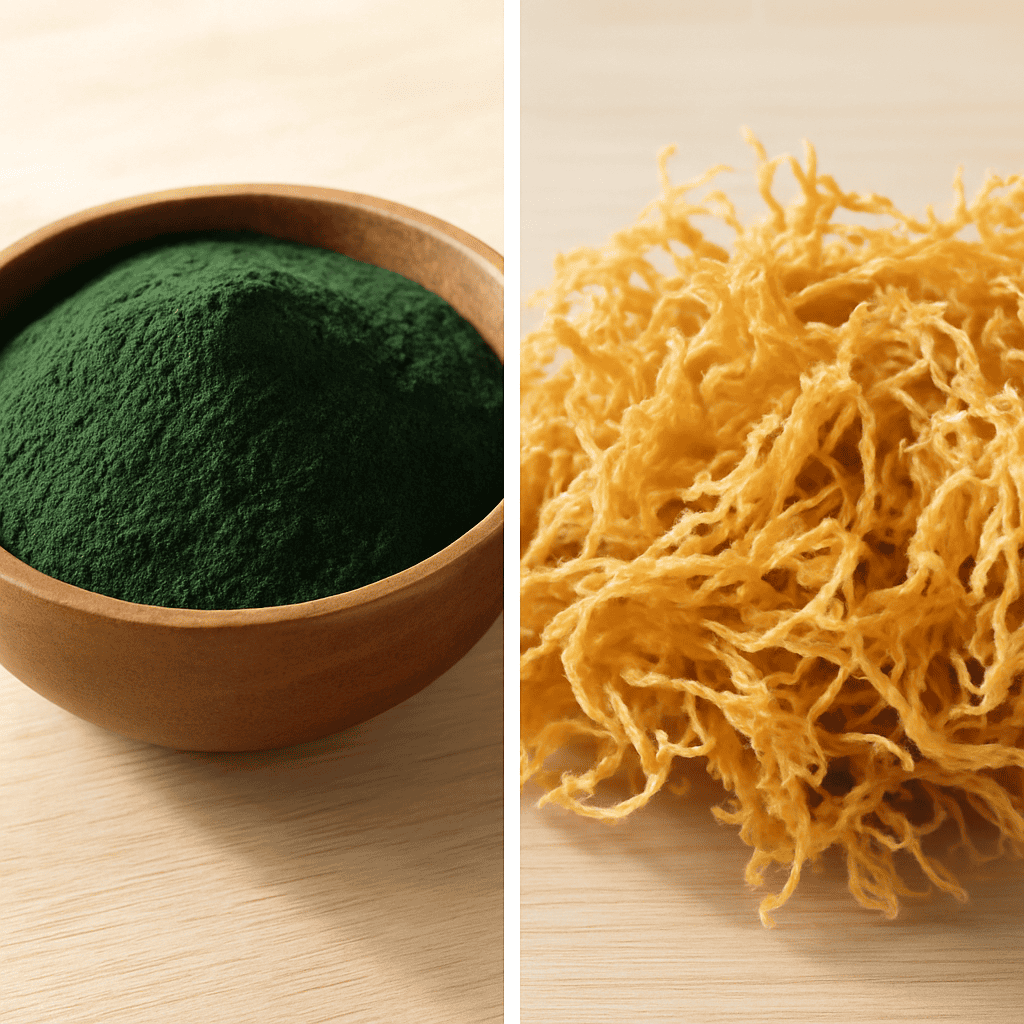
Sea moss — most commonly Chondrus crispus or Gracilaria species — is a red algae that grows along rocky Atlantic coastlines. It’s been eaten in Ireland and the Caribbean for centuries as a food thickener and nutritional supplement. When soaked and blended, it becomes the gel that’s all over wellness social media.
Spirulina is a blue-green algae (technically a cyanobacterium) that grows in warm, alkaline lakes. It’s been used as a food source by indigenous people in Mexico and Central Africa for centuries and became the subject of serious nutritional research starting in the 1970s. NASA has studied it as a potential food for long-duration space missions (Ciferri, Microbiological Reviews, 1983).
These aren’t just different brands of the same thing. They have different compositions, different flavors, different preparation methods, and different research bases.
Protein: Spirulina Wins by a Wide Margin
This is probably the most important nutritional difference. Spirulina is approximately 60 to 70 percent protein by dry weight — one of the highest protein concentrations in any natural food. A single tablespoon (about 7 grams) provides roughly 4 grams of complete protein containing all essential amino acids, with a digestibility rate comparable to egg protein (Ciferri, Microbiological Reviews, 1983).
Sea moss, by comparison, is not a meaningful protein source. Its protein content varies considerably by species and growing conditions, but typically falls below 3 percent by dry weight. A tablespoon of sea moss gel — which is mostly water — contributes minimal protein (Dawczynski et al., Food Chemistry, 2007).
If protein is your goal, spirulina isn’t just better — sea moss is barely in the conversation.
Iodine: Sea Moss Leads Here
Sea moss contains significantly more iodine than spirulina. Iodine is an essential mineral that your thyroid gland requires to produce hormones regulating metabolism, growth, and development. Many people — particularly those who avoid iodized salt or dairy — don’t get enough.
The iodine content in sea moss varies dramatically based on where it was grown. Studies analyzing commercial sea moss products have found ranges from approximately 16 mcg to over 2,400 mcg per gram of dried seaweed (Teas et al., Thyroid, 2004). The adult recommended daily intake is 150 mcg, with an upper tolerable limit of 1,100 mcg per day. This means the same food that could help an iodine-deficient person could cause problems in someone with a thyroid condition — a real consideration that the wellness community underplays.
Spirulina does contain some iodine, but at levels far lower and more consistent than sea moss. For someone who needs more iodine in their diet without the variability risk, sea moss is the stronger choice — but with the caveat that knowing your baseline iodine status matters.
Vitamins: Different Profiles for Different Needs
Spirulina is one of the few non-animal sources with meaningful amounts of B12 — though researchers note that the B12 in spirulina is largely in a form called pseudovitamin B12, which may not be as bioavailable as the form found in animal products (Watanabe et al., Journal of Agricultural and Food Chemistry, 1999). It’s not considered a reliable sole B12 source for vegans, but it contributes. Spirulina is also a good source of B1 (thiamine), B2 (riboflavin), and B3 (niacin).
Sea moss contains a broader range of vitamins in smaller amounts. It has some vitamin A (as beta-carotene), vitamin C, vitamin E, and small amounts of K and B vitamins. The vitamin C content is real but modest. Neither food is vitamin-dense in the way that broccoli or liver is, but spirulina’s B vitamin profile is the stronger of the two.
Minerals: Sea Moss Offers More Variety
The oft-repeated claim that sea moss contains “92 minerals” isn’t backed by published nutritional analysis, but sea moss does provide a variety of trace and major minerals. Published analyses have found calcium, magnesium, potassium, iron, selenium, manganese, and zinc at varying levels (Holdt & Kraan, Journal of Applied Phycology, 2011).
Spirulina has a solid mineral profile too — it’s a good iron source (one tablespoon provides roughly 11 percent of the daily value for women), and it contains magnesium and potassium. But sea moss’s wider mineral variety, including its iodine content, gives it an edge in the minerals category.
One important note: heavy metals are a genuine concern with both sea moss and spirulina, and with any algae-based supplement. Algae concentrate minerals from their growing environment — including lead, arsenic, mercury, and cadmium. Third-party testing for heavy metals should be a non-negotiable when choosing either product (Al-Dhabi, Saudi Journal of Biological Sciences, 2013).
Antioxidants and Anti-Inflammatory Compounds
Both sea moss and spirulina contain antioxidant compounds, though their specific profiles differ.
Spirulina’s standout compound is phycocyanin, the pigment that gives it its blue-green color. Phycocyanin is a potent antioxidant and has shown anti-inflammatory effects in cell and animal studies (Romay et al., Current Protein & Peptide Science, 2003). The evidence for phycocyanin’s anti-inflammatory properties is among the stronger stories in algae nutrition research, though large human trials are still limited.
Sea moss contains sulfated polysaccharides — carrageenan and related compounds — that show antioxidant activity in vitro. Some studies suggest these compounds may also modulate immune function, though again, most of this work is preclinical (Shannon & Abu-Ghannam, Phycologia, 2019).
Neither food is going to dramatically lower your inflammatory markers if the rest of your diet is poor. Both contribute antioxidant compounds as part of a balanced diet.
Digestive Health and Fiber
Sea moss has a meaningful advantage in the fiber department. The carrageenan and other polysaccharides in sea moss act as prebiotic fibers that feed beneficial gut bacteria. Animal studies and in vitro research suggest these polysaccharides may support gut microbial diversity, though human clinical evidence is limited (Bhattacharyya et al., Cancer Prevention Research, 2012).
Spirulina is low in fiber and not primarily used for digestive support. It has some research behind its effects on gut bacteria, but it isn’t a fiber source.
If gut health and digestive support are your primary goals, sea moss is the more relevant option.
Practical Considerations: Taste, Cost, and Convenience
Here’s where real-world use matters.
Spirulina has a strong, polarizing flavor — earthy, slightly sulfurous, distinctly “green.” In smoothies with fruit and strong flavors, most people can mask it. On its own or in lightly flavored drinks, it’s challenging. The powder form is the most common and easiest to find.
Sea moss gel has a much milder, more neutral flavor with a slight oceanic note that disappears in most recipes. The texture — thick and slightly mucilaginous — blends seamlessly into smoothies and soups. The gel form takes some preparation (soaking and blending dried sea moss), or you can buy pre-made gel at higher cost.
Cost varies significantly. Spirulina powder is widely available at $15 to $35 for 100 grams (about 14 tablespoon servings) at most health food stores. Dried sea moss is similarly priced by weight, though pre-made gel is considerably more expensive per serving.
Both are shelf-stable in their dry forms for a year or more. Sea moss gel needs refrigeration and lasts two to three weeks.
Can You Take Both?
Yes, and there’s a logical case for it. Their nutritional profiles are genuinely complementary — spirulina adds protein, B vitamins, and phycocyanin; sea moss adds iodine, fiber, and broader mineral variety. Many smoothie and supplement formulations combine them for exactly this reason.
The main thing to watch: if you’re already eating iodine-rich foods (fish, dairy, iodized salt), adding sea moss on top of spirulina could push iodine intake toward the upper end of the safe range, particularly with high-iodine sea moss batches. Keep portions modest — one tablespoon of each per day — and check in with your healthcare provider if you have any thyroid history.
Frequently Asked Questions
Which is better for weight loss — sea moss or spirulina?
Neither is a weight loss supplement, and framing them that way overstates the evidence. Spirulina’s high protein density may support satiety in some people, and protein is associated with appetite regulation. Sea moss’s fiber may have mild satiety effects. But the evidence for either producing measurable weight loss in humans is weak. They can be part of a healthy diet; they’re not a diet intervention.
Is spirulina safer than sea moss?
Both carry risks related to contamination. Spirulina from contaminated water sources can contain microcystins (cyanobacterial toxins) that damage the liver. Sea moss can accumulate heavy metals. The risk with both is manageable by choosing reputable brands with third-party testing. Neither is inherently safer in theory; product quality determines actual safety.
Can I mix sea moss and spirulina in a smoothie?
Yes. It’s one of the most popular combinations in wellness circles, and the flavors complement each other reasonably well when blended with fruit. Start with half a tablespoon of spirulina and one tablespoon of sea moss gel in a larger smoothie to assess your tolerance and iodine response before increasing amounts.
Does spirulina have more clinical research than sea moss?
Yes, significantly. Spirulina has been studied in human clinical trials for several outcomes including blood lipids, blood sugar regulation, and immune function. Sea moss research is more limited and largely preclinical. This doesn’t make spirulina definitively better for every use, but the human evidence base is more developed.
Which one tastes better?
Most people find sea moss gel more palatable in everyday use. Its neutral flavor blends invisibly into most recipes. Spirulina’s strong green flavor takes more culinary strategy. If you’re new to both and want to start with what’s easier to use daily, sea moss gel is usually the gentler introduction.
Sources
- Mucignat G et al. (2026). Transcriptome changes in overweight neutered female dogs undergoing a weight loss program with or without Spirulina (Arthrospira platensis) supplementation. BMC veterinary research. PMID: 41530709.
- Mucignat G et al. (2026). Transcriptome changes in overweight neutered female dogs undergoing a weight loss program with or without Spirulina (Arthrospira platensis) supplementation. BMC veterinary research. PMID: 41530709.
- Teas, J., Pino, S., Critchley, A., & Braverman, L.E. (2004). Variability of iodine content in common commercially available edible seaweeds. Thyroid, 14(10), 836–841.
- Ciferri, O. (1983). Spirulina, the edible microorganism. Microbiological Reviews, 47(4), 551–578.
- Watanabe, F., Katsura, H., Takenaka, S., Fujita, T., Abe, K., Tamura, Y., Nakatsuka, T., & Nakano, Y. (1999). Pseudovitamin B12 is the predominant cobamide of an algal health food, spirulina tablets. Journal of Agricultural and Food Chemistry, 47(11), 4736–4741.
- Romay, C., González, R., Ledón, N., Remirez, D., & Rimbau, V. (2003). C-phycocyanin: A biliprotein with antioxidant, anti-inflammatory and neuroprotective effects. Current Protein & Peptide Science, 4(3), 207–216.
- Shannon, E. & Abu-Ghannam, N. (2019). Seaweeds as nutraceuticals for health and nutrition. Phycologia, 58(5), 563–577.
- Al-Dhabi, N.A. (2013). Heavy metal analysis in commercial Spirulina products for human consumption. Saudi Journal of Biological Sciences, 20(4), 383–388.
- Bhattacharyya, S., Gill, R., Chen, M.L., Zhang, F., Linhardt, R.J., Dudeja, P.K., & Tobacman, J.K. (2012). Toll-like receptor 4 mediates induction of the Bcl10-NFκB-interleukin-8 inflammatory pathway by carrageenan in human intestinal epithelial cells. Cancer Prevention Research, 5(4), 627–640.
Related Articles
- Sea Moss Benefits: What the Research Actually Shows
- Sea Moss Benefits for Women: Thyroid, Fertility, Skin, and More
- Sea Moss Supplements: Benefits, Evidence, and What to Look For in 2026
- Sea Moss Gel: How to Make It, Use It, and Whether It’s Worth the Hype
- Sea Moss and Thyroid Health: The Iodine Connection You Need to Understand
- Sea Moss for Skin: What the Evidence Says About This Trending Ingredient
- Sea Moss Side Effects: What to Watch For Before You Start Taking It


Leave a Reply