Melatonin Guide 2026: Low-Dose vs High-Dose, Dosing Myths, and What Actually Works for Sleep
Quick Answer: Low-dose melatonin (0.3-1 mg) is more effective than high doses (5-10 mg) for most people. Melatonin is a sleep timing signal, not a sedative – take it 30-60 minutes before your target bedtime. It works best for jet lag, shift work, and sleep onset delay.
Melatonin is the world’s most widely used sleep supplement — and also one of the most widely misused. The standard US melatonin pill dose is 5-10 mg. The physiological dose — what your pineal gland actually produces on a good night — is approximately 0.1-0.3 mg (100-300 micrograms). The 10 mg pill is roughly 30-100x higher than what your body naturally produces.
This isn’t just inefficient — high-dose melatonin may actually be counterproductive for some sleep goals. Understanding how melatonin actually works as a chronobiotic (circadian regulator), not simply as a sleep drug, transforms how you should use it.
What Melatonin Actually Does
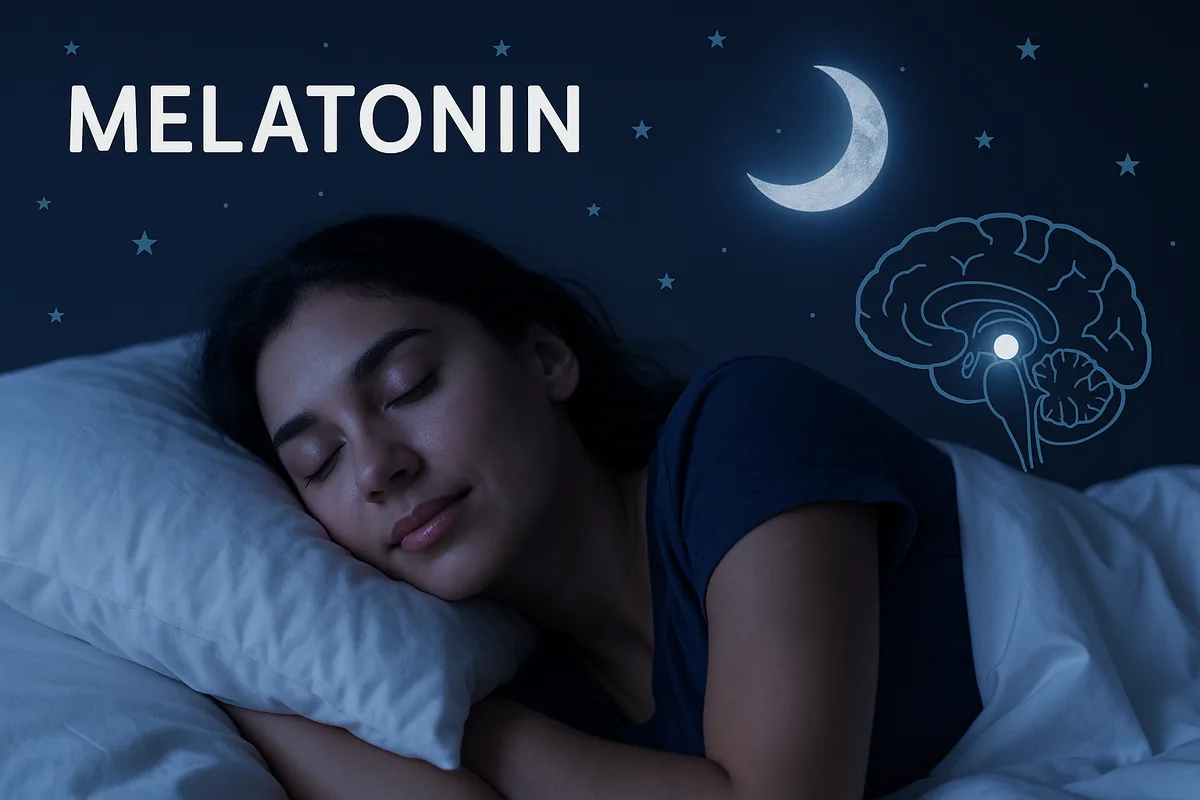
Melatonin is produced by the pineal gland in response to darkness. It’s the body’s “it’s dark, time to prepare for sleep” signal — a circadian regulator rather than a sedative.
Key distinction: Melatonin doesn’t directly cause sleep the way a sedative like benzodiazepin does. It doesn’t slow brain activity acutely. What it does:
Signals the circadian clock that it’s nighttime, promoting the biological processes associated with sleep onset (dropping core body temperature, reducing alertness)
Shifts the circadian rhythm when taken at specific times — it’s a chronobiotic (time-shifter)
Reduces sleep onset latency in people who are delayed-phase or jet-lagged — it moves the sleep window earlier
This is why melatonin works best for circadian-related sleep problems (jet lag, shift work, delayed sleep phase) and works less well for sleep maintenance problems (waking up in the middle of the night) or insomnia caused by anxiety, pain, or other non-circadian issues.
The Dose Myth
The research on melatonin dosing is fairly clear: more is not better, and 0.5-1 mg is effective for most purposes.
A landmark study by MIT researchers Zhdanova and colleagues showed that 0.3-0.5 mg of melatonin was as effective or more effective than higher doses for:
Reducing sleep onset latency
Improving sleep quality
Achieving physiological plasma melatonin levels that mimic natural production
Why does this matter? At low doses (0.3-0.5 mg), melatonin supplementation raises blood levels to a natural range (30-100 pg/mL). At 5-10 mg doses, blood levels spike to 300-10,000+ pg/mL — far exceeding normal physiological levels.
Problems with supraphysiological doses:
May desensitize melatonin receptors over time (MT1 and MT2 receptor downregulation)
Morning grogginess/”melatonin hangover” — high doses can extend melatonin levels into morning hours, impairing alertness
May suppress endogenous melatonin production over time (the body may reduce its own output)
Potential hormonal effects at high doses: melatonin has interactions with reproductive hormones
Why are US products so high-dose? Melatonin is sold as a dietary supplement in the US, where no approval process regulates dose. Manufacturers defaulted to higher doses as “more effective” marketing, and consumers reinforced this by choosing bigger numbers. Other countries — particularly in Europe, where melatonin is a prescription medication — regulate it at 0.5-2 mg doses.
Timing: The Most Important Variable
Because melatonin works by shifting the circadian clock, when you take it matters as much as how much you take.
For sleep onset (falling asleep earlier): Take 0.3-0.5 mg approximately 30-60 minutes before your desired bedtime. If you’re a night owl who wants to shift your sleep earlier, take melatonin 2-4 hours before your current natural sleep time to gradually advance your circadian phase.
For jet lag going east (losing hours): Take melatonin in the evening at your destination time for 2-4 days to help shift your circadian clock forward to the local night.
For jet lag going west (gaining hours): Going west is easier (delaying phase). Melatonin timing here is less critical; bright light avoidance in the evening helps more. If using melatonin, take it at destination bedtime.
For shift workers: Complex — depends on shift schedule. General principle: melatonin taken at the beginning of the daytime sleep period can help shift workers fall asleep during the day.
Important: Avoid taking melatonin in the morning or early afternoon — this can shift your clock in the wrong direction and worsen circadian disruption.
What Melatonin Is NOT Good For
Chronic primary insomnia (difficulty sleeping due to anxiety, racing thoughts, hyperarousal): Melatonin has modest to no effect for non-circadian insomnia. Cognitive behavioral therapy for insomnia (CBT-I) is the gold standard.
Sleep maintenance insomnia (waking up in the middle of the night): Standard immediate-release melatonin doesn’t help with 3 AM wake-ups — it’s mostly metabolized by then. Extended-release melatonin formulations have slightly better evidence here.
“More energy” sleep: Melatonin doesn’t improve sleep quality per se — it primarily affects sleep onset timing.
Extended-Release vs Immediate-Release
Immediate-release (standard): Peaks in blood within 30-60 minutes, metabolized in 3-5 hours. Best for sleep onset issues and jet lag.
Extended-release: Provides sustained low levels throughout the night, better mimicking natural nighttime melatonin patterns. Better evidence for sleep maintenance and in elderly patients (who often have reduced endogenous melatonin production). Circadin (prescription in Europe) is an extended-release 2 mg formulation with clinical trial data in older adults.
Melatonin in Special Populations
Children: Melatonin is widely used for children, especially those with ADHD, autism spectrum disorder (ASD), and developmental delays — conditions associated with disrupted circadian rhythms. Evidence supports efficacy and short-term safety. Long-term use in children should be supervised by a pediatrician. Doses are typically 0.5-3 mg in children.
Elderly: Melatonin production declines substantially with age. Older adults have lower endogenous levels and may benefit more from supplementation. Extended-release formulations are often preferred. Doses: 0.5-2 mg extended-release.
Pregnancy: Limited safety data. Melatonin crosses the placenta and appears in fetal circulation. Some animal studies suggest effects on fetal development at high doses. Best to avoid during pregnancy unless directed by a physician.
Melatonin Beyond Sleep
Melatonin has several non-sleep functions that are increasingly studied:
Antioxidant: Melatonin and its metabolites are potent antioxidants. Some research explores its potential role in protecting against oxidative stress-related conditions, including some cancers. This is the basis for interest in higher-dose melatonin as an adjunct in oncology — but this research is preliminary and doesn’t translate to supplement recommendations for the general public.
Mitochondrial protection: Melatonin concentrates in mitochondria and may protect mitochondrial membranes from oxidative damage. This is relevant to anti-aging research.
Immune modulation: Melatonin has complex interactions with the immune system. Not directly relevant to typical sleep supplementation.
COVID-19 and infections: Some interest in melatonin for viral infections based on antioxidant and immune effects. Evidence is insufficient to recommend for this purpose.
Safety Profile
Melatonin at physiological and moderate doses (0.5-5 mg) has an excellent safety profile:
No established organ toxicity at typical doses
Non-habit-forming in the classic sense
No documented withdrawal syndrome
Concerns at high doses:
Morning grogginess
Vivid dreams
Possible receptor downregulation with chronic high-dose use
Theoretical reproductive hormone interactions (melatonin has anti-gonadotropic effects at high doses in some species)
Blood thinners (warfarin): Some interactions reported
Immunosuppressants: Theoretical interaction
CNS depressants: Additive sedation
Building Better Sleep Without Melatonin
Melatonin can be a useful tool but works best as part of a broader sleep hygiene approach:
Darkness at night: Even low-level light suppresses melatonin. Blue-light-blocking glasses or screen dimming in the 2 hours before bed dramatically improves natural melatonin onset.
Consistent sleep schedule: The most powerful circadian regulator is consistent wake time.
Morning light exposure: 10-30 minutes of outdoor light within an hour of waking anchors your circadian clock.
Temperature: Sleeping in a cool room (65-68°F) supports the core body temperature drop that facilitates deep sleep.
Caffeine cutoff: Caffeine blocks adenosine receptors that drive sleep pressure; a 10-hour half-life means 3 PM coffee affects midnight sleep.
Frequently Asked Questions
Q: Can I take melatonin every night? A: Short to medium-term nightly use appears safe. For long-term chronic insomnia, the concern is whether nightly melatonin substitutes for addressing the underlying cause. Using it at low doses (0.3-0.5 mg) for circadian timing assistance is more sustainable than using high-dose as a sleep drug.
Q: Why do I wake up groggy from melatonin? A: Almost always a dose problem. 5-10 mg melatonin taken at bedtime extends elevated melatonin levels well into morning. Switch to 0.5 mg and the grogginess typically resolves.
Q: Does melatonin work immediately? A: For sleep onset, yes — 0.5 mg taken 30-60 minutes before bed can shorten the time to fall asleep. For circadian phase shifting (changing your body clock), it takes several days of consistent use.
Q: Is melatonin safe for teenagers? A: Cautious use is appropriate. The adolescent circadian rhythm naturally shifts later (delayed phase), and melatonin can help shift sleep earlier in teens with severe delayed sleep phase. However, melatonin has reproductive hormone interactions that are more relevant in adolescence. Short-term use at low doses with physician involvement is advisable.
Q: What about liquid melatonin? A: Liquid melatonin allows precise low-dose calibration (e.g., 0.2-0.5 mg). This is actually ideal for those who want physiological dosing and can’t find small-dose capsules. Some liquid formulations allow sub-milligram dosing.
Q: Does alcohol affect melatonin? A: Yes — alcohol disrupts melatonin secretion and circadian rhythm, impairing sleep quality. Even if you fall asleep easily with alcohol, sleep architecture is disrupted and natural melatonin production is blunted.
Key Takeaways
The optimal dose for most adults is 0.3-1 mg, not the 5-10 mg doses sold in most US supplements – higher doses do not improve sleep and may cause morning grogginess.
Melatonin is most effective as a chronobiotic (sleep timing signal), not a sedative – it helps phase-shift your circadian rhythm.
Best evidence-based uses: jet lag (especially eastward travel), delayed sleep phase disorder, and shift work adaptation.
Extended-release formulas help with sleep maintenance; immediate-release formulas are better for sleep onset.
Melatonin is generally safe short-term; long-term use should be evaluated – it does not cause dependence but may affect reproductive hormones at high doses.
Conclusion
The melatonin story in 2026 is clear: less is more. The US supplement market’s 5-10 mg default is a product of marketing, not physiology. Effective melatonin use means 0.3-0.5 mg taken 30-60 minutes before your desired sleep time, with consistent timing that works with your circadian biology rather than trying to sledgehammer your brain into sleep with pharmacological doses.
For jet lag, shift work, and delayed sleep phase — melatonin is genuinely excellent. For chronic anxiety-driven insomnia, address the root cause. And for everyone: morning light, consistent wake times, and darkness at night will do more for your sleep than any supplement.







Leave a Reply