
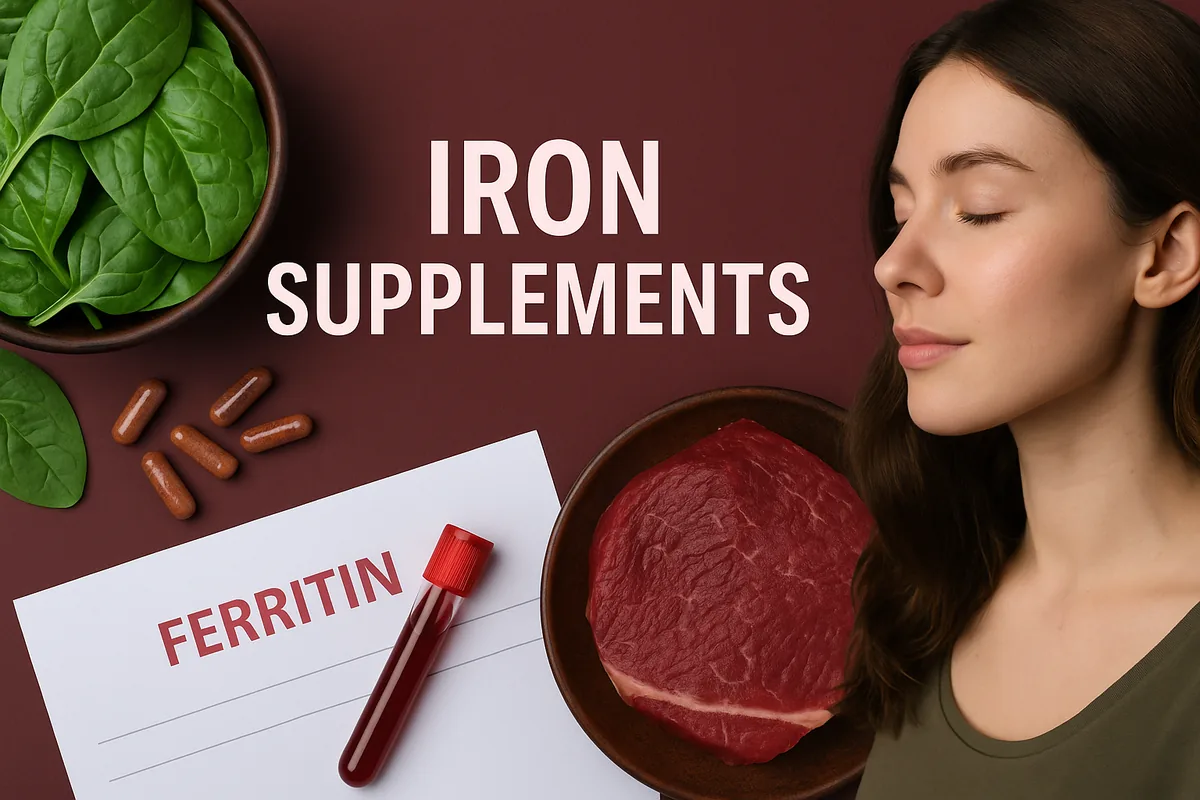
Best Iron Supplements in 2026: Gentle Forms, Women’s Health, and Ferritin Optimization
Quick Answer: Ferrous bisglycinate is the gentlest, best-absorbed iron form with less GI distress than ferrous sulfate. Test ferritin levels (not just hemoglobin) for true iron status, take with vitamin C on an empty stomach, and consider alternate-day dosing for better absorption.
Iron deficiency is the most prevalent nutritional deficiency worldwide, affecting roughly 2 billion people — with women of reproductive age and children at highest risk. In the US, about 10% of women aged 12-49 are iron deficient. It’s also one of the most mismanaged supplement categories: people taking iron they don’t need can cause harm, and people who do need it often use forms that cause unnecessary side effects.
This guide covers when to supplement, which forms are gentlest and most effective, optimal dosing strategies, and how to interpret ferritin levels.
Understanding Iron Status: It’s More Nuanced Than Hemoglobin
Most people associate iron deficiency with anemia — low hemoglobin and red blood cell count. But iron depletion exists on a spectrum:
Stage 1 — Iron depletion: Serum ferritin drops (stored iron being used), but blood counts remain normal. No obvious symptoms.
Stage 2 — Iron-deficient erythropoiesis: Ferritin low, transferrin saturation drops, red blood cell production becomes iron-limited. Symptoms may begin: fatigue, reduced exercise tolerance, hair loss.
Stage 3 — Iron deficiency anemia: Hemoglobin drops below normal. Classic anemia symptoms: pallor, shortness of breath, rapid heart rate, severe fatigue.
The critical insight: symptoms often appear at Stage 2, before anemia is present. Fatigue, brain fog, hair loss, restless leg syndrome, and exercise intolerance can all manifest with low ferritin but normal hemoglobin. Standard CBC (complete blood count) may be completely normal while ferritin is 8 ng/mL.
Key Iron Lab Tests and What They Mean

Serum ferritin: The most sensitive marker of iron stores. Often the most useful single test.
- Classic deficiency: <12-15 ng/mL
- “Optimal” by functional standards: Often set at 50-100 ng/mL for women (evidence for symptom relief up to these levels)
- Important caveat: Ferritin is an acute phase reactant — inflammation raises ferritin regardless of iron stores. A “normal” ferritin during illness or chronic inflammation may mask true iron deficiency.
Transferrin saturation: What percentage of transferrin (iron-transport protein) is loaded with iron.
- Low (<20%) suggests iron deficiency
- High (>45%) suggests iron overload or excess supplementation
TIBC (Total Iron Binding Capacity): High TIBC with low serum iron = iron deficient (the body makes more transferrin to capture more iron)
Hemoglobin/hematocrit: Anemia markers. Low indicates Stage 3. Normal doesn’t rule out iron deficiency.
Serum iron: Fluctuates widely day-to-day. Least reliable marker in isolation.
Iron Supplement Forms: Which Is Actually Gentlest?
Ferrous Sulfate
The traditional standard — most commonly prescribed and cheapest. Also the most likely to cause GI side effects: nausea, constipation, cramping, dark stools.
Absorption: 20-30% of elemental iron when taken correctly.
The GI side effects are the main reason for poor adherence and are directly related to the unabsorbed iron in the colon, which feeds pathogenic bacteria and irritates the gut lining.
Ferrous Bisglycinate (Iron Glycinate Chelate)
Iron bound to two glycine molecules. This chelate form is significantly better tolerated than ferrous sulfate, with studies showing:
- Comparable or better absorption at lower elemental iron doses
- Significantly fewer GI side effects (one study showed 78% fewer GI complaints)
- Less interaction with food components that inhibit absorption
This is now generally recommended as the first-choice supplement form, especially for those with sensitive GI systems or history of side effects with ferrous sulfate.
Ferrous Gluconate
Gentler than ferrous sulfate, less iron per gram, but easier to tolerate. A middle-ground option.
Ferric Iron Forms (Iron Polymaltose Complex, Ferric Citrate)
Ferric forms are less well absorbed than ferrous forms in general. Iron polymaltose complex (IPC) is used in some countries as it’s very well tolerated. Ferric carboxymaltose is an IV preparation for severe deficiency — not a supplement.
Carbonyl Iron
Elemental iron processed to very fine particles. Slowly absorbed in the stomach (acid-dependent). Considered safer in accidental overdose. Somewhat gentler than ferrous sulfate. Absorption is adequate at appropriate doses.
Heme Iron (from animal sources)
Not commonly available in standard supplements but found in liver supplements and some specialized products. Heme iron (from animal hemoglobin) is absorbed at 15-35% efficiency regardless of GI factors, and doesn’t interact with phytates, calcium, or other absorption inhibitors. Excellent form if available and appropriate for your diet.
Liquid Iron
Iron in liquid form (often ferrous sulfate or ferrous bisglycinate liquid). Easier to adjust dose, potentially faster absorption, but can stain teeth — use a straw.
Dosing: Surprising Evidence for Less-Is-More
The traditional recommendation was 150-200 mg elemental iron per day in divided doses. Research in the past decade has significantly revised this:
Alternate-day dosing: A landmark 2017 study by Moretti et al. in The Lancet Haematology found that iron absorption was higher on alternate days compared to daily dosing. After morning iron dosing, hepcidin (the iron-regulatory hormone) rises and blocks further absorption for approximately 24 hours. Daily dosing fights against this natural regulatory mechanism.
Practical recommendation: For most adults with iron deficiency (not severe anemia), one dose of iron every other morning on an empty stomach maximizes absorption and minimizes side effects.
Typical doses by form:
- Ferrous bisglycinate: 25-36 mg elemental iron every other day (conservative, gentle)
- Ferrous sulfate: 65-130 mg elemental iron every other day (if tolerated)
- Note: “Elemental iron” is what matters — ferrous sulfate 325 mg = 65 mg elemental iron
Absorption Optimization
Enhance absorption:
- Take on empty stomach (if tolerated)
- Take with vitamin C (100-200 mg with the iron dose increases absorption 2-4x)
- Orange juice or citrus alongside iron helps
- Take in the morning (iron absorption follows circadian patterns, better in AM)
Inhibit absorption (separate by 2+ hours):
- Calcium supplements and dairy
- Coffee and tea (tannins)
- Phytates (bran, whole grains, legumes) — though ferrous bisglycinate is less affected
- Polyphenol-rich foods
- Proton pump inhibitors (PPIs) reduce stomach acid needed for iron absorption
- Antacids
Women’s Health: The Ferritin Optimization Goal
Premenopausal women are at highest risk of iron deficiency due to menstrual blood loss. The iron requirements are:
- Adult men: 8 mg/day
- Premenopausal women: 18 mg/day
- Pregnant women: 27 mg/day
- Postmenopausal women: 8 mg/day (same as men)
For women with heavy periods, iron needs can be substantially higher. A woman with menorrhagia (heavy menstrual bleeding) can lose enough iron monthly to cause chronic deficiency even with dietary iron that would be adequate for average periods.
The ferritin target debate: Many conventional physicians treat ferritin >15 ng/mL as “normal.” Functional medicine practitioners often target 70-100 ng/mL for optimal energy and hair health. The evidence supports symptom improvement up to ferritin levels of 50-70 ng/mL:
- Hair loss studies: hair telogen effluvium often improves when ferritin rises above 40-70 ng/mL
- Restless leg syndrome responds to ferritin above 75-100 ng/mL
- Fatigue: some studies show improvement up to ferritin of 50 ng/mL
If your ferritin is 20 ng/mL and your CBC is normal, you may still benefit from iron supplementation — but get tested, don’t guess.
Iron Overload: The Important Contraindication
Iron supplementation is not benign in those who don’t need it. Excess iron:
- Causes oxidative stress (iron is a Fenton reaction catalyst, generating hydroxyl radicals)
- Feeds pathogenic bacteria
- Is associated with increased risk of cardiovascular disease and some cancers at high levels
- Hereditary hemochromatosis (HH): Genetic condition causing iron overabsorption — affects ~1 in 250 of Northern European descent. Taking iron supplements with undiagnosed HH can be dangerous.
Never supplement iron without testing. Get a ferritin and transferrin saturation first. If ferritin is high, do not supplement and investigate the cause.
Frequently Asked Questions
Q: Why do iron supplements cause constipation? A: Unabsorbed ferrous iron in the colon alters the microbiome (feeding less beneficial bacteria), irritates the gut lining, and can slow motility. Ferrous bisglycinate causes significantly less constipation because it’s more completely absorbed. Alternate-day dosing also reduces the amount of unabsorbed iron in the colon.
Q: How long does it take to raise ferritin? A: With consistent supplementation and good absorption, ferritin typically rises 1-2 ng/mL per week. Going from ferritin 15 to ferritin 60 might take 2-3 months. Recheck ferritin after 8-12 weeks of supplementation.
Q: Can I get enough iron from diet alone? A: If your ferritin is low, diet alone rarely corrects it fast enough, especially for premenopausal women with ongoing losses. Dietary changes (increasing red meat, liver, shellfish) can help maintain status after supplementation corrects the deficit.
Q: What’s the difference between heme and non-heme iron? A: Heme iron (from meat/blood) is absorbed at 15-35%, largely unaffected by dietary factors. Non-heme iron (plants, supplements) is absorbed at 2-20% and greatly affected by vitamin C (enhancing) and tannins/phytates (inhibiting). Vegetarians and vegans are at much higher risk of iron deficiency.
Q: I have an autoimmune condition — is iron supplementation safe? A: This is complex. Some autoimmune conditions cause anemia of chronic disease, where iron supplementation doesn’t work (and may worsen inflammation). Get a full iron panel before supplementing, and discuss with your physician.
Q: What about iron during pregnancy? A: Iron needs increase dramatically in pregnancy (27 mg/day). Most prenatal vitamins include iron. Many pregnant women still develop iron deficiency and need additional supplementation. Ferrous bisglycinate is ideal in pregnancy due to its tolerability.
Key Takeaways
- Always test before supplementing – iron excess is as harmful as deficiency; confirm with ferritin, serum iron, and TIBC labs.
- Ferrous bisglycinate (chelated) absorbs well with fewer GI side effects than ferrous sulfate; ferric forms require acid and absorb poorly.
- Alternate-day dosing may be more effective than daily dosing due to hepcidin regulation – confirmed in recent RCTs.
- Take iron with vitamin C (enhances absorption) and away from calcium, tea, coffee, and dairy (which inhibit absorption).
- Women of reproductive age and vegetarians have the highest deficiency rates; ferritin under 30 ng/mL warrants attention even without anemia.
Conclusion
Iron supplementation done right requires knowing your ferritin level, choosing the right form (ferrous bisglycinate is the modern first-choice for tolerability), using alternate-day morning dosing with vitamin C, and monitoring with follow-up testing. For women struggling with fatigue, hair loss, or restless legs — check ferritin before assuming you don’t have iron deficiency.
And critically: if you don’t have documented deficiency, don’t supplement iron. It’s one of the few supplements where unnecessary supplementation can cause real harm.
Sources
- Moretti D, et al. (2015). Oral iron supplements increase hepcidin and decrease iron absorption from daily vs. alternate-day doses. Blood, 126(17):1981-1989.
- Stoffel NU, et al. (2017). Iron absorption from oral iron supplements given on consecutive versus alternate days. Lancet Haematol, 4(11):e524-e533.
- Vaucher P, et al. (2012). Effect of iron supplementation on fatigue in nonanemic menstruating women with low ferritin. CMAJ, 184(11):1247-1254.
- Tolkien Z, et al. (2015). Ferrous sulfate supplementation causes significant GI side effects in adults. PLoS One, 10(2):e0117383.
- Office of Dietary Supplements – NIH. (2023). Iron Fact Sheet for Health Professionals.
Leave a Reply