
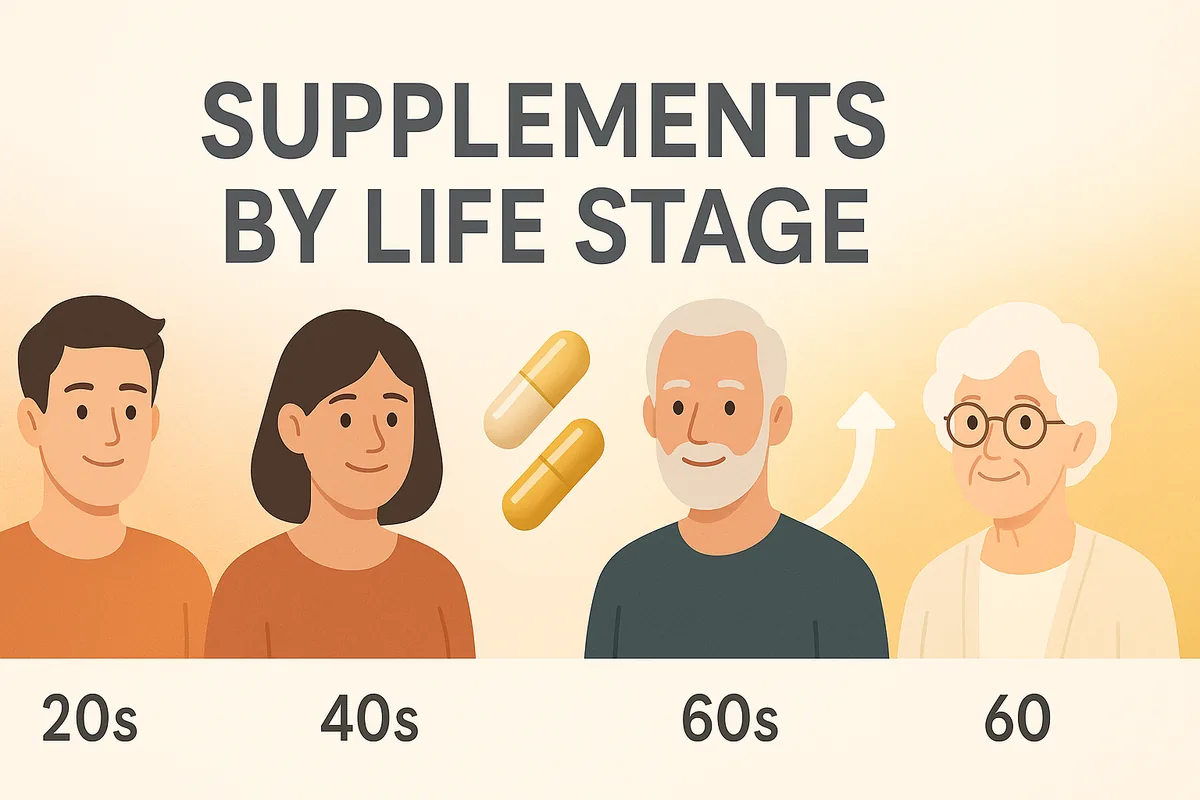
Supplements by Life Stage: What to Take in Your 20s, 30s, 40s, 50s, and 60s+
Quick Answer: Supplement needs change significantly across decades — what’s essential in your 60s may be irrelevant in your 20s, and vice versa. The universal core (vitamin D3, magnesium, omega-3) applies broadly, but targeted additions like folate for reproductive-age women, B12 for older adults, creatine for aging muscles, and bone support nutrients after menopause reflect real physiological changes. This guide maps evidence-backed supplements to each life stage.
- Tongkat Ali (LJ100, 200 mg/day) — RCT evidence for raising free testosterone in men with low-normal levels
- Zinc (25–30 mg) + Vitamin D3 — foundational for testosterone biosynthesis
In Your 50s: Bone, Heart, and Hormonal Pivots
Physiological Reality at This Stage
- Menopause (women): Average at 51. Bone resorption dramatically accelerates in the first 5–7 years. Risk of osteoporosis is real and requires active intervention.
- Testosterone in men: Typically 30–40% below peak; andropause is clinically significant for many
- Cardiovascular risk is highest: Hypertension, dyslipidemia, insulin resistance often established
- Cognitive function: Early decline in processing speed and memory is normal; interventions most relevant
- Chronic inflammation is often significantly elevated
Priority Supplements
Calcium citrate (500 mg 2x/day with meals) + D3 (2,000 IU) + K2 (MK-7, 100–200 mcg) The trifecta for bone protection post-menopause. Calcium citrate preferred over carbonate for this age group due to declining gastric acid. Vitamin K2 is essential to prevent arterial calcification.
Creatine (3–5g/day) — non-negotiable for aging muscle Sarcopenia accelerates in the 50s. Creatine combined with resistance training is the most evidence-backed intervention for preserving muscle mass and strength with age.
B12 (500–1,000 mcg methylcobalamin/day) Stomach acid production declines with age, impairing B12 absorption from food. By the 50s, B12 testing and supplementation becomes increasingly important. Neurological symptoms of deficiency can be subtle and cumulative.
NMN or NR (250–500 mg/day) NAD+ levels decline significantly with age — by the 50s, levels are roughly 50% of what they were in young adulthood. NMN and NR raise NAD+ and have growing evidence for energy metabolism and cellular repair (primarily through sirtuin activation).
Alpha lipoic acid (ALA, 300–600 mg/day) Mitochondrial antioxidant that also improves insulin sensitivity. Pairs well with CoQ10 for mitochondrial support.
GlyNAC (Glycine + NAC) Glutathione levels decline sharply after 50. GlyNAC combination raises glutathione more effectively than either alone and shows impressive results in aging biomarkers in clinical trials. Take with careful medical oversight if on blood thinners.
In Your 60s+: Longevity, Absorption, and Targeted Support
Physiological Reality at This Stage
- Absorption is significantly impaired: Less gastric acid, slower motility, potentially impaired intrinsic factor (B12 absorption)
- Sarcopenia is a real risk: Loss of muscle mass and function is a primary predictor of disability and mortality in older adults
- Cognitive decline risk increases: Dementia prevention becomes a priority concern
- Bone fragility and fall risk increase each year
- Immune senescence: Aging immune system is less effective at surveillance and response
Priority Supplements
B12 (sublingual methylcobalamin, 1,000 mcg/day) Sublingual or injectable B12 bypasses impaired GI absorption. Deficiency in the 60s+ is extremely common and causes neurological deterioration, fatigue, and anemia.
D3 (2,000–4,000 IU/day based on testing) Critical for muscle function, fall prevention, immune support, and mood. The RDA of 600–800 IU is widely considered insufficient for older adults.
Creatine (3–5g/day) + Protein (1.2–1.6g/kg/day) Sarcopenia prevention. Protein needs actually increase with age due to anabolic resistance. Combined creatine + adequate protein + resistance training is the evidence-backed approach.
Phosphatidylserine (100 mg 3x/day) Cognitive support with the most evidence among brain-targeted supplements for aging. An FDA-qualified health claim states: “very limited and preliminary scientific research suggests that phosphatidylserine may reduce the risk of dementia in the elderly.”
Lutein + Zeaxanthin (10 mg + 2 mg/day) Macular degeneration is the leading cause of vision loss in adults 60+. The AREDS2 clinical trial established lutein/zeaxanthin supplementation as an evidence-backed intervention for reducing progression risk.
Calcium citrate + D3 + K2 (continued) Bone fragility continues to increase. Calcium citrate is preferred at this age due to reduced gastric acid.
Probiotics (Bifidobacterium-dominant formulas) Gut microbiome diversity declines with age, with particular loss of Bifidobacterium species. Bifidobacterium-rich formulations support immunity, digestion, and neurotransmitter precursor production.
Summary Table: Supplements by Life Stage
Supplement 20s 30s 40s 50s 60s+ Vitamin D3 + K2 ✓ ✓ ✓ ✓ ✓ Magnesium ✓ ✓ ✓ ✓ ✓ Omega-3 ✓ ✓ ✓✓ ✓✓ ✓✓ Folate (women) ✓✓ ✓✓ – – – Creatine – – ✓✓ ✓✓ ✓✓ CoQ10/Ubiquinol – – ✓ ✓✓ ✓✓ B12 – – – ✓ ✓✓ Calcium citrate – – – ✓✓ ✓✓ NMN/NR – – – ✓ ✓ GlyNAC – – – ✓ ✓✓ Lutein/Zeaxanthin – – – – ✓✓ ✓ = Worth considering; ✓✓ = Priority; – = Generally not a priority at this stage
Key Takeaways
- Universal core for all adults: Vitamin D3 + K2, magnesium, omega-3 fatty acids
- 20s: Focus on folate (women), bone-building nutrients, and nutrient sufficiency
- 30s: Add collagen for joints, B vitamins for stress, consider hormonal support
- 40s: Creatine becomes important; CoQ10 for mitochondria; berberine for metabolic support; perimenopause/andropause-specific stacks
- 50s: Add B12, NMN, calcium citrate, GlyNAC; creatine is non-negotiable
- 60s+: B12 absorption is impaired — go sublingual; add phosphatidylserine and lutein/zeaxanthin; protein needs increase; prioritize sarcopenia prevention
- Get baseline bloodwork (vitamin D, B12, ferritin, fasting glucose, lipids) every 2–3 years and adjust accordingly
Frequently Asked Questions
At what age should I start taking supplements?
Most people benefit from vitamin D3, magnesium, and omega-3 at any adult age, particularly if diet quality is inconsistent. More targeted supplements become relevant as specific physiological needs emerge — typically in the 40s and 50s.
Do supplement needs differ for men and women at the same age?
Yes. Folate is primarily relevant for women of reproductive age. Hormonal changes at menopause create specific needs (calcium, bone protection). Men may benefit from testosterone-support supplements in the 40s+. Otherwise, most core recommendations apply similarly across sexes.
How do I know if I need B12 supplementation in my 50s?
Ask your doctor for a serum B12 and methylmalonic acid (MMA) test. MMA is a more sensitive marker of functional B12 deficiency. Symptoms of deficiency include fatigue, tingling in extremities, memory issues, and mood changes — but these are non-specific.
Is creatine safe for older adults?
Yes. Creatine has one of the best long-term safety records of any supplement, and evidence specifically in older adults shows benefits for muscle mass, strength, cognitive function, and bone density. 3–5g/day is the standard dose; no loading phase required.
Can I just take a good multivitamin and skip all of this?
A high-quality multivitamin fills some gaps but typically underdoses several key nutrients (D3, magnesium, omega-3) and can’t replace the targeted, age-appropriate approach for specific concerns like sarcopenia, bone health, or cognitive protection.
Sources
- The effects of a plant-based and a plant- and marine-based n-3 oil supplement on behavioral reactivity, heart rate variability, and plasma fatty acid profile in young healthy horses. Journal of animal science. 2025. PMID: 40202435.
- Buford TW, et al. (2007). International Society of Sports Nutrition position stand: creatine supplementation and exercise. J Int Soc Sports Nutr, 4(1):6.
- Sano M, et al. (1997). A controlled trial of selegiline, alpha-tocopherol, or both as treatment for Alzheimer’s disease. NEJM, 336(17):1216–1222.
- Aldoori J, Mitra S, Davie A, Toogood GJ, Edwards C, Hull MA (2026). The effect of omega-3 polyunsaturated fatty acids on short-chain fatty acid production and the gut microbiome in an. Gut microbiome (Cambridge, England). PMID: 41608298.
- Kumar P, et al. (2021). Glycine and N-acetylcysteine supplementation in aging. Clin Transl Med, 11(3):e372.
- Crandall CJ & Manson JE. (2021). Menopausal hormone therapy and calcium supplementation. JAMA, 326(13):1243–1244.
- Office of Dietary Supplements – NIH. Vitamin B12, Calcium, Vitamin D Fact Sheets.
Related Articles
- Best Calcium Supplements in 2026: Forms, Timing, Women Over 50, and Kidney Stone Risk
- Creatine for Women and Seniors: Benefits, Dosing, Safety, and Best Picks
- GlyNAC (Glycine + NAC): The Glutathione-Boosting Longevity Stack With Remarkable Clinical Results
- Supplement Stacking Guide 2026: What Combines Well, What Conflicts, and Timing



Leave a Reply