
Best Berberine Supplements in 2026: Evidence Guide
Quick Answer: Berberine is one of the most evidence-backed metabolic supplements available. It has real clinical data for blood sugar management — with HbA1c reductions rivaling metformin in some small trials — and modest, overhyped weight-loss effects. It is not “nature’s Ozempic.” At 500 mg three times daily, berberine carries meaningful drug interactions (especially with metformin, statins, and diabetes medications) and should not be added to any prescription regimen without physician oversight. Best products deliver dihydroberberine or berberine phytosome for better absorption.
Berberine went from niche herbal supplement to TikTok sensation almost overnight. Dubbed “nature’s Ozempic” by influencers, it’s now one of the most searched supplement ingredients in the metabolic health space.
Some of the hype has a real foundation. Some of it doesn’t.
This guide breaks down what berberine actually does, what the clinical research supports, where the marketing outruns the evidence, and how to choose a berberine supplement if it makes sense for you.
`r`n`r`n
What Berberine Is and How It Works
Berberine is an isoquinoline alkaloid found in several plants, including goldenseal (Hydrastis canadensis), barberry (Berberis vulgaris), Oregon grape (Mahonia aquifolium), and Chinese goldthread (Coptis chinensis). It has a long history in traditional Chinese and Ayurvedic medicine.
At the molecular level, berberine activates AMP-activated protein kinase (AMPK), sometimes called the body’s “metabolic master switch.” AMPK activation influences:
- Glucose uptake in muscle cells (independent of insulin)
- Insulin sensitivity in peripheral tissues
- Fatty acid oxidation in the liver
- Gluconeogenesis inhibition (reduced glucose production by the liver)
Berberine also appears to modulate gut microbiota composition, reduce intestinal absorption of glucose, and influence bile acid metabolism [1][2]. These mechanisms overlap significantly with metformin, which is why the comparison comes up constantly.
`r`n`r`n
Berberine and Blood Sugar: The Strongest Evidence
Blood sugar management is where berberine has its most credible clinical data.
`r`n`r`n
The landmark trials
The most-cited study is Yin et al. (2008), a pilot trial in newly diagnosed type 2 diabetes patients. Subjects taking 500 mg berberine three times daily saw HbA1c decrease by about 2% over 3 months, with fasting blood glucose dropping roughly 7.5 mmol/L to 5.6 mmol/L. In the same study, berberine’s glucose-lowering effect was comparable to metformin at the same dose [3].
Zhang et al. (2008) confirmed similar findings — berberine added to existing oral hypoglycemic agents improved fasting glucose, postprandial glucose, and HbA1c significantly compared to the medication alone [4].
`r`n`r`n
Meta-analyses paint a more nuanced picture
A 2022 systematic review and meta-analysis in Frontiers in Endocrinology pooled 37 studies and found that berberine significantly reduced fasting plasma glucose, postprandial glucose, and HbA1c in type 2 diabetes patients. However, the authors noted that most included trials were small, short-term (8–16 weeks), and conducted predominantly in Chinese populations [5].
A 2023 umbrella meta-analysis in Clinical Therapeutics examined multiple prior meta-analyses and concluded that berberine supplementation improves glycemic parameters, but findings on inflammatory markers remain inconsistent. The quality of evidence ranged from low to moderate [6].
A 2024 meta-analysis (published in Phytotherapy Research) searching eight databases through September 2024 reinforced that berberine — alone or combined with standard medications — significantly reduces fasting glucose and HbA1c, but called for larger, longer, more diverse trials [7].
`r`n`r`n
The honest assessment
Berberine has more clinical evidence for blood sugar management than the vast majority of supplements. The effect sizes are meaningful — HbA1c reductions of 0.5–2% in some studies rival pharmaceutical interventions.
But the caveats are real:
- Most trials are small (30–120 participants)
- Most are 8–16 weeks long — we don’t have strong long-term data
- The majority of research comes from Chinese populations with type 2 diabetes
- Study quality is often rated low to moderate
- Berberine is not a replacement for prescribed diabetes medication without physician supervision
If you have prediabetes or metabolic syndrome and your doctor is on board, berberine is one of the more evidence-supported supplements you can consider. If you have diagnosed diabetes on medication, do not add berberine without medical oversight — it can potentiate hypoglycemia.
`r`n`r`n
Berberine and Weight Loss: The “Nature’s Ozempic” Question
This is where the hype gets dangerous.
`r`n`r`n
What the studies actually show
A 2020 dose-response meta-analysis of randomized controlled trials found that berberine supplementation significantly reduced BMI (weighted mean difference: −0.47 kg/m²) and waist circumference, but — critically — did not significantly reduce body weight (WMD: −0.11 kg, p = 0.79) [8].
A separate 2020 meta-analysis focusing on obesity parameters found significant reductions in body weight, BMI, waist circumference, and CRP levels. However, many of the included studies were in metabolically unhealthy populations (PCOS, NAFLD, metabolic syndrome), and the weight loss was modest — typically 1–3 kg over 8–16 weeks [9].
`r`n`r`n
The “nature’s Ozempic” comparison is misleading
Semaglutide (Ozempic/Wegovy) produces average weight loss of 15–17% of body weight in clinical trials. Berberine, in the most favorable studies, produces weight loss of roughly 1–3% of body weight — and that’s in metabolically compromised populations where some loss may reflect improved metabolic function rather than a direct anti-obesity effect.
Calling berberine “nature’s Ozempic” is like calling a bicycle “nature’s Tesla.” They both get you somewhere, but the scale is completely different.
`r`n`r`n
The honest bottom line on berberine and weight loss
Berberine is not a weight loss supplement in any meaningful sense. It may modestly improve body composition markers — especially waist circumference and BMI — likely as a downstream effect of improved metabolic function (better insulin sensitivity, reduced lipogenesis). If you’re expecting the kind of dramatic weight loss that GLP-1 agonists produce, berberine will disappoint you.
Where berberine may legitimately help: if you carry excess weight because of insulin resistance and metabolic dysfunction, improving those underlying issues with berberine (alongside diet and exercise) could make weight management easier. That’s a far cry from “take this pill and lose 30 pounds.”
`r`n`r`n
Berberine vs. Metformin: A Fair Comparison
This comparison is inevitable, and it’s not entirely unfair — the two compounds share some mechanisms (primarily AMPK activation). But context matters.
What they share:
- Both activate AMPK
- Both reduce hepatic glucose output
- Both improve insulin sensitivity
- Both cause GI side effects
- Both have some evidence for lipid improvements
Where metformin wins:
- Decades of large-scale clinical trials (UKPDS, DPP)
- Proven long-term safety profile
- FDA-regulated manufacturing and dosing
- Established in clinical guidelines worldwide
- Long-term cardiovascular outcome data
Where berberine has potential advantages:
- Available without prescription
- May improve lipid profile more broadly (some studies show greater triglyceride reduction)
- Natural origin appeals to some patients
- May be better tolerated GI-wise in some individuals
The responsible position: Berberine is not a substitute for metformin in diagnosed diabetes. It may be a reasonable option for people with prediabetes or metabolic syndrome who aren’t yet candidates for medication, or as an adjunct — but always with medical oversight.
`r`n`r`n
Safety, Side Effects, and Drug Interactions
Common side effects
The most frequent side effects are gastrointestinal: nausea, diarrhea, constipation, abdominal pain, and bloating. These are dose-dependent and often improve with time or dose adjustment. Starting at a lower dose (500 mg/day) and working up can help [10].
`r`n`r`n
Drug interactions — this is important
Berberine inhibits several cytochrome P450 enzymes (CYP2D6, CYP2C9, CYP3A4) and P-glycoprotein. This means it can interact with a wide range of medications:
- Diabetes medications (metformin, sulfonylureas, insulin) — risk of hypoglycemia
- Blood thinners (warfarin) — altered anticoagulant effect
- Immunosuppressants (cyclosporine, tacrolimus) — increased drug levels
- Statins — potentially increased statin levels and side effects
- Antihypertensives — additive blood pressure lowering
- PPIs (omeprazole) — altered drug metabolism
If you take any prescription medication, talk to your doctor or pharmacist before starting berberine.
`r`n`r`n
Dosage
Most clinical trials use 900–1500 mg/day, divided into 2–3 doses taken with meals. Berberine has a short half-life (several hours), which is why split dosing is important.
The most common protocol: 500 mg three times daily with meals.
`r`n`r`n
Who should avoid berberine
- Pregnant or breastfeeding women (berberine crosses the placenta and may cause kernicterus)
- Children
- People with low blood pressure
- Anyone scheduled for surgery (discontinue 2 weeks prior)
- People on multiple medications without physician clearance
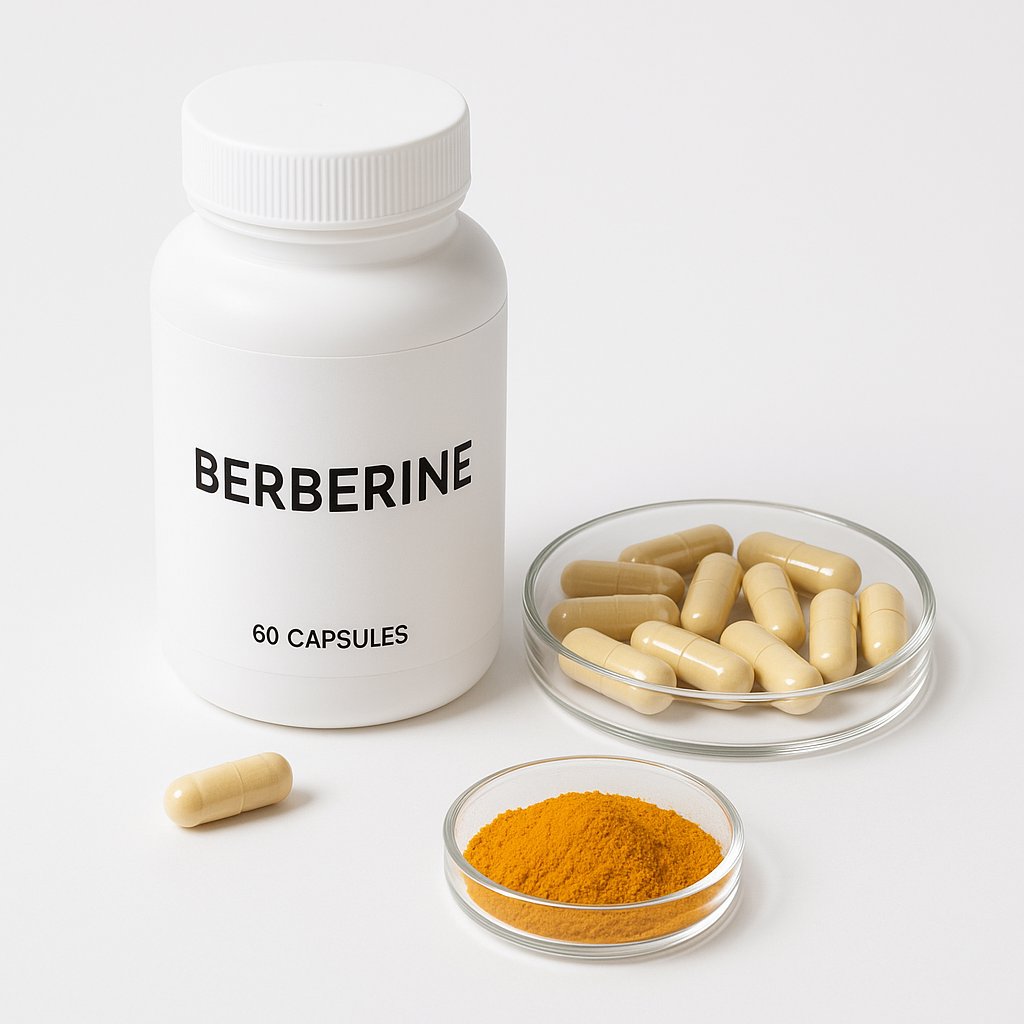
How to Choose a Berberine Supplement
Form matters
Standard berberine HCl has poor bioavailability (under 5% oral absorption). Several enhanced forms exist:
- Berberine HCl — the standard, most studied form. Cheap and well-researched, but low bioavailability.
- Berberine phytosome (e.g., Berbevis®) — lipid-complexed for better absorption
- Dihydroberberine (DHB) — a reduced form with reportedly 5x better absorption, allowing lower doses. Less clinical data than berberine HCl.
What to look for
- Third-party testing (USP, NSF, ConsumerLab) — berberine supplements have had quality control issues
- 500 mg berberine HCl per capsule for standard dosing flexibility
- No unnecessary fillers or proprietary blends
- Clear labeling of the berberine form and source plant
What to avoid
- Products marketed as “nature’s Ozempic” or promising dramatic weight loss
- Mega-dose formulas exceeding 1500 mg/day without evidence
- Combination products that bury berberine in a proprietary blend
- Any product making drug-like claims
The Bottom Line
Berberine is one of the more interesting and evidence-supported natural compounds for metabolic health. Its blood sugar benefits have real clinical backing, even if the studies are imperfect. Its weight loss benefits are modest at best and wildly overhyped by social media.
It is not nature’s Ozempic. It is not a replacement for diabetes medication. It is not a magic pill.
What it is: a supplement with genuine metabolic activity, meaningful (if limited) clinical evidence, real drug interactions, and a legitimate place in the conversation about metabolic health support — when used responsibly and with medical awareness.
`r`n`r`n
References
[1] Imenshahidi M, Hosseinzadeh H. “Berberine and barberry: A clinical review.” Phytotherapy Research. 2019;33(3):504–523.
[2] Och A, et al. “Biological Activity of Berberine — A Summary Update.” Toxins. 2020;12(11):713.
[3] Yin J, Xing H, Ye J. “Efficacy of berberine in patients with type 2 diabetes mellitus.” Metabolism. 2008;57(5):712–717.
[4] Zhang Y, et al. “Treatment of type 2 diabetes and dyslipidemia with the natural plant alkaloid berberine.” J Clin Endocrinol Metab. 2008;93(7):2559–2565.
[5] Liang Y, et al. “Glucose-lowering effect of berberine on type 2 diabetes: A systematic review and meta-analysis.” Front Endocrinol. 2022;13:1015045.
[6] Asbaghi O, et al. “The Effect of Berberine Supplementation on Glycemic Control and Inflammatory Biomarkers in Metabolic Disorders: An Umbrella Meta-analysis.” Clin Ther. 2024;46(1):e47–e56.
[7] Adel S, et al. “Effects of administering berberine alone or in combination on type 2 diabetes mellitus: a systematic review and meta-analysis.” Phytother Res. 2024 (online ahead of print).
[8] Asbaghi O, et al. “The effect of berberine supplementation on obesity indices: A dose-response meta-analysis.” Complement Ther Clin Pract. 2020;39:101113.
[9] Ilyas Z, et al. “The effect of berberine supplementation on obesity parameters, inflammation and liver function enzymes.” Complement Ther Med. 2020;51:102422.
[10] NCCIH. “Berberine and Weight Loss: What You Need to Know.” National Center for Complementary and Integrative Health. 2024.
Sources
- Impacts of Selected Dietary Nutrient Intakes on Skeletal Muscle Insulin Sensitivity and Applications to Early Prevention of Type 2 Diabetes. Advances in nutrition (Bethesda, Md.). 2021. PMID: 33418570.
- Nutraceutical approaches to metabolic syndrome. Annals of medicine. 2017. PMID: 28786719.
- The Effect of Berberine on Metabolic Profiles in Type 2 Diabetic Patients: A Systematic Review and Meta-Analysis of Randomized Controlled Trials. Oxidative medicine and cellular longevity. 2021. PMID: 34956436.
- Berberine and health outcomes: An umbrella review. Phytotherapy research : PTR. 2023. PMID: 36999891.
- National Institutes of Health Office of Dietary Supplements. Dietary supplement fact sheets.

Leave a Reply