
One of the most common supplement timing questions is also one of the most practical: when is the best time to take magnesium? The short answer is that consistency matters more than the clock. That said, the ideal timing depends on your goal, the form you’re using, and how your stomach responds – and getting these details right can make a real difference in outcomes.

The best time to take magnesium depends entirely on your primary goal. For sleep: take 1-2 hours before bed – magnesium’s GABA-modulating and melatonin-supporting effects benefit most from pre-sleep dosing. For muscle cramps and recovery: take post-workout or with dinner. For constipation: take at bedtime (magnesium citrate’s osmotic effect peaks 6-8 hours after ingestion). For anxiety or stress management: morning or midday dosing may better regulate daytime HPA axis activity. Magnesium can be taken with or without food – food increases tolerance for sensitive stomachs. Splitting the dose (morning and evening) optimizes total absorption and reduces laxative risk at higher doses.
- Sleep-targeting magnesium supplementation is most effective when taken 1-2 hours before bed – this timing aligns magnesium’s peak GABA receptor modulation and cortisol-reducing effects with the sleep initiation window, maximizing its sleep-promoting activity.
- Post-exercise magnesium replacement (within 30-60 minutes post-workout) addresses exercise-induced sweat and urinary magnesium losses – particularly relevant for endurance athletes and those doing prolonged resistance training who lose 4-8 mg magnesium per liter of sweat.
- Magnesium citrate for constipation works best taken at bedtime because the osmotic laxative effect typically manifests 6-8 hours after ingestion – evening dosing produces a morning bowel movement aligned with normal circadian gastrocolic reflex.
- Morning or midday magnesium (especially glycinate or malate) supports daytime energy and mood by supporting mitochondrial ATP production and reducing sympathetic nervous system overactivation during high-stress daytime hours.
- Taking magnesium with food reduces GI upset in sensitive individuals (food buffers the osmotic effect) but slightly reduces absorption efficiency compared to taking it 30-60 minutes before meals. For most people, taking it with dinner is the best compromise between comfort and absorption.
The Best Time Depends on Why You Take It
Magnesium is involved in over 300 enzymatic reactions in the body, including sleep regulation, muscle relaxation, nerve conduction, and energy metabolism. People take it for very different reasons, and those reasons affect the optimal timing:
- Sleep and relaxation – evening use is most logical
- Muscle cramps – timing around when cramps occur matters
- Constipation relief – timing around expected bowel activity matters
- General nutritional support – timing is largely irrelevant; consistency is what counts
- Cognitive support (magnesium L-threonate) – some evidence favors divided doses
There is no universally superior hour of the day. What matters is choosing a schedule aligned with your goal that you can maintain without side effects.
Best Time to Take Magnesium for Sleep
If sleep is your primary goal, evening use is well-supported by both mechanism and common practice. Magnesium works for sleep through several pathways:
- GABA activation – magnesium binds to GABA receptors, promoting relaxation without the grogginess of pharmaceutical sedatives
- Melatonin regulation – magnesium is required for melatonin synthesis; deficiency can disrupt natural melatonin release
- Cortisol reduction – adequate magnesium helps regulate the HPA axis, reducing the elevated evening cortisol that keeps people wired at bedtime
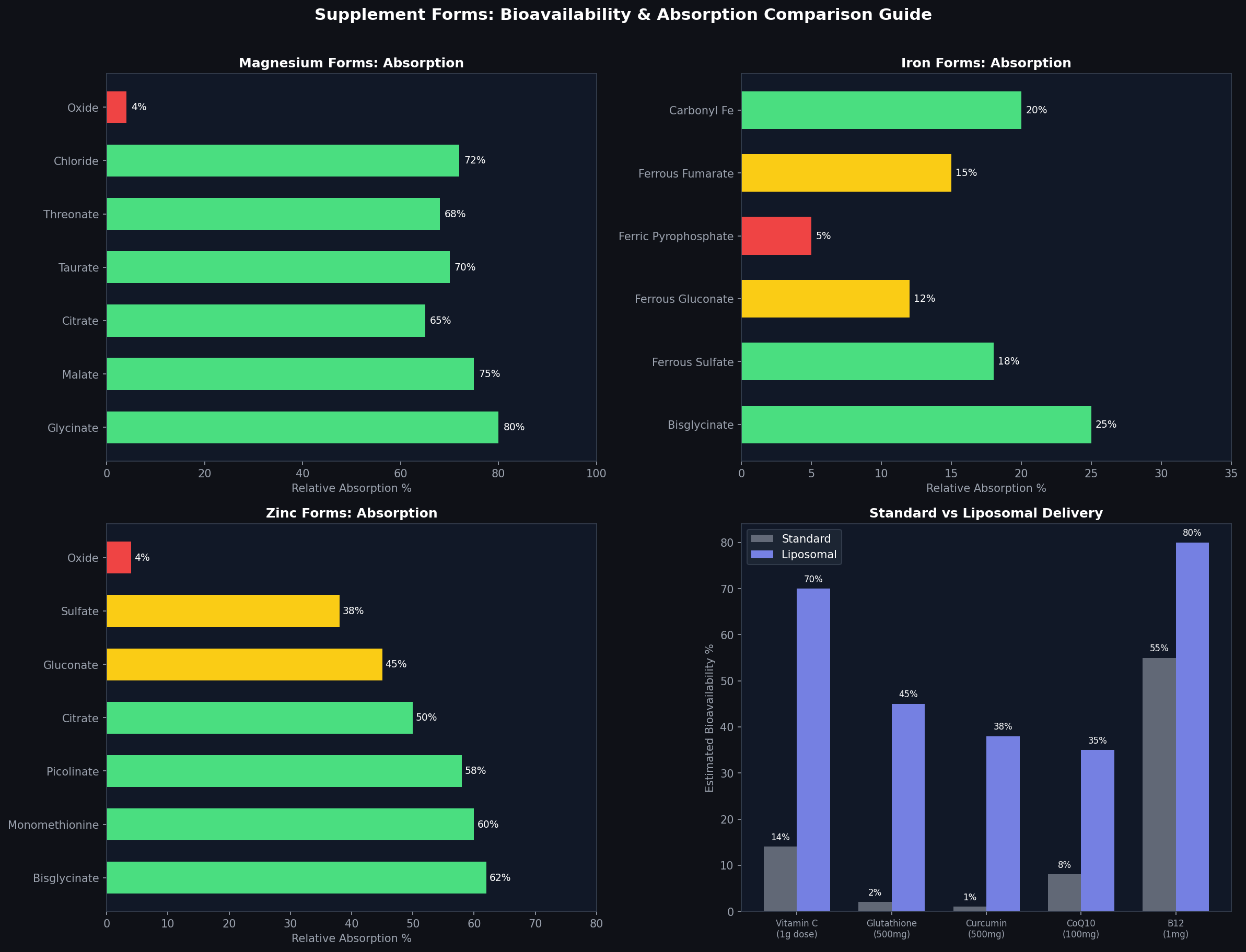
Most people take magnesium for sleep 30-60 minutes before bed, though some prefer 1-2 hours before for a more gradual effect. Magnesium glycinate (or bisglycinate) is the preferred form for this purpose – well absorbed, gentle on the stomach, and glycine itself has additional calming properties.
Best Time to Take Magnesium for Constipation
If you’re using magnesium citrate or magnesium oxide for bowel regularity, timing around the expected laxative effect matters more than any pharmacological window. Some considerations:
- Many people take it in the evening so it works by morning – this works well for most
- If the laxative effect is strong, taking it earlier in the day prevents middle-of-the-night disruption
- Test your personal response before committing to a timing that could cause urgency at an inconvenient time
Magnesium citrate has a more predictable and often stronger laxative effect than glycinate. Magnesium oxide has very poor absorption (around 4%) and works primarily as a laxative rather than a systemic magnesium source.
Best Time to Take Magnesium for Muscle Cramps
If nighttime cramps are the problem, evening dosing makes the most sense – both logically and because that’s when serum magnesium levels need to be adequate. If cramps occur during or after exercise, a split-dose approach (morning and evening) provides more continuous coverage.
For exercise-induced cramps specifically, hydration status and sodium intake often play a larger role than magnesium alone. If cramps persist despite supplementation, addressing electrolyte balance more broadly is worth considering.
Should You Take Magnesium With Food?
This depends on the form and your individual tolerance:
- Usually yes for citrate and oxide – these forms can cause stomach upset on an empty stomach; taking with food reduces GI irritation
- Glycinate is often fine without food – the amino acid chelation makes it gentler; most people tolerate it either way
- L-threonate is typically taken with food – the clinical dosing protocol used in research involves divided doses with meals
If magnesium makes you nauseated, move it to a meal or evening snack regardless of form. The benefits disappear if you stop taking it because of side effects.
Is Morning Magnesium Effective?
Yes – morning magnesium works well for several use cases:
- When you’re simply trying to increase total daily intake and fill a dietary gap
- For all-day stress management and HPA axis support
- When you already take multiple supplements in the evening and want to spread the load
- For cognitive support with magnesium L-threonate (some protocols use morning + evening)
The best schedule is the one you’ll actually maintain. Morning works. Evening works for sleep. Choose what fits your life.

Can You Split the Dose?
Yes, and there are good reasons to do so:
- Better tolerance – splitting into two smaller doses improves GI tolerability, especially at higher amounts that might cause loose stools as a single dose
- More consistent levels – magnesium is cleared from the bloodstream within hours; two doses maintains more stable tissue levels throughout the day
- Magnesium L-threonate specifically – the clinical protocols that showed brain magnesium increases typically used 3 divided doses daily (morning, afternoon, evening)
Drug and Nutrient Interactions to Consider
Timing becomes more important when medications are involved. The NIH notes that magnesium can interfere with the absorption of:
- Antibiotics (fluoroquinolones, tetracyclines) – separate by at least 2 hours
- Bisphosphonates (osteoporosis medications) – separate by at least 2 hours
- Thyroid medication (levothyroxine) – many practitioners recommend separating thyroid meds from all minerals by 4+ hours
People with kidney disease should not self-dose magnesium without medical supervision, as impaired kidneys cannot excrete excess magnesium effectively – this can lead to dangerous accumulation.
Bottom Line: Timing by Goal
- Sleep: 30-60 minutes before bed, magnesium glycinate preferred
- Constipation: Evening, magnesium citrate; adjust based on personal response
- Cramps: Evening for nighttime cramps; split dose for daytime cramps
- General support: Whenever you’ll remember to take it consistently
- Cognitive (L-threonate): Divided doses: morning + evening
The form you choose often matters more than the timing. Pick the right form for your goal first, then figure out when it fits your schedule.
This content is for informational purposes only. People with kidney disease or who take prescription medications should consult a healthcare provider before starting magnesium supplementation.
FAQ
Should magnesium be taken at night or in the morning?
Bedtime is the most popular and often most effective time, particularly for sleep benefits, anxiety reduction, and muscle relaxation during overnight recovery. Morning dosing is better if your primary goals are daytime energy, focus, and stress management. Many people split the dose – a smaller amount in the morning and the main dose before bed – to optimize both daytime and sleep benefits while staying within daily limits.
Can I take magnesium on an empty stomach?
Magnesium glycinate and malate are generally well-tolerated on an empty stomach. Magnesium citrate and oxide are more likely to cause nausea or GI upset on an empty stomach due to their osmotic effects – take these with food. If you experience stomach discomfort, take with food (dinner is most practical for evening doses). Absorption is slightly lower with food but the difference is modest with high-bioavailability chelated forms.
How long does magnesium take to start working?
Acute effects (muscle relaxation, reduced anxiety the same evening) can appear within 1-2 hours for sensitive individuals. Sleep improvements typically begin within the first few days of consistent use. For correction of deficiency and full systemic benefits (energy, mood stability, reduced cramps), consistent use for 4-8 weeks is needed to replenish intracellular magnesium stores. Serum magnesium normalizes faster than tissue levels.
Can I take magnesium with other supplements?
Yes – magnesium is compatible with most supplements. Beneficial combinations: magnesium + vitamin D (magnesium is required to activate vitamin D; taking them together improves both outcomes), magnesium + zinc (complementary minerals; separate if high doses of either are used, as they compete for absorption at high ratios), magnesium + L-theanine (for sleep and anxiety synergy). Avoid taking magnesium with high doses of calcium within the same meal – they compete for absorption.
Related Articles
- Pardo MR, Garicano Vilar E, San Mauro Martín I, Camina Martín MA (2021). Bioavailability of magnesium food supplements: A systematic review. Nutrition (Burbank, Los Angeles County, Calif.). PMID: 34111673.
- Magnesium Oil and Spray Guide 2026
- Best Supplements for Sleep in 2026
- Best Supplements for Muscle Cramps in 2026
- Best Supplements for Stress and Cortisol in 2026
Sources
- Cell-Penetrating Botulinum Neurotoxin Type A Proteins Alleviate Skeletal Muscle Hypertrophy with Associated Alterations of Mitochondrial Homeostasis. Toxins. 2026. PMID: 41745769.
- Mah JY, Pitre T, et al. Oral magnesium supplementation for insomnia in adults: a systematic review. Nutrients. 2022.
- Reviews on magnesium glycinate bioavailability and absorption. PubMed search.
- Studies on magnesium supplement timing, meals, and absorption pharmacokinetics. PubMed search.
- Surveys on magnesium deficiency prevalence and dietary intake in adults. PubMed search.
📚 Part of our Best Magnesium Supplements in 2026 hub. Explore all our magnesium guides.