
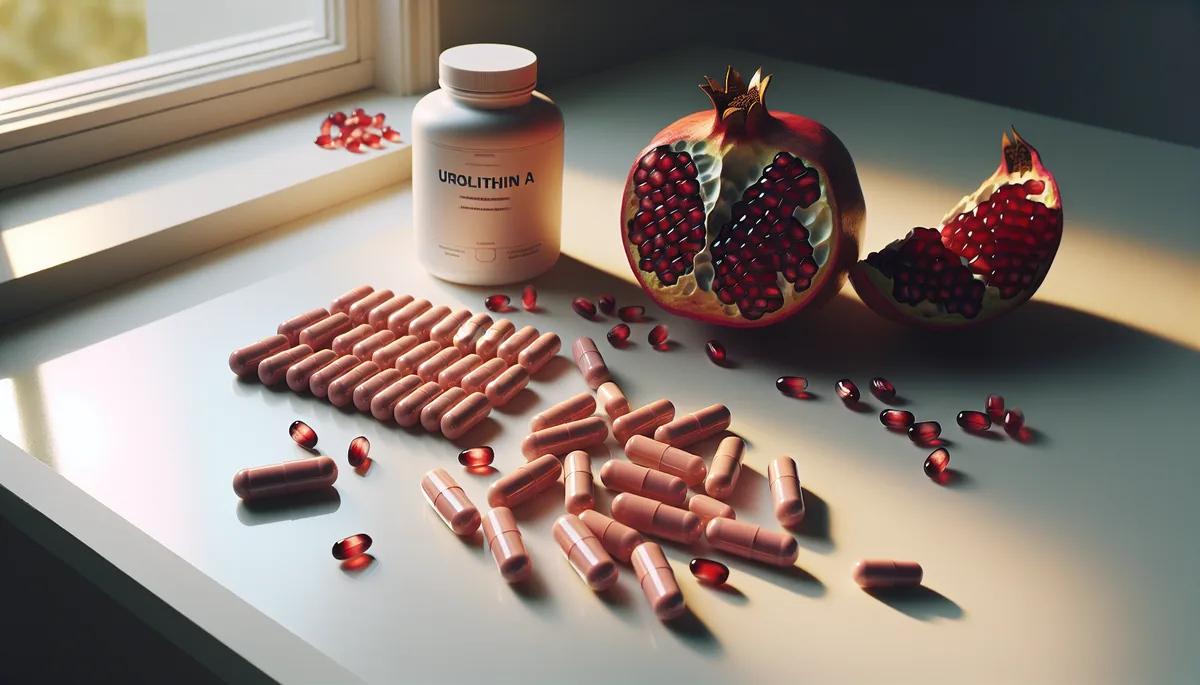
Mitochondria are the energy engines of your cells, but aging does not treat them kindly. Over time, damaged mitochondria can accumulate, produce energy less efficiently, and contribute to fatigue, reduced exercise capacity, and tissue decline. That is why mitochondrial health has become central to modern longevity discussions.
Urolithin A supports mitochondrial health through mitophagy induction – the selective degradation and recycling of damaged or dysfunctional mitochondria via the PINK1/Parkin pathway. In human muscle biopsies and clinical trials, urolithin A supplementation increases markers of mitophagy (LC3, PINK1, BNIP3L expression), improves mitochondrial biogenesis markers, and translates to measurable functional improvements in muscle endurance in older adults. The ATLAS trial (2019) and a subsequent 2022 cell energy study are the primary human datasets. Animal data strongly support the mechanism across multiple species. Current evidence is promising for the concept of pharmacological mitophagy enhancement but still limited to small-to-medium human trials.
If you are ready to try urolithin A, our supplement guide for urolithin A covers dosing, forms, and which products have the strongest evidence behind them.
- Mitophagy – the selective autophagy (cellular self-digestion) of dysfunctional mitochondria – declines with age in most tissues; this mitophagy decline contributes to the accumulation of damaged mitochondria that characterizes muscle and neurological aging.
- Urolithin A activates mitophagy via the PINK1/Parkin pathway: PINK1 (a kinase that accumulates on damaged mitochondria) recruits and activates Parkin (a ubiquitin ligase), which tags the mitochondrion for autophagic destruction – urolithin A upregulates this pathway.
- The ATLAS trial found that 500 mg/day Mitopure for 4 months significantly improved muscle cell energy metabolism (Complex I and II activity), increased mitophagy markers in muscle biopsies, and improved handgrip endurance – in a population of healthy adults aged 40-65.
- Urolithin A also has meaningful anti-inflammatory effects: it inhibits NF-kB signaling and reduces inflammasome activation (particularly NLRP3) in preclinical models – this is secondary to the mitophagy mechanism but adds relevance for age-related chronic inflammation.
- C. elegans and rodent lifespan studies consistently show urolithin A extends healthspan and reduces age-related functional decline – these findings motivated the human trials but are not directly translatable to human longevity claims.
Urolithin A stands out because it is linked to mitophagy, the selective cleanup process that removes worn-out mitochondria so healthier ones can take over.
What Is Urolithin A?
Urolithin A is a metabolite produced when gut microbes transform ellagitannins from foods such as pomegranate, walnuts, and certain berries. The problem is that not everyone produces it well. That means even a healthy diet does not guarantee meaningful urolithin A exposure.
Supplementation bypasses that conversion bottleneck.
Why Mitophagy Matters
Mitophagy is not just a science buzzword. It is basic cellular housekeeping. If damaged mitochondria are not cleared out, they can contribute to:
- lower cellular energy output
- more oxidative stress
- poorer muscle performance
- higher inflammatory signaling
Aging is associated with reduced mitochondrial quality control, so a compound that helps activate mitophagy naturally gets a lot of attention.
What Human Research Shows
Older adults trial
A 2022 randomized clinical trial in JAMA Network Open gave 1000 mg of urolithin A daily to adults aged 65 to 90 for 4 months. Compared with placebo, the urolithin A group showed significant improvements in muscle endurance tests and favorable changes in biomarkers including acylcarnitines, ceramides, and C-reactive protein.
Middle-aged adults trial
A 2022 Cell Reports Medicine study found that urolithin A improved muscle strength, aerobic endurance, and biomarkers of mitochondrial health in middle-aged adults. The trial also reported changes consistent with improved mitochondrial efficiency and reduced inflammation.
These are not vague associations. They are intervention studies, which makes the category more credible than many generic mitochondrial supplements.
How Urolithin A Supports Mitochondrial Health
1. It helps clear damaged mitochondria
This is the main selling point. Rather than only trying to stimulate energy output, urolithin A appears to improve mitochondrial quality control.
2. It may improve muscle energy handling
Better mitochondrial quality can translate into better endurance and improved metabolic signaling in muscle tissue.
3. It may reduce inflammation tied to poor mitochondrial function
The biomarker improvements seen in trials suggest that clearing dysfunctional mitochondria may reduce some downstream inflammatory stress.
Who Might Benefit Most?
Urolithin A is most relevant for:
- adults noticing age-related energy decline
- older adults concerned about physical function
- people focused on exercise endurance and recovery
- longevity-minded users who want mitochondria-specific support
How to Use Urolithin A
A typical effective range is 500 to 1000 mg daily, with 1000 mg being the dose used in notable human trials. Most people take it with food and judge results over a period of months, not days.
Limits and Reality Check
Urolithin A is promising, but it is still not a substitute for exercise. Resistance training and regular movement are major drivers of mitochondrial adaptation. If you sit all day and skip strength work, the supplement is trying to rescue a weak system.
The best use case is as an adjunct to a solid foundation that includes training, sleep, protein intake, and metabolic health.
FAQ
Does urolithin A increase mitochondria?
It is more accurate to say urolithin A supports mitochondrial quality through mitophagy rather than simply “creating more mitochondria.” Better cleanup can improve the overall mitochondrial pool.
Is urolithin A good for fatigue?
It may help in cases where aging-related mitochondrial inefficiency is part of the picture, but it is not a universal fatigue cure.
How long does urolithin A take to help mitochondrial health?
Human trials typically evaluate outcomes after 2 to 4 months of daily use.
Is urolithin A better than CoQ10 for mitochondria?
They work differently. CoQ10 supports the electron transport chain, while urolithin A is more about mitochondrial cleanup and quality control.
Sources
- Effect of Urolithin A Supplementation on Muscle Endurance and Mitochondrial Health in Older Adults. JAMA Netw Open. 2022.
- Urolithin A improves muscle strength, exercise performance, and biomarkers of mitochondrial health. Cell Rep Med. 2022.
- The mitophagy activator urolithin A is safe and induces improved mitochondrial and cellular health in humans. Nat Metab. 2019.
- Mitophagy activation by urolithin A to target muscle aging. Review. 2023.
- Additional reviews on urolithin A and mitochondrial health. PubMed search.
Related Articles
- Longevity Supplements in 2026: Complete Guide
- Urolithin A vs NMN: Which Longevity Supplement Wins?
- Urolithin A for Muscle Endurance With Age
- Is Urolithin A Worth the Cost for Healthy Aging?
- Best Urolithin A Supplements for Mitochondrial Health
📚 Part of our Longevity Supplements Guide hub. Explore all our longevity supplement evidence reviews.



Leave a Reply