
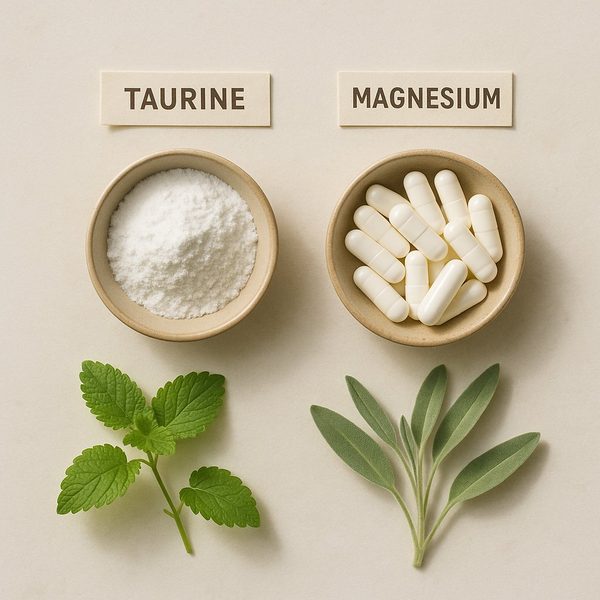
Taurine and magnesium are both popular for calming support, but they do not feel exactly the same and they do not solve the same problem equally well.

Taurine also has specific evidence for sleep support without the sedated feeling. See our article on taurine for sleep quality for the calming mechanism and dosing details.
Quick Answer
Taurine and magnesium both support calming, sleep, and stress relief — but through overlapping yet distinct mechanisms. Magnesium acts primarily as an NMDA receptor blocker and calcium channel modulator, reducing excitatory glutamate neurotransmission, activating GABA receptors, and regulating cortisol. Taurine activates GABA-A and glycine receptors and also modulates calcium handling. Because they act on partially complementary targets, they are most effective together rather than as competitors — but for specific applications: magnesium has stronger clinical evidence for sleep, constipation, and muscle tension; taurine has stronger evidence for cardiovascular, metabolic, and longevity benefits, with complementary calming properties.
Key Takeaways

- Magnesium deficiency is common — approximately 45-50% of Americans consume below the RDA — and manifests as anxiety, muscle tension, poor sleep, elevated cortisol, and cardiovascular dysfunction. Repletion alone produces measurable calming effects, making magnesium arguably the higher-priority supplement to check first.
- Taurine and magnesium share the GABA potentiation mechanism — both increase effective GABA signaling but via different upstream routes. The combination is synergistic: magnesium (300-400 mg glycinate) + taurine (500-1000 mg) + L-theanine (200 mg) covers NMDA blockade, GABA-A activation, glycine receptor activation, and alpha-wave promotion simultaneously.
- For anxiety specifically, magnesium’s evidence is stronger — multiple RCTs show significant reductions in GAD7 anxiety scores with magnesium glycinate (300-400 mg/day) supplementation in deficient adults. Taurine’s anxiety evidence is more preclinical, though some human trial data in combined formulas supports its contribution.
- For cardiovascular benefit, taurine dominates — magnesium also reduces blood pressure and supports cardiac function, but the volume and specificity of taurine’s cardiovascular RCT evidence (especially for heart failure, arrhythmia, and metabolic syndrome) is uniquely substantial.
- Practical protocol: take magnesium glycinate (300 mg) in the evening to cover sleep and calming. Add taurine (1-3 g/day) as a separate morning supplement for cardiovascular and longevity applications. Overlap the evening dose if nighttime calming support is a priority.
If you are choosing between them, the better question is not “Which one is stronger?” It is: what kind of overstimulation are you dealing with?
That answer usually tells you which one fits better.
What taurine does for calming support
Taurine is a sulfur-containing amino-acid-like compound abundant in the brain, heart, retina, and muscle. It appears to support inhibitory signaling, cell stability, and nervous-system balance.
People who like taurine often describe it as:
- Mentally smoothing
- Steadying
- Good for “tired but wired” evenings
- Calming without feeling heavy
Taurine often makes sense when the problem feels more neurological or stress-related than muscular.
What magnesium does for calming support
Magnesium is a mineral involved in hundreds of enzymatic processes. It supports muscle relaxation, nervous-system regulation, sleep quality, glucose control, and cardiovascular health.
People who like magnesium often describe it as:
- Physically relaxing
- Good for tension and restlessness
- Helpful for sleep quality
- Useful when diet is likely low in magnesium-rich foods
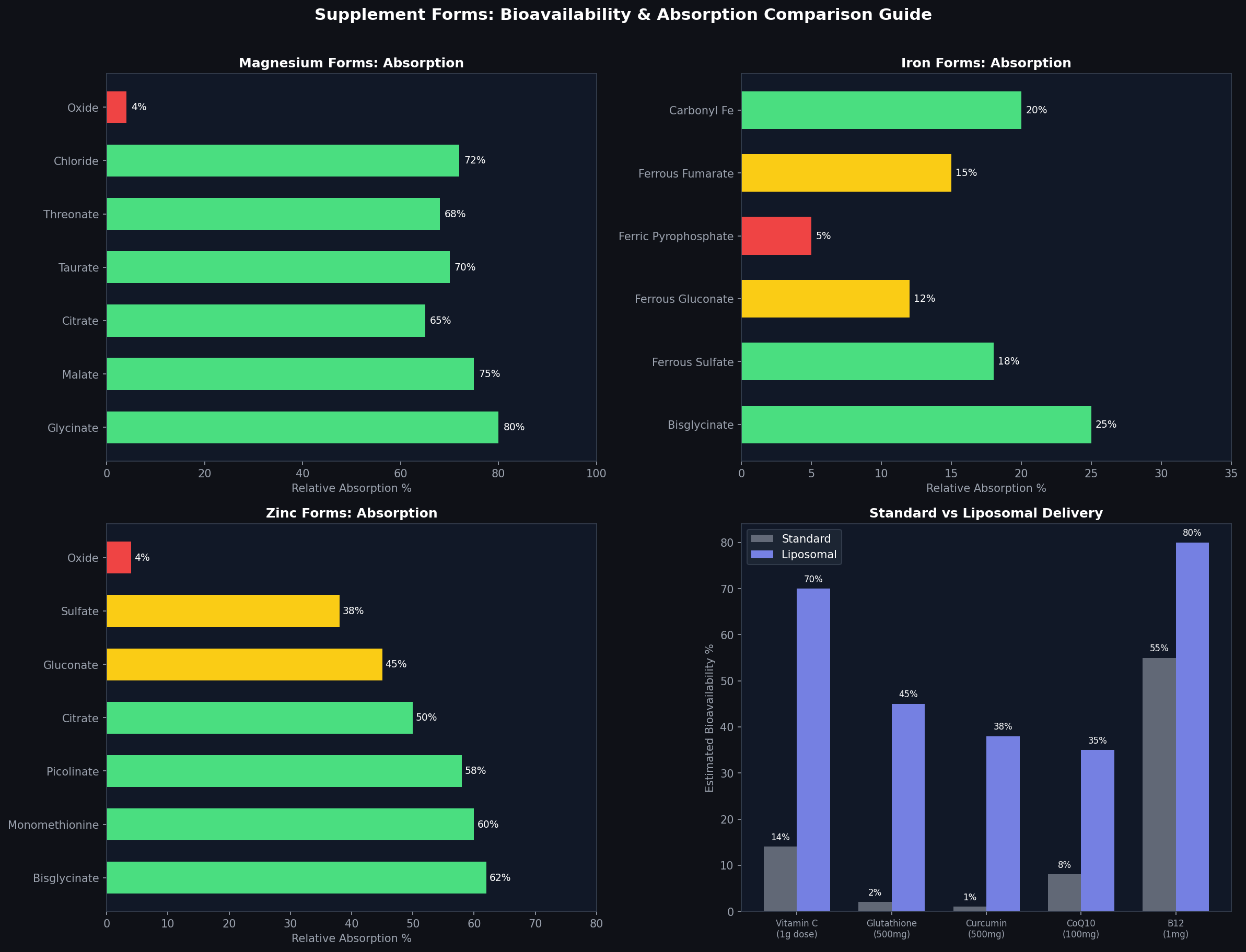
Magnesium glycinate is the go-to form for calming support because it is generally well tolerated and less laxative than forms like citrate.
Taurine vs magnesium: when taurine may be better
1. You feel mentally overstimulated
If your body is tired but your brain is still humming, taurine may fit better.
2. You want subtle support
Taurine tends to feel gentler and less “body heavy.”
3. You are already taking magnesium
If magnesium helps but not quite enough, taurine can be a useful complementary add-on.
Taurine vs magnesium: when magnesium may be better
1. You have muscle tension or restless sleep
Magnesium usually wins when physical tightness and poor sleep quality are major complaints.
2. Your diet is likely low in magnesium
Low intake is common, especially in people eating few nuts, seeds, legumes, or leafy greens.
3. You want the stronger evidence base for sleep support
Magnesium has more direct practical evidence for sleep quality than taurine.
Can you take taurine and magnesium together?
Yes, and that is often the smartest move.
They stack well because they seem to support different parts of the problem:
- Magnesium: more physical relaxation and sleep support
- Taurine: more nervous-system steadiness and calm
This combination is especially appealing for:
- Stress-heavy periods
- Shift workers
- People with evening overstimulation
- Older adults building a longevity-oriented stack
A practical comparison
Choose taurine first if:
- Stress feels mental more than muscular
- You dislike feeling sedated
- You want a broader longevity-friendly add-on
Choose magnesium first if:
- Sleep quality is the main issue
- You get muscle tension or cramps
- Your diet is probably low in magnesium
Use both if:
- You want the most balanced calming stack
- One alone helps, but not enough
Sample doses
Taurine
- 500 mg to 1 gram to start
- 1 to 3 grams for broader support
Magnesium glycinate
- 200 to 400 mg elemental magnesium, usually before bed
Start low. See how you respond. There is no prize for forcing the highest dose.
FAQ
Is taurine or magnesium better for anxiety-like tension?
It depends on the texture of the problem. Taurine may fit better when the issue is mental overstimulation. Magnesium may fit better when the issue is physical tension, poor sleep, or overall depletion.
Is magnesium stronger than taurine for sleep?
Usually yes. Magnesium generally has the more practical reputation and evidence base for sleep support.
Can I take taurine and magnesium together at night?
Yes. Many people combine them because they support relaxation through somewhat different mechanisms.
Which is better for healthy aging?
Both are useful, but taurine gets more attention specifically for longevity pathways, while magnesium is more foundational for broad nutritional sufficiency and sleep support.
Sources
- Ripps H, Shen W. Taurine: a “very essential” amino acid. Mol Vis. 2012;18:2673-2686.
- Jong CJ, et al. Role of taurine in mitochondria health. Amino Acids. 2012;42(6):2223-2232.
- Abbasi B, et al. The effect of magnesium supplementation on primary insomnia in elderly: A double-blind placebo-controlled clinical trial. J Res Med Sci. 2012;17(12):1161-1169.
- Gröber U, et al. Magnesium in prevention and therapy. Nutrients. 2015;7(9):8199-8226.
- Singh R, et al. Taurine deficiency as a driver of aging. Science. 2023;380(6649):eabn9257.
This article is for informational purposes only and does not constitute medical advice. If you have kidney disease, use magnesium or taurine therapeutically, or take multiple medications that affect blood pressure or sedation, get individualized medical guidance first.
Related Articles
- Bakuchiol vs Retinol for Sensitive Skin: Which One Is Better?
- Taurine Benefits After Age 40: What Changes and What It May Support
- Mullein vs. NAC for Lung Support: Which Has Better Evidence?
📚 Part of our Taurine for Aging hub. Explore all our taurine guides.