“Psychobiotics” is a term coined in 2013 by researchers Timothy Dinan and John Cryan to describe live organisms that produce mental health benefits when ingested. The supplement industry quickly adopted it as a marketing category. But is there a real scientific distinction between psychobiotics and regular probiotics, or is it mostly branding?
Quick Answer
Psychobiotics are a functional subset of probiotics specifically selected based on evidence for influencing the gut-brain axis and mental health outcomes — including anxiety, depression, stress response, and cognitive function. While regular probiotics are chosen for GI outcomes (diarrhea prevention, IBS symptom relief, immunity), psychobiotics are chosen for strains and combinations that modulate the HPA axis, influence neurotransmitter precursor levels, or alter vagal signaling. The term is primarily a research categorization rather than a regulatory designation, and not all products marketed as psychobiotics have supporting clinical trial evidence.
Key Takeaways
- The psychobiotic concept was first formally defined by Dinan, Stanton, and Cryan in 2013: ‘a live organism that, when ingested in adequate amounts, produces a mental health benefit.’ This definition has since broadened to include prebiotics that support psychobiotic bacteria.
- Not all probiotic strains have psychobiotic activity — benefit is strain-specific, not species-specific. L. rhamnosus JB-1, L. helveticus R0052, B. longum R0175, and B. longum NCC3001 are among the most studied; most commercially available ‘general wellness’ strains lack specific mental health trial evidence.
- Psychobiotic mechanisms operate primarily through: (1) production of GABA and serotonin precursors in the gut lumen, (2) modulation of HPA axis reactivity, (3) reduction of pro-inflammatory cytokines (IL-6, TNF-alpha) that drive neuroinflammation, and (4) vagus nerve activation via metabolite signaling.
- Prebiotics also qualify as psychobiotics when evidence demonstrates mental health effects — fructooligosaccharides (FOS) and galactooligosaccharides (GOS) together reduced salivary cortisol awakening response and improved attentional bias toward positive stimuli in healthy adults in a 2015 RCT.
- When evaluating psychobiotic products, verify: (1) specific strain name (e.g., R0175, not just ‘Bifidobacterium longum’), (2) effective dose matching published trials (typically 3-10 billion CFU), (3) third-party purity testing, and (4) at least one human RCT supporting the claim, not just animal data.
The Technical Definition
Psychobiotics (Dinan & Cryan, 2013):

“A live organism that, when ingested in adequate amounts, produces a health benefit in patients suffering from psychiatric illness.”
This has since been expanded informally to include:
- Probiotics with demonstrated effects on mood, anxiety, stress, or cognition in clinical trials
- Prebiotics that modulate gut bacteria in ways that affect mental health
- Postbiotics (bacterial metabolites) with neurological effects
Regular probiotics:
“Live microorganisms that, when administered in adequate amounts, confer a health benefit on the host” (WHO definition, 2001).
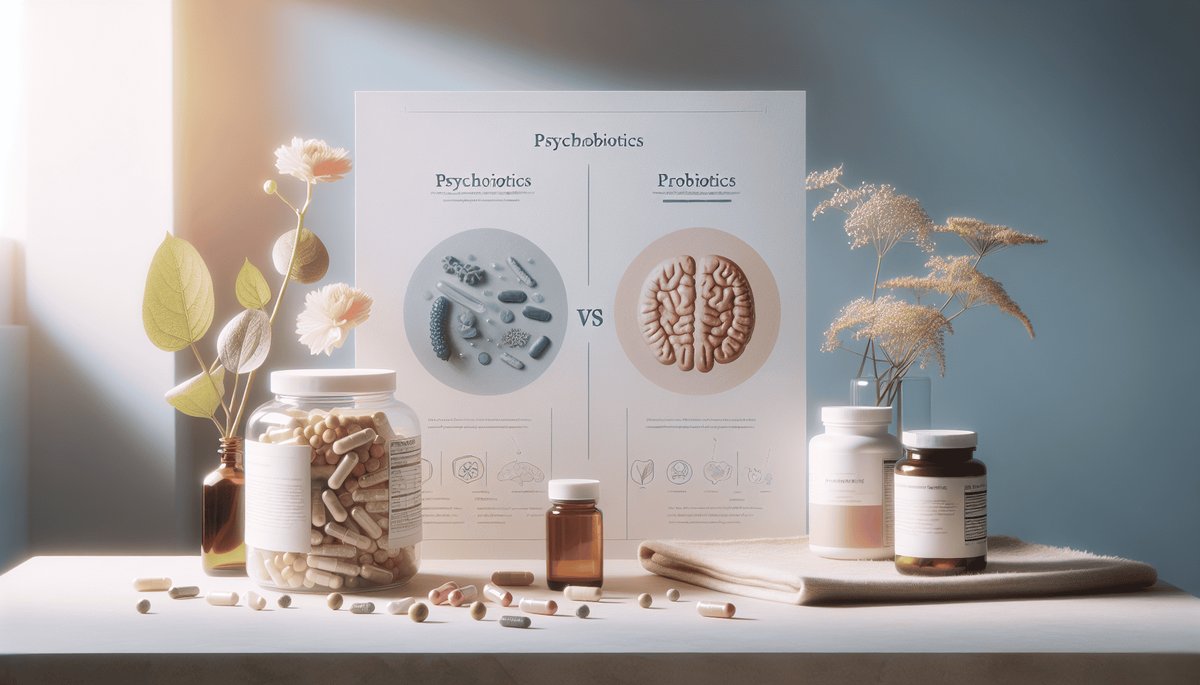
The distinction: psychobiotics are a subset of probiotics, selected specifically for their effects on brain function. Not a different type of organism – a different selection criterion.
What Makes a Probiotic “Psychobiotic”
There’s no official certification or regulatory definition. In practice, a probiotic gets called a psychobiotic when:
- It has been tested in mental health-related outcomes (anxiety, depression, stress, cognition) in human trials
- It demonstrates effects through gut-brain pathways – vagal stimulation, neurotransmitter modulation, HPA axis effects, or neuroinflammation reduction
- It’s marketed for mood or mental health (the less rigorous criterion)
Strains That Qualify as Psychobiotics
| Strain | Mental Health Evidence | Gut Health Evidence |
|—|—|—|
| L. helveticus R0052 + B. longum R0175 | Multiple RCTs for stress/anxiety | Also helps IBS symptoms |
| B. longum 1714 | Stress resilience, EEG changes | General gut health |
| L. casei Shirota | Cortisol reduction under stress | Gut transit, immune function |
| L. plantarum PS128 | Anxiety in ASD, mood in adults | Gut inflammation |
| L. rhamnosus JB-1 | Strong animal data (weak human) | General gut health |
Regular Probiotics Without Mental Health Evidence
| Strain | Primary Evidence |
|—|—|
| L. acidophilus NCFM | Lactose digestion, GI comfort |
| B. lactis BB-12 | Immune function, regularity |
| S. boulardii | Antibiotic-associated diarrhea |
| L. rhamnosus GG | Pediatric diarrhea, eczema prevention |
| VSL#3 (8-strain mix) | Ulcerative colitis maintenance |
These are excellent probiotics for their intended purposes. They’re just not psychobiotics because they haven’t been tested (or haven’t shown effects) for mental health outcomes.
The Practical Differences
Formulation
Psychobiotic products tend to:
- List specific strains (not just species) – because the evidence is strain-specific
- Use CFU counts matching clinical trial doses
- Include strains from the research literature above
- Cost more ($30-60/month vs. $15-25 for general probiotics)
Regular probiotics tend to:
- List species without strain identifiers (e.g., “Lactobacillus acidophilus” without specifying which strain)
- Compete on CFU count (30 billion! 50 billion! 100 billion!) – which is largely irrelevant; more isn’t better
- Include a broad mix of strains for general gut health
- Be cheaper and more widely available
Can Regular Probiotics Affect Mood?
Yes, potentially:
- Any probiotic that reduces gut inflammation may indirectly improve mood through the immune-inflammatory pathway
- General gut health improvement (reduced bloating, better regularity) improves quality of life and psychological wellbeing
- Placebo effects are real – believing you’re taking something for mood may improve mood (and this isn’t necessarily bad)
But the effect is less targeted and less predictable than using strains with specific mental health evidence.
Can Psychobiotics Help Gut Health?
Also yes:
- Most psychobiotic strains also have gut health benefits
- L. helveticus R0052 + B. longum R0175 help IBS symptoms alongside mood
- This makes sense – gut health and brain health are mechanistically linked
The Marketing Problem
“Psychobiotic” has become a premium marketing term. Products labeled “psychobiotic” command higher prices. But:
- Many “psychobiotic” products don’t contain the clinically studied strains
- Some simply relabel generic probiotic blends with “mood support” claims
- The term is not regulated by the FDA or any authority
How to Evaluate a “Psychobiotic” Product
- Check the strain (not just species). Is it L. helveticus R0052, or just “L. helveticus”?
- Look for the clinical trial dose. If the study used 3 billion CFU and the product has 300 million, it’s underdosed
- Check if the specific product (or its strains) have been studied, not just “probiotics” in general
- Ignore CFU wars. A product with 3 billion CFU of a studied strain is better than 100 billion CFU of unstudied strains
Should You Buy a Psychobiotic?
Choose a psychobiotic if:
- You have mild anxiety or stress and want a complementary approach
- You have both gut and mood symptoms (the overlap population)
- You’re willing to pay the premium for studied strains
- You understand it’s supplementary, not a replacement for therapy or medication
Choose a regular probiotic if:
- Your primary concern is digestive health
- You don’t have specific mental health goals for supplementation
- Budget is a factor
- You’re already managing mental health through other evidence-based approaches
Choose neither if:
- You have severe anxiety or depression (see a healthcare provider first)
- You expect dramatic mental health improvement from a supplement
- You’re already eating a diverse, fiber-rich diet with fermented foods (you may not need any probiotic)
The Honest Summary
Psychobiotics are a legitimate scientific concept – specific probiotic strains with clinical evidence for mental health effects. The distinction from regular probiotics is real but narrow: it’s about which outcomes have been studied, not a fundamentally different type of organism.
The marketing has outpaced the science. But if you choose a product containing genuinely studied strains at clinical doses, you’re making a reasonable evidence-based choice. Just keep your expectations modest.
Related reading:
- Psychobiotics: Gut Bacteria and Mental Health
- Best Probiotic Strains for Anxiety
- Gut-Brain Axis Explained Simply
FAQ
What is a psychobiotic?
A psychobiotic is a probiotic strain or combination that, when consumed in adequate amounts, produces a measurable mental health benefit — typically improved mood, reduced anxiety, or lower cortisol levels. The term was coined in 2013 by researchers at University College Cork and refers to a functional classification, not a regulatory category. Psychobiotics work via the gut-brain axis, influencing neurotransmitter production, immune signaling, and HPA axis reactivity.
Do psychobiotics actually work for anxiety?
Yes, for mild stress and anxiety in healthy adults, specific psychobiotic strains have shown significant effects in RCTs. The combination of L. helveticus R0052 and B. longum R0175 is the best replicated, with demonstrated reductions in self-reported anxiety and urinary cortisol. Effects are modest compared to pharmaceutical anxiolytics and are most consistent in people with baseline normal-to-mild anxiety. They are not a substitute for clinical anxiety treatment.
How are psychobiotics different from regular probiotics?
Regular probiotics are selected for GI outcomes — preventing diarrhea, supporting immune function, reducing IBS symptoms. Psychobiotics are selected specifically based on evidence for gut-brain axis modulation and mental health endpoints. Many probiotics marketed as ‘mood support’ or ‘stress support’ use strains with no psychobiotic-specific clinical evidence — always check the strain designations on the label against published trials.
What is the best psychobiotic supplement to buy?
Look for products containing documented psychobiotic strains: L. helveticus R0052 + B. longum R0175 (Lallemand’s Lacidofil/Probio’Stick blend) for general stress/anxiety, or B. longum NCC3001 (Nestlé strain) for the IBS-anxiety overlap. Viome, Seed, and a few European brands include these strains. Avoid products that only list genus and species names without strain identifiers — this signals generic formulas with no specific trial evidence.
Sources
- Dinan TG, Stanton C, Cryan JF. Psychobiotics: a novel class of psychotropic. Biol Psychiatry. 2013.
- Cryan JF, O’Riordan KJ, Cowan CSM, et al. The microbiota-gut-brain axis. Physiol Rev. 2019;99(4):1877-2013.
- Carabotti M, Scirocco A, Maselli MA, Severi C. The gut-brain axis: interactions between enteric microbiota, central and enteric nervous systems. Ann Gastroenterol. 2015;28(2):203-209.
- Hill C, Guarner F, Reid G, et al. The ISAPP consensus statement on the scope and appropriate use of the term probiotic. Nat Rev Gastroenterol Hepatol. 2014;11(8):506-514.
- Foster JA, Neufeld K-AM. Gut-brain axis and microbiome influences on mood and stress. PubMed search.