
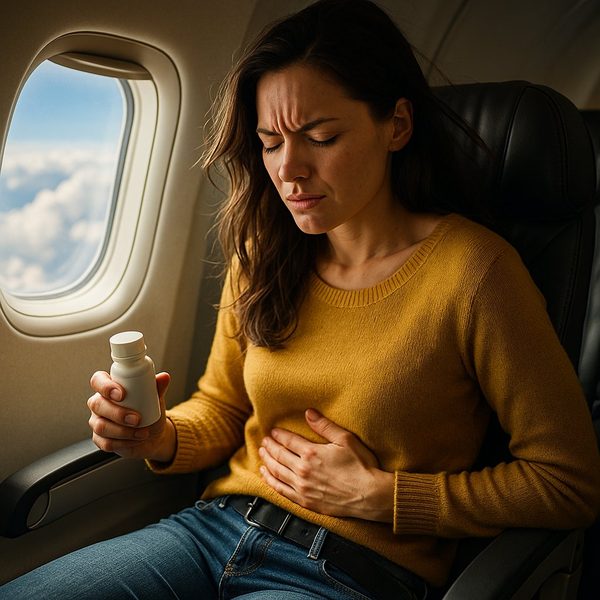

Travel is rough on digestion. Sleep changes, meal timing gets weird, hydration drops, and restaurant food replaces routine. If you already have a sensitive stomach, even a short trip can turn into bloating, constipation, or stomach-upset chaos.
Quick Answer
For travelers and those with sensitive GI systems, postbiotics offer a practical advantage over live probiotics: they require no refrigeration, survive heat and humidity, and carry no risk of the paradoxical GI reactions that live cultures can trigger in sensitive individuals. Heat-killed probiotic preparations, fermentate products (EpiCor), and butyrate compounds can be packed without ice packs, stored in carry-on luggage without concern, and taken alongside antibiotics prescribed for traveler’s diarrhea without the timing complications of live cultures.
Key Takeaways
- Traveler’s diarrhea affects 30-70% of international travelers and is caused primarily by enterotoxigenic Escherichia coli (ETEC), Campylobacter, and Salmonella – postbiotics that strengthen gut barrier integrity and prime innate immune defenses may reduce susceptibility, though evidence for prevention is stronger for live Saccharomyces boulardii than for most postbiotics.
- Heat-killed Lactobacillus acidophilus LB (Lacteol Fort) is one of the best-studied postbiotic preparations for acute diarrhea management – multiple RCTs show it reduces acute diarrhea duration in both adults and children, comparable to some pharmaceutical antidiarrheals, with an excellent safety profile.
- For sensitive stomachs prone to GI distress from live probiotic CFU (bloating, cramping, altered bowel habits during adjustment), heat-killed preparations deliver similar immune-modulatory and mucosal benefits without the active fermentation that causes GI adaptation symptoms.
- EpiCor (yeast fermentate postbiotic) is shelf-stable, requires no refrigeration, and has been shown in RCTs to increase secretory IgA (sIgA) in saliva – a first-line mucosal immune defense against pathogens encountered in new food and water environments during travel.
- Packing tip for travelers: heat-killed probiotic sachets (Lacteol, ImmuBalance), postbiotic fiber combinations, and electrolyte packets with inulin or FOS prebiotics cover three gut needs simultaneously – microbiome support, barrier protection, and hydration maintenance – without the cold chain problem of live cultures.

That is why postbiotics are getting attention in travel-focused gut support. Unlike probiotics, they do not rely on live organisms surviving heat, baggage, hotel-room conditions, and stomach acid.
For many people, postbiotics are a practical gut-support option for travel and sensitive digestion because they are shelf stable, simple, and often easier to tolerate.
Why travel disrupts digestion
Even healthy people notice digestive changes while traveling because several stressors pile up at once:
- Irregular sleep and circadian disruption
- Dehydration from flights or long drives
- Lower fiber intake
- More restaurant food and alcohol
- Less movement and more stress
For people with IBS-type symptoms or a history of bloating on probiotics, these variables matter even more.
Why postbiotics make sense for travel
Better stability
This is the biggest advantage. Live probiotics can degrade with heat, moisture, and time. Postbiotics generally do not have that viability problem because the active material is not supposed to be alive.
That makes them easier to:
- Keep in a bag
- Use on flights or road trips
- Store in warm places
- Take consistently without refrigeration anxiety
Potentially gentler for sensitive users
Some travelers do well with probiotics. Others get gas, bloating, or unpredictable bowel changes. A postbiotic may feel simpler because it skips the live-colonization issue.
Easy to pair with travel basics
Travel digestion is not fixed by one capsule, but a shelf-stable postbiotic fits well alongside hydration, electrolytes, and lighter protein-forward meals.
Best postbiotic options for travel
1. Butyrate supplements
Butyrate is the best-known postbiotic compound. It supports colonocyte energy and intestinal barrier function, which is why it is frequently discussed for sensitive digestion (Canani et al., World J Gastroenterol, 2011).
Best for
- General travel gut support
- People sensitive to live probiotics
- Users wanting a direct, simple ingredient
2. Tributyrin products
Tributyrin is a butyrate-delivery form often positioned as a more premium option.
Best for
- People comparing butyrate forms
- Users wanting a specialized format
- Travelers who prioritize compact, shelf-stable products
3. Heat-treated postbiotic blends
These use inactivated microbial materials rather than live strains.
Best for
- Those wanting the microbial-signaling concept without live organisms
- Frequent travelers
- Users prioritizing convenience and stability
A simple travel gut-support plan
Before the trip
If you are testing a new postbiotic, start a few days before travel so you know how you tolerate it.
During the trip
Focus on the basics that actually matter:
- Hydrate aggressively
- Use electrolytes if needed
- Prioritize light protein-forward meals
- Avoid stacking greasy food and alcohol together
- Walk after meals when possible
If your stomach is very sensitive
Keep the stack small. A butyrate or tributyrin product plus hydration is usually smarter than mixing probiotics, enzymes, fiber gummies, and random travel supplements all at once.
What postbiotics will not do
They are support tools, not force fields. They will not fully prevent:
- Food poisoning
- Traveler’s diarrhea from contaminated food or water
- Severe constipation from dehydration and inactivity
- Symptoms from major underlying GI disease
Food and water precautions still matter more than supplement hype.
Bottom line
If you want postbiotics for travel and sensitive stomachs, the main advantages are real ones:
- Shelf stability
- No live-organism viability concerns
- Potentially better tolerability for some users
- Easy pairing with a simple travel routine
For most people, a straightforward butyrate or tributyrin product is the most practical place to start.
FAQ
Are postbiotics better than probiotics for travel?
Often yes, at least for convenience and stability. They are usually easier to pack and less dependent on careful storage.
Can postbiotics help a sensitive stomach?
They may, especially for people who do poorly with live probiotics. But they are not a cure for every digestive complaint.
Should I take a postbiotic before or during a trip?
Ideally both. Start before the trip so you know how you tolerate it, then continue during travel.
What is the best type of postbiotic for travel?
A shelf-stable butyrate or tributyrin formula is often the simplest and most practical choice.
Related Articles
- Are Postbiotics Better for IBS?
- Are Postbiotics Safer Than Probiotics?
- Postbiotics Dedicated Guide: Benefits, Butyrate, Safety, and Best Uses
- Best Butyrate and Tributyrin Supplements in 2026
- Butyrate Supplements for Gut Lining Support
Sources
- Salminen S, Collado MC, Endo A, et al. The International Scientific Association of Probiotics and Prebiotics (ISAPP) consensus statement on the definition and scope of postbiotics. Nat Rev Gastroenterol Hepatol. 2021;18(9):649-667.
- Wegh CAM, Geerlings SY, Knol J, et al. Postbiotics and their potential applications in early life nutrition and beyond. Int J Mol Sci. 2019.
- Hamer HM, Jonkers D, Venema K, et al. Review article: the role of butyrate on colonic function. Aliment Pharmacol Ther. 2008.
- Cryan JF, O’Mahony SM. The microbiome-gut-brain axis: from bowel to behavior. Neurogastroenterol Motil. 2011;23(3):187-192.
- Liu RT, Walsh RFL, Sheehan AE. Prebiotics and probiotics for depression and anxiety: a systematic review and meta-analysis. BMJ Nutr Prev Health. 2019;2(2):81-89.
📚 Part of our Postbiotics Dedicated Guide hub. Explore all our postbiotic and butyrate guides.