

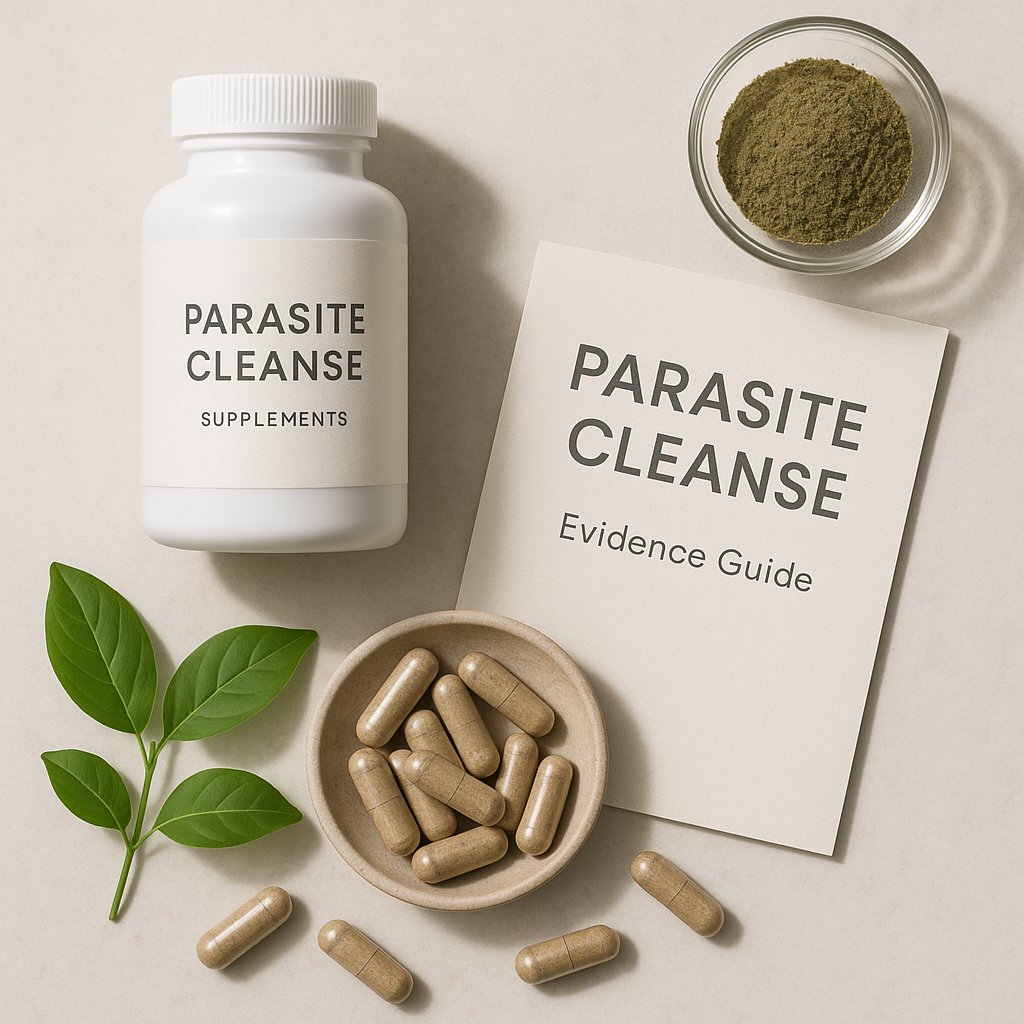
Most parasite cleanse supplements sold online have minimal or no clinical evidence for eliminating intestinal parasites in humans. Medically confirmed parasitic infections require prescription antiparasitic medications (albendazole, mebendazole, metronidazole, etc.), not herbal supplements. Ingredients commonly found in parasite cleanse products – black walnut, wormwood, clove – have some in vitro activity against parasites but lack robust human trial data. If parasitic infection is suspected, stool testing and physician evaluation are the appropriate first steps.
Individual parasite herbs have varying levels of evidence. Our review of herbal parasite remedies covers wormwood, black walnut, and more.
- Parasitic infections must be diagnosed with stool ova-and-parasite tests, not assumed based on symptoms; self-diagnosis leads to inappropriate treatment.
- Prescription antiparasitics (albendazole, mebendazole, metronidazole, ivermectin) are the medically validated treatment for confirmed parasitic infections.
- Herbal parasite cleanse ingredients like black walnut hull, wormwood, and clove show some antiparasitic activity in laboratory studies, but clinical evidence in humans is weak.
- The parasite cleanse market is largely unregulated; products make aggressive marketing claims without regulatory support.
- Periodic parasite cleansing as a wellness practice is not supported by medical evidence; it carries real risks (herb-drug interactions, hepatotoxicity from some botanicals) without demonstrated benefit.
“Parasite cleanse” has become one of the fastest-growing supplement categories on social media. Influencers post shocking photos, claim 80% of people are unknowingly infected, and sell herbal protocols promising to flush parasites from your body.
The reality is more nuanced – and much less alarming – than the marketing suggests.

Who actually has parasites?
Parasitic infections are real and can be serious. Globally, soil-transmitted helminths (roundworms, hookworms, whipworms) affect over 1.5 billion people, primarily in tropical and subtropical regions with limited sanitation [1]. Protozoan parasites like Giardia lamblia and Cryptosporidium cause significant illness worldwide.
In the United States and Western Europe, parasitic infections are relatively uncommon in the general population. The CDC estimates that most parasitic disease burden in the US comes from specific populations: recent immigrants, immunocompromised individuals, travelers returning from endemic areas, and people with specific exposures (contaminated water, undercooked meat, etc.) [2].
The social media claim that “most people have parasites and don’t know it” is not supported by epidemiological data in developed countries.
What are parasite cleanse supplements?
Most commercial parasite cleanse formulas combine some variation of these ingredients:
- Wormwood (Artemisia absinthium) – contains artemisinin and thujone
- Black walnut hull (Juglans nigra) – contains juglone
- Clove (Syzygium aromaticum) – contains eugenol
- Oregano oil – contains carvacrol and thymol
- Diatomaceous earth – fossilized algae (food grade)
- Papaya seeds – contain benzyl isothiocyanate
- Garlic – contains allicin
This combination – particularly the wormwood/black walnut/clove trio – was popularized by Hulda Clark in the 1990s. Clark’s broader claims (that all cancers are caused by a single parasite) have been thoroughly debunked, but the herbal combination persists in the supplement market [3].
What does the evidence say about these ingredients?
Wormwood (Artemisia)
Artemisinin, derived from Artemisia annua (sweet wormwood, a different species), is a WHO-approved antimalarial drug. This is legitimate, well-established medicine. However, the artemisinin content in supplement-grade Artemisia absinthium (common wormwood) is much lower and less standardized [4].
A 2010 study in Phytomedicine found that A. absinthium powder (500 mg three times daily) reduced egg counts in patients with Hymenolepis nana (dwarf tapeworm) infection, but the study was small (n=15) and not placebo-controlled [5].
Bottom line: Artemisinin-based drugs are proven antimalarials. Wormwood supplements are not the same thing, and evidence for them as broad-spectrum antiparasitic agents is weak.
Black walnut hull
Juglone, the active compound in black walnut hulls, has demonstrated anthelmintic (anti-worm) activity in laboratory studies. A 2016 in vitro study published in Experimental Parasitology showed juglone had activity against Schistosoma mansoni larvae [6].
However, in vitro activity does not mean oral supplementation works the same way. The gap between “kills parasites in a petri dish” and “eliminates parasites from the human gut at safe oral doses” is enormous. There are no published human clinical trials of black walnut hull for parasitic infections.
Clove / eugenol
Clove oil and its primary compound eugenol have shown antiparasitic activity in laboratory settings. A 2012 study in Parasitology Research found eugenol had activity against Leishmania parasites in vitro [7]. Animal studies have shown some promise against intestinal parasites.
For more detail on clove’s evidence and limitations, see our dedicated article: Clove Oil and Parasites: What the Research Actually Shows.
Papaya seeds
This is actually one of the more interesting ingredients. A 2007 randomized controlled trial published in the Journal of Medicinal Food found that children in Kenya who consumed papaya seed porridge had significantly reduced stool egg counts for Ascaris lumbricoides (roundworm) compared to placebo (71.4% egg clearance vs. 0%) [8].
A follow-up study in 2012 confirmed similar results. This is among the strongest evidence for any herbal antiparasitic, though it’s been studied specifically for Ascaris in endemic populations – not as a general “cleanse” for Western consumers.
Diatomaceous earth
Food-grade diatomaceous earth is commonly included in parasite cleanse products. Its proposed mechanism – that microscopic sharp edges physically damage parasites – has not been validated in any human study. A 2011 study in the Oxford Journal of Poultry Science found DE reduced intestinal parasites in free-range chickens, but poultry data does not transfer to human medicine [9].
There are no human clinical trials supporting diatomaceous earth for parasite removal.
The “rope worm” problem
Many parasite cleanse advocates post photos of what they claim are parasites expelled during a cleanse. In most cases, these are mucoid plaque – mucus and fiber that forms rope-like structures in the intestine, particularly after consuming large amounts of psyllium husk, bentonite clay, or similar bulking agents commonly included in cleanse protocols [10].
Actual parasitic infections are diagnosed through stool sample analysis, blood tests, or imaging – not by visual inspection of what comes out during a “cleanse.”
When you might actually need antiparasitic treatment
See a doctor and get proper testing if you have:
- Persistent unexplained diarrhea (especially after travel to endemic areas)
- Visible worms in stool (yes, this happens with pinworms and others)
- Unexplained weight loss with GI symptoms
- Eosinophilia on a blood test
- History of consuming raw/undercooked meat or contaminated water
If testing confirms a parasitic infection, prescription antiparasitics (albendazole, mebendazole, ivermectin, praziquantel, metronidazole) are far more effective and better studied than herbal alternatives [11].
Are parasite cleanses harmful?
For most healthy adults, a short course of the common herbal ingredients at typical supplement doses is unlikely to cause serious harm. However:
- Wormwood contains thujone, which is neurotoxic at high doses. Prolonged use is not recommended [12].
- Black walnut can cause liver toxicity in high doses.
- Clove oil in concentrated form can cause mucosal irritation and liver damage.
- Diatomaceous earth can irritate the lungs if inhaled during handling.
- Many cleanse protocols include extreme dietary restrictions and high-dose laxatives that can cause electrolyte imbalances.
The larger harm may be financial and psychological: spending $40-100/month on supplements for a condition you don’t have, while ignoring symptoms that warrant proper medical evaluation.
The honest bottom line
Some of the herbs used in parasite cleanses have demonstrated antiparasitic properties in laboratory studies and a handful of small human trials – primarily in populations with confirmed endemic infections. Papaya seeds and artemisinin-based compounds have the strongest evidence.
But the marketing around parasite cleanses vastly overstates both the likelihood that you have parasites and the effectiveness of these products. If you suspect a parasitic infection, get tested. If a test confirms one, use proven medical treatment.
If you’re still interested in these herbs for general digestive or immune support, stick to well-made products from reputable manufacturers, use them at recommended doses, and don’t expect them to “detox” parasites you almost certainly don’t have.
FAQ
Do parasite cleanse supplements actually work?
For medically confirmed parasitic infections, no herbal supplement has clinical evidence matching prescription antiparasitic drugs. Some ingredients have in vitro antiparasitic activity, but in vitro results do not translate reliably to human efficacy at safe supplement doses. If you have a confirmed parasitic infection, prescription medication is the evidence-based treatment.
How do I know if I have parasites?
Parasitic infections are diagnosed through stool testing (ova and parasite exam, stool PCR panels), sometimes blood testing, or endoscopy depending on the type of organism suspected. Symptoms like fatigue, bloating, and digestive issues are non-specific and can have many causes; testing is required to confirm parasites as the cause.
Are parasite cleanses safe?
Many herbal parasite cleanse products are relatively low-risk at labeled doses, but some contain herbs with hepatotoxicity potential (e.g., high-dose wormwood, which contains thujone). Drug interactions are also a concern. The main risk of parasite cleanse supplements is not toxicity but the opportunity cost: delaying proper diagnosis and treatment for a real parasitic infection.
What supplements are used in parasite cleanses?
Common ingredients include black walnut hull extract, wormwood (Artemisia absinthium), clove (Syzygium aromaticum), berberine, grapefruit seed extract, and diatomaceous earth. Some of these have documented antiparasitic properties in vitro; none have been validated in well-designed human clinical trials for treating diagnosed parasitic infections.
Related reading
- Clove Oil and Parasites: What the Research Actually Shows
- Parasite Cleanse Supplements: Ingredients, Doses, and What to Expect
- Signs of Parasites: Symptoms, Testing, and When to See a Doctor
- Wormwood, Black Walnut, and Herbal Parasite Remedies: Evidence Review
References
[1] WHO. Soil-transmitted helminth infections fact sheet. 2024.
[2] CDC. Parasitic Diseases in the United States. 2023.
[3] Barrett S. “A Skeptical Look at Hulda Clark.” Quackwatch. 2009.
[4] Ferreira JFS et al. “Artemisinin content in dried leaf.” Molecules. 2010;15(4):3135-3170.
[5] Mostafa OM et al. “Effect of Artemisia on Hymenolepis nana.” Phytomedicine. 2010;18(5):458-461.
[6] de Moraes J et al. “Schistosomicidal activity of juglone.” Experimental Parasitology. 2016;162:37-43.
[7] Ueda-Nakamura T et al. “Antileishmanial activity of eugenol.” Parasitology Research. 2012;111(3):1389-1396.
[8] Okeniyi JA et al. “Effectiveness of papaya seeds against intestinal parasites.” Journal of Medicinal Food. 2007;10(1):194-196.
[9] Bennett DC et al. “Effect of diatomaceous earth on parasites in poultry.” Poultry Science. 2011;90(7):1416-1426.
[10] Gubarev YA et al. “Possible origin of rope-like formations.” World Journal of Gastroenterology. 2014;15(8):1023-1025.
[11] Hotez PJ et al. “Helminth infections: the great neglected tropical diseases.” Journal of Clinical Investigation. 2008;118(4):1311-1321.
[12] Lachenmeier DW et al. “Thujone toxicity.” Regulatory Toxicology and Pharmacology. 2010;58(3):S16-S25.
Related Articles
- Factors associated with soil-transmitted helminths infection in Benin: Findings from the DeWorm3 study. PLoS neglected tropical diseases. 2021. PMID: 34403424.
- Best Vitamin D3 + K2 Supplements for Bone and Heart Health in 2026: What the Evidence Actually Shows
- Best Colostrum Supplements in 2026: Gut, Immunity, Recovery, and What the Evidence Really Says
- Benefits of Clove Oil and Clove Supplements in 2026: What the Evidence Actually Shows
- Best Supplements for Depression in 2026: What the Evidence Actually Shows



Leave a Reply