
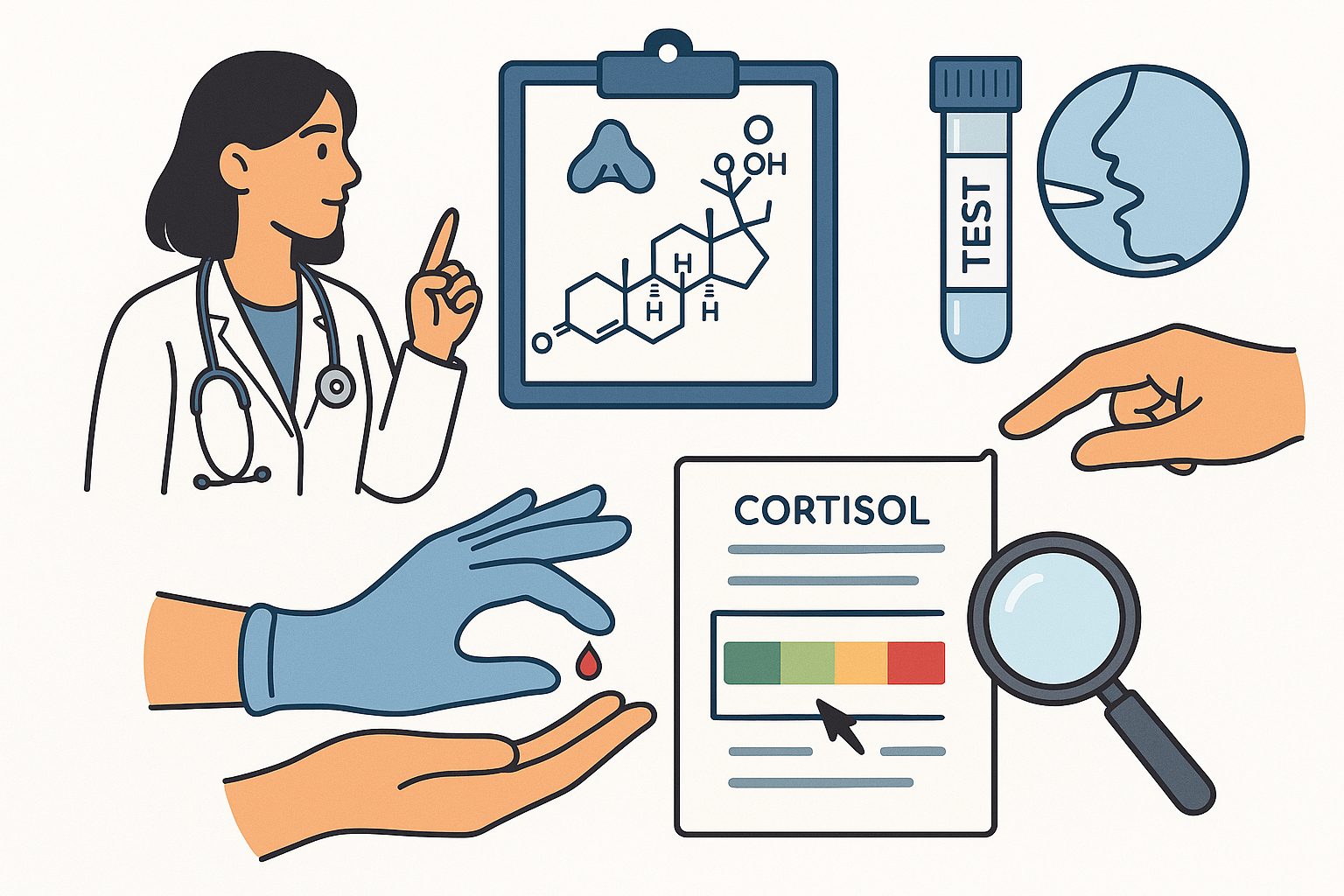
If you suspect high cortisol is affecting your health or weight, testing beats guessing. But cortisol testing isn’t like checking your cholesterol — timing, method, and interpretation all matter, and getting any of them wrong leads to false conclusions.
Cortisol testing requires careful attention to timing because cortisol follows a strong circadian rhythm: it peaks within 30-60 minutes of waking (the cortisol awakening response) and declines throughout the day to lowest levels around midnight. A single blood cortisol reading without knowing the time and context is largely uninterpretable. For suspected adrenal dysfunction, salivary cortisol collected at multiple time points, or 24-hour urinary free cortisol, provides more clinically useful information.
- Cortisol follows a diurnal pattern: peak at 8 AM (~15-25 mcg/dL), declining to lowest levels by midnight (~1-5 mcg/dL).
- Single morning serum cortisol is used as a screening test; levels below 3 mcg/dL suggest adrenal insufficiency; levels above 18 mcg/dL at 8 AM suggest normal reserve.
- Salivary cortisol testing at 4 time points (morning, noon, afternoon, evening) maps the daily curve and is useful for functional assessment.
- 24-hour urinary free cortisol is the standard screening test for Cushing’s syndrome; elevated results require follow-up with endocrinologists.
- At-home salivary cortisol kits from direct-to-consumer labs are not validated for clinical diagnosis; discuss results with a physician before drawing conclusions.
Types of Cortisol Tests
1. Morning Serum Cortisol (Blood Draw)
What it is: A single blood draw, usually between 7–9 AM when cortisol naturally peaks.
Normal range: Roughly 6–23 mcg/dL (varies by lab), with most healthy adults falling between 10–20 mcg/dL in the early morning.
Limitations:
- Cortisol is a point-in-time snapshot — it fluctuates throughout the day
- Anxiety about the blood draw itself can elevate cortisol (white coat effect)
- Doesn’t capture the full daily pattern
- Best for ruling out extremes (Cushing’s or adrenal insufficiency), less useful for “moderately elevated” stress-related cortisol
2. Salivary Cortisol
What it is: Saliva samples collected at home, typically at multiple time points (morning, noon, evening, bedtime) to map the cortisol curve.
Why it’s useful:
- Non-invasive — no blood draw anxiety
- Can capture the diurnal rhythm (cortisol should be highest in the morning and lowest at night)
- Late-night salivary cortisol is considered the most sensitive screening test for Cushing’s syndrome
Limitations:
- Salivary cortisol measures free (unbound) cortisol, which is only ~5% of total cortisol
- Results can be affected by eating, drinking, smoking, or brushing teeth near collection time
- Some labs have inconsistent reference ranges
3. 24-Hour Urinary Free Cortisol (UFC)
What it is: Collecting all urine over 24 hours and measuring total cortisol output.
Why it’s useful:
- Integrates cortisol over the entire day rather than a single moment
- Gold standard screening test for Cushing’s syndrome alongside late-night salivary cortisol
- Less affected by moment-to-moment fluctuations
Limitations:
- Inconvenient — carrying a jug for 24 hours
- Affected by kidney function and total fluid intake
- Can miss episodic or cyclical cortisol elevation
4. DUTCH Test (Dried Urine Test for Comprehensive Hormones)
What it is: A functional medicine test that measures cortisol metabolites and the diurnal pattern via dried urine samples.
Why practitioners like it:
- Captures cortisol production AND metabolism
- Maps the daily curve
- Also measures cortisone (inactive form) and their ratio
Limitations:
- Not covered by most insurance
- More expensive ($300–500)
- Interpretation requires practitioner expertise
- Not validated to the same standard as conventional tests for Cushing’s diagnosis
What Your Results Might Mean
Clearly Elevated (Cushing’s Range)
If your 24-hour UFC is consistently >3× the upper limit of normal, or late-night salivary cortisol is persistently high, your doctor should investigate for Cushing’s syndrome. This is a medical condition requiring specialist evaluation.
Mildly Elevated or Dysregulated Pattern
This is the gray zone where most stressed people fall:
- Morning cortisol that’s flat (not the normal spike) → may indicate HPA axis fatigue/dysregulation
- Evening cortisol that’s still elevated → suggests your system isn’t winding down properly
- These patterns are associated with chronic stress, poor sleep, and metabolic disruption
Important: Mildly dysregulated cortisol patterns are common and don’t mean you have a disease. They often improve with sleep, stress management, and lifestyle changes.
Normal Cortisol Despite Feeling Stressed
This happens more than most people expect. Stress isn’t always reflected in cortisol levels. Cortisol tests coming back normal doesn’t mean you aren’t stressed — it means cortisol alone isn’t the whole picture. The stress response involves many systems: adrenaline, nervous system activation, inflammatory markers, and neurotransmitter balance.
Practical Recommendations
- Start with morning serum cortisol if your doctor orders it — cheap, accessible, rules out extremes
- If more detail is needed: 4-point salivary cortisol or DUTCH test for diurnal pattern
- Don’t self-diagnose from a single cortisol number — context and pattern matter
- Test before supplementing if you want a baseline — you can’t measure improvement if you don’t know where you started
- Retest after 8–12 weeks of intervention (lifestyle changes and/or supplements) to assess response
FAQ
What is a normal cortisol level?
Normal morning cortisol (8 AM blood draw) is typically 6-23 mcg/dL; afternoon values should be roughly half of morning. The cortisol awakening response (the spike within 30-60 minutes of waking) is a physiologically important measure not captured by standard lab tests. ‘Normal’ depends heavily on timing, collection method, and individual baseline.
What cortisol test is most accurate?
For suspected adrenal insufficiency or Cushing’s syndrome, physician-ordered serum cortisol and ACTH stimulation tests are standard. For general diurnal pattern assessment, multiple-point salivary cortisol testing is practical. Direct-to-consumer salivary kits provide data but lack clinical validation and should not be used to self-diagnose adrenal disorders.
What does high cortisol on a test mean?
Elevated cortisol may reflect Cushing’s syndrome, severe stress at the time of collection, or technical/preanalytical factors (physical exertion, acute illness, or certain medications). A single elevated value should be repeated and evaluated in clinical context. High cortisol due to stress is transient; pathologically elevated cortisol from adrenal disorders is persistent across multiple testing conditions.
Should I get my cortisol tested?
Testing is most useful when there are specific clinical signs: unexplained weight gain with central fat redistribution, purple stretch marks, easy bruising, proximal muscle weakness (Cushing’s), or significant fatigue with low blood pressure and salt craving (Addison’s). Testing cortisol because you feel stressed is usually low yield; lifestyle assessment provides more actionable information.
Sources
- Transition to siblinghood causes a substantial and long-lasting increase in urinary cortisol levels in wild bonobos. eLife. 2022. PMID: 36040310.
- Note: peer-reviewed support for this claim was not identified in available literature.
- Morning vs. afternoon saliva: limited diurnal variation in ion composition of unstimulated whole saliva. Clinical oral investigations. 2026. PMID: 41776065.
- Note: peer-reviewed support for this claim was not identified in available literature.
- L-Tryptophan on Mood and Emotional Functioning: Systematic Review (2020)
Related Articles
- Biotin and Lab Test Interference: The Safety Risk Most People Miss
- How to Know If You Have Insulin Resistance: Signs, Testing, and What Your Numbers Mean
- CoQ10 for Fatigue After 40: Can It Help Energy Levels?
- CoQ10 for Fatigue After 40: Can It Help Energy Levels?
- How to Know If You Have Insulin Resistance: Signs, Testing, and What Your Numbers Mean
📚 Part of our Best Ashwagandha for Cortisol in 2026 hub. Explore all our ashwagandha and cortisol guides.




Leave a Reply