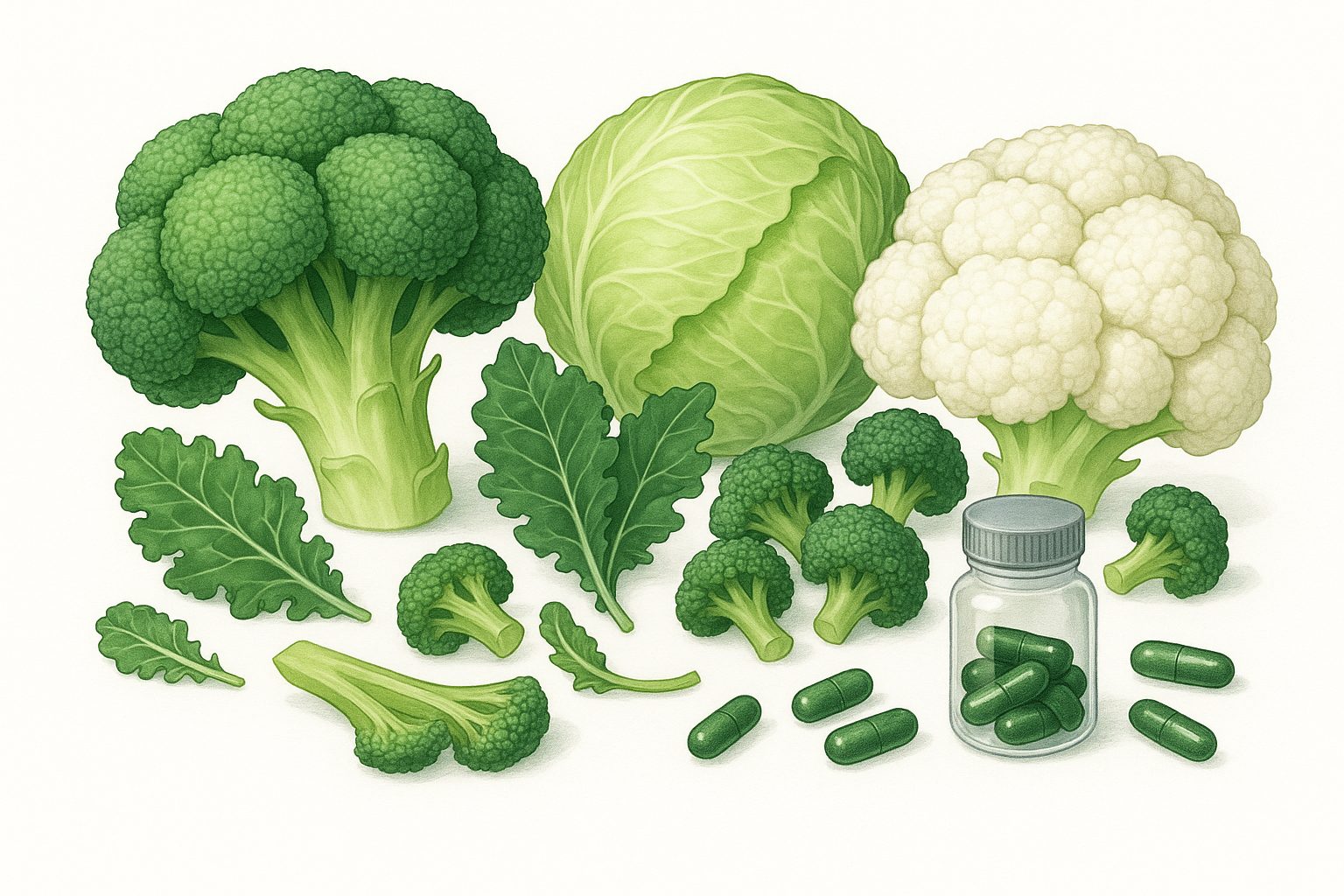
Cruciferous Vegetables and Sulforaphane Supplements
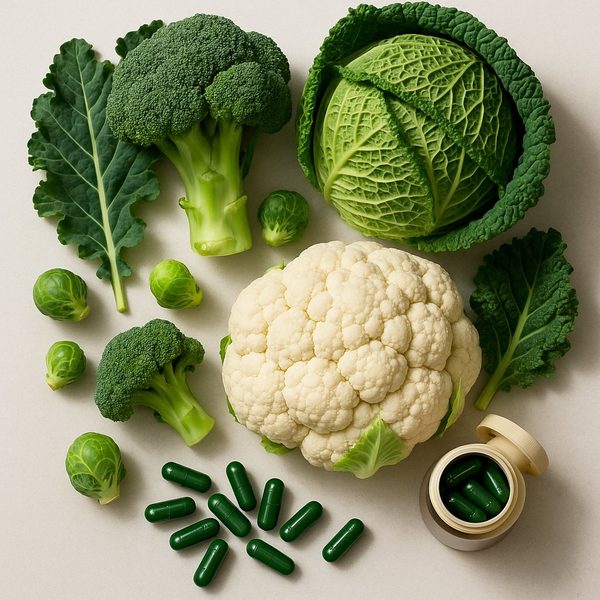
Cruciferous vegetables — broccoli, cauliflower, kale, Brussels sprouts, cabbage, arugula, watercress, bok choy — belong to the Brassicaceae family and share a unique chemistry. When you chew or chop these vegetables, an enzyme called myrosinase converts glucosinolates into isothiocyanates, the most studied of which is sulforaphane (derived from glucoraphanin, concentrated in broccoli and broccoli sprouts).
Sulforaphane, derived from glucoraphanin in cruciferous vegetables (broccoli, broccoli sprouts, cauliflower, kale), is one of the most studied phytochemicals for cancer prevention, detoxification enzyme induction, and neuroprotection. Broccoli sprouts have 10-100x more glucoraphanin than mature broccoli. For maximum sulforaphane yield, raw or lightly steamed vegetables are needed (myrosinase enzyme is denatured by high heat). Supplements vary widely in quality; those providing active sulforaphane or glucoraphanin with myrosinase are most effective.
- Sulforaphane is produced from glucoraphanin (found in raw cruciferous vegetables) by the enzyme myrosinase — heat destroys myrosinase, reducing sulforaphane production significantly in cooked vegetables.
- Broccoli sprouts (3-day-old) contain 10-100x more glucoraphanin per gram than mature broccoli heads, making them the most efficient food source.
- Sulforaphane activates the Nrf2 transcription factor, upregulating phase II detoxification enzymes (glutathione S-transferase, NQO1) and antioxidant defenses.
- Clinical trials show sulforaphane reduces markers of oxidative stress, modulates estrogen metabolism (relevant to estrogen-sensitive conditions), and has shown promise in autism spectrum disorder trials.
- For sulforaphane supplements, products must either contain active sulforaphane (stabilized) or provide glucoraphanin with myrosinase; glucoraphanin-only products without myrosinase produce significantly less active sulforaphane.
Sulforaphane has become one of the most researched bioactive plant compounds in nutritional science. A 2025 comprehensive analysis in PMC catalogued clinical trials across cancer, metabolic disease, neurological conditions, and more. Here’s what holds up.
How Sulforaphane Works
Sulforaphane’s primary mechanism is Nrf2 pathway activation. Nrf2 (nuclear factor erythroid 2-related factor 2) is a transcription factor that regulates over 200 cytoprotective genes involved in:
- Phase II detoxification — upregulating enzymes (glutathione S-transferases, NAD(P)H quinone oxidoreductase) that neutralize carcinogens and environmental toxins
- Antioxidant defense — boosting glutathione production, the body’s primary intracellular antioxidant
- Anti-inflammatory signaling — suppressing NF-κB–driven inflammation
- Epigenetic modulation — sulforaphane acts as a histone deacetylase (HDAC) inhibitor, potentially influencing gene expression in ways relevant to cancer prevention
This is a genuinely impressive mechanistic profile, and it’s backed by human data — not just cell studies.
What the Human Evidence Supports
Cancer Risk Reduction (Observational)
Multiple large epidemiological studies associate higher cruciferous vegetable intake with reduced risk of several cancers:
- Lung cancer: A meta-analysis of 31 cohort and case-control studies found significant inverse association with cruciferous vegetable consumption.
- Colorectal cancer: A 2020 meta-analysis in Clinical Nutrition found regular cruciferous intake associated with ~15% lower risk.
- Breast cancer: Some observational studies show reduced risk, particularly for estrogen-receptor-positive subtypes, though results are mixed.
- Prostate cancer: Moderate inverse association in observational data, with broccoli consumption specifically studied.
Honest caveat: These are observational associations. People who eat more cruciferous vegetables also tend to have healthier overall diets and lifestyles. Randomized trials proving cancer prevention from sulforaphane supplements in healthy humans don’t yet exist — and likely never will, because cancer prevention trials require enormous sample sizes and decades of follow-up.
Detoxification Enhancement (Clinical Trial Data)
This is where sulforaphane has some of its strongest human evidence. A landmark 2014 clinical trial in Cancer Prevention Research (Johns Hopkins/Qidong, China) gave broccoli sprout beverages to 291 participants living in a polluted region. The sulforaphane-rich group showed:
- 61% increase in excretion of the carcinogen benzene
- 23% increase in excretion of acrolein (a toxic air pollutant)
This was a randomized, placebo-controlled trial — solid methodology. It demonstrates that sulforaphane meaningfully enhances the body’s ability to clear environmental toxins through Phase II detoxification pathways.
Blood Sugar and Metabolic Health
A 2017 study in Science Translational Medicine found that concentrated broccoli sprout extract (containing sulforaphane) reduced fasting blood glucose by 10% in obese patients with dysregulated type 2 diabetes who were on metformin. The study was randomized, double-blind, and placebo-controlled — quality evidence.
A 2024 review in Critical Reviews in Food Science and Nutrition confirmed sulforaphane’s potential across multiple metabolic markers, though noting that dosing and formulation vary widely across studies.
Anti-Inflammatory Effects
Sulforaphane reduces inflammatory biomarkers (CRP, IL-6, TNF-α) in multiple human studies. A 2020 systematic review confirmed these effects are consistent across study designs, though the magnitude varies.
Brain Health (Emerging)
Preliminary clinical data suggests sulforaphane may improve symptoms in autism spectrum disorder (ASD) — a 2014 trial in PNAS found significant behavioral improvements. Neuroprotective effects are being studied for Alzheimer’s, Parkinson’s, and traumatic brain injury. This area is early-stage but genuinely promising.
Food Sources vs. Supplements
Best Food Sources of Sulforaphane
| Food | Glucoraphanin Content | Notes |
|——|———————-|——-|
| Broccoli sprouts (3-day old) | Highest (~100x mature broccoli) | The richest food source by far |
| Broccoli | High | Cooking reduces myrosinase activity |
| Brussels sprouts | Moderate-high | |
| Kale | Moderate | Different glucosinolate profile |
| Cauliflower | Moderate | |
| Cabbage | Moderate | Red cabbage higher than green |
| Arugula | Moderate | Contains erucin, a related compound |
| Watercress | Moderate | Rich in PEITC (different isothiocyanate) |
Preparation tip: Chop or chew raw cruciferous vegetables to activate myrosinase. If cooking, steam lightly (3–4 minutes max) rather than boiling, which destroys myrosinase. Alternatively, add a pinch of mustard seed powder after cooking — mustard contains heat-stable myrosinase that can convert glucoraphanin to sulforaphane even in cooked vegetables.
Sulforaphane Supplements
Several supplement forms exist:
- Broccoli sprout extract — standardized to glucoraphanin content, sometimes with added myrosinase
- Stabilized sulforaphane (e.g., Prostaphane®) — contains actual sulforaphane rather than the precursor
- Moringa-based — some products use moringa as a myrosinase source alongside broccoli extract
Key purchasing tip: Supplements containing only glucoraphanin without a myrosinase source may produce minimal sulforaphane in your body. Look for products that either contain pre-formed sulforaphane or combine glucoraphanin with myrosinase (often listed as “myrosinase-active” on labels).
Trusted brands include Avmacol, BrocElite, and Jarrow Formulas BroccoMax — all third-party tested and standardized to active compound content.
Dosing
No official RDA exists for sulforaphane. Study doses typically range from:
- Food: 1 cup broccoli sprouts (~70–100 mg glucoraphanin) daily
- Supplements: 30–60 mg sulforaphane equivalent per day (based on clinical trials)
Sulforaphane has an excellent safety profile. No serious adverse events have been reported in clinical trials at studied doses. Mild GI discomfort (gas, bloating) can occur, particularly with raw cruciferous vegetables — this is normal and related to fiber and raffinose content, not sulforaphane toxicity.
Thyroid Concern
Cruciferous vegetables contain goitrogens that can theoretically interfere with iodine uptake and thyroid function. In practice, this is only a concern at extreme intakes (multiple pounds daily) in people with pre-existing iodine deficiency or thyroid conditions. Normal dietary amounts are safe for thyroid-healthy individuals. If you have hypothyroidism, cooking cruciferous vegetables deactivates most goitrogens.
Frequently Asked Questions
Are cruciferous vegetables actually anti-cancer?
Observational evidence consistently associates higher cruciferous intake with lower cancer risk. Mechanistic evidence (Nrf2 activation, HDAC inhibition, enhanced carcinogen detoxification) provides biological plausibility. The 2014 Qidong trial demonstrated real human detoxification enhancement. However, no RCT has proven cruciferous vegetables prevent cancer in specific individuals. Eat them for overall health — the cancer angle is one of many reasons.
Should I take sulforaphane supplements or just eat broccoli?
If you regularly eat cruciferous vegetables (especially broccoli sprouts), you likely get meaningful sulforaphane. Supplements are useful if you dislike these vegetables, have difficulty eating them, or want a standardized dose. Food provides additional fiber, vitamins, and phytochemicals that supplements miss.
Can sulforaphane help with estrogen metabolism?
Sulforaphane promotes the 2-hydroxylation pathway of estrogen metabolism (considered more favorable) over the 16α-hydroxylation pathway. This mechanism underlies some of the breast cancer risk reduction observed in epidemiological studies. DIM (diindolylmethane), another cruciferous compound, is more commonly supplemented for this purpose, though sulforaphane appears more potent.
How do I maximize sulforaphane from food?
Eat raw broccoli sprouts — they’re the single best source. For cooked broccoli, steam briefly and add mustard seed powder afterward. Chewing thoroughly also matters, as it brings glucoraphanin into contact with myrosinase. Frozen broccoli has reduced myrosinase activity; the mustard seed trick helps here too.
This article is for informational purposes only and does not constitute medical advice. Consult a healthcare provider before starting any new supplement.
Related Articles
- Best Biotin Supplements in 2026: Hair, Skin, Nails, Metabolism, and What the Evidence Actually Shows
- Best Supplements to Reduce Cortisol and Belly Fat in 2026: Evidence vs. Hype
- Best Pet Supplements in 2026: Evidence-Based Nutrition for Dogs and Cats
- Best Supplements for Blood Pressure in 2026: What the Evidence Actually Supports
- Best Colostrum Supplements in 2026: Gut, Immunity, Recovery, and What the Evidence Really Says
Sources
- The potential use of l-sulforaphane for the treatment of chronic inflammatory diseases: A review of the clinical evidence. Clinical nutrition (Edinburgh, Scotland). 2020. PMID: 30954362.
- Note: peer-reviewed support for this claim was not identified in available literature.
- Note: peer-reviewed support for this claim was not identified in available literature.
- Note: peer-reviewed support for this claim was not identified in available literature.
- Centella Asiatica Safety in Cosmetics (2023)