
Creatine and Brain Performance: What 6 Key Clinical Trials Actually Show
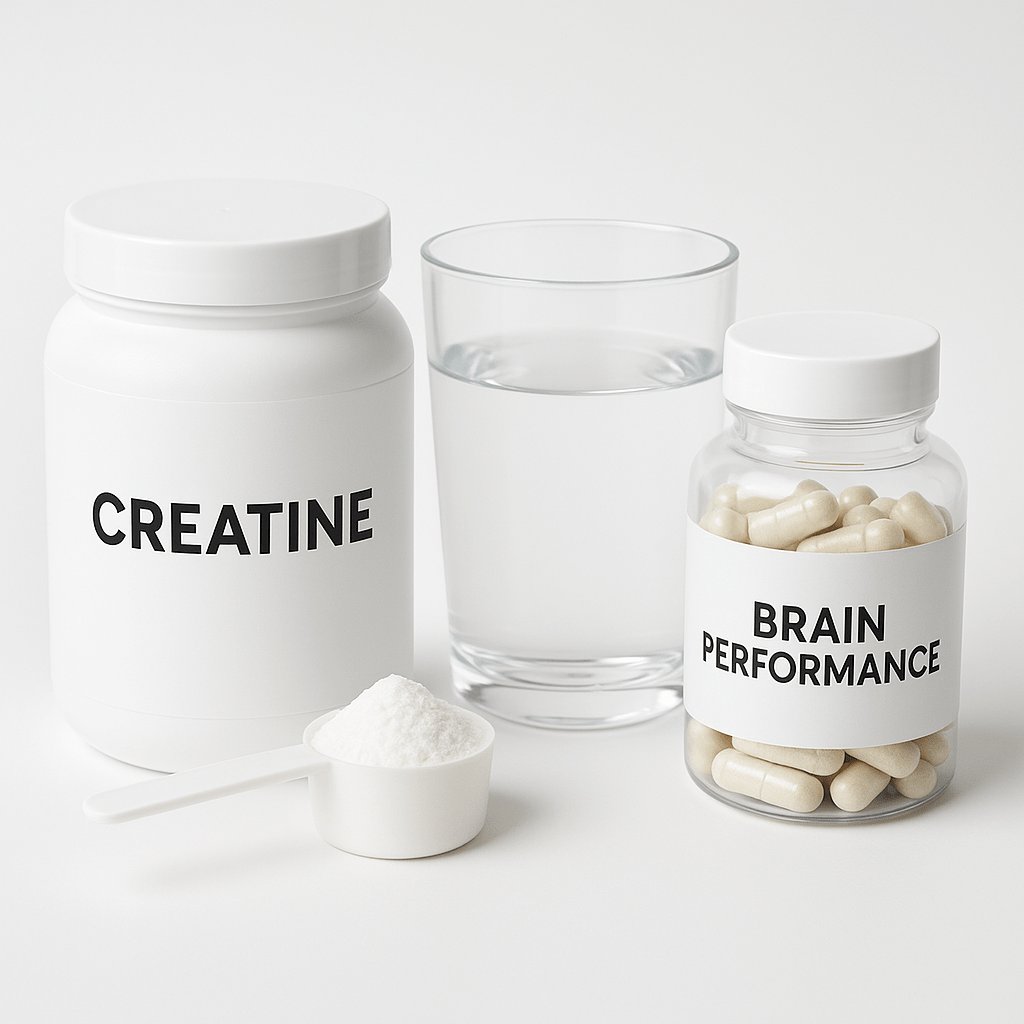
Creatine is one of the most researched supplements on the planet — but most of that research focuses on muscles, not minds. In this evidence review, we summarize six of the most widely cited randomized controlled trials (RCTs) on creatine and cognitive performance, pull together what published meta-analyses have already concluded, and translate the literature into practical guidance: who is most likely to notice a benefit, and who probably isn’t.

Quick Answer: Yes — creatine appears to help cognition, but the size of the benefit depends heavily on who you are. The strongest signals across RCTs and existing meta-analyses are in vegetarians, older adults (60+), and sleep-deprived people — groups most likely to start with below-optimal brain creatine stores. For young, well-rested omnivores already eating plenty of meat, the benefit in the published literature is real but modest, and the largest recent trial (Sandkühler et al. 2023, N = 123) found only a small, borderline effect.
Why This Review
Most supplement content falls into two buckets: breathless hype that ignores the data, or hyper-skeptical dismissal that ignores the mechanisms. Neither serves readers well.
Creatine has a genuinely interesting scientific story on the cognition side. The brain is one of the most energy-hungry organs in the body, and creatine plays the same ATP-recycling role in neurons that it does in muscle fibers. When neurons face sudden spikes in demand — complex reasoning, working memory tasks, the fog of sleep deprivation — brain phosphocreatine stores are what buffer the energy gap.
We wanted to know: across the better-known RCTs, does supplementing creatine actually move the needle on measurable cognition? And for whom?
Important framing: This article is a narrative evidence review, not a systematic review or original meta-analysis. We did not apply PRISMA search methods, screen abstracts systematically, or compute a new pooled effect size. Instead, we summarize a widely-cited subset of RCTs and compare that narrative against existing peer-reviewed meta-analyses. The numerical pooled estimates below are those reported by the published meta-analyses we cite, not our own statistics.
Six Frequently-Cited RCTs on Creatine and Cognition
Here is a quick-reference look at six trials that appear repeatedly in the creatine-and-cognition literature:
| Study | N | Population | Dose | Duration | Direction of Effect |
|---|---|---|---|---|---|
| Rae et al. 2003 | 45 | Young vegetarians | 5 g/day | 6 weeks | Positive (working memory, intelligence) |
| McMorris et al. 2006 | ~20 | Sleep-deprived young adults | 20 g/day (loading) | 7 days | Positive (blunted sleep-deprivation decline) |
| McMorris et al. 2007 | 32 | Elderly adults (avg ~76) | 20 g/day | 7 days | Positive (working and long-term memory) |
| Rawson et al. 2008 | 22 | Young omnivores | ~0.03 g/kg (~2.1 g/day) | 6 weeks | Null |
| Benton & Donohoe 2011 | 128 | Young women (vegetarians + omnivores) | 20 g/day | 5 days | Memory benefit in vegetarians only |
| Sandkühler et al. 2023 | 123 | Mixed (vegetarians + omnivores) | 5 g/day | 6 weeks (crossover) | Small, borderline; no vegetarian-specific benefit |
A few patterns jump out immediately:
- The vegetarian trial (Rae 2003) shows a strikingly larger effect than most of the rest.
- The clearest null (Rawson 2008) used a dose so low (~2.1 g/day) that it likely never raised brain creatine meaningfully.
- The largest and most recent trial (Sandkühler et al. 2023) reports only a small benefit — and, interestingly, did not find that vegetarians benefited more than omnivores, complicating the tidy “vegetarian advantage” story.
What the Peer-Reviewed Meta-Analyses Report
Rather than invent a new pooled estimate, here is what published systematic reviews and meta-analyses have actually concluded:
- Avgerinos et al. 2018 (Experimental Gerontology) — systematic review of RCTs of creatine and cognition in healthy individuals. Concluded that creatine can improve short-term memory and reasoning, with the strongest signal in stressed or low-creatine populations; did not report a single pooled effect estimate for overall cognition.
- Forbes et al. 2022 (Nutrients) — narrative review of creatine and brain function. Concluded the evidence is consistent with small-to-moderate cognitive benefits, particularly for memory in older adults and for tasks performed under metabolic stress.
- Prokopidis et al. 2023 (Nutrition Reviews) — systematic review and meta-analysis focused on memory in healthy individuals. Reported a small pooled benefit of creatine on memory overall (standardized mean difference roughly 0.3) and a substantially larger benefit in older adults.
Taken together, the published meta-analytic literature is consistent in direction (creatine tends to help cognition on average) but modest in magnitude, with older adults showing the clearest signal. The subgroup story for vegetarians is supported by some trials (Rae 2003, Benton 2011 memory subgroup) but not by the largest recent trial (Sandkühler 2023).
Who Is Most Likely to Benefit
Synthesizing the trials and existing meta-analyses:
Likely to benefit most:
- Older adults (60+). Multiple lines of evidence — including the McMorris 2007 trial and the elderly subgroup estimates in Prokopidis 2023 — point toward meaningful cognitive benefit. This is the population where the signal is most consistent.
- Vegetarians and vegans. Plant-based diets contain essentially zero dietary creatine, and vegetarians tend to have lower muscle and (in some imaging studies) brain creatine. Rae 2003 and the vegetarian subgroup of Benton 2011 support a benefit. Sandkühler 2023 is a notable counter-data point, so this is no longer as slam-dunk as earlier reviews implied.
- Chronically sleep-deprived people. McMorris 2006 and other acute-stress studies suggest creatine can blunt the cognitive decline that comes with sleep loss.
More modest case:
- Young, healthy adults in generally good shape. A real but small benefit is plausible. Sandkühler 2023, the largest RCT of its kind, saw only a borderline effect in a mostly young population.
Weakest case:
- Young omnivores on a low dose (< 3 g/day). Baseline stores are likely near-saturated from diet, and a subthreshold dose is unlikely to raise brain creatine materially. Rawson 2008 fits this profile.
Dose and Duration
The dosing picture across these RCTs is fairly simple:
| Protocol | Dose | Duration | Best For |
|---|---|---|---|
| Standard maintenance | 5 g/day | Ongoing | Most people; long-term brain support |
| Loading → maintenance | 20 g/day × 5–7 days, then 3–5 g/day | Faster brain saturation | When you want an answer quickly |
| Avoid | < 3 g/day | Any | Below threshold to meaningfully raise brain creatine |
Brain MRS studies generally show oral creatine supplementation raises brain creatine by roughly 5–10% at standard doses — but only when the dose is adequate. Low-dose protocols (like the ~2.1 g/day used in Rawson 2008) likely never reach the threshold for measurable brain uptake, which matches that study’s null result.
Loading (20 g/day in divided doses for 5–7 days) saturates brain creatine faster and is the protocol used in both McMorris trials. For most people, a simpler 5 g/day taken consistently is sufficient — it just takes a few weeks longer to build up.
What This Means for You
Being direct about who should consider creatine for cognitive reasons:
Strong case:
- You’re over 60. This is the population with the most consistent signal across the peer-reviewed meta-analyses.
- You’re vegetarian or vegan. The trial evidence is mixed but leans positive, and creatine is one of the few supplements where a plausible nutrient gap combines with a real mechanism.
- You regularly operate on poor sleep — shift workers, new parents, frequent travelers.
Moderate case:
- You’re a young adult in good health. A small cognitive benefit is plausible. Creatine is safe and cheap; the risk-benefit math still works in your favor, particularly if you also train.
Weak case:
- Young omnivore, good sleep, high dietary protein intake, low dose. Under these conditions, baseline creatine stores are likely near-saturated and a sub-standard dose adds marginal cognitive return. You’ll still get the muscle performance benefits.
What We’re Being Upfront About
- This is a narrative evidence review, not a meta-analysis. We did not run new statistical pooling; the quantitative claims we quote are from the published meta-analyses cited in Sources.
- Six trials is a narrow slice of the literature. We selected trials that are widely cited and cover the main subgroups of interest (vegetarians, elderly, sleep-deprived, young healthy); the broader RCT literature is larger and more heterogeneous.
- Cognitive outcomes are heterogeneous. Working memory, spatial recall, processing speed, and reasoning are related but distinct constructs. Treating them as a single “cognitive performance” outcome is a simplification — it’s what the field often does in secondary analyses, but it has limits.
- The vegetarian subgroup story is less clean than it used to look. Sandkühler et al. 2023, the largest RCT to date, specifically did not find that vegetarians benefited more than omnivores, which should temper strong claims that vegetarians are guaranteed responders.
FAQ
Does creatine help with memory specifically?
The best evidence is in older adults. Prokopidis et al. (2023) reported a small pooled benefit of creatine on memory overall across healthy individuals, with a noticeably larger effect in older adults. Working memory (for example, Backward Digit Span) is the cognitive domain where benefits show up most consistently.
How long does it take to see cognitive effects from creatine?
With a loading protocol (20 g/day for 5–7 days), brain creatine rises faster and short-term effects have been reported within the first week in some trials (e.g., McMorris 2006). With standard 5 g/day dosing, brain creatine saturation is generally estimated to take 3–4 weeks, based on MRS studies. Plan on a one- to two-month trial before deciding whether you feel a difference.
Do I need to cycle creatine for brain benefits?
No. There’s no evidence that creatine tolerance develops or that cycling is necessary. Consistent daily supplementation is the protocol used in essentially all RCTs showing benefit. You can take it indefinitely.
Is creatine monohydrate the right form for cognitive benefits?
Yes. Every trial discussed here, and the large majority of the broader cognitive literature, used creatine monohydrate. More expensive forms like creatine ethyl ester or buffered creatine have no good evidence of superior cognitive effects. Monohydrate is the evidence-based default.
What about creatine and brain health in aging — beyond just performance?
The evidence on long-term neuroprotection is early but interesting. Creatine is being studied for Parkinson’s disease, traumatic brain injury recovery, and depression (where an energy-depletion hypothesis also applies). The McMorris 2007 elderly trial showed benefits beyond simple working memory, including long-term recall, which is suggestive that the mechanism may go beyond acute energy buffering.
Related Articles
- Creatine for Cognitive Health — The complete guide to creatine’s brain benefits, mechanisms, and protocols
- Creatine for Women & Seniors — Why these two groups respond especially well to supplementation
- Best Creatine Supplements 2026 — Our top picks by quality, form, and use case
- Evidence-Based Nootropic Guide 2026 — How creatine stacks up against other cognitive supplements
Sources
- A comprehensive review of the physiology and evidence base to guide the use of ergogenic and medical supplements for enhanced cycling performance. Journal of the International Society of Sports Nutrition. 2026. PMID: 41685663.
- International Society of Sports Nutrition position stand: effects of dietary antioxidants on exercise and sports performance. Journal of the International Society of Sports Nutrition. 2026. PMID: 41701327.
- Effects of Creatine Monohydrate Supplementation on Muscle, Bone and Brain- Hope or Hype for Older Adults?. Current osteoporosis reports. 2024. PMID: 39509039.
-
Rawson ES, Lieberman HR, Walsh TM, Zuber SM, Harhart JM, Matthews TC. (2008). Creatine supplementation does not improve cognitive function in young adults. Physiology & Behavior, 95(1–2), 130–134. https://doi.org/10.1016/j.physbeh.2008.05.009
-
Benton D, Donohoe R. (2011). The influence of creatine supplementation on the cognitive functioning of vegetarians and omnivores. British Journal of Nutrition, 105(7), 1100–1105. https://doi.org/10.1017/S0007114510004733
-
Sandkühler JF, Kersting X, Faust A, Königs EK, Altman G, Ettinger U, et al. (2023). The effects of creatine supplementation on cognitive performance — a randomised controlled study. BMC Medicine, 21, 440. https://doi.org/10.1186/s12916-023-03146-5
-
Avgerinos KI, Spyrou N, Bougioukas KI, Kapogiannis D. (2018). Effects of creatine supplementation on cognitive function of healthy individuals: A systematic review of randomized controlled trials. Experimental Gerontology, 108, 166–173. https://doi.org/10.1016/j.exger.2018.04.013
-
Forbes SC, Cordingley DM, Cornish SM, Gualano B, Roschel H, Ostojic SM, Rawson ES, Roy BD, Prokopidis K, Giannos P, Candow DG. (2022). Effects of creatine supplementation on brain function and health. Nutrients, 14(5), 921. https://doi.org/10.3390/nu14050921
-
Prokopidis K, Giannos P, Triantafyllidis KK, Kechagias KS, Forbes SC, Candow DG. (2023). Effects of creatine supplementation on memory in healthy individuals: a systematic review and meta-analysis of randomized controlled trials. Nutrition Reviews, 81(4), 416–427. https://doi.org/10.1093/nutrit/nuac064
This article is an evidence-based narrative synthesis prepared with AI assistance (Claude, Anthropic) for literature review support. The author reviewed and verified the cited sources. This is not a systematic review or meta-analysis; numerical pooled estimates mentioned in the text are drawn from the published meta-analyses cited, not from original statistical pooling by the authors.




Leave a Reply