
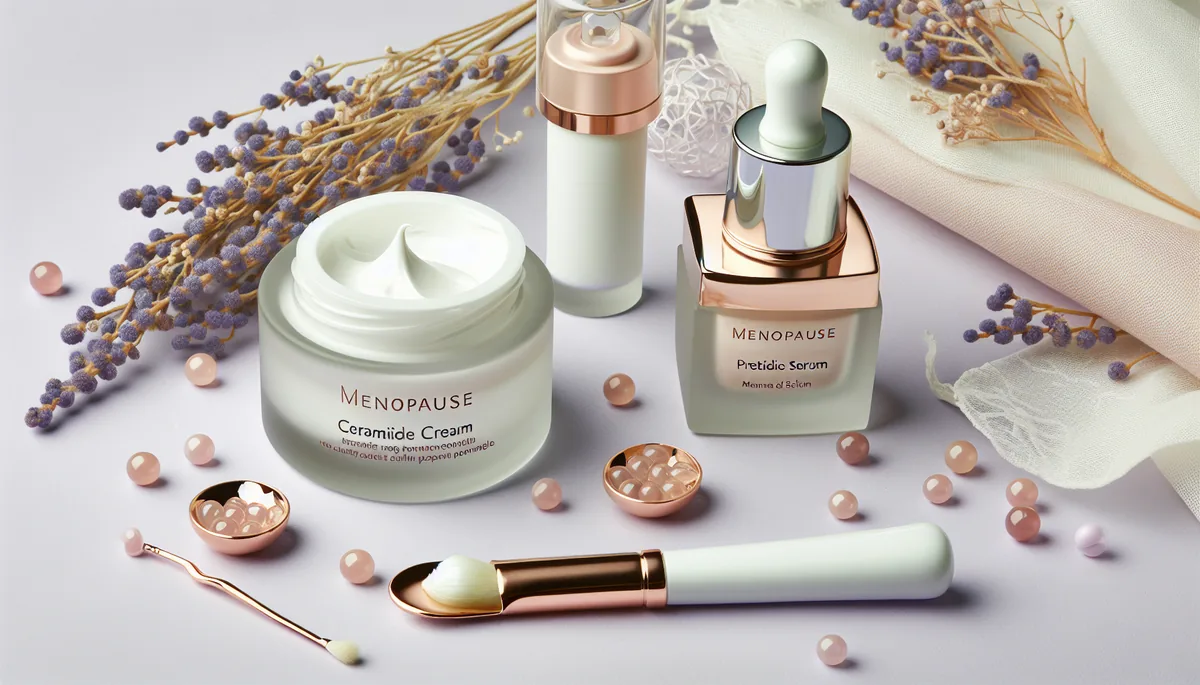
Perimenopause and menopause bring dramatic shifts in skin health. Estrogen decline leads to collagen loss, dryness, and thinning — but the right skincare strategy can slow and even reverse many of these changes. Here’s what actually works.
How Hormonal Changes Affect Your Skin
Estrogen is your skin’s best friend. It stimulates collagen production, maintains hydration via hyaluronic acid synthesis, and supports skin thickness. During perimenopause (typically ages 40-55), estrogen levels fluctuate unpredictably before declining permanently at menopause.
The impact is measurable: women lose approximately 30% of their collagen in the first five years post-menopause (Thornton MJ, Dermatoendocrinology, 2013; summarized from earlier work by Brincat et al.). Skin becomes thinner, drier, and more prone to sagging.
Key Skin Changes to Expect
- Increased dryness — reduced sebum and hyaluronic acid production
- Loss of elasticity — collagen and elastin degradation accelerates
- Thinning skin — epidermis becomes more fragile
- Hyperpigmentation — hormonal shifts trigger melasma and age spots
- Increased sensitivity — barrier function weakens
- Adult acne flare-ups — androgen dominance during perimenopause
Building Your Menopause Skincare Routine
Step 1: Gentle, Hydrating Cleanser
Your barrier is compromised. Ditch foaming cleansers and switch to cream or oil-based formulas.
Best for: Menopausal dryness and sensitivity.
Product Pick: La Roche-Posay Toleriane Hydrating Gentle Cleanser — ceramide-rich, pH-balanced, preserves the skin barrier.
Step 2: Estrogen-Mimicking Actives
Since your skin is losing its estrogen support, phytoestrogens and peptides can partially compensate.
Best for: Collagen loss and thinning skin.
- Bakuchiol — a plant-based retinol alternative with in-vitro evidence of retinoid-like and estrogen-receptor-binding activity
- Soy isoflavones — shown to improve skin thickness and elasticity
- Peptides (Matrixyl, copper peptides) — signal collagen synthesis
Product Pick: Emepelle Serum with MEP Technology — specifically formulated for estrogen-deficient skin using methyl estradiolpropanoate, a non-hormonal estrogen pathway activator.
Step 3: Deep Hydration Layers
Layer hydrating serums under rich moisturizers to combat transepidermal water loss.
Product Pick: Vichy Minéral 89 Hyaluronic Acid Serum — fragmented HA penetrates deeper; fortified with mineralizing water.
Step 4: Rich, Barrier-Repair Moisturizer
Look for ceramides, cholesterol, and fatty acids — the three lipids that compose your skin barrier.
Product Pick: SkinCeuticals Triple Lipid Restore 2:4:2 — optimal ratio of ceramides, cholesterol, and fatty acids backed by clinical data.
Step 5: Sunscreen (Non-Negotiable)
Thinner skin is more vulnerable to UV damage and hyperpigmentation.
Product Pick: Supergoop Unseen Sunscreen SPF 40 — invisible finish, comfortable under makeup.
Targeted Treatments
For Hyperpigmentation
Vitamin C (L-ascorbic acid 15-20%), tranexamic acid, and azelaic acid brighten without irritation.
Product Pick: SkinCeuticals C E Ferulic — the gold standard vitamin C serum with clinical evidence for photoaging.
For Severe Dryness
Facial oils with rosehip, marula, or squalane lock in hydration overnight.
Product Pick: Drunk Elephant Virgin Marula Luxury Facial Oil — cold-pressed, antioxidant-rich, non-comedogenic.
For Sagging and Loss of Firmness
Retinoids remain the most evidence-backed anti-aging ingredient, but start low and slow on sensitized menopausal skin.
Product Pick: RoC Retinol Correxion Line Smoothing Night Serum — pharmacy-grade retinol in a hydrating base.
Lifestyle Factors That Matter
- Collagen supplementation — 5–10 g hydrolyzed collagen peptides daily improved skin elasticity and hydration across randomized trials, summarized in a 2019 systematic review (Choi FD et al., J Drugs Dermatol 2019;18(1):9-16) and an RCT (Bolke L et al., Nutrients 2019;11(10):2494)
- Omega-3 fatty acids — support barrier function from within
- Strength training — improves circulation and skin structure
- Sleep quality — growth hormone peaks during deep sleep; prioritize it
FAQ
Q: Can skincare replace hormone replacement therapy (HRT) for skin? A: Skincare helps significantly but doesn’t fully replace systemic estrogen’s effects on skin. HRT has been shown to improve skin thickness and collagen density. Discuss options with your doctor.
Q: What’s the single most important ingredient for menopausal skin? A: Retinoids for anti-aging, but ceramides for immediate comfort. If you must choose one, a barrier-repair moisturizer with ceramides addresses the most urgent need.
Q: Does menopause cause acne? A: Yes — relative androgen excess during perimenopause can trigger breakouts, especially along the jawline. Niacinamide and azelaic acid treat this without over-drying.
Q: How do I treat neck and décolletage aging? A: Extend every product to your neck and chest. These areas thin faster and show aging sooner. Use SPF religiously here.
Q: Are “menopause skincare” brands worth the price? A: Some are genuinely formulated for estrogen-deficient skin (like Emepelle). Others are marketing repackages. Look at ingredients, not labels.
References: Lephart ED. “Skin aging and oxidative stress: Equol’s anti-aging effects.” J Cosmet Dermatol. 2016; Thornton MJ. “Estrogens and aging skin.” Dermatoendocrinology. 2013;5(2):264-270; Bolke L, et al. “A collagen supplement improves skin hydration, elasticity, roughness, and density.” Nutrients. 2019;11(10):2494.
Sources
- Baumann L. (2015). Cosmeceuticals and cosmetic ingredients. McGraw-Hill Education.
- Draelos ZD. (2011). Cosmetics and dermatologic problems and solutions. Third edition. CRC Press.
- AAD. (2024). Skin care tips and product guidance. American Academy of Dermatology.
- EWG Skin Deep Database. (2024). Cosmetic safety ratings and ingredient analysis. Environmental Working Group.
- Mukherjee PK, et al. (2011). Bioactive compounds from natural resources against skin aging. Phytomedicine, 19(1):64-73.

Leave a Reply