
Sea Moss and Thyroid Health: The Iodine Connection You Need to Understand
The Real Story Behind Sea Moss and Your Thyroid
Somewhere along the way, sea moss became shorthand for thyroid support in wellness circles – touted as a natural solution for sluggish metabolism, fatigue, and hormonal imbalance. The connection isn’t imaginary. Sea moss really does contain iodine, and your thyroid really does need iodine to function. But the relationship between sea moss and thyroid health is more complicated than the simple “eat seaweed, fix your thyroid” narrative that gets passed around online.
Quick Answer: Sea moss is a real source of iodine, which is essential for thyroid hormone production. For people who are genuinely iodine-deficient, it may support thyroid function. However, the iodine content in sea moss varies enormously between products, and consuming too much iodine – equally possible with sea moss – can worsen thyroid function rather than improve it. People with existing thyroid conditions should speak to a doctor before adding sea moss to their routine.
Why Your Thyroid Needs Iodine

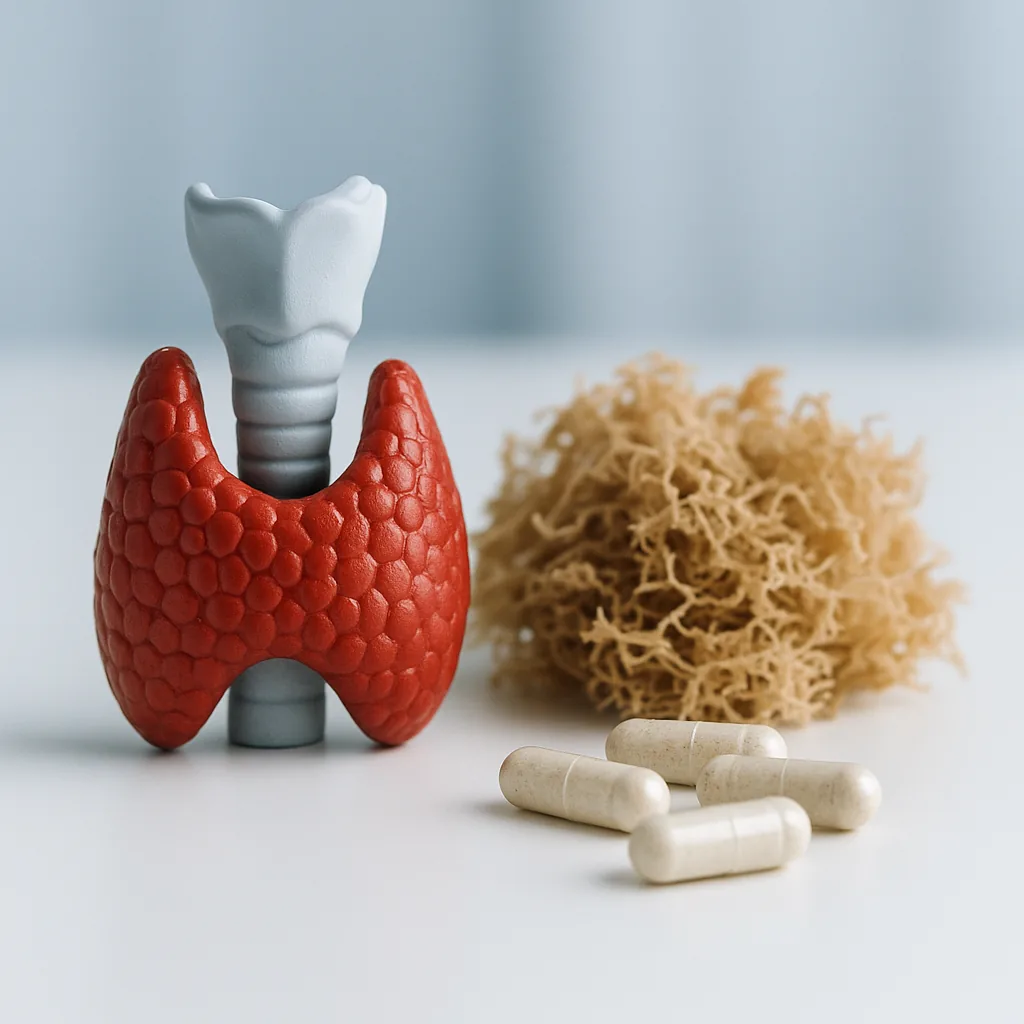
Your thyroid is a butterfly-shaped gland at the base of your neck, and it does a remarkable amount of work. It produces two main hormones – thyroxine (T4) and triiodothyronine (T3) – that regulate metabolism, heart rate, body temperature, mood, bone health, and reproductive function. These hormones affect virtually every cell in your body.
Iodine is the essential mineral the thyroid uses to synthesize these hormones. The thyroid actively concentrates iodine from the bloodstream – it’s the only tissue in the body that does this at scale. Without adequate iodine, the thyroid can’t make enough hormone. The result is hypothyroidism: fatigue, weight gain, cold intolerance, brain fog, and in severe or prolonged cases, goiter (an enlarged thyroid gland).
The recommended dietary allowance for iodine in adults is 150 micrograms per day. Pregnant and breastfeeding women need significantly more – 220 and 290 mcg per day, respectively – because iodine is critical for fetal brain development (National Institutes of Health, Office of Dietary Supplements, 2023).
Worldwide, iodine deficiency remains a significant public health issue. In the United States, iodine sufficiency improved dramatically after iodized salt was introduced in the 1920s. But iodine intake has declined in recent decades as Americans eat less iodized salt and more processed foods (which typically use non-iodized salt). People who follow low-salt diets, avoid dairy, or eat minimal seafood are at meaningful risk for suboptimal iodine intake.
How Much Iodine Is Actually in Sea Moss?
This is where the simple story gets complicated. The iodine content of sea moss isn’t a fixed number. It varies dramatically depending on species, geographic origin, growing conditions, harvest season, and processing method.
One of the most-cited studies on this topic analyzed commercially available edible seaweeds and found iodine content ranging from 16 mcg to over 2,400 mcg per gram of dried seaweed (Teas et al., Thyroid, 2004). That’s a 150-fold difference within what’s all sold as “sea moss.” A single gram of high-iodine sea moss could provide 16 times the adult daily requirement – or it could provide barely 10 percent of it.
A 2024 case report in Cureus documented a patient who developed hypothyroidism from regular seaweed consumption for health purposes. The iodine load from daily seaweed use triggered sustained hypothyroidism via the Wolff-Chaikoff effect, with symptoms resolving after thyroid hormone replacement therapy (Unosawa et al., Cureus, 2024). This is the iodine paradox: both too little and too much iodine can impair thyroid function.
The upper tolerable intake level for iodine is 1,100 mcg per day for adults. Beyond this, the risk of thyroid dysfunction increases, particularly for people with underlying thyroid autoimmunity – including Hashimoto’s thyroiditis, the most common cause of hypothyroidism in the developed world.
The Two Ways Iodine Can Help or Hurt
Understanding how iodine affects the thyroid requires knowing about two phenomena: the Wolff-Chaikoff effect and iodine-induced hyperthyroidism.
The Wolff-Chaikoff effect is the thyroid’s natural protective response to a sudden surge of iodine. When iodine levels spike sharply, the thyroid temporarily downregulates its hormone production. In healthy people, this is self-correcting within days. But in people with underlying thyroid disease – particularly Hashimoto’s thyroiditis or a nodular goiter – the autoregulation may fail, leading to sustained hypothyroidism from iodine excess (Leung & Braverman, Nature Reviews Endocrinology, 2014).
Iodine-induced hyperthyroidism (also called Jod-Basedow phenomenon) is the opposite problem. In people with autonomous thyroid nodules or latent Graves’ disease, a sudden increase in iodine can trigger overproduction of thyroid hormone – causing rapid heartbeat, weight loss, anxiety, and in severe cases, thyroid storm. This is more likely in populations that were previously iodine-deficient and then received a sudden high dose (Stanbury et al., Thyroid, 1998).
Neither of these scenarios is common in healthy people taking modest amounts of sea moss. But they illustrate why “sea moss supports thyroid health” is a half-truth that can be dangerous for people with thyroid conditions.
Who Might Actually Benefit
If you’re iodine-deficient – which your doctor can assess with a urine iodine test – adding a reliable source of dietary iodine may meaningfully support thyroid hormone production. Sea moss, used in modest and consistent amounts, could be one such source. So could seaweed, seafood, dairy, and iodized salt.
The advantage of sea moss over iodine supplements is that it provides iodine as part of a whole food matrix that includes other minerals and compounds. Some researchers suggest that whole-food sources of iodine may be better tolerated than high-dose supplemental iodine, though direct comparisons are limited.
People who are most likely to benefit from sea moss’s iodine contribution include those who avoid iodized salt, eat minimal seafood and dairy, follow strict plant-based diets, or have been told they have borderline-low iodine by a healthcare provider.
Who Should Be Cautious
If you have any diagnosed thyroid condition, the “sea moss supports your thyroid” message needs to be treated with significant caution:
Hashimoto’s thyroiditis is an autoimmune condition in which the immune system attacks the thyroid. High iodine intake has been associated with triggering autoimmune flares and worsening thyroid function in some Hashimoto’s patients. The evidence is not entirely consistent, but the risk is real enough that most endocrinologists recommend Hashimoto’s patients avoid supplemental iodine beyond dietary amounts (Liontiris & Mazokopakis, Hellenic Journal of Nuclear Medicine, 2017).
Graves’ disease is the most common cause of hyperthyroidism. Adding high-iodine foods can exacerbate overactivity in some patients and interfere with antithyroid medications.
Thyroid nodules – solid or fluid-filled growths in the thyroid – are common (found in about 10% of the population). Most are benign, but some autonomous nodules can produce excess hormone when given extra iodine substrate.
Thyroid cancer survivors and patients receiving radioactive iodine treatment are typically placed on iodine-restricted diets, where sea moss would be contraindicated.
What Sea Moss Provides Beyond Iodine
It’s worth noting that the thyroid story isn’t only about iodine. The thyroid also requires selenium for the conversion of T4 to the more active T3, and selenium deficiency is associated with increased risk of thyroid disease (Rayman, The Lancet, 2000). Sea moss contains small amounts of selenium, though the levels vary and it’s not a primary dietary source.
Zinc is another mineral with a role in thyroid hormone synthesis and metabolism. Sea moss provides trace amounts of zinc, though again, this shouldn’t be counted as your primary zinc source.
The polysaccharides in sea moss – particularly carrageenan – have been studied for potential anti-inflammatory effects that could theoretically be relevant to autoimmune thyroid disease. But this is highly speculative territory; there are no human trials linking sea moss polysaccharides to improved autoimmune thyroid outcomes (Shannon & Abu-Ghannam, Phycologia, 2019).
Practical Guidance
If you’re considering sea moss for thyroid support, here’s what actually matters:
Get your thyroid and iodine status checked before making significant dietary changes. A TSH test assesses overall thyroid function; urine iodine concentration (typically collected over 24 hours) assesses iodine status. Neither is exotic – your primary care doctor can order both.
If you have no thyroid condition and your iodine levels are suboptimal, modest sea moss consumption (one tablespoon of gel per day) from a product with documented iodine content is a reasonable approach. Look for brands that provide third-party testing so you know roughly how much iodine you’re getting.
If you have any diagnosed thyroid condition – hypothyroid, hyperthyroid, Hashimoto’s, or nodular goiter – talk to your endocrinologist before adding sea moss. The iodine variability is too significant to manage blindly.
Don’t use sea moss as a substitute for medical treatment of thyroid disease. It’s a dietary ingredient, not a medication, and there are no clinical trials showing it reverses, treats, or significantly improves thyroid disorders.
Frequently Asked Questions
Can sea moss improve my thyroid levels?
Sea moss can contribute to iodine intake, which supports thyroid hormone synthesis if you’re iodine-deficient. But sea moss doesn’t directly improve thyroid function in people who already have adequate iodine, and it can worsen function in people with thyroid conditions who get too much iodine. Your thyroid hormone levels are best assessed and managed with your doctor, not a dietary supplement alone.
How much sea moss is safe for thyroid health?
There’s no universally established safe dose because iodine content varies so much between products. Most experts suggest no more than one to two tablespoons of sea moss gel per day for healthy adults – a range that typically provides between 20 and several hundred mcg of iodine depending on the specific product. Third-party testing documentation from your sea moss brand helps enormously with this calculation.
Does sea moss help with hypothyroidism?
It depends on why you have hypothyroidism. If iodine deficiency is the cause – uncommon in the US but possible – addressing iodine intake makes sense. If your hypothyroidism is due to Hashimoto’s, surgery, radioiodine treatment, or other causes unrelated to iodine, sea moss won’t fix it and could cause problems. Most hypothyroidism in the United States is Hashimoto’s. Sea moss is not a substitute for levothyroxine or other thyroid medications.
Is sea moss safe during pregnancy?
Pregnancy significantly increases iodine requirements (220 mcg/day recommended). Sea moss could contribute to iodine intake during pregnancy, but the high variability in iodine content makes it a risky primary source. Prenatal vitamins with iodine are more reliable. Pregnant women should consult their OB or midwife before adding sea moss.
Should I take sea moss with or without thyroid medication?
Sea moss should not be taken at the same time as thyroid medication (levothyroxine). Minerals in sea moss – including calcium – can bind to levothyroxine and reduce absorption. Standard guidance is to take levothyroxine on an empty stomach and wait at least four hours before taking any mineral-containing supplements or foods.
Sources
- National Institutes of Health, Office of Dietary Supplements. (2023). Iodine: Fact Sheet for Health Professionals. Retrieved from https://ods.od.nih.gov/factsheets/Iodine-HealthProfessional/
- Teas, J., Pino, S., Critchley, A., & Braverman, L.E. (2004). Variability of iodine content in common commercially available edible seaweeds. Thyroid, 14(10), 836-841.
- Leung, A.M. & Braverman, L.E. (2014). Consequences of excess iodine. Nature Reviews Endocrinology, 10(3), 136-142.
- Stanbury, J.B., Ermans, A.E., Bourdoux, P., Todd, C., Oken, E., Tonglet, R., Vidor, G., Braverman, L.E., & Medeiros-Neto, G. (1998). Iodine-induced hyperthyroidism: occurrence and epidemiology. Thyroid, 8(1), 83-100.
- Liontiris, M.I. & Mazokopakis, E.E. (2017). A concise review of Hashimoto thyroiditis (HT) and the importance of iodine, selenium, vitamin D and gluten on the autoimmunity and dietary management of HT patients. Hellenic Journal of Nuclear Medicine, 20(1), 51-56.
- Rayman, M.P. (2000). The importance of selenium to human health. The Lancet, 356(9225), 233-241.
- Shannon, E. & Abu-Ghannam, N. (2019). Seaweeds as nutraceuticals for health and nutrition. Phycologia, 58(5), 563-577.
- Unosawa, K., et al. (2024). Hypothyroidism due to seaweed overconsumption. Cureus, 16(2), e55231. doi:10.7759/cureus.55231
Related Articles
- Sea Moss Benefits: What the Research Actually Shows
- Sea Moss Benefits for Women: Thyroid, Fertility, Skin, and More
- Sea Moss Supplements: Benefits, Evidence, and What to Look For in 2026
- Sea Moss Gel: How to Make It, Use It, and Whether It’s Worth the Hype
- Sea Moss vs Spirulina: Two Superfoods Compared Side by Side
- Sea Moss for Skin: What the Evidence Says About This Trending Ingredient
- Sea Moss Side Effects: What to Watch For Before You Start Taking It


Leave a Reply