Tart Cherry for Gout: What the Evidence Actually Shows
Quick Answer: Tart cherry has legitimate clinical evidence for reducing gout flare frequency and lowering uric acid levels. Multiple observational studies and small RCTs show meaningful reductions in gout attacks. It’s not a replacement for urate-lowering medications in chronic gout, but it’s an effective adjunct with a strong safety profile.
Gout is one of the most painful conditions in medicine — a form of inflammatory arthritis caused by monosodium urate crystal deposition in joints, most commonly the big toe (podagra). It affects approximately 8 million Americans, with rising prevalence. The standard pharmaceutical approach (allopurinol for urate lowering, NSAIDs or colchicine for acute flares) is effective but imperfect — many patients experience frequent flares despite medication, and some can’t tolerate the standard drugs.
Tart cherry has emerged as one of the more evidence-backed complementary approaches for gout management. This guide covers the mechanism, the clinical data, practical protocols, and where tart cherry fits in the overall gout management strategy.
Why Tart Cherry for Gout? The Mechanisms
Tart cherries (Prunus cerasus) contain several compounds that address different aspects of gout pathophysiology:
Anthocyanins (particularly cyanidin-3-glucosylrutinoside and cyanidin-3-rutinoside): These potent antioxidants have multiple anti-inflammatory effects:
Inhibit cyclooxygenase (COX) enzymes — similar mechanism to NSAIDs, reducing prostaglandin synthesis
Reduce NF-κB pathway activation (a central inflammatory signaling cascade)
Specifically inhibit production of IL-1β — the cytokine most directly responsible for the inflammatory cascade in gout crystal deposition
Uric acid reduction: Multiple studies document that tart cherry consumption reduces serum uric acid levels, likely through:
Increased renal uric acid excretion (xanthine oxidase inhibition, the enzyme that synthesizes uric acid, may be involved)
Anti-inflammatory properties that indirectly reduce purine catabolism
Xanthine oxidase inhibition: Some research suggests tart cherry anthocyanins have direct xanthine oxidase inhibitory activity (the same target as allopurinol, though far less potent). This would directly reduce uric acid synthesis.
Clinical Evidence
Observational and Epidemiological Data
A pivotal 2012 study by Chen et al. in Arthritis & Rheumatism followed 633 gout patients over approximately 1 year (retrospective interview study). Those who consumed cherries in the prior 2 days had:
35% lower risk of gout attack vs. no cherry consumption
Combined cherry plus allopurinol: 75% reduction in gout attack risk vs. neither
Effect was dose-dependent: 10-30+ servings per month associated with further risk reduction
This remains the landmark study — large-scale, real-world gout patients, meaningful effect size.
Randomized Controlled Trials
RCT by Kelley et al. (2006): Tart cherry juice (480 ml/day) in healthy adults for 4 weeks reduced serum uric acid by 19.2 μmol/L (approximately 0.32 mg/dL). Not a gout-specific population but demonstrated the uric acid reduction mechanism.
RCT by Jacob et al. (2003): 45 adult women consumed 2 servings of cherries (280g). Serum urate decreased by 14.2 μmol/L at 5 hours post-consumption; plasma uric acid reduction was statistically significant.
Pilot RCT by Schumacher et al. (2013): In gout patients specifically, 1 tablespoon of tart cherry juice concentrate twice daily for 4 months: 50% of patients in cherry group had no gout flares vs. 15% in placebo. Preliminary but encouraging.
2019 systematic review in Rheumatology International: Reviewed available human studies and concluded cherry consumption was associated with reduced uric acid levels and reduced gout attacks, with effects most consistent across higher-quality studies.
Tart Cherry vs. Regular (Sweet) Cherry
Most research has focused on tart cherries (Prunus cerasus), not sweet cherries (Prunus avium). Tart cherries contain approximately 5x more anthocyanins than sweet cherries, which likely accounts for their superior effects. Montmorency tart cherries are the variety most studied.
Forms and Dosing
Tart cherry juice: Most studies used juice or juice concentrate.
Whole juice: 240-480 ml/day (8-16 oz)
Concentrate: 1-2 tablespoons/day diluted in water (most practical, lower sugar)
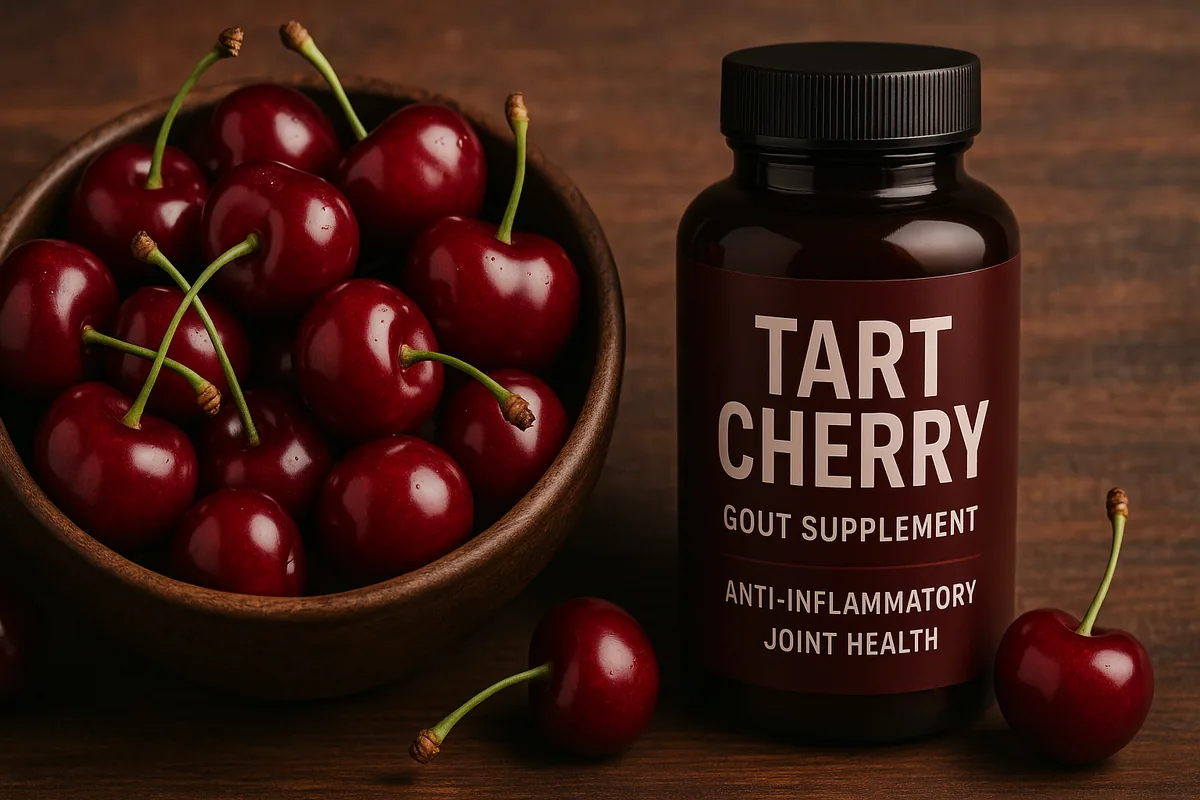
Tart cherry capsules: Freeze-dried tart cherry powder in capsules. Easier to standardize; dose typically 480-1,000 mg/day of Montmorency tart cherry equivalent.
For acute gout flares: Higher doses immediately (2-3 tablespoons concentrate or 2-3 servings) may help reduce inflammation alongside standard treatment
For gout prevention: Daily use at maintenance doses (1 tablespoon concentrate or 500-1,000 mg capsules)
Sugar consideration: Tart cherry juice does contain fructose and sugar. Fructose itself raises uric acid (one of the dietary drivers of gout). Concentrated capsule form avoids the sugar load while providing the anthocyanins — preferable for diabetics and those watching calories.
Tart Cherry in the Context of Complete Gout Management
Gout management involves multiple components, and tart cherry fits as one piece:
Dietary approach:
Low-purine diet (reduce red meat, organ meats, shellfish)
Avoid fructose and high-fructose corn syrup (major driver of uric acid)
Limit alcohol, especially beer (high in purines and raises uric acid)
Increase hydration — dilutes urate and supports renal excretion
Coffee (counterintuitively) is associated with lower gout risk in large studies
Medications (for moderate-to-severe gout):
Allopurinol or febuxostat (xanthine oxidase inhibitors — urate lowering)
Colchicine (flare prevention and treatment)
NSAIDs or corticosteroids (acute flare treatment)
Tart cherry’s role: Most evidence-supported as adjunctive therapy — combined with allopurinol, the Chen (2012) study showed 75% attack reduction. Tart cherry doesn’t replace urate-lowering therapy for chronic, established gout, but meaningfully adds to it.
For those with mild, infrequent gout attacks who prefer natural approaches before pharmacotherapy, tart cherry is the strongest evidence-based natural option. See also our Tart Cherry Juice for Arthritis and Joint Pain article for its broader use in joint conditions.
Key Takeaways
Tart cherry (Montmorency) reduces gout flare risk by ~35% in large observational data; combined with allopurinol, 75% reduction was observed
Mechanisms: anthocyanin-driven COX inhibition, IL-1β reduction, and modest xanthine oxidase inhibition all contribute
Reduces serum uric acid by approximately 0.2-0.4 mg/dL — modest but clinically meaningful
Concentrate form is more practical than whole juice (less sugar, easier to dose)
Not a replacement for allopurinol in chronic hyperuricemia — best used as an adjunct
Works within the broader gout management picture alongside low-purine diet, hydration, and avoiding fructose/alcohol
Frequently Asked Questions
How quickly does tart cherry reduce gout symptoms?
For acute flares, some patients report partial relief within 24-48 hours of high-dose tart cherry consumption. For prevention, consistent daily use over 4-8 weeks appears to reduce flare frequency based on trial data. It’s not as fast-acting as colchicine or NSAIDs for acute attacks.
How much tart cherry concentrate should I take for gout?
1-2 tablespoons of Montmorency tart cherry concentrate per day (diluted in water or taken straight) represents the dose most consistent with clinical studies. During a flare or high-risk period (after a trigger meal), some practitioners suggest 2-3 tablespoons.
Can I take tart cherry with allopurinol?
Yes — the Chen (2012) study specifically studied this combination and showed synergistic risk reduction. No known adverse interaction between tart cherry and allopurinol. Always inform your physician of all supplements.
Does the sugar in tart cherry juice negate its benefits?
This is a legitimate concern. Fructose increases uric acid synthesis. Standard tart cherry juice contains meaningful fructose. The net effect in studies has been positive (uric acid reduction despite the fructose), suggesting the xanthine oxidase inhibition and excretion enhancement outweigh the fructose effect at typical doses. However, using freeze-dried capsules or diluted concentrate minimizes fructose intake while retaining anthocyanin benefits.
Is tart cherry effective for arthritis beyond gout?




Leave a Reply