
Quick Answer: Mushroom gummies can deliver real benefits — but only if they contain properly extracted fruiting body material, not mycelium grown on grain. Look for beta-glucan content on the label (aim for ≥25% beta-glucans), avoid proprietary blends that obscure per-species doses, and understand that extraction method matters far more than whether your supplement is a gummy, capsule, or powder. The convenience is real; the quality varies wildly.
Mushroom supplements have moved from specialty health food stores to mainstream wellness culture at remarkable speed. And now they’ve taken their most approachable form yet: the gummy. Walk through any supplement aisle or scroll any wellness brand’s website and you’ll find lion’s mane gummies, reishi gummies, chaga gummies, and elaborate “mushroom complex” formulations promising focus, calm, immunity, and energy in a single chewy bite.
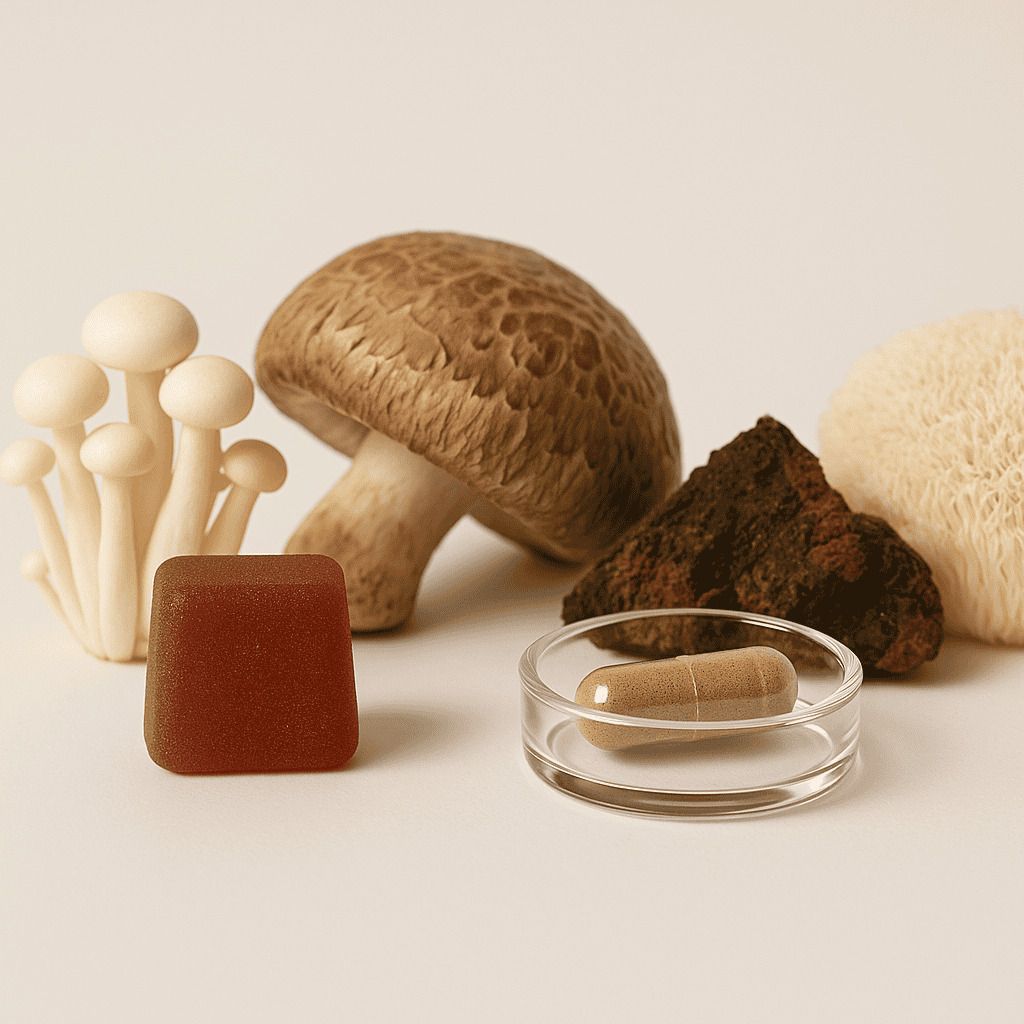
But gummies introduce a genuinely complicated set of tradeoffs for functional mushroom supplementation. The sugars, gelling agents, and stabilizers required to make a shelf-stable gummy compete for space — in terms of volume and cost — with the active compounds you’re actually paying for. The result is a product category where marketing consistently outpaces actual content. Understanding what’s worth buying requires knowing how mushroom extracts work at a biochemical level, which species have meaningful clinical research behind them, and which quality signals separate a serious supplement from a wellness-branded gummy bear. This guide covers all of it.
Which Mushroom Species Are Available in Gummy Form
The functional mushroom category is large, but not every species has made it into the gummy format in meaningful doses. The most common species you’ll encounter are lion’s mane (Hericium erinaceus), reishi (Ganoderma lucidum), chaga (Inonotus obliquus), cordyceps (Cordyceps militaris or the traditionally-used Cordyceps sinensis), turkey tail (Trametes versicolor), and various branded “mushroom complex” blends that combine anywhere from two to ten species in a single serving.
Lion’s mane is by far the most prevalent in gummy form, driven by intense consumer interest in nootropic and cognitive support applications. The species contains hericenones (found in the fruiting body) and erinacines (found in the mycelium), compounds that have demonstrated nerve growth factor (NGF) stimulation in preclinical research. A 2009 double-blind, placebo-controlled trial by Mori et al., published in Phytotherapy Research, showed statistically significant cognitive function improvements in older adults with mild cognitive impairment who supplemented with 3g/day of H. erinaceus powder for 16 weeks. A 2023 study by Rosenbloom et al. in Scientific Reports extended this evidence to younger populations, finding improvements in anxiety scores and cognitive processing after four weeks of supplementation.
Reishi gummies typically bill themselves on immune support and stress modulation. Reishi contains triterpenes (ganoderic acids) and beta-glucans, both of which contribute to its well-documented immunomodulatory activity. The challenge with reishi in a gummy format is that the therapeutic dose in most studies is substantial — often 1.5–9g of dried mushroom equivalent per day — and compressing that into gummy-friendly amounts without losing potency requires high-concentration extracts that many budget products simply don’t use.
Chaga is phytochemically interesting, containing betulinic acid derivatives (derived from its birch tree host), melanin complexes, and beta-glucans. Its antioxidant capacity is among the highest measured in any natural substance. However, chaga’s clinical research in humans is thin compared to lion’s mane or turkey tail. Most evidence remains in vitro or animal-model based, making evidence-based dosing claims for gummy formats difficult to substantiate. That said, its inclusion as part of a mushroom complex isn’t unreasonable given the preclinical signal.
Cordyceps gummies typically target energy and athletic performance. The critical distinction here is species: most research supporting performance benefits uses Cordyceps militaris (the cultivated species), not Cordyceps sinensis (the rare caterpillar fungus used in traditional Chinese medicine). A 2016 study by Hirsch et al. in the Journal of Dietary Supplements found that four weeks of supplementation with 4g/day C. militaris led to statistically significant improvements in aerobic threshold in young adults. Check that any cordyceps product you purchase specifies C. militaris from fruiting bodies — not the mycelium-derived material that most budget products use.
Turkey tail (Trametes versicolor) is among the best-researched medicinal mushrooms, primarily for immune and gut microbiome support. Its polysaccharide-K (PSK) and polysaccharide-peptide (PSP) are the subject of decades of clinical research, including as adjuvant support during conventional cancer treatment in Japan and Korea. However, PSK is a proprietary pharmaceutical-grade extract — not the standard turkey tail powder or extract found in most gummies. Products with turkey tail powder can still deliver beta-glucans and polysaccharides with immune relevance; they just shouldn’t be conflated with PSK’s specific evidence base.
Bioavailability: Why Extraction Matters More Than Delivery Format
This is the single most important concept in functional mushroom supplementation, gummies included: the delivery format (gummy vs. capsule vs. powder) is largely irrelevant compared to whether the mushroom material was properly extracted before it was put into that gummy.
The bioactive compounds in functional mushrooms — primarily beta-glucans, triterpenes, and specific polysaccharides — are locked inside chitin cell walls. Chitin is the structural polymer that makes up fungal cell walls, and it is not digestible by human enzymes. Without breaking down those walls through extraction, you’re essentially swallowing inert biomass. Your body cannot access the beta-glucans or triterpenes inside, regardless of whether the biomass is in a gummy, capsule, or smoothie.
Hot water extraction liberates beta-glucans and polysaccharides. Alcohol extraction (ethanol) is required for triterpenes — the class of compounds behind reishi’s adaptogenic and immunomodulatory properties. A “dual extraction” process uses both methods sequentially and is considered the gold standard for species like reishi that contain meaningful amounts of both compound classes. For lion’s mane, hot water extraction is typically sufficient to access the active polysaccharides, though some formulators argue that alcohol extraction also increases hericenone bioavailability.
A 2020 review by Wasser published in the International Journal of Medicinal Mushrooms emphasized that beta-glucan content — not total polysaccharide content — is the meaningful quality marker. This distinction matters because products made from mycelium grown on grain contain large amounts of grain starch, which shows up as “polysaccharides” on a label without providing any of the immunologically active beta-glucan structure. A product listing “polysaccharides: 30%” could be mostly starch. A product listing “beta-glucans: 28%” is giving you actual information about active content.
Gummies add one additional complication beyond the extraction question: manufacturing conditions. Creating a stable gummy requires heat, acidic environments (from citric acid or pectin), and processing steps that can degrade heat-sensitive compounds. Erinacines from lion’s mane, for example, are sensitive to sustained high temperatures. The precise degree to which gummy manufacturing degrades potency varies by brand and process and hasn’t been systematically studied — but it’s a real variable that capsule or tincture forms don’t face to the same degree.
The bottom line: a high-quality mushroom gummy made with properly extracted fruiting body material at an honest dose is a legitimate supplement. A mushroom gummy made with unextracted mycelium-on-grain powder at a micro-dose is a piece of candy with a sophisticated label.
Quality Red Flags to Watch For Before You Buy
Mycelium on Grain (MOG)
The single biggest quality issue in the functional mushroom supplement industry is mycelium grown on grain substrates. The mycelium (the root-like network of the fungus) is cultivated on rice, oats, or other cereals, and then the entire substrate — grain and all — is dried and powdered for use in supplements. Because no separation occurs, the resulting powder is substantially grain starch by weight.
A 2017 analysis published in Biomedical Research International tested multiple commercial mushroom products and found that many mycelium-on-grain products contained starch as the dominant component — sometimes dramatically outnumbering beta-glucan content. This inverts the profile you’d expect from a genuine fruiting body extract.
How do you identify MOG products? Look for the words “mycelium,” “myceliated grain,” or “myceliated brown rice” in the ingredient list. Legitimate fruiting body products will specify “fruiting body extract.” If the product simply says “lion’s mane (Hericium erinaceus)” without specifying the part, that’s a yellow flag. If the Supplement Facts panel shows significant starch content, that’s a red flag confirming grain substrate is present and unaccounted for.
Proprietary Blends That Obscure Per-Species Dosing
Mushroom complex gummies often contain five to ten species in a single serving. This sounds impressively comprehensive. The problem arrives when those species are grouped under a single proprietary blend total — say, 600mg — without breaking out individual species amounts. Divide 600mg across eight species and you’re averaging 75mg per species. That’s a fraction of the amounts used in clinical trials. Honest products either disclose per-species dosing or are transparent that their formulation is a low-dose “breadth stack” rather than a therapeutic single-species product. Neither approach is wrong, but they serve different purposes and you should know which you’re buying.
Missing Beta-Glucan Standardization
As discussed above, beta-glucan percentage is the industry-accepted quality marker for mushroom immune compounds. Products that don’t list beta-glucan content — or that only list “polysaccharides” — give you no meaningful way to assess whether you’re getting active material or grain filler. Brands that are confident in their extract quality will list beta-glucans because it’s a selling point. Brands that don’t list it often have a reason.
Excessive Sugar and Filler Loads
Gummies require binding and flavoring agents. Cleaner formulations use pectin (plant-derived) rather than gelatin and minimize added sugar. Some mushroom gummies deliver 3–5g of added sugar per serving. When you’re taking mushroom supplements for health benefits, adding meaningful daily sugar is at minimum counterproductive, and for those managing blood sugar, tracking carbohydrate intake, or following ketogenic protocols, it’s a genuine dietary concern. Scan the Supplement Facts for total sugars and the ingredient list for corn syrup, glucose syrup, or similar sweeteners.
Top Mushroom Gummy Brands: Species Coverage and Quality Indicators
| Brand | Primary Species Offered | Fruiting Body Specified | Beta-Glucan Listed | Extraction Disclosed | Typical Per-Serving Extract | |—|—|—|—|—|—| | Real Mushrooms | Lion’s mane, reishi, chaga | Yes — fruiting body | Yes (≥25–30%) | Hot water / dual extraction | 1,000mg | | Host Defense (Fungi Perfecti) | Turkey tail, lion’s mane, reishi blends | Mixed (mycelium + fruiting body varies by product) | No | Not specified | 500–1,000mg | | Om Mushroom | Blends of 5–10 species | Mycelium + fruiting body, blended | No (lists “polysaccharides”) | Not specified | 500mg blend total | | Four Sigmatic | Lion’s mane focus | Not consistently specified | No | Not specified | 500–750mg | | Troomy | Single-species gummies, multiple options | Not clearly specified | No | Not specified | 350–500mg |
Formulations and labels change. Always verify current product labels before purchasing.
Real Mushrooms stands out in the gummy-format space for explicitly listing beta-glucan content and specifying fruiting body sourcing — two markers that reflect genuine quality commitment. Host Defense carries strong brand credibility through its founder (mycologist Paul Stamets) and extensive research background, but uses a mix of mycelium and fruiting body across product lines; quality varies by specific product. Om and Four Sigmatic are widely accessible but less transparent on the quality markers that matter most.
Who Mushroom Gummies Are Actually Good For
Mushroom gummies are a genuinely reasonable choice for a specific type of person: someone who is interested in the documented benefits of functional mushrooms but finds capsules or powders inconvenient enough that they won’t take them consistently. This matters more than it sounds. Functional mushrooms and adaptogens work through cumulative, sustained biological effects — not acute responses like caffeine or melatonin. A gummy someone takes every day produces more benefit than a high-quality capsule they forget half the time. Consistency is the real variable.
They also serve people who are new to functional mushrooms and want a low-barrier entry point. If the familiar format helps someone build a daily habit, that’s a legitimate win. Many people start with gummies and graduate to higher-potency extracted powders or capsules once they’ve confirmed the category works for them.
Gummies are a less ideal choice in several specific situations. People seeking therapeutic-range dosing for specific health conditions — cognitive decline, serious immune challenges, performance optimization — will typically need the higher doses achievable with powders or concentrated capsules. Users monitoring blood sugar or following low-carbohydrate diets should account for gummy-added sugars and may prefer capsule formats. Anyone prioritizing cost efficiency should know that gummies consistently deliver the lowest amount of active compound per dollar spent compared to equivalent powders or capsules. And for lion’s mane specifically, users who want both the fruiting body hericenones and the mycelial erinacines will need a product that explicitly sources both — most gummies are fruiting body only.
For a deeper look at the cognitive applications, see our guide to nootropic mushrooms and the broader overview at functional mushrooms explained. For lion’s mane specifically — the species with the strongest cognitive evidence and the most gummy-format representation — our dedicated lion’s mane mushroom guide covers the full clinical literature and dosing considerations.
Frequently Asked Questions
Are mushroom gummies as effective as capsules or powders?
They can be, provided the underlying extract quality is equivalent. Delivery format is secondary to extraction quality and source material. A gummy built around a high-quality dual-extracted fruiting body powder can outperform a capsule containing unextracted mycelium-on-grain material. The format you’ll actually take consistently is ultimately more important than marginal differences between formats at equivalent quality levels.
How many milligrams should a mushroom gummy contain per serving?
Most single-species clinical trials use 500mg–3,000mg of dried mushroom equivalent per day. A quality gummy serving typically delivers 500–1,000mg of extract. When an extract is concentrated (e.g., 8:1 ratio), 500mg extract represents approximately 4,000mg of raw dried mushroom equivalent. Check whether the label specifies a concentration ratio or raw powder equivalent — without this information, comparing products by milligrams alone is misleading.
What is the difference between fruiting body and mycelium?
The fruiting body is the visible mushroom — the cap, stem, and spore-bearing structure. Mycelium is the underground network of fungal threads. Both contain some bioactive compounds, but fruiting bodies are richer in beta-glucans and species-specific compounds (like hericenones in lion’s mane) that have the most clinical research support. Mycelium grown on grain contains significant grain starch that dilutes beta-glucan content and can dominate the supplement’s overall composition.
Can I take multiple mushroom species at once?
Yes, and it’s generally safe. The concern isn’t safety — functional mushrooms have a well-established safety profile with rare and typically mild adverse effects — but dose fragmentation. If your goal is lion’s mane’s cognitive benefits specifically, a single-species product at 1,000–3,000mg/day will outperform a 10-species complex with 100mg of lion’s mane per species. Multi-species complexes make more sense as a broad health maintenance stack when you’re not targeting a single outcome.
Are mushroom gummies safe for daily use?
Functional mushrooms have a long history of traditional use and a favorable safety profile in contemporary research. Adverse effects are uncommon and typically limited to mild gastrointestinal sensitivity. Reishi at high doses has some evidence of mild blood-thinning effects and should be used cautiously alongside anticoagulant medications. As with any supplement, consult a healthcare provider if you have specific health conditions, are pregnant or nursing, or take prescription medications.
Do mushroom gummies contain psilocybin?
No. Functional mushroom supplements — including all commercially sold gummies — contain species like lion’s mane, reishi, chaga, cordyceps, and turkey tail. None of these contain psilocybin, psilocin, or any other psychoactive compound. They are non-psychoactive supplements sold legally through mainstream retail channels. Psilocybin mushrooms (Psilocybe species) are an entirely different genus and are not used in functional supplement products.
What is the best mushroom gummy for focus and brain health?
Lion’s mane (Hericium erinaceus) has the strongest clinical evidence for cognitive and neurological applications. Look for a fruiting body extract product that specifies beta-glucan content, uses hot water extraction, and delivers at least 500mg per serving — ideally 750–1,000mg if your goal is cognitive support. Products that combine lion’s mane with other species at the expense of lion’s mane dose are less appropriate for this specific goal.
Key Takeaways
- Extraction method and source material (fruiting body vs. mycelium-on-grain) matter far more than whether your supplement is a gummy, capsule, or powder.
- Beta-glucan content on the label is the meaningful quality marker — not total polysaccharides, which can include grain starch.
- Mycelium-on-grain products are a widespread quality issue; look for “fruiting body extract” specifically and avoid products with undisclosed starch content.
- Proprietary blends that pool multiple species without per-species dosing make it impossible to know if you’re approaching therapeutic amounts for any single species.
- Gummies are ideal for people who won’t take capsules consistently — daily compliance beats optimal format.
- Lion’s mane has the strongest cognitive evidence for gummy-format use; turkey tail has the strongest immune research overall but its best-studied compounds (PSK) aren’t typically in consumer gummies.
- Gummies cost more per milligram of active compound than equivalent powders or capsules — factor this into long-term supplement budgeting.
- Real Mushrooms is currently the most transparent gummy-format brand on key quality indicators; always verify current labels as formulations change.
Sources
- Carrara JE et al. (2025). Application of spent mushroom compost enhances wheat yield but reduces mycorrhizal associations and grain nutrient concentration. Mycorrhiza. PMID: 41288789.
- Baião R, Capitão LP, Higgins C, Browning M, Harmer CJ, Burnet PWJ (2023). Multispecies probiotic administration reduces emotional salience and improves mood in subjects with moderate depression: a randomised, double-blind, placebo-controlled study. Psychological medicine. PMID: 35129111.
- Hirsch, K. R., Smith-Ryan, A. E., Roelofs, E. J., Trexler, E. T., & Mock, M. G. (2016). Cordyceps militaris improves tolerance to high-intensity exercise after acute and chronic supplementation. Journal of Dietary Supplements, 14(1), 42–53.
- Wasser, S. P. (2020). The current status of medicinal mushrooms use in cancer treatment. International Journal of Medicinal Mushrooms, 22(2), 1–16.
- Stamets, P., & Zwickey, H. (2014). Medicinal mushrooms: Ancient remedies meet modern science. Integrative Medicine: A Clinician’s Journal, 13(1), 46–47.
- Bao, X., Fang, J., & Li, X. (2001). Structural characterization and immunomodulating activity of a complex glucan from spores of Ganoderma lucidum. Bioscience, Biotechnology, and Biochemistry, 65(11), 2384–2391.
- Elkhateeb, W. A., Daba, G. M., Thomas, P. W., & Wen, T. C. (2019). Medicinal mushrooms as a new source of natural therapeutic bioactive compounds. Egyptian Pharmaceutical Journal, 18(2), 88–101.

Leave a Reply