
The supplement market for estrogen and progesterone “support” targets women during menopause, PMS, PCOS, and fertility challenges. The stakes are higher here than in most supplement categories — these hormones affect bone density, cardiovascular health, cancer risk, fertility, and quality of life. Misleading claims can cause real harm.
Quick Answer
Some supplement claims in this space are partially evidence-based (for example, soy isoflavones for modest menopause symptom relief and vitex for certain PMS/luteal patterns), but many claims are overstated or biologically incorrect (for example, wild yam converting to progesterone in the body). Hormone symptoms deserve real diagnosis, not one-size-fits-all “balance” marketing.

Key Takeaways
- Soy isoflavones have the strongest supplement-level evidence for modest hot-flash support.
- Vitex can help some PMS/luteal issues, mainly through prolactin-related pathways.
- Wild yam cream does not reliably raise progesterone unless actual progesterone is added.
- DIM/I3C can shift metabolites, but clinical outcome relevance remains uncertain.
- For related hormone-pathway context, review the hormone precursors parent guide and companion subtopics on dopamine precursors and serotonin/melatonin precursors.
Estrogen Basics
Estrogen isn’t one hormone — it’s a family:
- Estradiol (E2): The primary estrogen in reproductive-age women. Most potent.
- Estrone (E1): Dominant after menopause. Produced in adipose tissue.
- Estriol (E3): Weakest. Significant mainly during pregnancy.
Production: Ovaries (primary), adrenal glands, adipose tissue (via aromatase converting androgens to estrogens).
After menopause, ovarian production drops ~90%. Remaining estrogen comes from adrenal androgens aromatized in fat tissue.
Phytoestrogens: The Most-Studied Category
Phytoestrogens are plant compounds that bind estrogen receptors (ERα and ERβ) with weak affinity — roughly 100–1,000x weaker than estradiol.
Soy Isoflavones (Genistein, Daidzein)
Evidence for menopause:
- Taku et al. (2012) meta-analysis of 17 RCTs: Soy isoflavones reduced hot flash frequency by 20.6% and severity by 26.2% vs. placebo. Statistically significant but modest compared to HRT.
- Daily et al. (2019) meta-analysis: Confirmed benefit for hot flashes. No significant effect on vaginal dryness or bone density at typical supplement doses.
- Equol production matters: Genistein is metabolized to equol by certain gut bacteria. Only ~30–50% of Western populations are “equol producers.” Equol producers consistently show better response to soy isoflavones (Setchell et al., 2002). This explains the high variability in trial results.
Cancer concerns and reassurance:
- The “soy causes breast cancer” narrative is outdated. Large prospective studies (Shanghai Women’s Health Study; LACE study) show soy intake is neutral to protective for breast cancer — even in survivors.
- American Cancer Society and World Cancer Research Fund both state moderate soy consumption is safe.
- Isolated isoflavone supplements at very high doses (>100 mg/day) are less studied and may have different risk profiles than dietary soy.
Red Clover Isoflavones
- Similar mechanism to soy (contains formononetin, biochanin A).
- Lethaby et al. (2007) Cochrane review: “There is no evidence that red clover isoflavones are effective for menopausal hot flashes.” Studies showed mixed results with methodological limitations.
- Tice et al. (2003): 82 mg/day Promensil (red clover extract) — no significant difference from placebo for hot flashes.
- Verdict: Weaker evidence than soy. Not recommended over soy isoflavones.
Black Cohosh (Actaea racemosa)
- Mechanism unclear. Probably not estrogenic — may act on serotonin receptors or opioid pathways.
- Leach & Moore (2012) Cochrane review: Insufficient evidence to support or refute use for menopause symptoms. Some positive trials, some negative.
- Borrelli & Ernst (2008): Moderate evidence for short-term hot flash reduction.
- Safety: Rare but serious hepatotoxicity reports. Several regulatory agencies (EU, Australia) require liver function warnings. Avoid with liver disease.
DIM (Diindolylmethane) and I3C (Indole-3-Carbinol)
Both derive from cruciferous vegetables. I3C converts to DIM in the stomach.
The Marketing Claim
DIM “balances” estrogen by shifting metabolism toward 2-hydroxyestrone (2-OHE1, “good” estrogen) and away from 16α-hydroxyestrone (16α-OHE1, “bad” estrogen). Higher 2:16 ratio supposedly reduces cancer risk.
The Evidence Reality
- The 2:16 ratio theory is contested: Zeleniuch-Jacquotte et al. (2004) prospective study found no association between urinary 2:16 ratio and breast cancer risk. Other studies have been inconsistent.
- Bradlow et al. (1996) originally proposed the favorable ratio concept, but subsequent epidemiological data haven’t confirmed it as a reliable cancer risk marker.
- DIM does shift estrogen metabolite ratios in human studies (Thomson et al., 2017; Rajoria et al., 2011), but whether this shift matters clinically is unknown.
- Anti-cancer properties: DIM has antiproliferative effects in cell and animal studies. No human cancer prevention trials.
Verdict: DIM may affect estrogen metabolism, but the clinical significance is unproven. Selling it as an “estrogen balancer” for cancer prevention is premature.
“Natural Progesterone” Claims
Wild Yam Cream
The myth: Wild yam contains diosgenin, a chemical precursor used in laboratories to synthesize progesterone. Marketers extrapolate that applying wild yam cream provides “natural progesterone.”
The reality: The human body lacks the enzymes to convert diosgenin to progesterone. The industrial synthesis requires multiple chemical steps not available in human metabolism.
- Komesaroff et al. (2001) RCT: Wild yam cream for 3 months — no change in progesterone, FSH, or estradiol levels. No symptom improvement over placebo.
- Important distinction: Some “wild yam creams” actually contain USP progesterone added during manufacturing but labeled deceptively as “from wild yam.” These do work — because they contain actual progesterone, not because of diosgenin.
Vitex (Chasteberry, Vitex agnus-castus)
Mechanism: Doesn’t contain hormones. Acts on dopamine D2 receptors in the pituitary, reducing prolactin secretion. Since high prolactin can suppress progesterone (via disrupted LH pulsatility), reducing prolactin can indirectly normalize the cycle.
Evidence:
- Schellenberg (2001): 20 mg/day Vitex significantly improved PMS symptoms vs. placebo. Well-designed RCT.
- He et al. (2009) systematic review: Vitex showed benefit for PMS across multiple trials, though study quality varied.
- Milewicz et al. (1993): Vitex normalized luteal phase progesterone and shortened cycles in women with luteal phase deficiency.
- Eltbogen et al. (2014): Vitex improved cycle regularity in women with PCOS-related menstrual irregularities (small study).
Limitations:
- Not a direct hormone supplement — works only when the issue is prolactin-mediated.
- Not appropriate for all causes of low progesterone (e.g., premature ovarian insufficiency, post-menopausal).
- Can interfere with hormonal contraceptives and fertility medications.
Verdict: The most evidence-based supplement in this category for PMS and luteal phase support. But it’s not “natural progesterone” — it’s dopamine modulation.
Supplements Often Included in “Estrogen Balance” Formulas
Calcium-D-Glucarate
- Marketed for estrogen detoxification by supporting glucuronidation (a liver detox pathway).
- Animal studies show reduced circulating estrogen (Walaszek et al., 1986).
- No human clinical trials on estrogen metabolism or cancer outcomes.
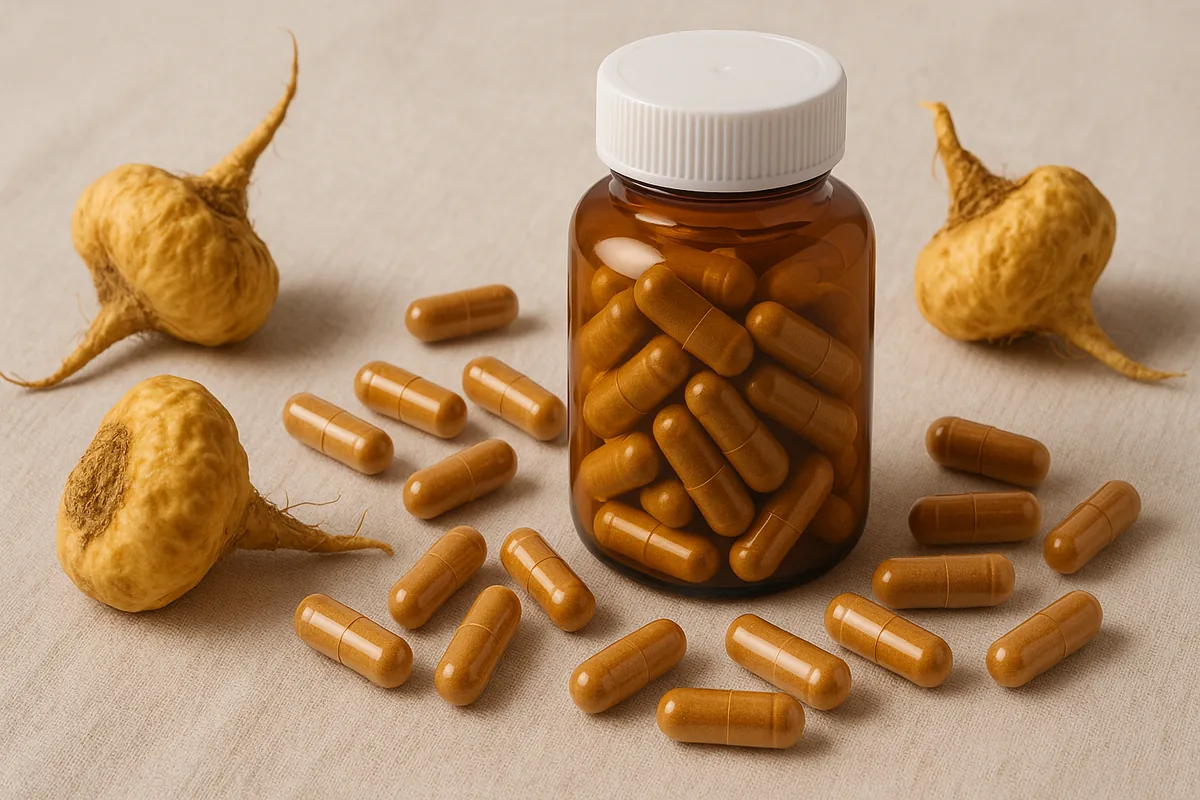
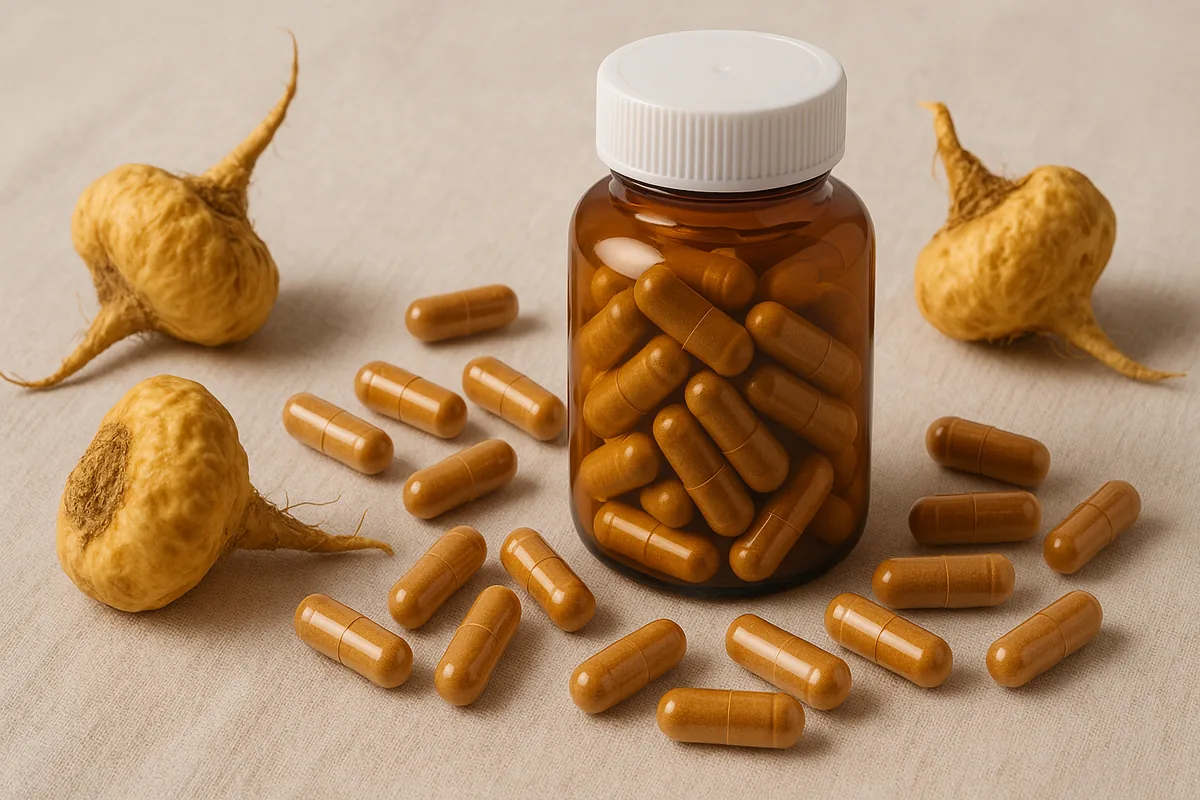
Maca
- Not estrogenic. Does not change estradiol, FSH, or LH levels (Meissner et al., 2006).
- Some evidence for menopause symptom improvement independent of hormone changes — possibly through action on endorphin/serotonin pathways.
- Brooks et al. (2008): Reduced psychological symptoms (anxiety, depression) in postmenopausal women. Small study.
Evening Primrose Oil (GLA)
- Long marketed for PMS and menopause.
- Budeiri et al. (1996) systematic review: No convincing evidence for PMS.
- Chenoy et al. (1994): No benefit for hot flashes.
- Despite decades of marketing, evidence is consistently weak.
The Honest Framework
For menopause symptoms:
- HRT (hormone replacement therapy) is the most effective treatment. The risk-benefit conversation has shifted significantly since the WHI study was re-analyzed — for women under 60 or within 10 years of menopause, benefits generally outweigh risks.
- Soy isoflavones have the best supplement evidence. Modest effects. Worth trying if avoiding HRT.
- Black cohosh is a reasonable trial but monitor liver function and don’t expect dramatic results.
- Everything else in this category has weak or no evidence.
For PMS/luteal phase:
- Vitex has real evidence for PMS and prolactin-mediated progesterone issues.
- Other options are largely unproven.
For “estrogen dominance”:
- This is a functional/integrative medicine concept without consensus definition in mainstream endocrinology. It describes a real clinical pattern (relatively high estrogen vs. progesterone) but the supplement solutions marketed for it (DIM, calcium-D-glucarate, cruciferous extracts) lack clinical trial support.
FAQ
Do phytoestrogens work as well as HRT?
No. They may provide modest symptom relief for some women, but they are generally less effective than appropriately prescribed hormone therapy.
Is wild yam cream the same as natural progesterone?
Not by default. Wild yam itself does not reliably convert to progesterone in the body.
Is DIM proven to prevent hormone-related cancers?
No. DIM can alter metabolite patterns, but strong clinical prevention evidence is not established.
Is vitex useful for all low-progesterone symptoms?
No. It may help when prolactin-related cycle disruption is involved, but not all hormone patterns respond.
When should someone skip supplements and seek medical evaluation first?
With persistent cycle irregularity, severe menopause symptoms, infertility concerns, heavy bleeding, or personal/family cancer risk.
Not medical advice. Hormone-related symptoms — especially menopause, irregular cycles, or fertility concerns — deserve proper evaluation with blood work and imaging as indicated. Supplements are not a substitute for HRT when HRT is appropriate.
Related Articles
Sources
- Patisaul HB, Jefferson W. The pros and cons of phytoestrogens. Front Neuroendocrinol. 2010;31(4):400-419.
- Messina M. Soy and health update: evaluation of the clinical and epidemiologic literature. Nutrients. 2016;8(12):754.
- Sirotkin AV, Harrath AH. Phytoestrogens and their effects. Eur J Pharmacol. 2014;741:230-236.
- van Die MD, Burger HG, Teede HJ, Bone KM. Vitex agnus-castus extracts for female reproductive disorders: a systematic review of clinical trials. Planta Med. 2013;79(7):562-575.
- Chen MN, Lin CC, Liu CF. Efficacy of phytoestrogens for menopausal symptoms: a meta-analysis and systematic review. Climacteric. 2015;18(2):260-269.