Dopamine Precursors: L-Tyrosine & Mucuna Evidence
Dopamine is the neurotransmitter most associated with motivation, reward, and focus. Naturally, the supplement industry has built a massive category around “dopamine support.” Here’s what’s physiology, what’s marketing, and what the research actually demonstrates.
Quick Answer
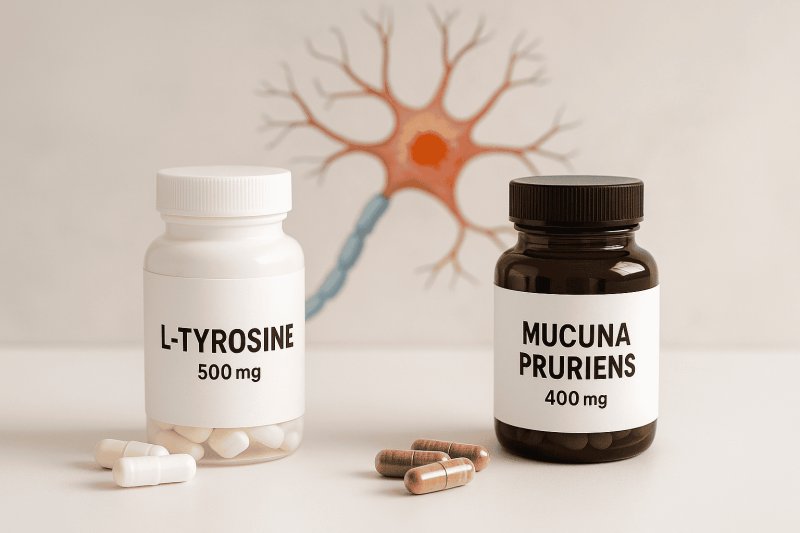
L-tyrosine and mucuna are not interchangeable. Tyrosine has the best support for short-term cognitive resilience under acute stress, while mucuna delivers pharmacologically active L-DOPA and carries higher upside and higher risk. For routine “motivation boosting” in healthy people, evidence is limited and safety nuance matters.
Key Takeaways
- Tyrosine helps most in acute stress/sleep-loss contexts, not as a daily universal dopamine booster.
- Mucuna is effectively an L-DOPA source and should be treated with drug-like caution.
- Chronic precursor use can create neurotransmitter imbalance, especially without supervision.
- Claims about broad nootropic enhancement are stronger in marketing than in trials.
- For broader context, see the hormone precursors parent hub and related subtopics on serotonin/melatonin precursors and estrogen/progesterone claims.
The Dopamine Synthesis Pathway
Phenylalanine → Tyrosine → L-DOPA → Dopamine → Norepinephrine → Epinephrine
Key enzymes:
- Tyrosine hydroxylase (TH): Converts tyrosine to L-DOPA. This is the rate-limiting step. TH is tightly regulated — when dopamine levels are adequate, TH activity decreases. This is why simply eating more tyrosine doesn’t raise dopamine in normal conditions.
- DOPA decarboxylase (AADC): Converts L-DOPA to dopamine. Not rate-limiting — it runs fast.
This enzyme regulation is why L-tyrosine and L-DOPA (mucuna) have fundamentally different pharmacological profiles.
L-Tyrosine
What It Does
Tyrosine is a conditionally essential amino acid (your body makes it from phenylalanine, and you get it from protein-rich foods). It’s the starting material for dopamine, norepinephrine, epinephrine, and thyroid hormones.
The Evidence
Where it works — acute stress:
- Mahoney et al. (2007): 150 mg/kg tyrosine before cold-water stress improved cognitive performance and mood in military personnel.
- Jongkees et al. (2015) meta-analysis: Tyrosine “replenishes cognitive resources” under demanding conditions. Reliable effect on working memory and cognitive flexibility during stress.
- Deijen & Orlebeke (1994): Improved performance during sleep deprivation.
- Thomas et al. (1999): Improved multitask performance in a military stress battery.
Where it doesn’t work — normal conditions:
- The same Jongkees meta-analysis found no reliable benefit in non-demanding, non-stressful conditions.
- Grown & Froehlich (2016): No mood improvement in unstressed participants.
- No evidence of increased baseline dopamine levels from chronic tyrosine supplementation in healthy people.
Why This Pattern Exists
Under acute stress, catecholamine (dopamine, norepinephrine) synthesis ramps up, potentially depleting tyrosine availability. Supplementing restores the substrate pool. Under normal conditions, TH is already running at a regulated pace — extra tyrosine just gets metabolized elsewhere.
Think of it as: Tyrosine is like keeping a spare tire in your trunk. Essential when you get a flat, useless for making your car go faster.
Practical Use
- Dose: 500–2,000 mg, taken 30–60 minutes before a stressful/demanding task.
- Not useful as: A daily dopamine supplement for “motivation” or “drive.”
- Forms: L-tyrosine is more common; N-acetyl-L-tyrosine (NALT) is more soluble but has lower bioavailability and less evidence.
- Safety: Generally well-tolerated. May interact with MAOIs, L-DOPA, and thyroid medications. Avoid with hyperthyroidism.
Mucuna pruriens (Velvet Bean)
What It Is
Mucuna seeds contain 3–6% L-DOPA by weight — the direct precursor to dopamine that bypasses the rate-limiting tyrosine hydroxylase step. This makes mucuna fundamentally different from tyrosine: it’s essentially an unregulated source of a Parkinson’s drug.
The Evidence
Parkinson’s disease:
- Katzenschlager et al. (2004): Mucuna seed powder (containing 15–30 mg L-DOPA equivalent) produced comparable clinical improvement to synthetic levodopa in Parkinson’s patients, with potentially faster onset and fewer dyskinesias.
- HP-200 (mucuna formulation) showed motor improvements in small Parkinson’s trials.
Male fertility:
- Shukla et al. (2009): 5 g/day mucuna powder improved semen quality parameters in infertile men. Likely mechanism: dopamine inhibits prolactin, and high prolactin suppresses fertility.
- Ahmad et al. (2008): Similar findings — improved sperm motility and count, reduced oxidative stress markers.
Testosterone:
- Shukla et al. (2010): Infertile men showed increased testosterone alongside improved semen parameters. The mechanism appears to be prolactin reduction (dopamine is the primary prolactin inhibitor) and cortisol reduction.
- Important: These are infertile men with potential hormonal dysregulation, not healthy baseline populations.
“Nootropic” / cognitive use:
- No well-designed studies support mucuna for cognitive enhancement in healthy people.
- Anecdotal reports in nootropics communities are common but uncontrolled.
Safety Concerns — This Is Not a Casual Supplement
Because mucuna provides L-DOPA directly:
- Dopamine excess: Nausea, vomiting, agitation, insomnia, vivid dreams, headaches.
- Chronic use risks: Potentially the same long-term concerns as synthetic L-DOPA — dyskinesias, wearing-off effects, dopamine receptor downregulation. No long-term studies in healthy populations.
- Catecholamine imbalance: L-DOPA increases dopamine but may deplete serotonin (they share AADC enzyme and compete for decarboxylation). Chronic use without monitoring could shift neurotransmitter balance unfavorably.
- Drug interactions: Dangerous with MAOIs, antipsychotics, and cardiac medications. Contraindicated alongside Parkinson’s medications without supervision.
- Unstandardized dosing: L-DOPA content varies dramatically between mucuna products. Some “mucuna extract” capsules contain 15% L-DOPA or more — a pharmacologically significant dose.
Honest assessment: Mucuna is a drug masquerading as a supplement. It has legitimate pharmacological effects but should not be treated as a benign “natural dopamine booster.”
Other Dopamine-Adjacent Supplements
DL-Phenylalanine (DLPA)
- Converts to tyrosine, which converts to L-DOPA, which converts to dopamine — three enzymatic steps away.
- Even less likely than tyrosine to raise dopamine meaningfully.
- D-phenylalanine may have pain-modulating effects via enkephalinase inhibition, but this is unrelated to dopamine.
SAMe (S-Adenosyl-L-Methionine)
- Involved in dopamine metabolism (methylation). Some evidence for depression (Sharma et al., 2017 meta-analysis) but mechanism is broad and not specifically dopaminergic.
- Expensive. Risk of triggering mania in bipolar patients.
Uridine + CDP-Choline Stack
- Popular in nootropics communities. Proposed mechanism: uridine increases dopamine receptor density (mainly D2).
- Evidence is primarily from animal studies and theoretical models. Wurtman et al. (2000) showed CDP-choline increases dopamine release in animal models.
- No robust human RCTs specifically on dopamine outcomes.
The Bigger Picture
The supplement industry’s dopamine narrative — “low dopamine causes low motivation, take this to boost it” — is a dramatic oversimplification. Dopamine signaling involves:
- Tonic vs. phasic firing patterns
- Receptor density and sensitivity (D1, D2, D3, D4, D5)
- Reuptake and degradation (MAO, COMT)
- Regional specificity (prefrontal cortex vs. nucleus accumbens vs. striatum)
None of this is addressed by taking a precursor. The evidence-based use cases are narrow: tyrosine for acute stress resilience, mucuna as a pharmacological agent (not a casual supplement), and deficiency correction in specific populations.
FAQ
Is L-tyrosine good for everyday motivation?
Usually not in a dramatic way. Evidence is strongest for short-term support during stress, sleep deprivation, or cognitively demanding tasks.
Is mucuna safer because it is “natural”?
Not necessarily. Mucuna contains L-DOPA, which has meaningful pharmacologic effects and interaction risks.
Can I combine tyrosine and mucuna?
Some protocols do, but this should be clinician-guided because of dosing variability, interaction risk, and neurotransmitter-balance concerns.
Who should avoid mucuna without supervision?
People on psychiatric meds, Parkinson’s medications, MAOIs, or with cardiovascular/psychiatric vulnerability should avoid unsupervised use.
What should I try first if my issue is stress-related focus?
Lifestyle and sleep basics first, then a conservative tyrosine trial before considering stronger dopaminergic options.
Not medical advice. If you’re experiencing persistent low motivation, anhedonia, or cognitive changes, consult a healthcare provider — these can be symptoms of depression, ADHD, or other conditions that require proper evaluation.
Related Articles
Sources
- Jongkees BJ, Hommel B, Kühn S, Colzato LS. Effect of tyrosine supplementation on clinical and healthy populations under stress or cognitive demands – a review. J Psychiatr Res. 2015;70:50-57.
- Lampariello LR, Cortelazzo A, Guerranti R, et al. The magic velvet bean of Mucuna pruriens. J Tradit Complement Med. 2012;2(4):331-339.
- Hinz M, Stein A, Uncini T. The discrepancy between human and animal studies of L-DOPA and Mucuna pruriens. Neuropsychiatr Dis Treat. 2011;7:629-636.
- Cools R, D’Esposito M. Inverted-U-shaped dopamine actions on human working memory and cognitive control. Biol Psychiatry. 2011;69(12):e113-e125.
- Fernstrom JD, Fernstrom MH. Tyrosine, phenylalanine, and catecholamine synthesis and function in the brain. J Nutr. 2007;137(6 Suppl 1):1539S-1547S.