

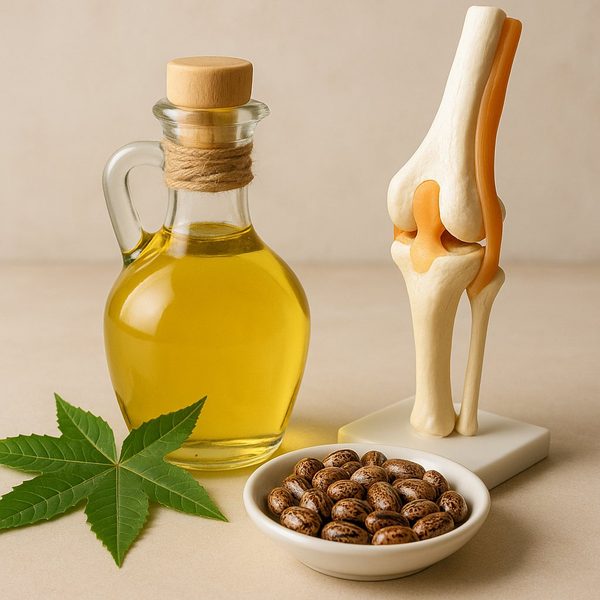

Quick Answer: Castor oil applied topically to arthritic or sore joints has modest but real evidence supporting it. Small clinical trials show ricinoleic acid reduces joint pain and inflammation, particularly in knee osteoarthritis. It’s not going to replace a rheumatologist or proven treatments, but as a low-risk complementary approach for localized joint discomfort, the evidence supports giving it a fair try.
Key Takeaways
- Ricinoleic acid, the dominant fatty acid in castor oil (~85-90%), has confirmed anti-inflammatory properties through multiple pathways: substance P inhibition, EP3 receptor modulation, and prostaglandin regulation.
- A small randomized trial compared castor oil packs to diclofenac gel for knee osteoarthritis and found comparable pain reduction – a notable finding given diclofenac is a well-established NSAID.
- Castor oil for joints is best used topically – applied directly or via a castor oil pack – not orally.
- It works best as complementary support alongside standard care, not as a primary treatment for moderate-to-severe joint disease.
- Application with heat (via a heating pad during a pack session) may enhance transdermal absorption and the anti-inflammatory benefit.
- Most people tolerate topical castor oil well; contact dermatitis is the main individual risk.
Joint Pain: A Common and Complicated Problem

Joint pain affects tens of millions of people. Osteoarthritis alone is the most common form of arthritis globally, causing progressive cartilage degradation, joint space narrowing, and chronic pain in the knees, hips, hands, and spine. Inflammatory arthritis (rheumatoid, psoriatic) involves autoimmune joint destruction on top of the pain and stiffness. Then there are the everyday joint complaints – post-exercise soreness, overuse injuries, and the general ache that comes with aging.
People in every one of these categories end up looking for topical solutions – something they can apply directly to the painful area without taking a pill. This is where castor oil enters the conversation.
The question worth asking honestly: is there anything to it beyond tradition?
How Ricinoleic Acid Targets Joint Inflammation
Castor oil’s anti-inflammatory story begins with ricinoleic acid (RA), an 18-carbon omega-9 hydroxylated fatty acid that makes up the vast majority of castor oil’s composition. RA is pharmacologically active in ways that most dietary fatty acids aren’t, and several of its mechanisms are directly relevant to joint inflammation.
Substance P Inhibition
Substance P is a neuropeptide central to both pain signaling and neurogenic inflammation. When tissue is damaged or inflamed, substance P is released at the site, amplifying both the pain signal and the local inflammatory response. It also triggers the release of pro-inflammatory cytokines that perpetuate the inflammatory cycle.
Research has shown that ricinoleic acid inhibits the release of substance P from sensory nerve fibers. This dual action – reducing both pain transmission and inflammation initiation – makes it pharmacologically relevant for joint pain in a way that simple emollient oils are not.
EP3 Receptor Interaction
EP3 (prostaglandin E2 receptor 3) activation by ricinoleic acid drives effects both in the gut (the basis of its laxative use) and in peripheral tissues. In the context of joint tissue, EP3 receptor modulation affects the balance of prostaglandin signaling that governs both pain sensitization and inflammatory mediator release.
Prostaglandin and Cytokine Modulation
A 2000 study by Vieira et al. in Mediators of Inflammation demonstrated that ricinoleic acid reduced both carrageenan-induced paw edema (an acute inflammation model) and chronic inflammation in rodent models. The effect was attributed to a combination of reduced prostaglandin synthesis and lower tumor necrosis factor-alpha (TNF-?) levels. TNF-? is a key cytokine in joint inflammation, particularly in rheumatoid arthritis.
The Clinical Evidence: What Human Studies Show
Castor Oil vs. Diclofenac for Knee Osteoarthritis
The most frequently cited human study on castor oil for joint pain was published in Phytotherapy Research (Medhi et al., 2009). The study design:
- Population: 90 older adults with symptomatic knee osteoarthritis
- Intervention: Castor oil packs (3 times/week for 4 weeks) vs. diclofenac gel (a standard topical NSAID)
- Outcomes: Pain intensity, physical function, and morning stiffness
Results: Both groups showed significant improvement from baseline. The castor oil group showed comparable reductions in pain and stiffness to the diclofenac group, with no significant difference between groups. Side effects were minimal in both arms.
Interpretation caveats: The sample was small, the study was not blinded, and the comparison group (diclofenac gel) is itself modest in effect size compared to oral NSAIDs or intra-articular injections. Still, the finding that castor oil performed as well as a standard topical NSAID in a randomized trial is not nothing.
Ricinoleic Acid Cream Study
A separate pilot study examined a standardized ricinoleic acid cream applied to arthritic finger joints over four weeks. Pain and grip strength showed improvement compared to placebo cream. Sample size was small and the study wasn’t published in a high-impact journal, but it adds a second data point to the topical-benefit picture.
What the Evidence Does Not Show
- Castor oil has not been tested in rheumatoid arthritis RCTs.
- There are no studies on castor oil for hip or spinal joint pain specifically.
- Long-term data (beyond 8 weeks) does not exist.
- No bioavailability studies confirm how much ricinoleic acid actually reaches joint tissue after topical application in humans.
Who Might Benefit Most
Based on the available evidence, the people most likely to get value from topical castor oil for joints are:
- People with mild-to-moderate knee osteoarthritis looking for topical adjuncts to heat therapy, exercise, and physical therapy
- Anyone avoiding NSAIDs due to GI sensitivity, cardiovascular risk, or personal preference
- People with localized joint pain (a specific knee, a single finger joint) that responds well to topical approaches
- People who find the castor oil pack ritual itself soothing – the heat and compression element is genuinely helpful independent of the oil
People with severe joint disease, active inflammatory flares, or recent joint surgery should prioritize medical management.
How to Apply Castor Oil for Joint Pain
Method 1: Direct Topical Massage
The simplest approach – best for ongoing daily use:
- Clean and dry the skin over the affected joint.
- Warm the castor oil slightly (place the bottle in warm water for a few minutes – do not microwave).
- Apply a small amount and massage in circular motions for 5-10 minutes.
- Cover with a cloth wrap if desired.
- Leave for 30-60 minutes before rinsing.
Doing this after a warm shower (when skin is more permeable) may improve absorption.
Method 2: Castor Oil Pack for Joints
The pack method adds heat and extended contact time, which may enhance the anti-inflammatory effect:
Supplies:
- 100% cold-pressed, hexane-free castor oil
- Flannel cloth or soft cotton cloth
- Plastic wrap
- Heating pad (set to low or medium – never high)
Steps:
- Saturate the flannel cloth with castor oil. It should be thoroughly wet but not dripping.
- Place the cloth over the affected joint.
- Cover with plastic wrap to prevent staining.
- Apply the heating pad over the top at low-medium heat.
- Leave in place for 45-90 minutes.
- Wipe the skin with a baking soda solution (1 tsp baking soda dissolved in a cup of warm water) to remove residue.
- Repeat 3-5 times per week for at least four weeks to assess benefit.
Application Frequency
Most users see the best results with 3-5 sessions per week for 4-6 weeks. Daily use is also reasonable. Less frequent use (once weekly) is unlikely to produce a meaningful effect.
Integration with Standard Joint Care
Castor oil for joints works best as a component of a broader joint care strategy:
- Exercise and movement – Low-impact exercise (swimming, cycling, walking) preserves joint function better than any supplement or topical.
- Weight management – Reducing mechanical load on joints (especially knees) has outsized impact on osteoarthritis progression.
- Physical therapy – Strengthening surrounding musculature reduces joint stress.
- Heat/cold therapy – Heat before activity (to loosen stiffness); cold after activity (to reduce post-activity inflammation). Castor oil packs with heat fit naturally into the pre-activity warm-up routine.
- Medical management – NSAIDs, acetaminophen, or intra-articular interventions when appropriate.
Castor oil is not a substitute for this framework – it’s a complement within it.
Safety Considerations for Joint Use
Topical castor oil is well-tolerated by most people. Key safety points:
- Contact dermatitis – A minority of users develop skin irritation. Patch-test on the inner arm before extended use on a joint.
- Staining – Castor oil stains fabric. Use old or dedicated cloths, and protect furniture and bedding.
- Heating pad safety – Use on low or medium. Never fall asleep with a heating pad applied.
- Skin integrity – Do not apply to broken, cracked, or actively inflamed (rash, psoriasis flare) skin.
- Ricin misconception – Commercial cold-pressed castor oil contains no ricin. Ricin is a water-soluble protein that remains in the seed mash after pressing and is not present in properly manufactured oil.
Frequently Asked Questions
Q: Can castor oil help with rheumatoid arthritis? A: The anti-inflammatory mechanism is relevant to RA, but there are no human trials specifically testing castor oil in RA patients. Given that RA involves active autoimmune joint destruction, it should be treated with disease-modifying antirheumatic drugs (DMARDs) as the primary approach. Castor oil packs for symptom comfort are not likely to interfere with DMARD therapy and are reasonable as an adjunct – but discuss with your rheumatologist.
Q: How long before I notice improvement in joint pain? A: The knee OA trial showed meaningful improvement after four weeks of three-times-weekly use. Consistent daily use might show effects sooner. Give it at least three to four weeks before evaluating.
Q: Is JBCO better for joints than regular castor oil? A: No evidence supports this claim. Jamaican black castor oil has comparable ricinoleic acid content; its higher ash content (from roasted beans) has no known anti-inflammatory advantage for joint tissue.
Q: Can I use castor oil on my hands or fingers for arthritis? A: Yes. Direct massage into finger joints is a common self-care practice. It’s particularly suited to the hands because you can work the oil in with massage that itself has therapeutic value for small-joint arthritis.
Q: Will castor oil stop joint disease from progressing? A: No evidence supports this. Castor oil may reduce symptoms but has no demonstrated disease-modifying effect – it will not slow the progression of cartilage loss in osteoarthritis or joint erosion in inflammatory arthritis.
The Bottom Line
Topical castor oil for joint pain sits in a legitimate but modest evidence category. The mechanism is pharmacologically sound, and the best available human trial shows it performs comparably to a standard topical NSAID for knee osteoarthritis over four weeks. That’s genuinely encouraging for a natural topical option. What it is not is a substitute for comprehensive joint care or a remedy for moderate-to-severe joint disease. For the person managing mild arthritic pain, everyday joint soreness, or post-exercise joint aches, castor oil packs represent a low-cost, low-risk, and scientifically defensible option worth incorporating.
Related Reading
- Castor Oil in 2026: What It Can and Cannot Do – An Honest Guide
- Castor Oil for Pain Relief: What the Evidence Actually Shows
- Castor Oil Packs: Do They Actually Work? Evidence vs. Tradition
- Castor Oil Safety and Side Effects: What You Need to Know
- Castor Oil for Liver Detox: What Castor Oil Packs Can and Cannot Do
Sources
- Tunaru S, Althoff TF, Nüsing RM, Diener M, Offermanns S. Castor oil induces laxation and uterus contraction via ricinoleic acid activating prostaglandin EP3 receptors. Proc Natl Acad Sci USA. 2012;109(23):9179-9184.
- Arslan GG, Eşer I. An examination of the effect of castor oil packs on constipation in the elderly. Complement Ther Clin Pract. 2011;17(1):58-62.
- Final report on the safety assessment of Ricinus Communis (Castor) Seed Oil. Int J Toxicol. 2007;26 Suppl 3:31-77.
- Vieira C, Evangelista S, Cirillo R, et al. Effect of ricinoleic acid in acute and subchronic experimental models of inflammation. Mediators Inflamm. 2000;9(5):223-228.
📚 Part of our Castor Oil: Benefits, Limits & Honest Guide hub. Explore all our castor oil evidence reviews.