
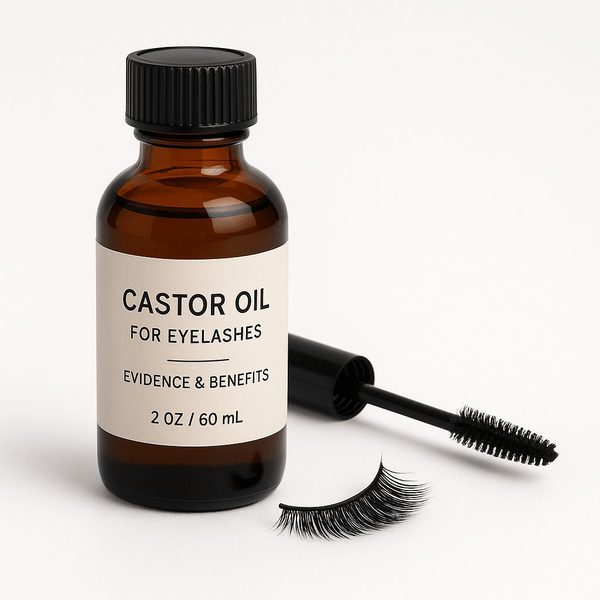

Quick Answer: Castor oil is widely used for eyelash growth, but the clinical evidence for this specific claim is essentially nonexistent. What it can do reliably is condition and moisturize lash hairs, reducing breakage and making existing lashes appear fuller and healthier. There is no published human trial demonstrating castor oil stimulates new lash follicle activity. The growth claims outrun the evidence – but the conditioning benefits are real.
Key Takeaways
- No controlled clinical trials have tested castor oil specifically for eyelash growth in humans.
- Ricinoleic acid in castor oil has theoretical mechanisms that could support hair follicle health (prostaglandin modulation, anti-inflammatory effects), but these have not been confirmed in eyelash tissue specifically.
- The most reliable benefit is mechanical conditioning – castor oil coats lash fibers, reducing breakage and improving the appearance of thickness and length.
- Castor oil applied to the lash line carries real safety risks: eye irritation, blocked meibomian glands, and chemical conjunctivitis from accidental contact.
- Jamaican black castor oil (JBCO) is a popular variant for this use, but there is no clinical evidence it outperforms regular cold-pressed castor oil for lashes.
- If actual lash growth is the goal, prescription bimatoprost (Latisse) is the only FDA-approved option with proven clinical efficacy.
The Popularity Behind the Claim
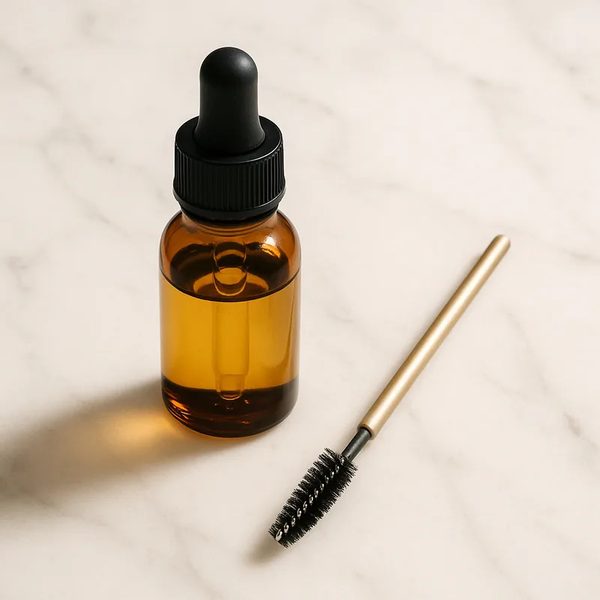
Castor oil’s reputation as a lash-thickening treatment has been building since at least the mid-2010s, driven largely by beauty bloggers and social media before-and-after comparisons. Today it’s a standard recommendation in natural beauty communities, with dozens of serums on the market featuring castor oil as a primary or featured ingredient.
The claim typically sounds like this: “Apply castor oil to your lashes every night, and over four to eight weeks you’ll see longer, fuller, thicker lashes.” It’s appealing – it’s inexpensive, it’s natural, and it sounds simple. The question is whether the before-and-after photos represent real growth or just better-conditioned, less-broken lashes that photograph differently.
Both explanations are possible. Understanding which mechanisms are actually at play changes the expectations you should have.
The Proposed Mechanisms: What Could Castor Oil Actually Do for Lashes?
1. Ricinoleic Acid and Prostaglandin E2
One of the more scientifically grounded theories connects ricinoleic acid to prostaglandin E2 (PGE2) signaling. PGE2 is involved in the hair growth cycle, and disruption of prostaglandin balance is associated with hair loss conditions. Some researchers have speculated that ricinoleic acid’s modulation of prostaglandin receptors could maintain a hair follicle in the growth (anagen) phase for longer, potentially extending the growth window before the follicle enters its resting phase.
This is the same general pathway that bimatoprost (Latisse) exploits – it’s a prostaglandin analog that demonstrably extends the anagen phase in eyelash follicles. However, the pharmacological potency of ricinoleic acid in this context is far, far lower than a prescription prostaglandin agonist, and there are no human studies confirming that topical castor oil actually modulates lash follicle cycling.
2. Castor Oil and Prostaglandin D2 Inhibition
A separate line of reasoning involves prostaglandin D2 (PGD2), which is associated with hair follicle miniaturization and certain forms of alopecia. Some compounds that reduce PGD2 signaling have been explored as hair growth agents. Ricinoleic acid may influence this pathway, but again – no human eyelash data exists.
3. Anti-Inflammatory Effect at the Lash Follicle Root
Chronic low-grade inflammation at the hair follicle is a contributor to follicle damage and reduced hair production. Ricinoleic acid’s anti-inflammatory properties (via substance P inhibition and EP3 modulation) could theoretically reduce follicle-adjacent inflammation, creating a more favorable environment for hair growth. This is biologically plausible but untested in this specific context.
4. Mechanical Conditioning (Most Reliable)
This is the mechanism with the strongest real-world support – not because of a clinical trial, but because it’s physically straightforward. Castor oil is a very thick, viscous oil. When applied to lash fibers:
- It coats the hair shaft, reducing friction and breakage.
- It helps retain moisture within the hair cortex, preventing brittleness.
- It may reduce the incidence of premature lash shed due to breakage from mascara application and removal.
- It makes individual lashes reflect light more uniformly, which can create the visual impression of more defined, darker lashes.
The result of consistent conditioning is not new hair growth – it’s better-preserved existing hairs that appear healthier and fuller. This is a real and legitimate benefit; it’s just not the same as biological lash regrowth.
What the Research Actually Shows
The Honest Evidence Gap
There are no published randomized controlled trials specifically examining castor oil for eyelash growth. The beauty industry has no incentive to fund such studies, and academic researchers tend to focus on conditions with medical relevance (like alopecia areata) rather than cosmetic lash enhancement. The evidence base is:
- Case reports and anecdotes: abundant
- Mechanistic rationale: plausible but unconfirmed for lashes specifically
- Controlled human trials: zero
What Exists for Hair More Broadly
There is some modest evidence that castor oil or ricinoleic acid may benefit scalp hair. A small study of ricinoleic acid in combination hair treatments showed reduced hair loss in the shower over time. A Japanese study found that prostaglandin D2 inhibition promoted hair growth in male pattern baldness. These provide weak, indirect support for the lash growth claim – but are not lash-specific.
The Bimatoprost Contrast
For context: bimatoprost (Latisse) went through rigorous clinical trials demonstrating statistically significant increases in lash length, thickness, and darkness. The mechanism is confirmed. The effect is real. The difference between bimatoprost and castor oil in terms of evidence quality is not a small gap – it is enormous.
How to Use Castor Oil on Eyelashes Safely
If you want to try castor oil for lash conditioning despite the evidence limitations, these guidelines help minimize the risk of eye irritation:
Application Method
What you need:
- 100% pure, cold-pressed castor oil (hexane-free)
- A clean mascara wand or small disposable applicator brush (never a used mascara wand – bacteria risk)
- A steady hand
Process:
- Remove all eye makeup thoroughly before applying.
- Dip the clean wand into the castor oil – use a minimal amount. Less is more here.
- Apply along the upper lash line from inner to outer corner. Think “mascara application” rather than a heavy coat.
- Apply very carefully to lower lashes if desired, keeping the brush well away from the inner eye.
- Leave overnight. Avoid rubbing your eyes before it absorbs.
- Remove in the morning with gentle makeup remover.
Safety Rules
- Never apply castor oil directly to the eyeball. It can cause significant irritation and temporary blurred vision.
- Avoid the inner corner of the eye – this is where the meibomian gland openings are concentrated, and castor oil can block these ducts, contributing to dry eye or meibomian gland dysfunction.
- Patch test first. Apply a tiny amount to the inner wrist or elbow and check for a reaction before using near your eyes.
- Stop immediately if you experience redness, itching, burning, or increased eye discharge.
- Do not share applicators. Eye-area bacterial transfer is a real infection risk.
Jamaican Black Castor Oil vs. Regular Castor Oil for Lashes
JBCO (Jamaican Black Castor Oil) is produced by roasting the castor beans before pressing, which creates a darker oil with a higher ash content. It’s marketed specifically for hair and lash applications and is often positioned as more effective than cold-pressed castor oil.
What’s true:
- JBCO has a higher pH due to its ash content, which may help lift the hair cuticle slightly.
- Many users prefer its scent and texture for hair applications.
- Its ricinoleic acid content is comparable to regular cold-pressed castor oil.
What’s not proven:
- There is no clinical study comparing JBCO to regular castor oil for eyelash growth or conditioning outcomes.
- The higher pH could be mildly irritating in the sensitive eye area.
If you prefer JBCO, it’s a reasonable choice. If you have sensitive eyes, cold-pressed regular castor oil may be gentler.
Comparing Your Options for Lash Growth
| Option | Evidence Level | FDA Status | Realistic Outcome |
|---|---|---|---|
| Castor oil | Anecdotal/mechanistic only | Not evaluated | Conditioning, reduced breakage |
| Biotin supplements | Very weak (only helps if deficient) | Supplement | Minimal without deficiency |
| Peptide serums | Small industry studies | Cosmetic | Modest conditioning |
| Bimatoprost (Latisse) | Strong RCTs | Rx drug – FDA-approved | Clinically proven lash growth |
| Minoxidil (off-label) | Some evidence for scalp; lash data limited | OTC drug | Not well-studied for lashes |
Realistic Expectations
If you apply castor oil to your lashes consistently for 4-8 weeks, the most likely outcomes are:
- Better-conditioned lash fibers – less breakage, especially if you regularly use mascara or lash curlers.
- Slightly fuller appearance – the oil coats and plumps lash fibers visually.
- Possibly darker-looking lashes – the oil increases light absorption slightly.
What you are unlikely to see:
- Measurable increase in lash length from follicle-level growth
- Regrowth of lashes lost due to thyroid disease, alopecia, or aging-related follicle miniaturization
Frequently Asked Questions
Q: How long does it take to see results from castor oil on eyelashes? A: If conditioning is occurring, you might notice less lash breakage and a slightly fuller appearance within 4-6 weeks of nightly use. Genuine biological growth changes (if any are occurring) would take longer – 8-12 weeks or more.
Q: Can castor oil damage my eyes? A: Applied to the lash line carefully, it’s generally well-tolerated by most people. The main risks are eye irritation from accidental contact, blocked meibomian glands from overuse, and infection if applicators aren’t kept sterile. Keep it on the lash line, not in the eye itself.
Q: Is there any proof castor oil grows eyelashes? A: No controlled human trials exist. The growth claim rests on mechanistic plausibility and anecdotal reports. The conditioning and reduced-breakage benefits are more reliably supported by the oil’s physical properties.
Q: Should I buy a castor oil lash serum or just use plain castor oil? A: Most commercial lash serums are heavily marked up. Plain, pure cold-pressed castor oil achieves the same basic function at a fraction of the cost. Look for hexane-free, cold-pressed oil from a reputable supplier.
Q: Can castor oil help if I lost lashes from chemotherapy? A: There is no evidence castor oil can accelerate lash regrowth after chemo-related loss. Lash recovery after chemotherapy follows the natural hair regrowth cycle, which takes 3-6 months regardless. Discuss eyelash concerns with your oncology team.
The Bottom Line
Castor oil for eyelashes is a plausible conditioning treatment with an overstated growth claim. It won’t do what bimatoprost does – there’s no prescription-free shortcut to genuine follicle-level lash growth. What it can do is protect, condition, and preserve the lashes you already have, which is a legitimate benefit worth the modest effort if you want healthier-looking lashes without adding another prescription to your routine. Just keep the expectations realistic and the application careful.
Related Reading
- Castor Oil in 2026: What It Can and Cannot Do – An Honest Guide
- Castor Oil for Hair Growth: What the Research Actually Says
- Castor Oil for Skin: Moisturizer, Dark Circles, and Acne Claims
- Castor Oil Safety and Side Effects: What You Need to Know
- Castor Oil Packs: Do They Actually Work? Evidence vs. Tradition
Sources
- Tunaru S, Althoff TF, Nüsing RM, Diener M, Offermanns S. Castor oil induces laxation and uterus contraction via ricinoleic acid activating prostaglandin EP3 receptors. Proc Natl Acad Sci USA. 2012;109(23):9179-9184.
- Arslan GG, Eşer I. An examination of the effect of castor oil packs on constipation in the elderly. Complement Ther Clin Pract. 2011;17(1):58-62.
- Final report on the safety assessment of Ricinus Communis (Castor) Seed Oil. Int J Toxicol. 2007;26 Suppl 3:31-77.
- Vieira C, Evangelista S, Cirillo R, et al. Effect of ricinoleic acid in acute and subchronic experimental models of inflammation. Mediators Inflamm. 2000;9(5):223-228.
📚 Part of our Castor Oil: Benefits, Limits & Honest Guide hub. Explore all our castor oil evidence reviews.