
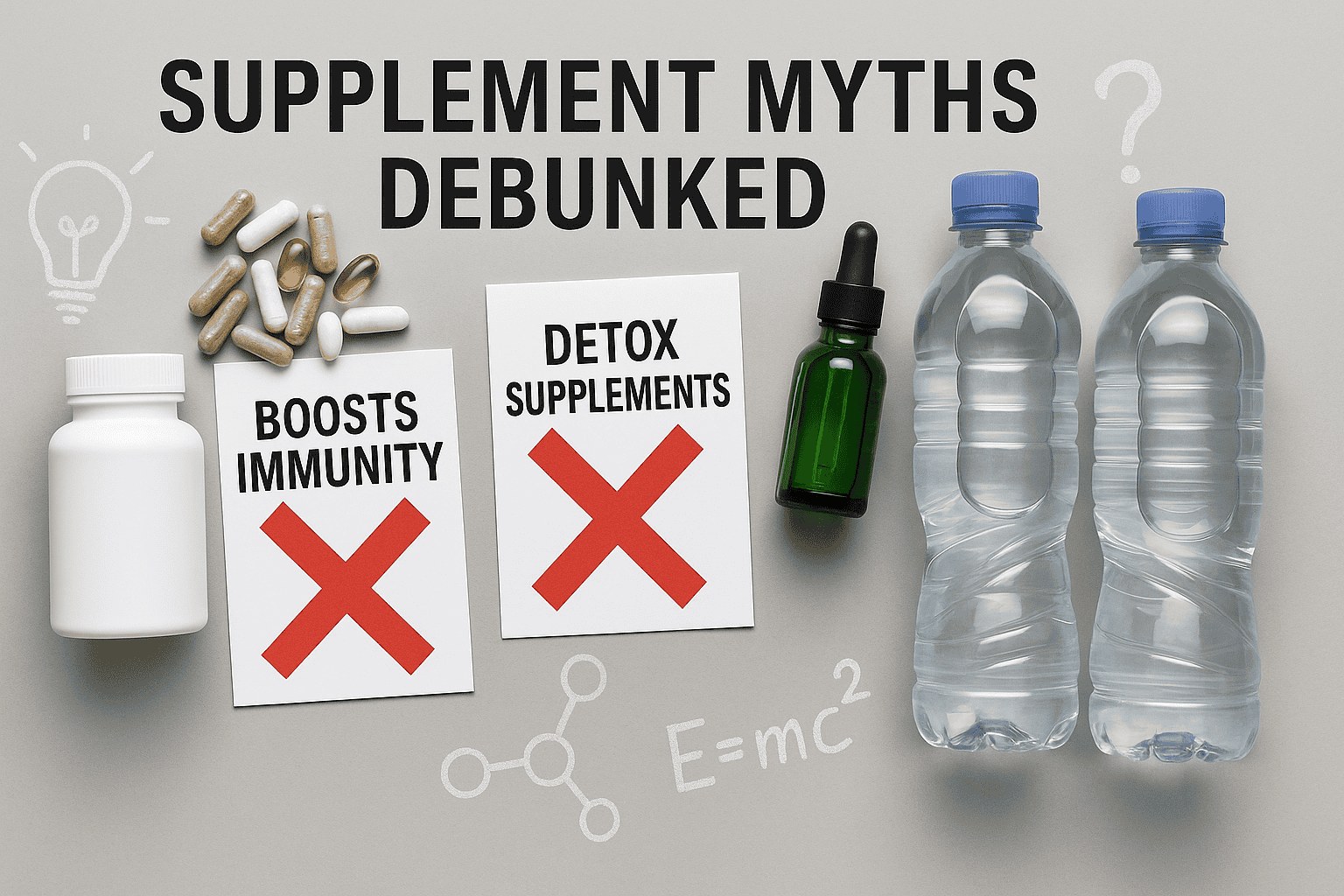
Supplement Myths Debunked: Detox, Alkaline Water
Quick Answer: Most “detox” supplements have no scientific basis – your liver and kidneys handle detoxification and supplements don’t enhance this. Alkaline water doesn’t change body pH. Collagen drinks may work but for different reasons than marketed. Knowing which supplement claims are fiction (and which are real) saves you money and protects your health.
The supplement industry generates over $150 billion annually – and a significant portion of that rides on myths, misunderstood biology, and outright pseudoscience. Some of the most popular supplement categories are built almost entirely on concepts that don’t survive basic physiological scrutiny.
This guide systematically examines the most persistent supplement myths, what the science actually shows, and in some cases where there’s more nuance than a simple “false” verdict.
—
Myth 1: “Detox Supplements Cleanse Your System”
The Claim: Certain herbs, juices, teas, or supplement protocols “detox” the liver, “flush” toxins from the body, or “cleanse” the colon.
Activated charcoal is a common example of detox marketing outrunning the science. Our review of activated charcoal as a daily detox supplement separates emergency use from the hype.
Lymphatic cleanses are a popular supplement trend. For what the research actually supports versus what is mostly marketing, see our lymphatic cleanse supplement review.
Chelation is another category where marketing outpaces evidence. Our chelation therapy guide separates the legitimate medical uses from supplement industry hype.
The Reality: This category is built almost entirely on a fundamental misunderstanding of human physiology.
Your body runs a continuous, sophisticated detoxification system:
- Liver: Phase I (cytochrome P450 enzymes) and Phase II (conjugation) detoxification pathways process endogenous and exogenous compounds 24/7
- Kidneys: Filter blood ~30 times per day, excreting water-soluble waste
- Lungs: Exhale volatile compounds (including metabolic CO2)
- Gut: Eliminates fat-soluble toxin conjugates via bile
- Skin: Minor pathway for some compounds via sweat
This system doesn’t need a “jump start” from supplements. It operates continuously and efficiently in healthy people.
What “detox” products actually do (when they do anything):
- Herbal teas with senna or cassia ? laxative effect (not detoxification; can cause electrolyte depletion with overuse)
- High-dose vitamin C ? antioxidant effects; at very high doses, reduces heavy metal absorption
- Chlorella/spirulina ? some evidence for binding heavy metals like methylmercury; not a “detox” in the spiritual sense
- Milk thistle (silymarin) ? genuine hepatoprotective effects in liver-damaged patients; no evidence for “enhancing” liver detox in healthy people
What’s harmful:
- Prolonged “juice cleanses” ? caloric restriction, nutrient gaps, potential blood sugar disruption
- Herbal “liver flush” protocols ? some contain hepatotoxic compounds (kava, comfrey, pennyroyal)
- Colon “cleanses” ? mechanical gut flushing removes beneficial bacteria and has caused hospitalization
Verdict: Detox supplements are mostly health theater. Support your actual detoxification systems: adequate hydration, limiting alcohol, minimizing processed food, maintaining a healthy weight, and sleeping adequately.
—
Myth 2: “Alkaline Water Optimizes Body pH for Better Health”
The Claim: Drinking alkaline water (pH 8-9.5) changes your body’s pH to be more “alkaline,” preventing cancer, improving energy, and reducing disease.
The Reality: Your body maintains blood pH between 7.35 and 7.45 through powerful homeostatic mechanisms. Drinking alkaline water doesn’t change your blood pH by any clinically meaningful amount.
If your blood pH drops below 7.35 (acidosis) or rises above 7.45 (alkalosis), these are medical emergencies requiring ICU-level intervention. Your respiratory and renal systems work constantly to maintain this precise balance. A drink can’t override these mechanisms.
The lactic acid argument is wrong too:
The common “alkaline water neutralizes exercise-produced lactic acid” claim misunderstands basic biochemistry. Lactic acid dissociates to lactate and hydrogen ions almost instantly at physiological pH. The issue in muscle fatigue is H+ accumulation, buffered primarily by bicarbonate and phosphate systems – not the pH of water you drank hours earlier.
Is there anything real here?
Very modest preliminary evidence suggests alkaline water may have minor benefits for:
- Acid reflux (mechanical buffering effect in the esophagus)
- Hydration in some elite athletes under very specific conditions (one small Japanese study)
These are not the transformative “alkalinize your body” effects claimed by marketing.
Verdict: Alkaline water is an expensive way to drink water. It does not change your blood pH and the primary health claims are physiologically impossible. Filtered tap water is functionally equivalent.
—
Myth 3: “Collagen Drinks Make Your Skin Younger”
The Claim: Drinking collagen peptides is directly incorporated into your skin, reducing wrinkles and improving elasticity.
The Reality: More nuanced than a simple “false.”
The skeptic’s argument (partially correct):
Collagen peptides you drink are digested into amino acids (primarily glycine, proline, hydroxyproline). These amino acids don’t specifically go to your skin. Your body uses them wherever they’re needed. The “drink skin, get better skin” model is simplistic.
The evidence-based reality:
Multiple double-blind RCTs (the University of Kiel studies, the Seoul National University studies, and others) have found that oral collagen peptide supplementation (5-10g/day) does:
- Significantly improve skin hydration
- Reduce dermal density changes associated with aging in older women
- Modestly improve skin elasticity measurable by standard dermatology instruments
How it works (mechanism)
Collagen peptides are not directly incorporated into skin collagen. Instead:
- Small collagen-derived peptides (dipeptides and tripeptides including Pro-Hyp and Hyp-Gly) are absorbed intact in the gut
- These peptides act as signaling molecules that stimulate fibroblasts to produce more endogenous collagen and hyaluronic acid
- This is an indirect mechanism, but it appears to be real
What collagen supplements won’t do:
- Replace sunscreen as a primary skin aging prevention (UV is the #1 extrinsic aging factor)
- Produce dramatic wrinkle elimination
- Work as well for people who already have adequate dietary glycine, proline, and hydroxyproline
Verdict: Partially true, for a mechanism that’s different from the marketing narrative. Collagen peptides (10g/day, hydrolyzed, with vitamin C for cofactor) have legitimate modest evidence for skin hydration and possible elasticity support. But mechanism is indirect signaling, not “drink skin.”
Related: Foundation With Peptides vs Collagen
—
Myth 4: “Natural = Safe”
The Claim: If a supplement is made from plants or natural sources, it’s safe. Anything natural is better than anything synthetic.
The Reality: This is a false dichotomy exploited relentlessly by supplement marketing.
Natural compounds that cause harm:
- Comfrey: Contains pyrrolizidine alkaloids that cause veno-occlusive liver disease
- Kava kava: Associated with acute liver failure even at recommended doses in some individuals
- Aristolochic acid (in some traditional Chinese herbs): Causes nephrotoxicity and urothelial carcinoma
- Ephedra (ma huang): Caused dozens of deaths from cardiovascular events before FDA banned it
- Pennyroyal: Abortifacient at high doses; deaths documented
- Belladonna (atropine): Anticholinergic toxicity
- High-dose vitamin A from animal sources: Teratogenic in pregnancy
Synthetic compounds with excellent safety:
- Creatine monohydrate (synthetic; exceptional long-term safety record)
- Synthetic vitamin B12 (cyanocobalamin): Effective and safe
- Lab-synthesized vitamin D3: Functionally identical to sun-produced version
The molecule doesn’t care about its origin story. What matters is the dose, the bioavailability, and the individual’s specific context.
Verdict: “Natural” is not a synonym for safe. Evaluate supplements on evidence, not origin. Natural supplements carry real risks and deserve the same scrutiny as pharmaceuticals.
—
Myth 5: “More Is Better for Antioxidants”
The Claim: Antioxidants fight free radicals and oxidative stress. Therefore, taking high doses of antioxidants is good.
The Reality: Antioxidant supplementation is one of the most oversimplified topics in nutrition.
The problem with mega-dosing:
Beta-carotene and lung cancer: In smokers, high-dose beta-carotene supplementation (ATBC trial, CARET trial) significantly increased lung cancer risk. The mechanism: beta-carotene under oxidative conditions (cigarette smoke) becomes pro-oxidant.
High-dose Vitamin E (400 IU+): Meta-analyses (Miller et al., 2005) found all-cause mortality was higher in high-dose vitamin E groups. The HOPE trial found 400 IU/day did not reduce cardiovascular events.
Antioxidants blunting training adaptations: A seminal 2014 paper (Ristow lab, NEJM) found that high-dose vitamin C and E supplementation prevented the metabolic benefits of exercise by blunting the transient ROS signaling that triggers mitochondrial biogenesis and insulin sensitivity improvements.
The nuance:
- Whole food antioxidants (from berries, vegetables, herbs) work within complex matrices and have consistently positive associations with health outcomes
- Moderate supplemental antioxidants (200 IU vitamin E, 500 mg vitamin C) appear safe
- Megadoses of isolated synthetic antioxidants can be harmful in specific populations
Verdict: More is not better for antioxidants. Whole food sources are vastly superior to isolated high-dose supplements. Specific supplemental antioxidants have appropriate doses; exceeding them can cause harm.
—
Myth 6: “Supplements Are Tightly Regulated Like Medications”
The Claim: Because supplements are sold in pharmacies and health food stores, they’ve been tested and approved for safety and effectiveness.
The Reality: In the US, dietary supplements are regulated under DSHEA (Dietary Supplement Health and Education Act, 1994) – a framework that is fundamentally different from drug regulation.
Under DSHEA:
- Supplements do not require proof of efficacy before sale
- Supplements do not require FDA approval before reaching consumers
- The FDA must prove a supplement is harmful to remove it (not the company proving safety)
- Current Good Manufacturing Practices (cGMPs) require quality manufacturing but not efficacy testing
Real-world consequences:
- ConsumerLab.com tests regularly find products with wrong ingredient amounts (sometimes 0% of labeled ingredient)
- Herbal products are frequently adulterated with pharmaceutical drugs (erectile dysfunction drugs in “natural” male enhancement products; weight-loss drugs in “herbal” products)
- Heavy metal contamination in some Ayurvedic and traditional Chinese medicine supplements is documented
What you can do:
- Buy supplements with third-party testing: USP Verified, NSF Certified for Sport, or ConsumerLab approved
- Check NSF Sport certification if you’re an athlete (verifies absence of banned substances)
- Research brands’ manufacturing practices and ask for CoA (Certificate of Analysis)
Verdict: Supplements are NOT regulated like drugs. Quality testing and verification by independent third parties is essential for safety and efficacy confidence.
—
Myth 7: “Biotin Makes Hair Grow”
The Claim: Taking high-dose biotin supplements prevents hair loss and promotes hair growth.
The Reality: This is true only in cases of genuine biotin deficiency, which is rare.
Biotin is a B vitamin essential for keratin synthesis. Severe deficiency causes hair loss, brittle nails, and dermatitis. Correcting deficiency restores hair and nail health dramatically.
The problem: biotin deficiency is uncommon in people eating varied diets. Most people already have adequate biotin. Supplementing beyond sufficiency has no demonstrated benefit for hair in non-deficient individuals.
The biotin-hair-growth industry exploits the very dramatic images of biotin deficiency resolution – which look like miraculous hair restoration but are simply deficiency correction.
What actually does cause hair loss:
- Androgenic alopecia (hereditary) – treated with finasteride, minoxidil, not biotin
- Iron deficiency anemia – treat iron, not biotin
- Hypothyroidism – treat the thyroid
- Protein deficiency – increase dietary protein
- Telogen effluvium (stress, postpartum, crash diets) – resolves with root cause management
High-dose biotin also interferes with lab tests: FDA has issued warnings that biotin supplementation can falsely elevate or suppress thyroid function tests, troponin levels, and other immunoassay-based labs – potentially dangerous.
Verdict: Biotin for hair growth only works if you have genuine biotin deficiency. For the vast majority taking it, the evidence is absent. And high-dose biotin can interfere with important diagnostic tests.
—
What Actually Works (Brief Summary)
| Category | What the Evidence Supports |
|---|---|
| Vitamin D3 | Bone health, immune function, mood – when deficient |
| Omega-3 | Inflammation, cardiovascular, depression |
| Creatine | Muscle mass, strength, cognitive function |
| Magnesium | Sleep, blood pressure, insulin sensitivity |
| Zinc | Immune function, testosterone – when deficient |
| B12 | Neurological function in older adults and vegans |
| Probiotics (strain-specific) | IBS, AAD, vaginal health – strain specific |
—
Key Takeaways
- Detox supplements don’t work – your liver, kidneys, and gut do the real work
- Alkaline water cannot change blood pH; health claims are physiologically implausible
- Collagen peptides may work, but via indirect fibroblast signaling – not direct skin incorporation
- Natural ? safe – multiple natural supplements have caused serious harm or death
- Antioxidant megadosing can be harmful; whole food sources vastly outperform isolated high doses
- Supplement regulation in the US is weak – third-party testing is essential
- Biotin for hair growth only works for deficiency, which is rare; high-dose biotin can interfere with diagnostic tests
—
Frequently Asked Questions
Do detox teas work?
Most “detox” teas contain senna (a laxative) and produce bowel movements that create a sensation of “cleansing.” This is not detoxification – it’s a laxative effect. Overuse can cause electrolyte imbalances, diarrhea, and dependency.
Is there any reason to drink alkaline water?
For acid reflux, there is some evidence that alkaline water (pH 8.8) may inactivate pepsin in the esophagus, providing minor symptomatic relief. This is the one plausible mechanism. For general health optimization, there’s no evidence.
Should I take collagen supplements for skin?
The evidence supports a modest benefit for skin hydration and possibly elasticity at 5-10g/day hydrolyzed collagen peptides taken with vitamin C. The mechanism is real (fibroblast stimulation) but different from “drinking skin.” Sunscreen and sleep are more impactful for skin aging.
Can a high-quality multivitamin replace individual supplements?
A good multivitamin addresses common nutrient gaps (D3, B12, folate) but typically underdoses several key nutrients. It’s a foundation, not a comprehensive protocol.
How do I know if a supplement brand is trustworthy?
Look for USP Verified, NSF Certified, or ConsumerLab Approved seals. These indicate third-party verification that the product contains what the label claims and is free of common contaminants.
—
Sources
- Reviews on detox supplement evidence. PubMed search.
- Reviews on alkaline water health claims. PubMed search.
- Reviews on common supplement myths. PubMed search.
- National Institutes of Health Office of Dietary Supplements. Dietary supplement fact sheets.
- Reviews on megadose vitamins and safety. PubMed search.



Leave a Reply