“NO booster” pre-workouts are a massive category. Walk into any supplement store and you’ll see dozens of products promising skin-splitting pumps, enhanced endurance, and faster recovery — all through nitric oxide. Some of this is rooted in real physiology. Some of it is marketing running laps around the evidence.

Nitric oxide (NO) supplements are among the most popular performance ergogenics, but their actual effects depend on the population and the training context. Dietary nitrate (beetroot, ~500 mg nitrate) consistently reduces oxygen cost of submaximal exercise — meaning athletes can maintain the same intensity at lower VO2, extending time to exhaustion. L-citrulline (6-8 g) reduces muscle soreness and improves reps-to-failure at the end of high-volume resistance training. L-arginine has weak evidence for trained athletes (eNOS pathway is already optimized in trained individuals). Effects are most pronounced in untrained, older, or altitude-exposed individuals — elite athletes may see minimal ergogenic benefit.
Worth noting: antibacterial mouthwashes can reduce oral nitrate-reducing bacteria, which may lower nitric oxide production. Our mouthwash guide covers which types preserve the oral microbiome and which do not.
For people sensitive to caffeine, these same pathways form the basis of effective pre-workout formulas without stimulants.
For a broader look at performance supplementation, including gender-specific considerations, see our guide to women’s sports nutrition supplements.
- Dietary nitrate reduces the O2 cost of submaximal exercise by improving mitochondrial efficiency — specifically by reducing the proton leak across the inner mitochondrial membrane, allowing more ATP production per unit of oxygen consumed.
- A 2009 landmark study (Bailey et al.) found beetroot juice supplementation reduced VO2 during cycling at 45%, 55%, and 65% Wmax by 4-7%, extending time to exhaustion by 16% — one of the most replicated ergogenic findings in sports nutrition.
- L-citrulline malate (8 g, 60 min pre-workout) increased bench press reps-to-failure by 52.92% on the 8th set in a 2010 RCT vs. placebo — with significant reductions in post-exercise muscle soreness at 24 and 48 hours.
- Nitrate’s ergogenic effect is greatest during moderate-intensity exercise (50-80% Wmax) and in hypoxic conditions (altitude, restricted blood flow) — the benefit diminishes at high intensities where aerobic efficiency is less limiting.
- For recreational athletes and those exercising at altitude, dietary nitrate supplementation (1-2 beetroot shots 2-3 hours pre-exercise) offers a well-supported, low-risk ergogenic intervention with a meaningful effect size.
Here’s what the research actually supports, supplement by supplement and exercise type by exercise type.
How NO Affects Exercise
Nitric oxide influences exercise performance through several mechanisms:
- Vasodilation and blood flow: NO relaxes vascular smooth muscle, potentially increasing blood delivery to working muscles [1]
- Mitochondrial efficiency: Dietary nitrate appears to reduce the oxygen cost of exercise, meaning muscles can do the same work with less O₂ [2]
- Muscle contractile function: Some evidence suggests NO/nitrate may enhance calcium handling in skeletal muscle, improving force production at submaximal intensities [3]
- Glucose uptake: NO signaling may facilitate glucose transport into muscle cells during exercise [4]
Mechanisms 2 and 3 are specific to the nitrate pathway (beetroot), while mechanism 1 applies to all NO precursors.
Beetroot / Nitrate for Endurance Performance
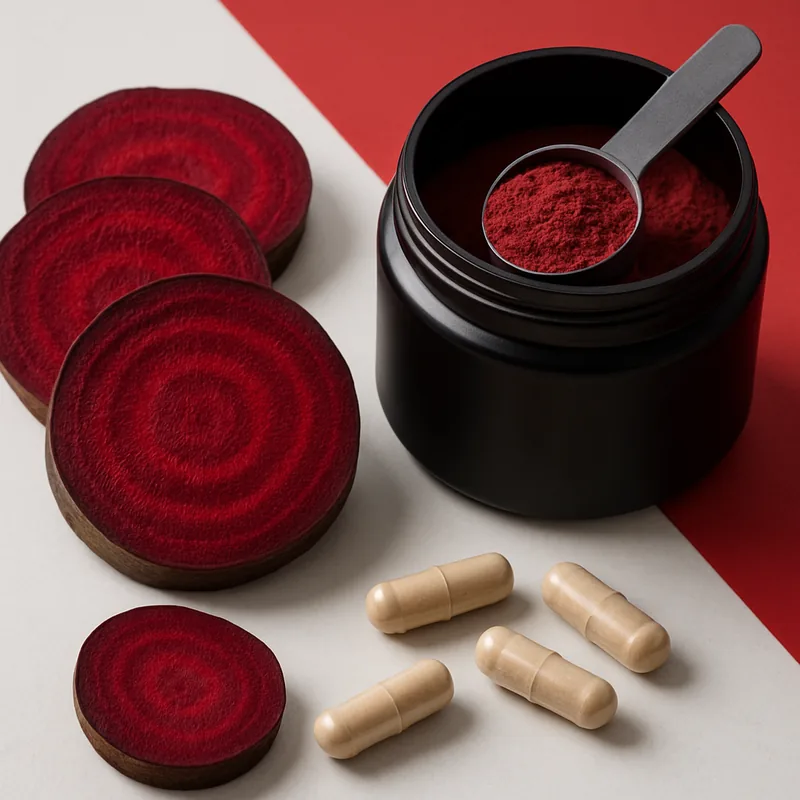
Evidence strength: Moderate to strong
This is the most well-supported NO supplement–exercise combination. Key findings:
- Time-to-exhaustion improvements of 4–25% across studies, with the average closer to 3–5% [5]
- Time-trial improvements of 1–3% — smaller but potentially significant in competitive sport [6]
- Reduced oxygen cost at submaximal work rates (a consistent and well-replicated finding)
- Benefits most apparent in moderate-to-vigorous intensity exercise lasting 5–30 minutes
Who responds best:
- Recreational athletes and those with moderate fitness levels
- Older adults (NOS function declines with age)
- People exercising in hypoxic conditions (altitude) — the nitrate–NO pathway is enhanced under low oxygen [7]
Who responds least:
- Highly trained endurance athletes (VO₂max > 65 mL/kg/min)
- Sprint-only efforts (<60 seconds)
- Ultra-endurance events (>2 hours) — limited evidence
Practical protocol: 6–8 mmol nitrate from concentrated beetroot juice, 2–3 hours before exercise. Chronic loading (3–7 days prior) may enhance the acute benefit.
Citrulline for Resistance Training
Evidence strength: Moderate, effect size small
Citrulline malate (6–8 g) has been studied primarily for resistance exercise:
- The Pérez-Guisado (2010) study showing +53% reps on bench press remains an outlier [8]. Most subsequent studies show smaller effects.
- A 2020 review found that citrulline supplementation increased total repetitions across multiple sets, typically by 5–15% on the final sets when fatigue is highest [9].
- Reduced ratings of perceived exertion (RPE) are a fairly consistent finding.
- Muscle soreness reduction has been reported but not consistently replicated.
Practical translation: Citrulline malate might let you squeeze out 1–3 extra reps on your last couple of high-rep sets. Over weeks and months of training, those extra reps accumulate into more total volume, which drives hypertrophy. It’s a small edge, not a transformation.
L-Arginine for Exercise: Mostly Disappointing
Evidence strength: Weak
Arginine was the original “NO booster” in pre-workouts, but the performance evidence has not held up:
- A comprehensive 2020 systematic review found no consistent benefit for either aerobic or anaerobic exercise [10]
- The poor oral bioavailability likely explains the disconnect between mechanism and outcome
- Most sports nutrition experts now recommend citrulline over arginine for exercise purposes
The “Pump” — What It Is and Isn’t
The exercise-induced pump (reactive hyperemia) is a real physiological phenomenon where blood flow to working muscles transiently exceeds outflow, causing muscle swelling. NO precursors may modestly enhance this effect.
What the pump IS: A temporary increase in intramuscular fluid and blood volume. It feels good and looks impressive.
What the pump ISN’T: A reliable indicator of muscle growth stimulation. Muscle hypertrophy is driven by mechanical tension, metabolic stress, and muscle damage — not by how swollen your muscles look mid-workout [11]. A great pump doesn’t mean a great workout, and a mediocre pump doesn’t mean you wasted your time.
Some bodybuilders report that the enhanced pump from NO precursors helps them maintain a better mind-muscle connection. This is plausible but subjective and unstudied.
Stacking NO Precursors
Since beetroot (nitrate pathway) and citrulline (NOS pathway) work through different mechanisms, combining them is theoretically additive. A few small studies support this, but the combination hasn’t been rigorously tested in large trials [12].
A reasonable pre-workout stack for someone wanting to cover both pathways:
- 6 g citrulline malate + 70 mL concentrated beetroot shot, taken 2 hours before exercise
This is speculative beyond what either supplement does individually, but the safety profile of combining them is well-established.
What About Other “NO Boosting” Ingredients?
Many pre-workouts include additional ingredients marketed as NO enhancers:
- Agmatine sulfate: Theoretically an NOS modulator, but human performance data is almost nonexistent.
- Nitrosigine® (arginine silicate inositol): Patented form with a few small positive studies, but the evidence base is thin and mostly industry-funded.
- S7™ (plant-based polyphenol blend): One published study showing increased NO metabolites, but no independent performance data.
- Pine bark extract / pycnogenol: Some evidence for vascular function, but exercise performance data is minimal.
None of these have anywhere near the evidence base of citrulline or dietary nitrate. They may have potential, but right now they’re in the “plausible mechanism, insufficient evidence” category.
The Bottom Line for Athletes
Nitric oxide supplements are among the better-supported ergogenic aids. But “better-supported” still means modest effects. The hierarchy of training priorities remains: consistent training > adequate nutrition > sufficient sleep > recovery management > and then, maybe, a citrulline or beetroot supplement to squeeze out a small additional edge.
Do nitric oxide supplements actually improve performance?
For most recreational athletes, yes — dietary nitrate (beetroot) consistently reduces oxygen cost of exercise and extends time to exhaustion in controlled trials. L-citrulline reduces late-set muscle fatigue in resistance training. The benefit is most reliable for endurance-type exercise at moderate intensity. Elite trained athletes tend to see smaller effects.
When should I take nitric oxide supplements before a workout?
Beetroot juice or dietary nitrate: 2-3 hours before exercise for peak plasma nitrite elevation. L-citrulline: 60-90 minutes pre-workout on an empty or light stomach. L-arginine: less effective timing-dependent but typically 30-60 min pre-workout. Avoid antiseptic mouthwash before nitrate supplementation as it eliminates the conversion pathway.
What is the best nitric oxide supplement for endurance exercise?
Concentrated beetroot juice (Beet It Sport, Biotta) or sodium nitrate supplements providing ~400-500 mg nitrate per serving have the strongest endurance evidence. For convenience, many athletes use concentrated beetroot shots (70 ml). L-citrulline is a better choice for resistance training and mixed-modality training than for pure endurance.
Does L-arginine boost nitric oxide in athletes?
L-arginine is a poor NO booster in trained individuals because eNOS in trained muscle is already saturated with substrate. It also has poor bioavailability from supplements due to first-pass catabolism in the gut and liver. L-citrulline (which converts to arginine in the kidneys) is substantially more effective and better absorbed. Most sports nutritionists have moved away from arginine in favor of citrulline or dietary nitrate.
References
- Joyner MJ, Casey DP. Regulation of increased blood flow to muscles during exercise. Physiol Rev. 2015.
- McMahon NF, Leveritt MD, Pavey TG. Dietary nitrate supplementation and endurance exercise performance. Sports Med. 2017.
- Jones AM, et al. Dietary nitrate and physical performance. Annu Rev Food Sci Technol. 2018.
- Gonzalez AM, Trexler ET. Effects of citrulline supplementation on exercise performance in humans. JSCR.
- Systematic reviews on nitric oxide support and exercise performance. PubMed search.
Related Articles
- Best Nitric Oxide Supplements for Blood Flow
- Beetroot vs Citrulline for Pumps
- Nitric Oxide Supplements for Walking Endurance
- L-Citrulline Supplements: Dosing and Evidence
- Beetroot and Nitrate Supplements
Sources
- Siervo M, Lara J, Ogbonmwan I, Mathers JC. Inorganic nitrate and beetroot juice supplementation: a meta-analysis of cardiovascular and exercise outcomes. PubMed search.
- Systematic reviews on dietary nitrate and exercise performance. PubMed search.
- Systematic reviews on citrulline and exercise performance. PubMed search.
- Reviews on nitric oxide support and exercise economy. PubMed search.
- Meta-analyses on beetroot supplementation and exercise performance. PubMed search.
📚 Part of our Best Nitric Oxide Supplements 2026 hub. Explore all our nitric oxide and blood flow guides.