Quick Answer: The best at-home LED masks for anti-aging are the ones that publish meaningful specs: red light around 630–660 nm, near-infrared around 810–850 nm, realistic session times, and enough irradiance to deliver a useful dose at the skin. The mask matters less than the buying criteria, because many consumer devices market LED count and vague “7-color” claims while omitting the parameters that actually predict results.
At-home LED masks can help with early photoaging, but they work best as a slow, consistency-driven maintenance tool rather than a miracle treatment. If your goal is softer fine lines, better skin texture, and a mild collagen-support effect, a well-specified LED mask can be reasonable. If your goal is dramatic lifting, major pigment correction, or fast wrinkle reversal, expectations need to stay grounded.
If you want the broader science first, read our complete guide to LED light therapy at home. If you are still deciding whether any consumer device is worth the money, our realistic LED buyer’s guide covers that question directly. This article is narrower: it is specifically about how to shop for an anti-aging LED mask without getting distracted by hype.
Why anti-aging LED masks are different from general skincare devices
This is where cannibalization can happen, so the distinction matters. A general skincare-device roundup compares technologies like radiofrequency, microneedling, cleansing brushes, and LED. An LED efficacy explainer asks whether photobiomodulation works at all. An anti-aging LED mask buyer’s guide should do something more practical: help you decide which mask specifications are worth paying for and which claims are mostly decoration.
That means the core questions are not “Does LED exist?” but:
Does the mask use the right wavelengths for anti-aging rather than acne-only treatment?
Does it disclose irradiance or at least enough dosing information to judge performance?
Does the mask fit the face closely enough to deliver light consistently?
Is the treatment schedule realistic enough that you will actually use it for 8–12 weeks?
The specs that matter most before you buy
1. Wavelength matters more than color names
For anti-aging use, the strongest consumer-device targets are red light in roughly the 630–660 nm range and near-infrared light in roughly the 810–850 nm range. Red light is the classic collagen-support wavelength. Near-infrared penetrates more deeply and is often paired with red light in better masks.
What you should be skeptical of is color-heavy marketing without numbers. “Amber,” “purple,” or “7-color rejuvenation” sounds impressive, but if the brand does not publish the wavelengths in nanometers, you cannot tell what you are actually buying.
2. Irradiance is the spec most brands hide
Irradiance tells you how much power reaches the skin surface, usually in mW/cm². This matters because dose is a function of power and time. A mask with the right wavelength but weak output can still underdeliver unless you use it for a very long time.
Consumer brands often highlight LED count instead. That is not useless, but it is secondary. A mask with more bulbs is not automatically better if the light output at the skin is low or uneven. Published irradiance data, treatment distance, and session guidance are much more useful buying signals.
3. Near-skin fit affects real-world performance
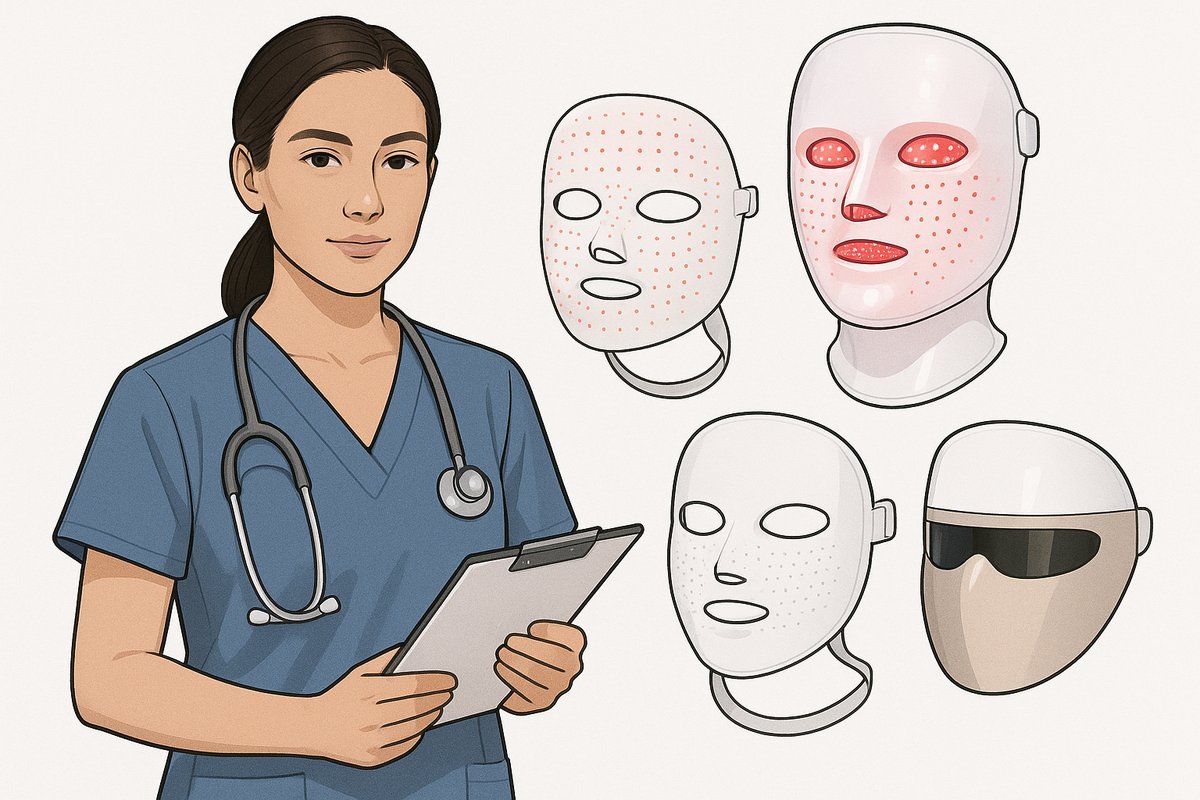
A rigid panel can produce good results, but masks have one big advantage: they sit close to the face. That matters because light intensity falls with distance. A flexible or well-contoured mask that keeps even contact across the cheeks, forehead, and jawline usually makes better practical sense than a device that only hits part of the face well.
Pay attention to eye cutouts, nose bridge fit, and whether the device leaves large dead zones around the mouth or temples. Anti-aging results tend to be subtle anyway, so inconsistent coverage is not a small issue.
4. Session realism beats aspirational specs
A mask that needs 30–40 minutes every day is harder to stick with than one that asks for 10–15 minutes four or five times per week. The evidence for LED tends to depend on cumulative use over weeks, not a few isolated sessions. In practice, the best mask is often the one with good-enough specs and a routine you will actually follow.
What anti-aging LED masks can realistically improve
At-home LED masks are best viewed as support tools for:
early fine lines
mild texture roughness
overall tone and glow
maintenance between professional treatments
low-grade inflammation recovery
They are less convincing for deep wrinkles, significant skin laxity, major hyperpigmentation, or dramatic contour changes. Those goals usually require in-office procedures, prescription topicals, or a broader treatment plan.
Red flags that usually signal weak value
“7-color” masks with no clear purpose
Most anti-aging shoppers do not need a rainbow device. Red and near-infrared are the main anti-aging wavelengths with the strongest rationale. Blue light has a clearer role in acne. Once a product starts adding a long menu of colors without explaining dose, tissue target, or evidence, the marketing is usually outrunning the science.
No irradiance, no dose, no treatment rationale
If a company will not publish output or at least provide a coherent explanation of session length and expected dose, it becomes hard to compare the device with anything evidence-based. That does not automatically mean the mask is useless, but it makes the purchase more speculative.
Claims that sound like in-office resurfacing
At-home LED can support collagen signaling. It does not behave like ablative laser resurfacing, deep radiofrequency tightening, or a facelift. Be suspicious of before-and-after claims that imply dramatic structural reversal from a mask alone.
How to compare masks without turning this into a gimmicky roundup
Rather than chasing a single “best” model, use this short checklist:
Wavelengths published: ideally red 630–660 nm and often near-infrared 810–850 nm.
Dosing transparency: published irradiance or enough session detail to estimate dose.
Face coverage: even fit across the main treatment zones.
Comfort and compliance: light enough, easy enough, and not irritating to use regularly.
Safety and credibility: eye protection guidance, clear contraindications, and preferably FDA-cleared consumer positioning.
If you are considering alternatives beyond masks, our skincare-device guide explains when radiofrequency, microneedling, or other tools may be more appropriate.
How often should you use an anti-aging LED mask?
Most at-home anti-aging protocols land in the range of 3–5 sessions per week for roughly 8–12 weeks before reassessment, then a maintenance schedule after that. Exact timing depends on device output and manufacturer instructions. More is not always better; photobiomodulation follows a dose-response curve, and overshooting may reduce benefit rather than improve it.
Avoid masks from brands that provide almost no safety guidance.
Be more cautious if you have photosensitivity, melasma triggers, seizure disorders involving flashing lights, or are using photosensitizing medications.
Eye comfort matters. Even with eye cutouts, very bright devices can be unpleasant if poorly designed.
Clean the mask consistently, especially if it sits directly against the skin.
Key Takeaways
The best at-home anti-aging LED masks are judged by wavelength, irradiance, fit, and routine adherence—not by LED count alone.
Red light around 630–660 nm and near-infrared around 810–850 nm are the most relevant wavelengths for anti-aging use.
Many consumer masks are vague about power output, which makes comparison harder and increases the risk of paying for marketing rather than performance.
Results are usually modest and cumulative: think texture support and gradual fine-line improvement, not dramatic wrinkle reversal.
A mask-only buyer’s guide should stay separate from general LED explainers and broader skincare-device roundups.
FAQ
Are at-home LED masks actually worth buying for anti-aging?
They can be worth buying if you want gradual improvement and will use the device consistently for months. They are usually not worth it if you expect office-level results from occasional sessions.
What wavelengths should I look for in an anti-aging LED mask?
Look first for red light around 630–660 nm and often near-infrared around 810–850 nm. Those are the wavelengths with the clearest anti-aging rationale for collagen support and photobiomodulation.
Is LED count a reliable way to compare masks?
No, not by itself. LED count can matter for coverage, but irradiance, dose, fit, and wavelength transparency are much better indicators of practical performance.
How long does it take to see results from an anti-aging LED mask?
Most people who respond notice changes gradually over roughly 8–12 weeks of consistent use. The improvements are usually subtle, such as smoother texture or softer fine lines.
Sources
Note: peer-reviewed support for this claim was not identified in available literature.






Leave a Reply